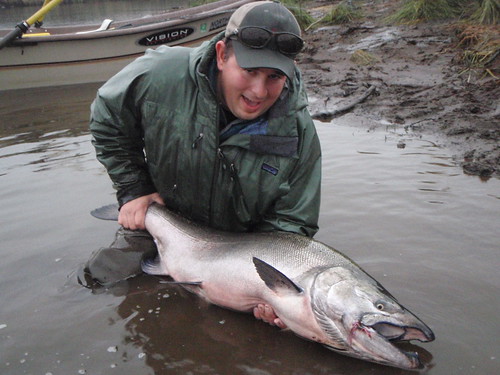
PDX showing of Where Hope Resides Tues. night

Jeff Hickman is hosting a showing of Where Hope Resides Tues 11/10/09 at 6:30pm at Jeff’s office (1821 SE Ankeny St, PDX). The event is partnered with Sierra Club, Native Fish Society and Kaufmann Streamborn. $10, FREE BEER and snacks!!!!
revisedposter

For Eugeneans, come check out our showing Thurs night.
-MS

Posted in Oregon Fly Fishing Clubs and Events | Leave a comment

Three days swinging flies for Deschutes River Steelhead

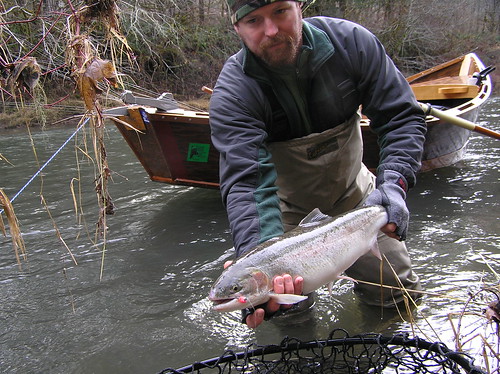
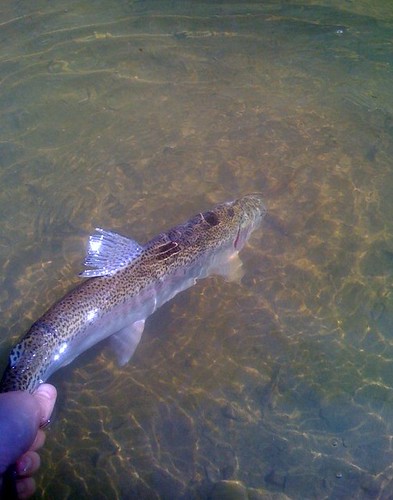
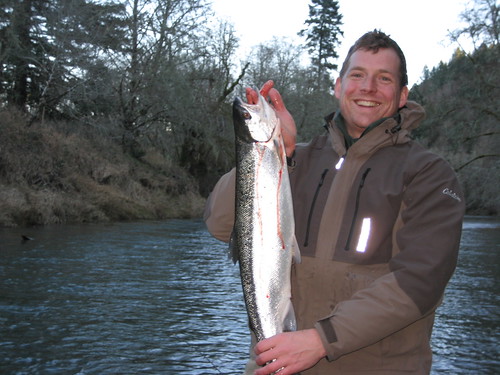
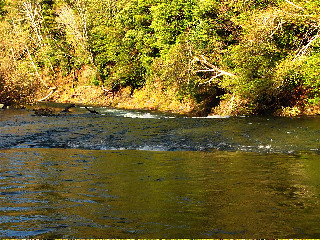
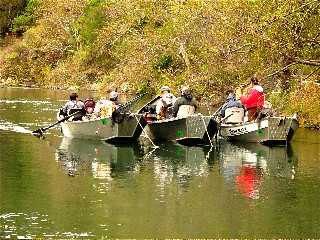
Trout Creek to Harpham Flat, Nov 5-7: Eight of us set out last week from Eugene to the high desert to chase steelhead on the Deschutes River. Ethan Nickel Outfitters ran the program to celebrate the end of the ‘09 guide season and we came along for the ride, enjoying Ethan and Kyle Duke’s hard-won fishing knowledge and camping skills.

Deschutes River Fall Steelhead

Deschutes River Fall Steelhead

Deschutes River Fall Steelhead

The first day we put in at Trout Creek and moved quickly downstream. We had great weather and seemed to have the whole river to ourselves.

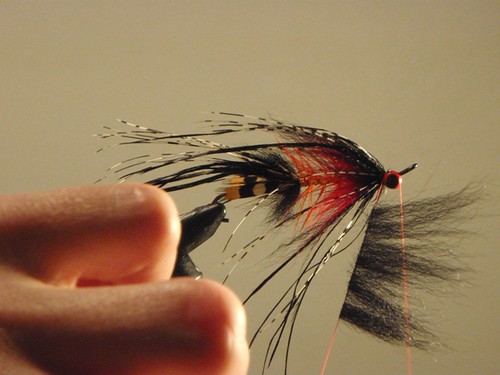
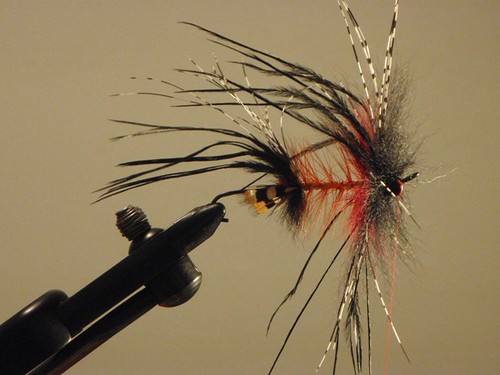
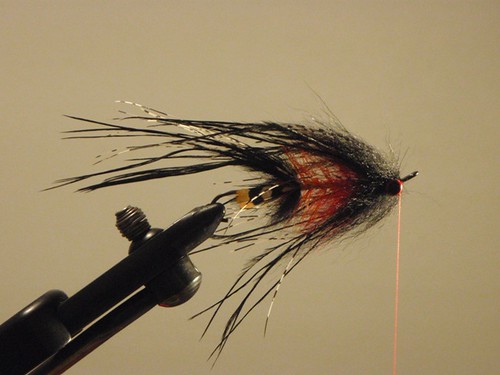
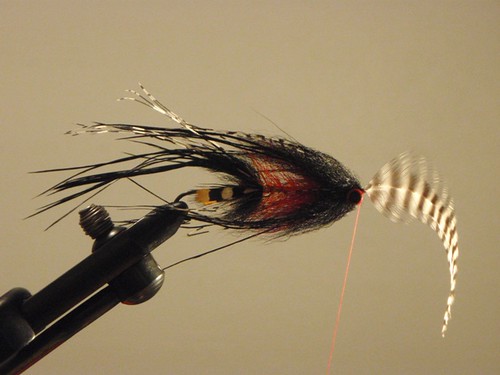
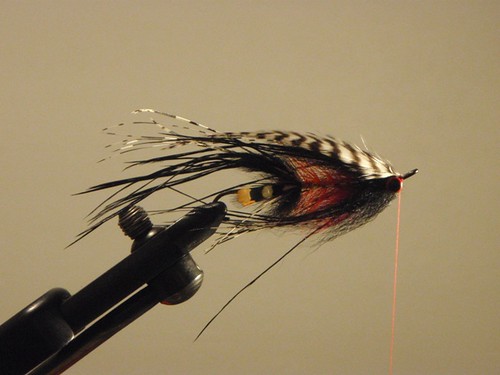
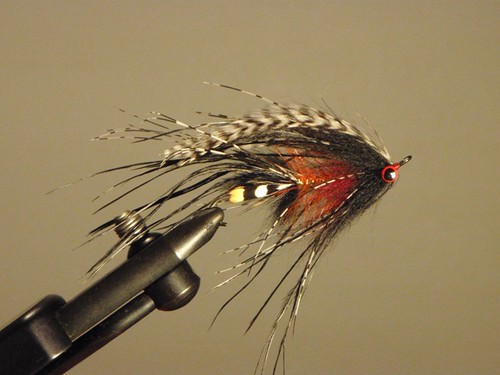
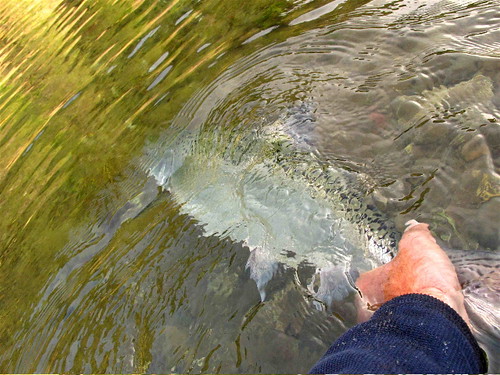
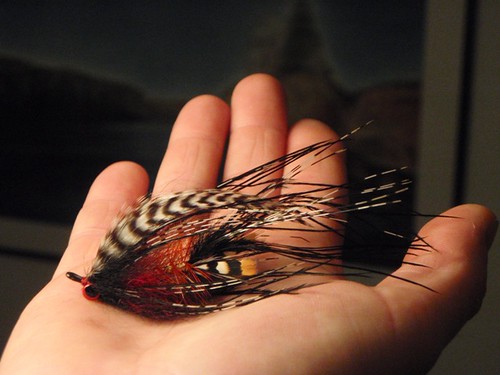
We spread out and picked a few likely spots to fish before Whitehorse rapid. I picked up my first Deschutes steelhead that morning, swinging a black palmered marabou fly (patterned after the George Cook Alaskabou series) on a big Alec Jackson hook. I lost that fly soon after that and didn’t have anything else exactly like it.

Deschutes River Fall Steelhead

Not that it mattered a whole lot. The main requisites for Deschutes steelhead flies that week were that they be a little heavy, dark, and wiggle a lot. I had a handful of flies in different patterns that fit that bill. Unfortunately, I’d been tying so many different styles and types of flies for this trip that I only had a few of any one pattern, so when something worked it was a real pain to lose that fly.

Deschutes River Fall Steelhead

I’d been working a lot with marabou lately. While not typically my favorite material, every once in a while it looks amazing in the water. Other times it has about the same action as a pencil eraser.

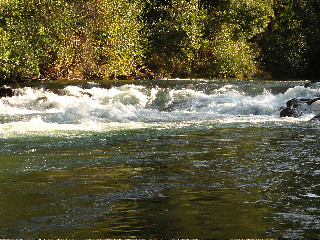
Rob Russell had been mentally preparing run Whitehorse rapid all day. He hadn’t run it in 20 years, and the last time he’d sunk a raft. This time we made it through without getting a drop of water in the boat

Deschutes River Fall Steelhead

The days are short and we wound up at camp soon after. That night at camp a hellacious wind storm blew through the canyon and I was sure we were going to lose the pavilion tent.

Deschutes River Fall Steelhead

The next morning we set off and I hooked three steelhead on a single run. Then Rob and I moved down to another run and hooked a couple more and saw dozens of big fish. We thought we were going to be into the action all day. Little did we know that we were blowing past the only big concentration of fish we’d see all trip. The rest of the fish we hooked were spread out few and far between.

Deschutes River Fall Steelhead

Deschutes River Fall Steelhead

Deschutes River Fall Steelhead

Luckily, I’d hooked enough fish to have a lot of confidence in my steelhead presentation. Maybe for the first time ever. And I started to feel that shift. I’ll always love trout: slurping, hungry, tuggy little torpedoes. But something about the first headshake on a steelhead that everybody talks about… The fact that each of these wild fish is a globetrotting, nutrient-replenishing, ocean-fattened goddamn ecological miracle just makes my head spin.

And I just caught enough of them this weekend to actually start think I can get them to bite with some regularity (as in more than like once a year). Not that I understand why they bite or don’t. That’s the madness that keeps grown and serious men awake at night, writing to zoological societies to beg for discarded feathers from exotic birds, wrecking marriages and careers.

More photos below, including a big beautiful hatchery buck I clubbed in defense of wild fish. He’ll taste righteous after the smoker has its way with him.
-MS

Deschutes River Fall Steelhead

IMG_2438

Deschutes River Fall Steelhead

Deschutes River Fall Steelhead

Deschutes River Fall Steelhead

Deschutes River Fall Steelhead

Deschutes River Fall Steelhead

Deschutes River Fall Steelhead

Deschutes River Fall Steelhead

Deschutes River Fall Steelhead

Deschutes River Fall Steelhead

Deschutes River Fall Steelhead

Deschutes River Fall Steelhead

Posted in Central Oregon Fishing Report, Fishing Porn, Summer Steelhead | 9 Comments

Big fly fishing events in Eugene this week

Wednesday night, November 11th steelhead book author John Larison will be signing books at the Caddis Fly Shop from 3:30 to 5pm.

John will also be presenting at the McKenzie Upper-Willamette Chapter of Trout Unlimited’s meeting that night at 7pm at the Eagles Aerie, 1375 Irving Rd. in Eugene. John’s presentation will be on successful winter steelheading tactics and the public is welcome. We’ll also be discussing our efforts to reduce or remove hatchery trout on the McKenzie River.

Then Thursday night 11/12, come to the David Minor Theater to see the new film Where Hope Resides at 6:30pm. We expect this movie to sell out this week, so pick up your tickets at the shop ASAP. This gorgeous new film is about salmon and steelhead conservation issues in British Columbia’s Skeena River system. Join filmmakers, Boots Allen and Jason Sutton at the event.

Posted in Oregon Fly Fishing Clubs and Events | Leave a comment

Deschutes Fall Trip 09; A Passage in Time

Mid October brought some fine fall weather from Trout Creek to Harpham.
TMC Fall 09 075

This Fall trip was special, I brought along my son a recent U of O grad. His first overnight trip was age 8. He’s older now and much stronger or simply stated: less boat bags to haul, less rowing, and more camp help!
TMC Fall 09 072

After a few pointers from someone who had a bit more Deschutes experience, he seemed to get the hang of it:
TMC Fall 09 050

TMC Fall 09 048

Whitehorse always provides those “pucker moments in time” but we all safely passed and headed down river. It’s always about the knuckles: stay too far left your headed for the can opener, stay too far right, and your boat becomes an aluminum bell chime.

TMC Fall 09 036

Bottom line a great fall trip and a very special time.

LV

Posted in Uncategorized | 1 Comment

New Hareline fly tying contest: Unibobber patterns

For our next Hareline Dubbin fly tying contest, we’re looking for your best original patterns using Unibobbers.

Contest rules are the same as last time. We want to see your best Unibobber pattern, either an original or your own spin on a classic. Fly Tying Unibobbers are sure to keep your fly floating. We have used them as parachute posts with great success. See Barrett’s Unibobber example pattern.

IMG_2088

RULES
Come by the shop and pick up your free Unibobbers. Email Chris with your address if you’re from out of town and we’ll mail you your Unibobbers. Drop off two finished flies at The Caddis Fly Shop, along with paperwork that includes the fly pattern name, material list, your name and address, and either email or phone number for contact. You will not get the flies back — one will go to Hareline and one will go to the shop. Bob Borden and the folks from Hareline Dubbin will be judge of the fly patterns.

If you are not local, please send your flies in the mail to the shop.

PRIZES
First prize is a new StonFo C-clamp fly tying vise. Second prize is a Dr. Slick fly tying tool kit. And third prize is a Dr. Slick scissor pack.

Stonfo c-clamp fly tying vise

Dr. Slick Fly tying tool kit

Dr. Slick Scissor pack

Turn these in by Dec 10th. to be eligible.

Posted in Fly Tying | 8 Comments

1872 Mining Law reform on the horizon

Reform of the 1872 Mining Law has been on the agenda of every major conservation organization for years, and it looks like the issue is finally coming to a head. For those of you unaware of the 1872 Mining Law, here is a summary from TU’s Web site.

The General Mining Law of 1872 was passed at a time when conquering the western wilderness was our primary goal. To do this, our visionary lawmakers at the time, decided they should give away minerals on our public lands and the land itself to miners to foster development of the new frontier, allow miners to pillage many thousands of acres, take the gold, silver and other minerals, and pay nothing for them–and with no requirement to clean up the mess, reclaim the landscape, close the roads, or keep acid mine waste from killing watersheds.

A group of conservation organizations, including NWF, the Theodore Roosevelt Conservation Partnership and Trout Unlimited have formed a partnership, Sportsmen United for Sensible Mining, to help guide outdoor sports enthusiasts in the effort to reform the law.

There are complementary House HR 699 and Senate S 796 bills introduced to Congress. And Obama’s Secretary of the Interior Ken Salazar has testified in favor of 1872 mining law reform.

Oregon’s congressional delegation has been active in this legislation, as the Senate bill is co-sponsored by Ron Wyden and the House bill is co-sponsored by Earl Blumenauer and David Wu. The big hurdle has historically been mining industry shill, Democratic Majority Leader Harry Reid, but we doubt Reid will be able to hold this back much longer.

The Teddy Roosevelt Conservation Partnership folks have an action campaign to email your Senators in favor of S796.

From TRCP: Senate Bill 796 takes a judicious approach to updating the 1872 Mining Law – an approach that sportsmen can confidently support. The legislation would eliminate the sale of public lands to mining companies. It would allow federal agencies to do their jobs by directing the BLM and Forest Service to review “high value” lands for possible withdrawal from minerals development. It would establish royalties of between 2 and 5 percent on new mines located on public lands. Just like other industries that operate on public lands, the mining industry would be required to pay a reasonable fee for the multi-billion-dollar resources that are owned by American citizens. Finally, S. 796 would institute a reclamation fee to help restore the thousands of abandoned mines that are scattered across our landscapes.

-MS

Posted in Oregon Conservation News | 2 Comments

The Complete Steelheader: John Larison Q&A and book signing

John Larison’s The Complete Steelheader has changed the way I fish more than any other book I’ve read. There are lots of other books out there that have had an effect on my life, fishing philosophy, etc. But no other book actually changed the way I approach the mechanics of the sport. I think this book had the impact it did because it was written exactly for me — the trout guy who only catches a few steelhead a year because he’s fishing for them like trout. In modern steelhead books, I consider this book to be among the big three: Trey Combs’ Steelhead Fly Fishing and Dec Hogan’s A Passion for Steelhead.

Below is an interview with the author of The Complete Steelheader and the new novel, Northwest of Normal. Be sure to stop by the shop on Wed. November 11th when Larison will be on hand to sign books at the Caddis Fly Shop. He will also be presenting at the McKenzie Upper-Willamette Chapter of Trout Unlimited’s meeting Wed 11/11 at 7pm at the Eagles Aerie, 1375 Irving Rd. in Eugene. John’s presentation will be on successful winter steelheading tactics and the public is welcome.

Rob Russell fly fishing for salmon

MS: You did exactly what you set out to do in the intro — you wrote a book that will help the average steelhead fly fisherman catch more fish. But based on what I know about steelheaders, you shouldn’t want that to happen. So why did you write such a great book?

JL: When I was guiding, I was constantly meeting competent and good-hearted trout anglers who complained about steelhead.  “They’re so damn picky.”  Or “Why would I go stand in the rain all day when I know I’m not going to catch anything?”  These were  people with time and money, folks with that compelling urge to protect watersheds and fish.  But they weren’t doing much to help steelhead.  They didn’t know much about the modern threats to steelhead.  They just hadn’t touched enough chrome to become enchanted with it, to see that when we help steelhead, we help all native fish.  Which got me thinking: how many other anglers are out there like this?  I assumed a lot.  And I assumed that these folks weren’t catching steelhead because they were fishing like the revered “old books” taught us too–using one or two techniques and conventional flies. 

Steelheading used to be easy.  When wild fish filled each run, an angler could swing small flies near the top and catch plenty of fish.  Here’s how I think of it: Of every 100 freshly returned steelhead, let’s say 10 will strike a small fly near the surface.  5 of those and another 10 will strike a big fly swung low.  10 of those and another 20 will strike a dead-drifted egg or stonefly or whatever.  (Of course this oversimplifies the equation–some conditions make fish ignore some presentations and smash others–but the point remains).  When a guy could fish a dozen runs in a day and show his goods to two-hundred fish, he could catch steelhead doing just about anything he wanted.  But now, as our fish counts spiral the drain, that same guy covering those same dozen runs might show his goods to 10 fish–if he’s going to consistently hook steelies, he has to work harder.  And he’s got to experiment.  The anglers I know who average a fish or two a trip all year are doing just this, they are fishing three or four or five presentations, big flies and little flies, skated flies and dead-drifted flies, all of it. 

I figured if the clients I met while guiding were going to become advocates for steelhead, they had to start catching fish, and if they were going to consistently catch fish in these troubled times, they probably needed some guidance written for these troubled times.

But I hear you, who wants more anglers on their local rivers?  Not me, not you, not any steelheader I know.  But, I think this is a selfish sentiment, one that is putting our own fishing experience above the well-being of steelhead.  Sure we want a run all to ourselves, but more than that, we want steelhead populations to recover.  And they will only recover if droves of people stand up and say, WHAT THE FUCK!  The industries decimating steelhead populations are entrenched; the only way we’ll ever uproot them give them that big kick in the ass they so deserve is by organizing our buddies and shouting in unison. I saw the book as one way I could rouse new voices.               

MS: You mention your wife is understanding of your fishing obsession. Can she talk to my wife?
JL: That can be arranged.  Though I’m sure you and I in the same boat, figuratively speaking.  For us chronic anglers, spousal negotiating is like balancing a two-hander on a pinkie–its requires precision, foresight, and delicacy.  Be warned Matt: If your lady convinces mine to retract her generous “fish-whenever-you-want” offer, I’m coming to sleep on your couch when she throws me out. 

MS: I heard your recommendation to gear fish new rivers, and the inclusion of fly rod jigs got this book blackballed by some fly shops. Was that a risk you knew you were running when you wrote it?

JL: Great question.  First off, the recommendation.  When I’m new to a medium-sized “ditch” river like those in the coast range of Oregon, I prefer to start with a spinner or jig.  I’m trying to locate five or six spots I can trust to hold fish, and a spinner or jig will allow me to cover about three or four times more water in a day.  Once I’ve got some go-to spots, I switch back to fly gear and fish with confidence.  I won’t fish gear on small or big rivers because I can typically cover the lies in a smaller river in the same amount of time with flies, and on a big river, I have a much easier time locating prime holding water.  (Personally, I think medium-sized rivers, especially those with deep guts, are the most tricky and technically demanding of all steelhead rivers). 

I knew I was running a risk when I included the hybrid technique (jig fishing off a fly rod, a really fun and challenging way to fish during high water events).  Just like I knew I was running a risk including a chapter on fishing indie tactics.  I didn’t expect to get blacklisted by any shops–I thought people would see the balance, six chapters on traditional methods and two on “radical” methods, and cut me some slack.  But to be totally honest, I was hoping to ruffle a few of the more uppity and elitist feathers. The one thing about steelheading culture that has always driven me crazy is how seriously we take ourselves.  I mean come on, it’s fishing.  It’s the coolest kind of fishing, but it’s still fishing.  I disagree that there is an ethical difference between fishing a floating line or a sinking line, a dead-drifted fly or a swung fly.  The difference is a stylistic one. 

Don’t get me wrong here: when guys target dark, wild steelhead with dead-drifted flies, I see an ethical problem.  Just like I see an ethical problem when a guy loops on a sinking line, a ten foot leader, and a heavily weighted fly and swings it across a smooth tailout.  These are ethical problems because these folks are taking advantage of the fish; they’re catching native steelhead that don’t have the energy to chase down a fly on their own accord, fish that should be left to spawn.  But these ethical problems don’t implicate the techniques–they implicate the anglers. So I just chuckle when I hear people up on their high horses dissing indie tactics or sinking lines as inherently “lesser” than, say, skated dries.  They’re not lesser, they’re just different.  Personally, I’d rather catch a fish on a dry, but that doesn’t make catching one on indie tactics wrong.  And I get straight-up annoyed when I hear guys dissing other anglers for fishing styles different than their own.  We’re in this together; we’re on the same team.  Let’s focus on what we have in common so that when we need to fight for the fish, we’ll have a strong and unified voice.

A note about the North Umpqua’s ban on indie tactics: I’m all for it.  Too many people were posting up on staging areas and pounding dark and dour fish.  The ban was needed to protect the fish.  But, again, the problem wasn’t the indicators, it was the anglers.

Though I was surprised–and a little dismayed–by the blacklisting of the book, I was hoping to spark a conversation among steelheaders.  Right now, a lot of us see steelheaders as split into two camps, indie anglers  and swingers.  I see that division as being very bad for steelhead.  I hoped if a book came out that included a thorough coverage of indie tactics, the technique might gain a bit more legitimacy, and that those folks who’ve hated on it for so long might reconsider their prejudices–they might see that indie dudes care about the fish too.  Maybe, just maybe, the next generation of steelheaders (if there are any steelhead left) will focus on what binds us, not what divides us.

Also, just on a personal note, steelheading became much more rewarding for me once I allowed myself to fish both swinging and dead-drifting presentations.  They each dovetail with a different type of water, and for me, the real pleasure of steelheading is found in exploring a river–its riffles and its pockets.  Keeping an open mind allows a person to see a river as a more dynamic and nuanced entity.  It’s not just the buckets in the swingable runs; it’s also the migration routes through the pocket water, the slots along the rapids, that seam where the white water slides along the ledge.  They all hold steelies, and they’re all fun to ply in their own way.  For me, it’s pretty simple; using the technique that best matches the water delivers more of the candy I so crave: that moment just before a chromer takes when you know you’re fishing a perfect spot, perfectly.           

MS: I have a couple questions from our esteemed anadromous fish columnist Rob Russell.

What’s with the beard, are you a Quaker? 

JL: Ha!  No, I’m just a steelheader.  This beard is my fly patch.     

Marijuana was a central character in Northwest of Normal. Exactly how much pot do you smoke?

JL: Mar-i-what?  Never heard of it.

Come meet John Larison next Wed at the shop or the Trout Unlimited meeting!

Posted in Coastal Steelhead Fishing, Fly Fishing Books, Oregon Fly Fishing Clubs and Events, Oregon Winter Steelhead Fishing, Summer Steelhead | 2 Comments

Pacific salmon on the fly — best day of fishing of my life

In the cold pre-dawn on a Pacific tidal estuary, Rob pushed us out with the tide into a maze of muddy banks that all looked alike, snaggy dead trees sticking up out of the water, reaching for the boat. We had fog shrouding the hills around us, rain falling around our ears. We were traveling some kind of River Styx, purgatorial dream, every once in a while some character would emerge out of the fog and then soon we’d be alone again with the rain and the tide.

The sun came up and morning went by fast. After hooking up with one salmon and losing it in a seal-induced panic, I broke into our 40s of PBR in the cooler. Buzzed and soaked, we were anchored up above a good run we had to ourselves, but we decided to move on.

Just around a bend, a piece of shoreline we hadn’t given a passing glance on the way in blew up with rolling fish.

We watched a wave of fish pushing up-current toward the boat in the estuary and actually got a little scared. Sixty pound chinook aren’t unheard of. They’d look like a damn alligator in the water. We swallowed our fear and anchored up above the fish anyway.

I had total confidence in my comets going into the trip. I had a rainbow of them, a full saltwater C&F box stuffed with beautiful Jay Nicholas-inspired, Rob Russell-tweaked, crittery-ass comets. The key to Jay’s flies that I’ve noticed was small, sparse and bright. Rob’s big emphasis was contrast and bugginess. I tried to keep all of those qualities in mind while tying dozens of comets over weeks of chili-cookoff fly-tying nights, and came up with a quality collection.

The hot fly of the day proved to be a pink comet on a Gamakatsu L11S-3H, sparse pink bucktail, holographic silver braid body, small black hackle rib, black chenille ball collar to push out the hackle, and pink saddle hackle. I used lead eyes instead of bead chain and the fly swam hook pointed up.

I was casting into a pool, stripping in slowly when my comet seemed to hang on the bottom. And then the bottom took off across the pool. I didn’t know it was a chum salmon right away, I just knew it was big and mean. It bulldogged me around the pool, and then just kept beating on me when most any other fish would have been done. Chum salmon don’t stop fighting.

Salmon on the fly by Rob Russell

By the time we got back into the boat and got back on the pool, I’d already had the best day of fly fishing for salmon in my life, and it was only noon and the fish were still rolling.

I’d love to tell you the play-by-play, who caught what when, but I was in full-adrenaline blackout for the next several hours. What I can tell you is that Rob and I landed a bunch of chums and they’re bad mother-fu#kers.

IMG_5946

Salmon on the fly by Rob Russell

It’s hard for me to say I’m concerned with salmon doing me physical harm when I’ve got a chinook in the smoker, but you didn’t see the chum salmon bust out of the water like Air Jaws, charging the boat, mouth open when it first felt the prick of one of my comets. The teeth on these things are amazing.

Eventually I got into the zone Rob talked about in one of his latest posts, swinging and stripping, tense with the potential. You feel your shooting head, leader length, fly weight and retrieve all come together in a perfectly slow, crittery pulse at the perfect depth.

Some casts I’d have three or four hits on a single retrieve. The hits were all different, sometimes a hanging weight, sometimes a trouty pluck, one hit rob like a freight train and nearly pulled the rod out of his hand. Chum salmon were going airborne, churning the pool like a spin cycle.

Salmon on the fly by Rob Russell

Toward evening, I started losing concentration and fished sloppily. I’d fished Rob’s right-hand retrieve reel for most of the day, and my left bicep was too sore to fight another fish anyway. But I’d force myself to focus with the thought that it could be five years, or a lifetime, before I was casting flies to a pile of salty salmon in a pool like this again.

Near dark, the chinook hit. I assumed it was another chum, so I put the wood to it. I also had no idea Rob’s leader was only 12lb test. Once out of the boat and on the bank, the big chinook brought me to my knees. I had no arm left, I was sinking in the mud, falling down. I could see the silver sides and started to panic a little, but Rob kept me in the game long enough to get it to the beach.

Salmon on the fly by Rob Russell

Salmon on the fly by Rob Russell

This big buck was one of the biggest fish I’d ever caught, fly or otherwise. And by far the biggest salmon. Rob and I celebrated, tried to take photos with my jello-arms, and then said thanks and prepped the fish to go home, ending the best day of fishing of my life.
-MS

Posted in Fishing Porn, Oregon Salmon fly fishing | 18 Comments

Comet patterns for fall chinook salmon on the fly

In these two videos, Barrett Christiansen shows you two variations of the classic salmon fly pattern, the Comet. These flies have accounted for a lot of fall chinook salmon over the decades and are probably the best all-around pattern for fly fishing Pacific salmon.

CLIFF BUGGER BEAST
Rob's Lay Salmon

The two videos show the standard comet and a low-water version.

Chartreuse Comet

Chartruese Comet

Hook: Size 4 Gamakatsu L11S-3H
Thread: Ultra Thread
Eyes: Medium silver bead chain
Tail: Chartreuse Calftail
Body: Flat silver diamond braid
Collar: Crystal chenille
Hackle: Chartreuse webby hackle or schlappen

Barrett’s low water comet

Orange Comet

Hook: Size 2 C14S Globug
Thread: 6/0 uni thread
Eyes: Medium gold bead chain
Tail: Black calf tail
Body: Antron hot orange crystal chenille
Hackle: Black webby hackle or schlappen

Barrett says fish green/chartreuse in the morning, orange in the afternoons. The run is on. Go get ’em.

Posted in Fly Tying, Oregon Salmon fly fishing | 6 Comments

Montanans weighing in on the McKenzie River hatchery issue

As many of you are aware, Montana was once a hatchery-addicted state, and moved to wild fish management decades ago. From the recent book, Saving Homewaters:

Montana fisheries managers also realized early on that put-and-take trout planting hurts native fish: Every river has a limited amount of energy it can produce in the form of food for aquatic life. Pollution, siltation, increased water temperature, and dewatering by irrigation or drought all play significant roles as trout species compete with one another for available food. In lay terms, the equation is: More competition requires more expenditure of physical energy, leading to less growth. Older larger trout, especially wild rainbows, browns and cutthroats, simply cannot compete as effectively with younger, more aggressive feeders like stocked trout.

Some Montanans raised a lot of the same arguments that McKenzie River hatchery proponents are using now. And if you don’t believe me that fishing is better in Montana since the change, you can hear it from them:

From Curt McChesney: Folks, I have lived in Mt for 57 years and have lived through the era of “we cannot quit planting fish, what will we eat and no one will stay in our hotels and eat in our cafes?”. We have survived quite well and yes the meathooks can still eat a few fish. The fisheries in Mt have never been better since we quit this method of fish production and turned to fisheries management. We have not planted a fish in moving water since 1973 and last Loch Laven (brown trout) was in planted in the Big Ho;e in 1968. I encourage you all to read a excellant book titled “Saving Home Waters”. Great read about a few folks who had the balls to make BIG changes in fisheries in Montana.

From Montana fishing guide Josh Stanish: Found this site online and I am amazed that your state guides association is in support of hatchery programs. I don’t know if it will help but the University of Montana has a great resource for finding economic benefits from fishing, hunting and outdoor recreation. They did a study years ago in regards to the price per pound of a trout versus good ole Beef. They found that the trout was many times more per pound due to the amount of money people invest in catching a trout, ie travel, hotel stays, guides, license purchases, dining out and other monies people spend on a fishing vacation. I will try and dig up the study from my old archives in my office.

This may be a great place to get some data to help support management of Wild Trout on the Mckenzie. The University of Montana has a program under their Forestry department called the Institute for Tourism and Recreation. They were the ones who did the study on trout vs beef and should be able to help provide information on the importance of Tourism related to fishing. Here is their website. http://www.itrr.umt.edu/index.html

Good luck with the fight! Wild trout live longer and grow larger, that in itself should be enough to encourage your guides association.

If you’re ready for wild trout management on the McKenzie, take ODFW’s angler preference survey and follow our top ten ways to fix the problem.

Posted in McKenzie River, Oregon Conservation News | 1 Comment

South Coast Salmon Report

Right now the South Coast Salmon fishery is best described as “A Fishery of Two Thousand Casts”. There are a few fish being caught and we saw some decent pods of Chinook moving, rolling, swimming, splashing and mostly not biting in the lower river. To sum it up we logged 24 hours of fishing between two anglers and had one fish to show for it. We saw a few other fish caught but it wasn’t exactly on fire. Most of the fish were caught on small darker colored flies presented with a clear intermediate shooting head.

Rob's Lay Salmon


If you go to the Elk or Sixes you’ll have company. Everyone is making their two thousand casts!

Posted in Oregon Salmon fly fishing | 2 Comments

Fill out an angler preference survey for ODFW on the McKenzie River

Thanks to everybody who’s been commenting and following along with our public relations campaign to reduce or remove hatchery trout from the McKenzie River. But ODFW decisions are made based on data, and the agency this summer conducted an angler preference survey to see if people would rather catch wild or hatchery trout.

The majority of this sampling was taken on the hatchery-planted section of the river — as Scott Kinney put it, it was like asking people at McDonald’s if they like Big Macs. But ODFW is interested in hearing your input, even if you didn’t float the hatchery zone this summer. ODFW has offered to take preference surveys till Mid-November from wild trout supporters.

Download the ODFW survey form, print it and fill it out, and turn it in. According to ODFW’s Jeff Ziller, there are several questions that pertain to the angling day and even though you will not likely be on the river, he suggests filling them out as though you were.

Please fill out the forms and mail these to Jeff Ziller Oregon Department of Fish and Wildlife, 3150 Main St., Springfield, OR 97478.

For more on reducing or removing hatchery trout from the McKenzie River, check out our action checklist.
-MS

Posted in McKenzie River, Oregon Conservation News | 5 Comments

Jay Nicholas Fly Tying Glossary: Bug Net to Chrome-on-Chrome

This is the fifth installment of The Fly Fishers Glossary: Snippets From the Underbelly of Fly Fishing, Fly Tying, Fish Biology, Dusty old Facts, Hallucinations, and the Plain Truth as I know it, by Jay Nicholas.

Bug Net
Now here is a wonder to behold. Take a really dorky looking hat, string mosquito netting around the brim and put a hangman’s noose around the bottom of the net. Then sell this abomination to flyfishers who are rich enough to travel to destinations where there are as many salmon and steelhead as there are mosquitoes, and in this case it is a lot of both.

The advertised function of the Bug Net is to keep mosquitoes from biting the angler. However, what actually occurs is that the net functions as a trap to reduce competition among mosquitoes by giving at least two hundred mosquitoes and black flies uninterrupted access to the angler’s face, cheeks, ears, neck, eyes and nose holes. The little devils inside the net are as happy as pigs in shit. They feed and fed until they nearly pop. Meanwhile the fifty thousand mosquitoes that have been excluded from the bug corral are getting more and more pissed by the minute, and are swarming in thick clouds around the angler.

Bugger Beast
The Cliff Bugger Beast is about the smallest-capacity fly box useful to contemporary fly fishers. A superior product that is adaptable to flies from size 64 to 17/0. See also “Carrying One Fly Box”.

CLIFF BUGGER BEAST

Carp
Verb: The act of complaining about not catching salmon or steelhead in spite of having fished for same over a twenty-nine-day period, hiring seven different guides, spending thousands of dollars on new equipment, watching Spey casting videos all last winter, and going to church once during the last twenty years.

Nate with random carp

Alternate
Noun: A carp is a noble fish that is not a salmon, steelhead, or trout. It has big golden scales. It would probably kiss like that girl you had a crush on in High School but never had the nerve to ask out. Carp masquerade as big lumbering slobs that should be easy to catch. Not so. Fly anglers have shit-fits trying to catch Carp on flies, unless they stuff a gob of Wonder Bread on a dry fly and chuck it out into the pond. The only fish that is more difficult to catch on a fly than a carp is a Northern Pike Minnow.

Cat gut
Fishing leaders were formerly made of either silkworm or cat gut. The cat gut was actually fine ligaments found in the intestines of cats. Yuck. My friend Andy told me that in 1935 he would carry his cat gut leader from the farm to the stream in a wetted fold of a felt hat in order to keep the gut pliable. He would tie a string on a pole, bait his hook, and tie on the leader last, keeping it wet to prevent it from becoming brittle.

Catch and release
This is a much talked about practice among salmon and steelhead anglers, a practice more talked than walked, if you get my drift. The catching part of the practice is where most of the difficulty comes in. Weeks, months or even years typically elapse between actual catching of salmon or steelhead by fly anglers.

Cleats, wading
Noun. Hardened metal spikes embedded in the soles of wading boots, purportedly designed to increase traction as the fly fisher negotiates treacherous boulders and slimy rock ledges in order to approach an area where salmon or steelhead might actually be laying. In practice cleats do not perform their intended function. Most often, the Rockwell Index hardness of the cleats is off-set from the hardness of the river substrate in the perfect ratio such that the cleats function like an ice skate. Thus the cleats liquefy the substrate, forming a WD-40-like layer between angler and the rock, resulting in said angler going head over toes into the river, off cliffs, under log trucks, and into hatchery ponds.

Comet
Not to be confused with a celestial thingy streaking across the sky that will someday destroy the earth and all fly fishing as we know it, the Comet is a fly typically used in an attempt to entice a bite from a salmon or steelhead. The effectiveness of this fly is vastly over-rated; the fly barely merits more than a passing glance.

Carrying one fly-box
Obsolete Fly Fishing Practice. This behavior was limited to the dark ages of the Fly Fishing Industry. Prior to 1974, all the trout flies any fly angler might need (e.g., Royal Coachman Bucktail, Grey hackle Peacock, Renegade) could be held in a single aluminum fly box with rusty clips. Most fly anglers carried “Perrine” fly boxes. A few wealthy fly fishers owned a Wheatley box. These days, well-prepared flyfishers have discovered that preparedness requires carrying somewhere around twenty-two hundred flies on the water at any time. See also “Bugger Beast”.

Cane Rod
See “Three-thousand bucks down the toilet, Orvis, and Remorse”.

Cheater
Fly fisher who provides misleading information regarding where fish were seen or caught, the sink rate of the most effective fly line, or the size and color of the most effective flies; thus, virtually all salmon fishers are “Cheaters”.

Alternate
A cheater is a short section of fly line attached between the Body of a Spey line and the Tip of said line, for the purpose of improving the casters stroke by achieving molecular harmony between rod and line length. The correct formula for selecting a cheater is as follows: start with fly-rod length, subtract the angler’s boot size in Swahili, multiply by the number of times said angler has hooked their ear on a Snap-T cast, and lastly, elevate to the power of the number of pints of Coors Light consumed at breakfast.

Alternate
A would-be fly fisher using a spinning rod. See also “Gear”.

Cheetos
Preferred food of monster-sized bull trout (see also “Dollie”) and fourteen-pound rainbow trout in the Metolius River. If you don’t believe this, try tossing some Cheetos the off the Allingham Bridge into the Metolius sometime. For safety sake, don’t let your kids hold Cheetos in their hands over the water.

Chenille
Obsolete fly tying material. Sad thing, but this stuff doesn’t work anymore. It did, once, like on Skunks and Polar Shrimps, and Female Coachman flies. But not no mo’. Nope. Gotta use new-age chenille these days in order for a steelhead or salmon to bite the dang fly. Or sparkle chenille. Or Fiz-Fuz Chenille, or some damn thing. Go figure.

Crossover Pattern
Cleverly coined phrase designed to increase sales of flies. What-in-the-hell is a crossover fly anyway? Halfway between a dry and a wet? Small and big? Thick and thin? Dark and bright? Bait and lure? Whatever. Application of this alluring sales-term has induced fly fishers to purchase approximately seven billion flies, so I guess it worked. See also switch rod.

Chap
Noun. See man room, client, and dude. Foreign term used to identify a male as opposed to female (lass, lassie). The normal attire of a chap was often acquired from an Orvis-like source and included penny loafers, pipes, khaki, and good Scotch Whiskey.

Alternate
Verb. To irritate one’s fishing companion in any of a variety of ways, including catching more fish, feeling more felts, hooking one’s companions in ears with barbed hooks, sitting on their seven-hundred-buck prescription Polaroids, and the like. Used as in: Like Dude, you’re chapping my ass, knock it off”.

Cheap Fly Tackle
Nonsensical term. Doesn’t exist. See also price-point fly rod.

Chrome
Term applied to describe a really bright salmon or steelhead, usually, or occasionally a Sea-run cutthroat; bright as in chrome bright, as in shiny like the chrome bumper of a 60s muscle car. It is an unspoken understanding that the majority of anadromous fish caught by fly anglers are chrome bright or chromers, especially if said anglers are fishing alone, and practicing catch-and-release, and if a photograph is not taken of said fish before it is released. Research has shown conclusively that the mere act of pointing a digital camera at a chromer causes the fish to mature sexually and turn rather “dark”. See also dime brite, dark salmon.

Chrome on Chrome
This is a silly term, really. If a salmon or steelhead is really chrome bright, how can it be brighter than that? This descriptive term is often used by anglers who have exaggerated the chromeness of fish they have caught in the past, who have finally caught a real chromer, and want to tell the world that this fish is even more chrome than the last fish that was chrome. Silly boys, they ain’t foolin’ no one. It’s either chrome or not. So there.
-JN

Posted in Fly Fishing Glossary | 2 Comments

Battle for native fish continues in the Register-Guard

Following our initial call on September 17th in the Register-Guard to remove or at least reduce the number of hatchery trout in the McKenzie, the McKenzie River Guides Association responded with its counterargument.

Today, David Vázquez and Scott Kinney blew that counterargument out of the water with Hatchery trout have their place, just not in the McKenzie. Here are a few great excerpts:

Why the McKenzie Guides Association supports hatchery fish:
The only party outside of the Oregon Department of Fish & Wildlife that has direct input on the inner workings of the McKenzie stocking program is the McKenzie Guides’ Association. Every January, three association representatives meet with the state and decide where and when to plant trout in the McKen­zie. The guides stock from boats, frequently placing fish in areas inaccessible to the non-boating public.

Hatchery trout are not the property of the guides, even though “regular” anglers may never see fish stocked by them.

Why hatchery trout hurt native fish populations:
The states’s own management plans implicate hatchery trout as the main barrier to healthy wild populations. The science is simple: When Fish and Wildlife plants hundreds of thousands of hatchery trout, they simply outnumber (and thereby outcompete) wild rainbow and cutthroat trout, Endangered Species Act-listed bull trout and spring chinook salmon rearing in the river.

What the future could hold:
Guides and their clients still could fish for wild fish (which are perceived by many anglers to be a superior quarry). Even better, guides could charge premium prices for the experience as wild fish populations increase.

The assumption that wild fish would increase as hatchery fish are removed is not an unsupported claim. The state’s own biologists have stated publicly that wild fish would migrate quickly into areas overrun with hatchery fish. Oregon’s blue-ribbon Metolius and Deschutes rivers are examples of a rapid recovery of wild populations after the elimination of hatchery plants.

If you’re interested in getting involved with this debate over native fish management on the McKenzie, check out our list of the top ten ways to get involved.

-MS

Posted in McKenzie River, Oregon Conservation News | 5 Comments

BIG B-Run steelhead enjoying the greasy late fall flows of the lower Deschutes River

Right now is my favorite time of the year to be on the Deschutes. You probably thought it was getting to be a bit late for Lower Deschutes steelhead didn’t you? Well so did everyone else, which leaves the lower section of river pretty much void of fisherman and still full of fresh steelhead. The best part of all is, this time of the year a lot of the fish are BIG.

Hickman's Lower Deschutes Madness

Skating Purple Steelhead Muddlers and Orange Shade Chaser is still bringing many fish up to the surface too…. which is always awesome. Other necessary floating line flies to have in the box have been Morejohn’s Steelhead Caddis and Silvey’s Purple Nurple. Idyl’s Last Call is also needed to follow up with those non-committal plucks that are so common in the Deschutes. When the sun comes on the water, it is time to switch to a light sink-tip. My favorite combo out there is 12ft of T-11 which turns over effortlessly with an Airflo Compact Skagit head, this is the easiest to cast and most effective combo I have found. With a sink-tip, the Fish Taco has been the go to fly. Chrome Magnet also has been finding those deep stubborn big boys that don’t want to move for many flies.

Hickman's Lower Deschutes Madness

These are a few shots from a couple recent trips. There are still a few prime, late season dates open, check them out here.

Hickman's Lower Deschutes Madness

Jeff Hickman, George Cook Deschutes Steelhead Double

Winter is almost here, but not quite yet. Get out there while you still can. Hope to see you on the water!

-Jeff Hickman

Posted in Central Oregon Fishing Report, Fishing Porn, Summer Steelhead | Leave a comment