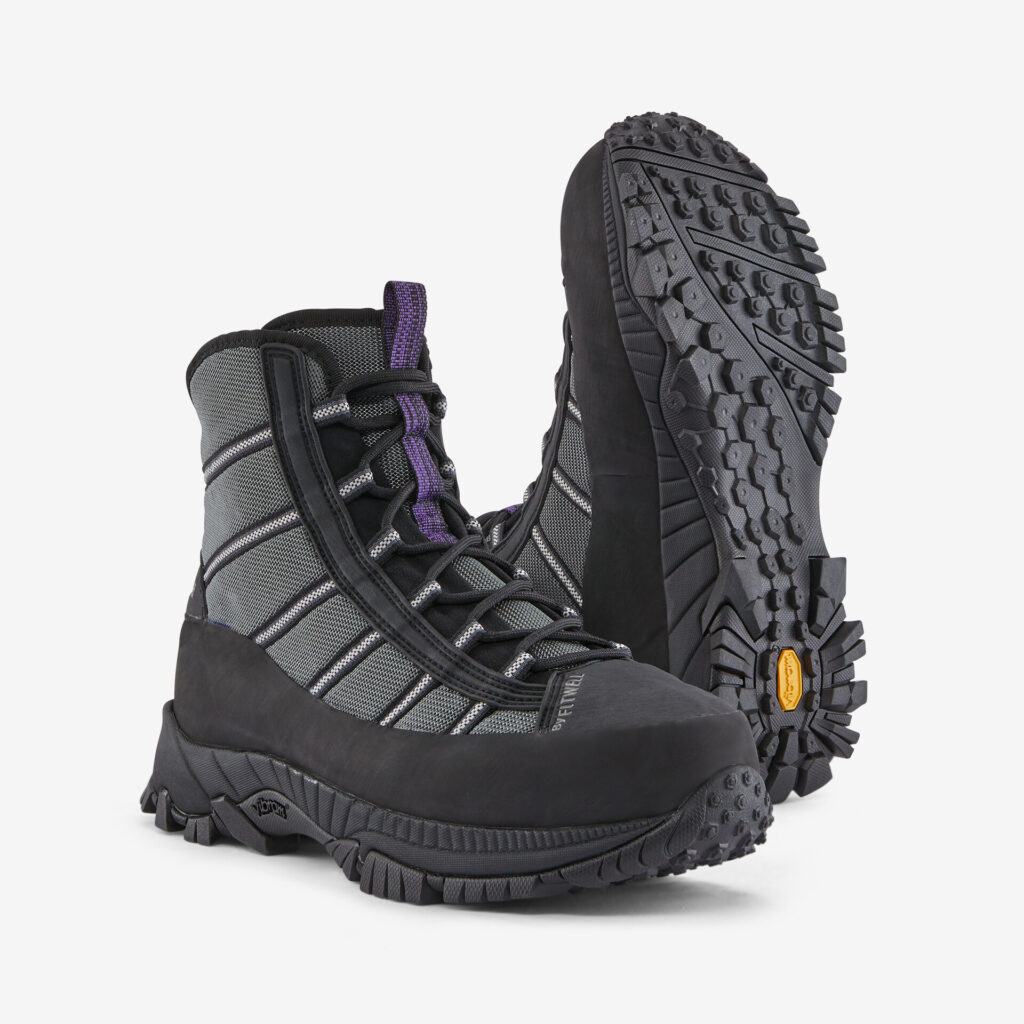
Patagonia’s new Forra Wading Boot offers a lightweight, aggressive looking, and competitive wading boot in terms of its construction. Made by Fitwells in Italy, they feature a sticky Vibram sole which is great for hiking and wading. Both boots weigh in at an impressively light 41 oz. They retail at $299, which, in my opinion, is a steal for a boot of this quality. Studs can be added to these boots as well.
For destinations where you cannot wear felt, and may be hiking a lot, this boot excels. It is extremely lightweight and its streamlined design reduces bulk making it a great travel boot. Despite its minimalist design, the webbing running off each lace loop offers a significant amount of lateral support. The snug fit at the ankle helps support your ankles in the most slick conditions and aids in reducing the amount of sediment that gets into your boots, thus saving your wader booties. The sole is wide with knobby edges that grip when you need them to most. They are also made with non-corrosive components meaning they are saltwater safe.
Sizing for this boot was a little tricky as they run small. I was debating between sizing one or two whole sizes up from my previous boot. I ended up sizing up one size and am happy with my choice. Keep in mind you will likely have to size up at least one size. We have a wide stock of sizes at the shop to help you figure out what works best.
I put this boot to the test in several different environments and wading conditions. The initial test was in Central Oregon and I put about 20,000 steps in each day for two days of fishing. This roughly comes out to about 10 miles each day. During those days I waded on rocky and mossy riverbeds, slippery slopes, and walked through the mud and muck at the inlet of a reservoir. I knew pretty soon into the first day that these were hands down the best wading boot I have hiked long distances in. The Cordura upper dries, and sheds water quickly reducing weight for walking long distances. I do wish these boots came in felt, but if you really need additional grip, these boots can be studded.
I have also been fishing in the surf on the Oregon coast lately, and have taken these to the beaches several times. I’ve found fishing for surfperch on the fly requires a significant amount of walking, and these boots are great for that. The aggressive, wide sole provides a solid foundation for wading in the surf: a place where staying upright on your two feet is crucial. The snug upper fit helps sand keep sand out when compared to other boots. Standing on rocky outcroppings, and the jetty can be dicey; the grippy vibram sole really makes a significant difference.
Overall, this is one of the best boots I’ve had the chance to test myself. I do wish they had a felt option for our slippery rivers, and you must keep in mind the sizing when purchasing, especially online. These are a phenomenal boot, made by a company that will take care of you and your gear for the long haul. Stop by the shop and try them on if you’re interested, or give us a call with any questions if you’re from out of town; we’re happy to help.
One Boat is available for our annual tournament. Sign up here: TWO FLY
Since 2008, the Two Fly Tournament has raised more than $160,000 to benefit clean water, abundant fish and wildlife habitats and thriving communities for Western Oregon. A benefit for McKenzie River Trust, you’ll be connecting with other people who care and fishing for a cause during the Two Fly Tournament!
Friday: The tournament begins at the Caddis Fly Angling Shop with an evening dinner and local brew. You’ll recieve your own Two-Fly Tournament t-shirt and your team will draw your guide for the tournament. Need new gear? On Friday, 10% of all sales at the Caddis Fly Shop will go to McKenzie River Trust!
Saturday: Enjoy a full day of fly fishing with your local guide on either the McKenzie or Willamette River. In the evening, participants will come back together again at Hendrick’s Bridge Park to celebrate a great day of fishing on Oregon’s pristine rivers. A catered dinner is provided alongside local brews as the annual winner is announced.
Since Aug. 7th, there’s been one ecological disaster after another as the Winchester Water Control District (WWCD) made repairs to the dilapidated Winchester Dam to the minimum extent necessary to address public safety issues. Sadly, their cheap-as-possible approach came with near-maximum environmental damage.
The last several weeks have seen:
A massive fish kill of Pacific Lamprey as a result of the repair process, in which upwards of hundreds of thousands of fish died.
Mats made from old vehicle tires, likely containing a compound lethal to salmon and steelhead, were placed in the river and driven over again and again with heavy equipment.
Blocked passage for native migratory fish, including imperiled, iconic Summer Steelhead.
Wet concrete dumped into the waters of the North Umpqua, likely changing the river’s PH level and harming or killing fish and habitat downstream.
Thankfully, this ecological disaster is coming to an end. Fish passage is being restored, and native migratory fish will once again be able to access the 160 miles of habitat upstream.
Please consider testifying on Friday, 9/15 to the ODFW Commission asking the commission to investigate these reported violations and, if substantiated, bring enforcement action to the fullest extent possible. The meeting will be held in Bend starting at 8am (location of meeting). Folks must register to testify by 8am on Wednesday, 9/13, under the topic of public forum (link to register – check agenda item “other”).
In this video, Simon Stephen demonstrates how to tie a fantastic hi-vis cricket pattern. Tested this summer on the spring creeks of the Midwest’s Driftless area, it was his most productive fly he brought along. Locally, this fly has brought large fish up when they are keying in on terrestrials. This fly would be phenomenal on the South Island of New Zealand, and anywhere else with brushy banks and a significant terrestrial season. This fly is durable, hi-vis, and high floating. Try tying it with different colors like tan or light green for an all around deadly terrestrial pattern that best matches your local insects.
In this video Simon demonstrates how to tie a Pale Morning Dun “cripple” fly pattern. This pattern imitates the PMD as it emerges, attempting to break the water’s surface meniscus. This half in half out or struggling mayfly is like candy for feeding trout. During heavy hatches, trout will often key in on easy meals like emerging mayflies shedding their nymphal shuck. Mayflies that run into issues during their emergence such as getting stuck, or soaking their wings make for an even easier meal. A cripple pattern like this effectively imitates both emerging mayflies and crippled ones by dropping the rear of the fly into the water mimicking an emerging PMD. The pattern can be altered in size and color for other hatches. Have some of this particular style tied up in your box for summer months.
In this video, Simon ties a “Rusty Spinner” dry fly. This fly pattern is an indispensable pattern in a summer angler’s box. It effectively mimics the spent Spinner stage of Pale Morning/Evening Duns in the West, and Sulphurs in the Midwest and out East. Sparsely tied, this pattern effectively imitates a variety of smaller spent mayflies.
Mayflies go through several metamorphoses in their life. The most drastic is the nymph to Dun or Subimago transition where they shed their nymphal shuck and become a winged adult. Some anglers don’t know that mayflies go through a second metamorphosis where they molt in stream-side vegetation or in the air to become sexually mature adults called Spinners, or Imagoes. These Spinners or Imagoes are often more rust colored hence the namesake of the pattern “Rusty Spinner”. After this metamorphosis, adults will gather in clusters dancing up and down often above the river. After mating and depositing eggs, they will fall to the river dead or “spent”. Fish key in on this and spinner falls can bring some of the largest fish of the summer to the surface for dries. They know they will have access to vulnerable insects that won’t escape from them often under lower light. Whether they’re overlooked or kept tight lipped, a Rusty Spinner is a fly you always want in your box during the summer time.
Despite warmer weather and smokey conditions, trout fishing remains good. Recent wildfires to our East have left the valley filled to the brim with smoke and haze. The haze and smoke mimics cloud cover, and has contributed to good dry fly fishing despite the poor air quality. With warmer weather, carrying a thermometer is wise this time of year. Once the water reaches 65F you should be mindful on it’s effect on fish behavior and their wellbeing. If the temp is 68F or over, you should stop fishing and move upstream to find cooler water. Warm-water species like carp and bass are fun summer fisheries that can give our trout a break if the water is too warm. Smallmouth fishing on the Umpqua has been hot. There have been a lot of reports in the shop of customers losing track of how many bass they caught in a day down there.
Hoppers are here in full force
Terrestrials should be a staple in your box this time of year. Beetles, ants, hoppers, crickets, and other terrestrial insects are out in full force. We are in between the major seasonal hatches of our summer and fall aquatic bugs. You may see some lingering Pale Morning Duns (PMDs), and you will definitely see some caddis. Aquatic insect activity and hatches will be concentrated to the coolest parts of the day (morning and especially evening). Fish are looking up this time of year so general attractors make great dry fly choices.
A well-fed resident coastal cutthroat
There are several wildfires east of us in the Cascades. There are two larger fires, Lookout Fire is burning on the Upper Mckenzie near Mckenzie Bridge, and the Bedrock fire is burning near Fall Creek Northeast of Lowell. There are some smaller fires, as a result of a lightning storm that passed through last week, that they are getting a handle on. Containment on most of them is increasing every day as they create fire breaks and corral the fires. Checking on the fire status before heading East to fish is a smart idea. Here is a link to information on the fires.
Fishing a dry-dropper rig works great this time of year. A Moorish Hopper #8-12 or Double Stack Chubby Chernobyl #8-10 with a small nymph below can be productive. Some small nymphs include: Jigged PCP#14 or a Jigged Frenchie #12-14. This allows you to fish on the surface and subsurface simultaneously. For this reason, this makes dry-dropper rigs great searching rigs. They also can help with the warm mid-day lull, or are a great place to start if there is not an active hatch coming off. If fish happen to be more interested in your dry fly, consider clipping your nymph off and tagging on a small dry on the end of the piece of tippet. Running a large and small dry allows you to keep track of your small dry, and allows you to offer two different sized flies simultaneously.
A PMD spinner on the front door of the shop one morning last week
Being between hatches of summer aquatic insects and fall ones means that terrestrials play a large role in teasing trout to the surface. In grassier sections of the river, throwing a terrestrial can produce an explosive eat this time of year. This is especially true for areas on the Mckenzie burned in the holiday farm fire with lots of grass and brush growing along the banks. Some of the best terrestrial patterns we have in the shop are: Blade Runner Hopper #10-12, Dry Humper/ Hippie Stomper #10-12, CFO Ant #12-14, Grillo’s Hamburgler #12, or a Moorish Hopper #8-12. Although we are reaching the tail end of the PMD hatch, there may be some lingering on the river. They will be active in the cooler parts of the day especially the evening. Here are some of our favorite PMD patterns: Sparkle Flag PMD #16-18, Tilt Wing PMD #14-16, or a PMD Film Critic #16. Caddis are the big players this time of year in terms of active aquatic insects. They can be seen sporadically throughout the day, but most activity will be concentrated to the late afternoon, evenving, and overnight. This is when the majority of hatching and egg laying will happen. Here are some hot caddis patterns that have been producing lately: Splitsville Caddis #14-16, Tan/Brown Elk Hair Caddis #12-16, Parachute Caddis #12-16, or a Clueless Caddis #14. With a few months of eating dries under their belts, trout are generally looking up for insects on the surface this time of year, which means general attractors will really start working. Here are some we like if matching the hatch is difficult or impossible: Stimulator #8-14, Purple Haze #12-16, Renegade #12-14, Chubby Chernobyl # 8-10, Dry Humper/Hippie Stomper #10-12, or Parachute Adams #12-16. These patterns don’t exactly imitate one insect, but are suggestive of many.
Our next McKenzie Chapter Meeting is coming up on Wednesday, August 30th at 5:30pm at the Ninkasi Better Living Room in Eugene, OR and you’re invited to join!
What: August McKenzie Chapter Meeting–a fish-themed trivia night
Where: Ninkasi’s Better Living Room, 155 Blair Blvd, Eugene, OR 97402
When: 5:30 pm, Wednesday, August 30th
Are you ready to go back to school? Native Fish Society will be hosting a trivia night, featuring categories such as “Native Fish of Oregon” and “Rivers of Oregon.” In addition to bragging rights, there will be some special prizes up for grabs. Teams of up to four people are welcome at this all-ages event.
The Goddard Caddis is a classic adult caddis pattern. This fly pattern is high floating and versatile in terms of the variety of caddis species it can imitate. In this video, Simon demonstrates how to tie the Goddard Caddis with a mixed color scheme for a new take on a timeless classic. He also demonstrates how to spin and pack deer or elk hair. Both are important techniques to have in your tying arsenal which are used on countless patterns.
Current repairs at Winchester Dam on the North Umpqua River.
On August 7, 2023, Winchester Water Control District (WWCD) started repairing the derelict Winchester Dam. Despite far more expansive recent claims made to the public by WWCD about these repairs, WWCD representatives previously told state and federal regulators that the repairs would be “to the minimum extent necessary to eliminate known and reasonably anticipated dam safety deficiencies at the dam.” (DOWL Technical Memo, April 4, 2022, p. 4). On this basis, WWCD received approvals from the Oregon Department of Fish and Wildlife, Oregon Department of Environmental Quality, NOAA Fisheries, and the U.S. Army Corps of Engineers to proceed with the repairs. State and federal agencies issued the permits even after river advocates repeatedly raised concerns and pointed out multiple irregularities in the process (read about these irregularities and concerns here).
WWCD has hired the residential/commercial basement repair company of their own board president, Terra Firma Foundation Systems, as the primary dam repair contractor, despite the fact that his company has no experience in dam repair.
River advocates have been pressing this issue in part because harm from the previous Winchester Dam repair was devastating and well-documented. According to state investigators, pollution from the 2018 repairs at the dam degraded aquatic habitat, killed fish, and harmed the primary drinking water source for the City of Roseburg and the Umpqua Basin Water Association – serving approximately 37,700 people combined. Investigators also found that dam repairs were conducted without following known best management practices, even after authorities provided WWCD with information in advance on how to protect water quality and fish.
This ecological disaster is happening now because government agencies have consistently failed to hold WWCD accountable. Please take action by sending a letter to your state and federal representatives asking them to fully investigate these reported violations and, if substantiated, bring enforcement action to the fullest extent possible.
Together, we can end the ongoing harm from Winchester Dam once and for all. Please encourage your elected leaders to support the removal of Winchester Dam to restore a free-flowing North Umpqua River benefiting the fish, wildlife, and people who depend on it!
Three years after the Holiday Farm fire burned more than 173,000 acres in the McKenzie River valley, partners are celebrating the completion of floodplain restoration work at Finn Rock Reach. Beginning in the summer of 2021, restoration activities have included reshaping nearly 90 acres of floodplain forest and returning the area back to aquatic habitat along the Middle McKenzie River.
The project, led by partners including McKenzie River Trust, the US Forest Service, and the McKenzie Watershed Council, builds on years of investments in the Middle McKenzie Valley. The project has increased habitat diversity and available slow-water areas to protect fish, capture sediment, and bolster groundwater recharging. Across the site, aquatic habitat has been increased by around 50%, supporting Spring Chinook salmon, Pacific lamprey, Western Pond Turtles, and other plants and animals who call this area home.
Part of a long-term vision for restoring the Middle McKenzie River, Finn Rock Reach is one of many completed and planned projects. Working collaboratively across the basin, partners have already restored more than 900 acres between Finn Rock and the headwaters of the McKenzie River. Beyond benefiting fish and wildlife, restoration work offers broad community benefits. According to Susan Fricke, the Water Resources and Quality Assurance Supervisor for EWEB, one of the project’s key funders, “These large-scale restoration projects help build resiliency for downstream infrastructure. Community benefits include supporting clean drinking water by dropping out sediment and contaminants and slowing down water during storm events by spreading the water across a floodplain.”
Over the years ahead, contractors and volunteers will work to replant the site, tend to invasive species, and monitor the ongoing recovery of the area. With your support, we’ll continue to work in partnership across the McKenzie basin to support clean water, abundant fish and wildlife habitat, and thriving communities.
2023 Repair at Dam First Since Botched 2018 Attempt That Caused Fish Kill and Polluted Drinking Water Supply for 37,000 People
Winchester, OR ¬– On Monday August 7th, the fish ladder at Winchester Dam on the North Umpqua River near Roseburg will close until August 28th to allow reservoir drawdown and structural repairs at the 450-foot wide, 17-foot tall, 130-year-old wood, steel, and concrete structure. This drawdown method, chosen as the cheapest dam repair method by dam owner Winchester Water Control District over other well-established and more fish-friendly dam repair options, will release stored sediment downstream onto state-designated Essential Salmonid Habitat/federally-designated critical Coho salmon habitat while creating an migratory dead-end for imperiled summer steelhead, spring Chinook salmon, and other native species attempting to move upstream to the 160 miles of excellent cold water habitat above the dam. The release of stored water downstream on August 7th will likely attract native migratory fish towards the dam just after the ladder closes, confining them for weeks to the warm water below the dam, with no cold water refugia nearby. Compounding this harm, the reservoir refill occurring around August 28th will temporarily reduce river flows downstream of the dam during the driest and hottest period of the year and likely injure North Umpqua instream water rights intended to protect salmon and steelhead. Adding insult to injury, Oregon Department of Fish and Wildlife (ODFW) officials declined to answer river advocates’ formal request to use their authority to require a less harmful repair alternative maintaining upstream fish migration ¬– only weeks before collapsing summer steelhead numbers spurred ODFW to shut all angling in the North Umpqua from August through November.
Winchester Dam is a derelict former hydropower facility now owned and maintained solely to provide a private water ski lake for approximately 110 landowners surrounding the reservoir pool. River advocates from coalition of fishing, conservation, and whitewater groups have been working for years to raise alarm bells with government officials over the Winchester Water Control District’s chronic non-compliance with state and federal repair permitting, engineering, water quality, and dam safety requirements as well as their disregard for protections for fish and wildlife despite the essential habitat importance of the North Umpqua for salmon and steelhead.
Concerns and irregularities that river advocates raised during the permitting process in the lead up to the 2023 repairs include but are not limited to:
1. The dam owners failed to disclose to regulators that during past unpermitted repairs, the release of stored reservoir water also released stored sediment downstream onto salmon habitat and into public drinking water supplies. State and federal permit approvals for the 2023 repair were given after the dam owners told regulators that the presence of invasive aquatic plants in the reservoir would prevent release of sediment, and additionally, that they would secure a 50’ x 100’ tarp to the reservoir bed with sandbags. The plants and tarp will be subject to the full force and flow of the river flowing through the dam’s two narrow water release gates. (On average, Winchester Dam repairs have occurred once every three years since the 1960s, but public records show no permits for repairs prior to 2023.) 2. State records show the dam owners have previously repaired the dam by installing large numbers of toxic pressure treated wood planks. The U.S. Environmental Protection Agency and U.S. Department of Human Services recommend that treated wood not be used where it may come in direct or indirect contact with public drinking water. Winchester Dam is just 50 feet upstream from Roseburg’s public drinking water intake. Despite this, regulators have not required removal of any pressure treated wood from the structure. The 2023 repair plan calls for drilling large numbers of holes into the dam’s pressure treated wood to secure a steel lattice. 3. Previous repairs used rock fill to repair the many cavities within the wooden central span of the dam. As a cost-saving method, the 2023 dam cavity repairs will abandon rock fill in favor of injections of chemical intensive polyurethane foam, a known source of microplastic pollution, just 50 feet upstream from Roseburg’s public drinking water intake. 4. The Winchester Dam owners were notified by state officials in a January 2023 letter that they were storing water in excess of their filed water right claim SW 398. The letter instructed the owners to come into compliance by lowering their reservoir pool by 1.5 feet, or to file for a new water right. The owners have disregarded the state’s instructions, and instead proposed a repair involving a reservoir refill that will likely injure downstream water rights, including certificated instream rights intended to protect the North Umpqua’s invaluable fisheries, including Oregon Coast Coho, which are listed under the federal Endangered Species Act. Despite ongoing unlawful storage of water, the dam’s repair proposal has received all necessary state and federal permits.
Harm from the most recent previous Winchester Dam repair is well-documented. According to state investigators, pollution from the 2018 repairs at the dam degraded aquatic habitat, killed fish, and harmed the primary drinking water source for the City of Roseburg and the Umpqua Basin Water Association – serving approximately 37,700 people combined. Investigators also found that dam repairs were conducted without following known best management practices, even after authorities provided the dam owners with information in advance on how to protect water quality and fish. Winchester Dam lies entirely within state designated Essential Salmonid Habitat and federally designated critical habitat for Oregon Coast Coho salmon protected under the federal Endangered Species Act.
Unfortunately, 2018 likely wasn’t the first time Winchester Dam repairs polluted drinking water supplies and harmed North Umpqua fish and wildlife. Public records describe “leakage” during one previous repair and a state official complaining to the contractor “about cement in the river and no permits.”
According to the Oregon Department of Fish and Wildlife, Winchester Dam impedes access to 160 miles of high quality habitat for salmon and steelhead. Recently, the coalition forced the owners to finally agree to a schedule for bringing their emergency preparedness into compliance with state law for the first time in decades.
River advocates will be documenting the repairs during the three week fish migration closure and available to reporters for comment.
FOR MORE INFORMATION PLEASE CONTACT: Jim McCarthy, WaterWatch of Oregon, 541-941-9450, jim@waterwatch.org Kirk Blaine, Native Fish Society, 307-299-7834, kirk@nativefishsociety.org
Patagonia’s Swiftcurrent Ultralight Wader is their answer to a travel-friendly, super-light pair of waders. The Ultralight wader was added to their “Swiftcurrent” line of waders and is the lightest and least expensive pair priced at $499. They fit true to size, and if you have any of the other products in the Swiftcurrent line, these waders will fit the same. They are a fantastic option for traveling or backcountry adventures where packing light is preferred.
The Swiftcurrent Ultralight waders are the most lightweight wader in the line weighing in at an impressive 36 oz. As Patagonia says, they pack down into a “Grande Burrito” sized stuff sack, making them perfect for traveling by plane, car, or on foot backpacking. They are constructed with a gusseted crotch for maximum movement and freedom. They have a unique ultra-thin bootie which helps them pack down. Just like the other swiftcurrent waders, they have a sliding overall strap system making it easy to get into them. This system also allows you to slide the chest portion down to your waist, and wear them as pants to cool off on hot days. They are outfitted with a solid waterproof pouch on the chest just like their other waders. This is an often overlooked component on waders; I have put that pouch’s effectiveness to the test several times on the different models, and my keys and phone are always dry. They come with the unmatched warranty/repair program that only Patagonia offers.
I had the opportunity to put these waders to the test on two recent trips: one to Central Washington, and one to the Driftless area in the Midwest. They were both tested in cool mornings, and in hot weather. I was impressed with them on both trips for their performance as a light-weight, warm-weather wader that was also extremely packable.
They waders pack up small and take up minimal space.
My trip to the hot desert of Central Washington took place on some Yakima tributaries towards the end of July so it was a great time to test these waders in some hot weather. This trip was a camping trip and the waders packed nicely into my backpacking bag. The waders took up minimal space in their small stuff sack which kept them compartmentalized from the rest of my gear. Fishing early in the morning was best for the fish, and having the waders helped when it hadn’t warmed up yet completely. The same held true for fishing in the evening, some of the canyons got chilly once the sun tucked away behind the mountains. Having a pair of lightweight waders helped immensely, compared to wet wading in those conditions. They dried quickly at camp and were ready the next day to either be used again, or be packed up to head home.
Putting them to the test in the hot weather of Central Washington.
My most recent trip to the Driftless Area in the Midwest involved fishing meandering spring creeks for native brook trout and wiley browns hiding beneath undercut banks and streamside grasses. There was a trico hatch which came off early in the morning and a spinner fall which happened a few hours after. Often the valleys and coulees which the spring creeks flow through are thick with fog a few hours into the morning. The creeks stay cool and are shaded by the nearby hills and bluffs until late morning/early afternoon. Having a pair of thin waders was helpful on those cool mornings, fishing those cold spring fed streams. The waders were cool enough where if you didn’t want to change and wet wade, you wouldn’t overheat as it warmed up throughout the day. The waders on this trip packed into a small duffel bag, they were compact and light, being much better than a conventional pair of waders.
Morning Trico hatch in the Driftless.
My only critique of the waders is that the booties are very thin, which may not always be a bad thing, especially on hot days. With stockingfoot waders, and wading socks, we are used to the cushion of a neoprene bootie. These waders lack a neoprene bootie and in turn lack the cushion that most booties or wading socks provide. This is less of an actual issue, and more of something different that you have to get used to. The booties are thin enough that you can wear a pair of socks with more padding if this becomes an issue.
My younger brother trying them showing how the chest can be pushed down once it warms up.
During the dog-days of summer, wet wading can be nice during the middle of the day. Unfortunately that is when fishing is slow and can be dangerous for trout. Early in the morning and at last light in the summer is when hatches and spinner falls are concentrated and fishing is better. Unfortunately this is often when it is the coolest, especially when you are wet from wet wading. Having an ultra-light pair of waders that packs up small, and is easy to get in and out of is a game changer.
Our local rivers the McKenzie and Middle Fork of the Willamette continue to fish well despite a lack of significant hatches. Hopper dropper set ups with Chubby Chernobyls and various jigged nymphs continue to be very effective. Attractor patterns like Purple Haze and RIO’s Dry Humper are effective early and late in the day. Terrestrial patterns like hoppers and ants are also a good call to have on hand.
Smallmouth Bass fishing on the Umpqua is excellent! We floated from Umpqua landing to James Woods landing on Sunday and small clousers, stonefly nymphs, and poppers all caught plenty of willing bass.
It’s a great time to look at the Williamson and Wood rivers. The famous Hex hatch is happening at dark or after dark on the Williamson and you will find some of the states largest trout looking for these huge mayflies. Hoppers on the lower wood and lightly dressed bugger style patterns on intermediate lines for both rivers can be productive.
The steelhead forecast is pretty grim. The North Umpqua is flat out closed. You can read about the states decision here. The Deschutes remains open for the time being but numbers are not overly impressive. For more info on the potential open/closed fall fishing you can read the states explanation and criteria here. Steelhead counts over Willamette Falls are abysmal for 2023, we have yet to reach 1000 Summer Steelhead. That sub 1000 feeds the Willamette, McKenzie and Santiam systems. Catching a summer steelhead in the Willamette system this year is a bit like finding a needle in a haystack.
It’s a great time of year to get up into the upper reaches of our local waters. The North Fork of the Middle Fork of the Willamette, the Middle Fork of the Willamette above Hills Creek Reservoir and the South Fork of the McKenzie above Cougar Reservoir all off great wet wading and dry fly fishing for native trout. Similar attractor patterns as mentioned for the McKenzie and Middle Fork main-stems will work well.
If you are heading to the coast to escape the heat it’s a good time to start looking for Sea Run Cutthroat in the Alsea, Siuslaw, Siletz, and Nestucca rivers. Cloudy days are best and with little rain in the forecast you will find these fish in the lower reaches of coastal streams, even tidal areas. Here are a couple of older posts with a bit of info in them for chasing Sea Runs. Have fun out there, Fall isn’t far away!
Send thanks to Representative Val Hoyle for reintroducing the Southern Oregon Watershed and Salmon Protection Act!
Yesterday, U.S. Representative Val Hoyle took a significant step to protect Oregon’s treasured wild rivers by reintroducing the Southern Oregon Watershed and Salmon Protection Act (SOWSPA) to Congress!
SOWSPA aims to safeguard over 101,000 acres of Oregon public lands and will help to permanently protect the headwaters of Southwest Oregon’s outstanding collection of wild rivers – including the National Wild and Scenic Illinois and the National Wild and Scenic North Fork Smith, plus Pistol River and Hunter Creek – from the threat of mining pollution. The communities of Southern Oregon and Northern California depend on these wild rivers for pure drinking water, salmon and steelhead runs, and outstanding opportunities for outdoor recreation. Read the full legislation at this link.
Today, we’re requesting two minutes of your time to help share our gratitude to Representative Val Hoyle for her unwavering commitment to safeguarding Oregon’s precious rivers and the incredible life they sustain.
How can you help?
Send thanks to Representative Val Hoyle HERE by submitting the Action Alert. It will only take you a minute or two, but it will be hugely helpful in sharing our appreciation!
Additionally, Rep. Hoyle will be coming to Southern Oregon this weekend with Senator Wyden for public town hall meetings. We encourage anyone in the area to attend and thank Rep. Hoyle in person to share your support for reintroducing SOWSPA and her continued dedication to Oregon’s rivers! Town hall meeting details:
Please take a moment share your thanks to Rep. Val Hoyle today and join the groundswell of public support for the reintroduction of the SOWSPA that will protect the homewaters we all love!