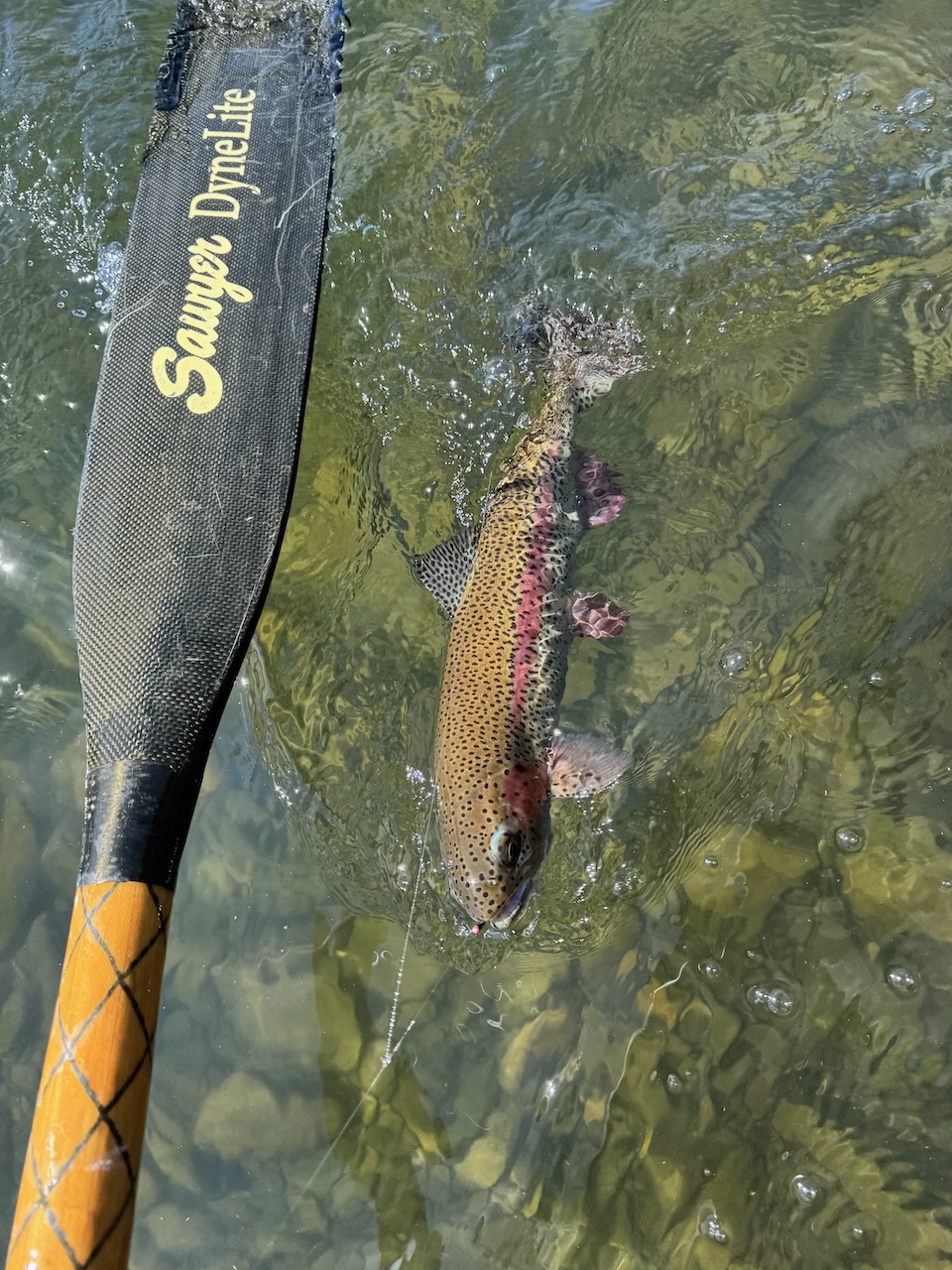
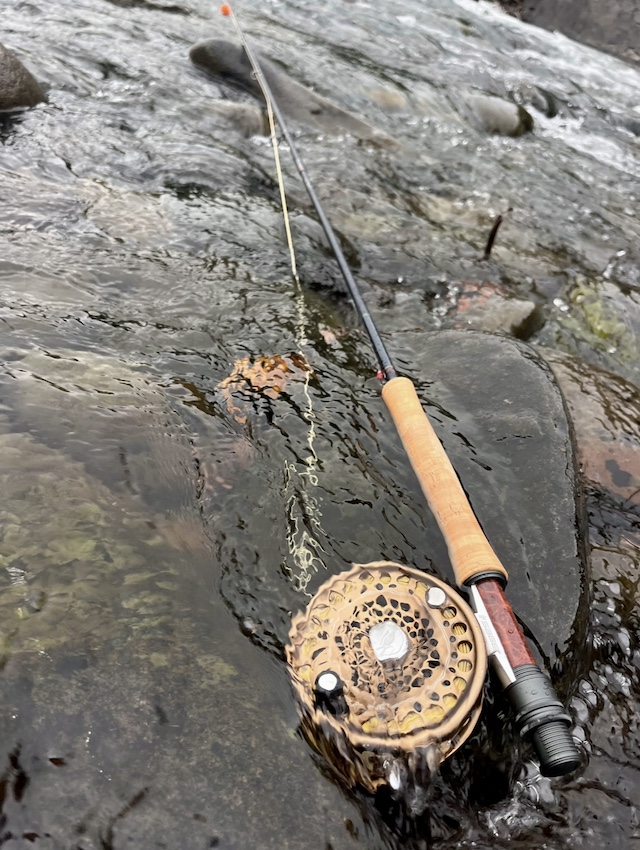
High water and cold water temps have been the norm of late. Fishing has still held up on the McKenzie River near Eugene. Blips of sunshine have shown what’s to come. Pale Morning Duns, Green McKenzie Caddis, stonefly adults, Little Yellow Stones and assorted caddis have been emerging. With the nice weather to come, we should see a lot more in terms of hatches in the near term.
Water temps have remained really cold. During the day water temps move up and fishing has been best between 1-6pm. Once the current “melt off” related to all the recent rains pushes through, we will see temps move up, and remain more stable. Temps in the 46-51 range give us more productive fishing the entire day.
Levels seem to have crested so look for lower water in the days ahead.
Nymphing remains the most productive method. Make sure you have black and brown stonefly nymphs, and get them near the bottom. It’s time to start thinking hopper dropper over pure strike indicator set-ups as fish will smash a big salmon or golden stonefly. Have fun out there!
Our next in-person meeting will be on Monday, May 20th at the PublicHouse in Springfield from 6 to 8 pm in The Study room (adjacent to the Beer Hall). In addition to the great food, drink, and company, we’ll have Trout Unlimited’s Oregon Policy Director James Fraser on hand. James will talk about recent and current TU efforts and projects in the state. Please join us!
Board Members & Chapter Officers Wanted! Are you interested in helping to plan future Redsides events and efforts? We’re looking for new Board Members and a chapter Treasurer to help us with chapter operations and our strategic planing, and would love to have you join us. Please reach out to Jesse Robbins, jesselancerobbins@gmail.com.
The next Snake River Dinner Hour, a monthly webinar series for folks to learn more about saving salmon, honoring treaty obligations, and creating solutions for Northwest communities, is on May 14th. Click here to learn more and register.
The TU Western Regional Rendezvous will be held in Idaho Falls, ID from May 17 – 19. Click here for more info.
The largest dam removal effort in U.S. history is underway on the Klamath River in southern Oregon. The Reconnect Klamath website is a great resource to stay up-to-date on the removals.
In Eugene, the McKenzie River Trust has a number of upcoming events and volunteer opportunities. Check out their calendar here.
The Oregon Council of Trout Unlimited is another tremendous resource for updates on state-wide conservation news and activity. I highly recommend subscribing to their monthly newsletter for more information.The Instagram channels of the following are more great ways to stay up to date on news and events: Trout Unlimited nationalTrout Unlimited Oregon
In this video, Simon ties a great extended body Salmonfly dry fly. Every spring some of the West’s largest aquatic insects make their emergence. The salmonfly often marks the beginning of trout season, and means summer is on the way. Here in Oregon, you may have plans to hit the Deschutes, Rogue, or Umpqua for their legendary Salmonfly hatches. Most of the Western United States sees these insects at some point in the spring. It can be a busy event on some rivers, especially during the height of the hatch. Although the Chubby Cheronobyl is a fantastic fly, during this hatch, these fish see countless Chubbies every day. This is where the Mothership Salmonfly makes a huge difference. The long, extended, and segmented body looks far more natural than other dries often thrown during the hatch. When fish are refusing everything else, a more realistic fly like this can save the day. Fish this fly aggressively near brush, trees, and grassy banks, slapping it on the water suggestive of a salmonfly that just fell in.
The fly features a long shank, wide gap Ahrex hook which is fantastic for this type of foam fly. Hareline Hi-Float Foam is new for 2024 and is ultra buoyant and more durable than past types. This fly is ultra buoyant and would make a great dry for a dry dropper setup. During the sun and heat in the middle of the day on the Lower Deschutes things can slow down. Consider running a dropper below the Mothership Salmonfly. A Small caddis nymph, or a frenchie would be a great choice during the salmonfly hatch. This general blueprint can be repurposed for other stonefly species as well: Gold Stones, Skwalas, Shortwing Stones, Nocturnal Stones, Etc. Tie some up, let us know on instagram how they turn out. Even better, tag us on instagram to show us some big redbands with the Mothership Salmonfly in their mouth on the Lower D this spring!
Writers on the Fly (WOTF), the popular fly fishing reading series and pop-up art show, hits the road again this April with their 2024 West Coast Tour. The Spring tour brings WOTF’s unique mix of fly fishing literature and art to Northern California and Southern Oregon, kicking things off in San Francisco and finishing up in Eugene, OR, four days later.
WOTF began in 2015, establishing itself as one of the most unique, engaging and authentic in-person event series in the fly fishing community. Since its inception, the shows have cycled around the Pacific Northwest with the well-known Cascadia Tour—but this Spring the show expands down the West Coast.
There’ll be fly fishing stories, local artwork, fisheries conservation, good beer, and great people! The shows feature adventure-holic, writing rambler, Patagonia Fly fish ambassador, and bass whisperer Riverhorse Nakadate andpoet, writer, guide, ski racer and black belt Anne Landfield as well as other, local writers. Featured artists include San Francisco-based artist and angler Sarah Landstrom(at the CA shows) and Grants Pass-based artist and fly fishing guide James Sampsel (at the OR shows).
With our raffles, we’ll be raising funds for CalTrout, The Steamboaters and McKenzie River Trust by raffling off great gear from Sage, RIO Products, and RepYourWater, including fly rods, reels, lines, hats, tees, and more!
In this video Simon ties a killer crab fly for permit, triggers, and all around flats use. It takes inspiration from various crab flies. This particular pattern is tied with heavy tungsten eyes which we chose to show off a new hareline product. The construction of this fly really caters to picky fish, especially in shallow water. For scenarios like this, consider using brass or bead chain eyes. The light body made of microflex lands more gently than other flies. This makes this fly a killer one for fishing places with pressured fish cruising shallow flats. A SL12S from Gamakatsu means this fly will hold up to the largest permit and is trigger safe. The new Microflex Soft Hackle Chenille comes in a variety of colors, so this blueprint can be adjusted to tie countless variations. This fly was taken down to the Bahamas earlier this year and tested and it is bonefish approved too! Tie some up, tag us in your photos on Instagram, and let us know how they fish.
The term “Emerger” is often heard when discussing fly fishing techniques, but is not always explained in depth. To the novice angler this term can cause more confusion and hindrance than help. The term emerger can refer to a variety of scenarios. They common theme is that this term refers to an insect on its way to the surface to hatch. The importance of this vulnerable state becomes very clear when thinking of feeding from a trout’s point of view.
Note the nymphal shuck this Baetis Dun is emerging out of. Its old “skin” can become a hindrance during hatching which makes it an easy meal for a trout.
Wild trout are subject to the harshness of nature which make them experts of mastering the delicate balance of calories consumed versus calories burnt that keeps them alive. Swimming to the surface to eat a fly burns calories. If that fish is surfacing to eat, they better catch that bug, otherwise it was a waste of their precious energy. This is even more important for trout living in rivers, where holding their feeding position costs more energy than one in a lake. Trout prefer to surface and eat insects which are vulnerable, which in turn, makes them an easier meal. It’s a game of odds, and surfacing to a emerging insect increases that trout’s odds of returning to the bottom with an insect in their mouth.
Here is a real Baetis Dun stuck in its nymphal shuck. As you scroll down you will see it emerge.
An emerger is a broad term that refers to an aquatic insect that is surfacing to shed its exoskeleton and turn into a winged adult. This can be in the center of the water column on their way up, just below the surface of the water, or in the surface film where the insect is shedding its skin. Generally, the two latter situations is what most people are talking about when referencing emergers. When insects are rising to the surface in the water column, I like to refer to them as an “ascending” nymph. This distinction is important because fly choice and your approach changes when imitating an ascending nymph.
As the Dun emerges, it leaves behind a shuck. The fish often see this and can single out an emerging insect. A good emerger fly pattern has a shuck towards the rear of the fly.
The surface tension can be incredibly taxing for an already exhausted nymph to penetrate, and the trout know this. When you see trout feeding directly below the surface this is often what these fish are feeding on. If fish are breaking the surface, but ignoring your dry fly they may be keyed in on insects which are struggling to break free from their old skin or “nymphal shuck” they are shedding. Due to the nymphs being exhausted, distracted, or stuck in their old skin, focusing on meals like this help trout increase their odds of successfully feeding.
This Dun is almost fully emerged, but it has kinked its wing on its way out. This is one of the many ways a failed emergence can happen. If the insect cannot get its wing dry/upright we would then consider it a stillborn or a cripple.
For insects just below the surface or in the surface film, there must be an element of buoyancy present to help suspend the fly in the film. Here are some of our favorite emerger patterns for targeting fish feeding closer to the surface: Film Critic, X2 Caddis, CDC Emerger, or a Poxyback Emerger. All of these flies contain a shuck or the rear is dropped into the water to imitate an insect shedding its old skin. For nymphs which are ascending to the surface from the riverbed, soft hackle type patterns are more appropriate. Here are some shop favorites: Simple Soft Hackle, Partridge and Pheasant, Soft Emerger, or a March Brown Emerger.
For the more buoyant emergers which I listed above, fish them like you would any other dry fly. Often mayflies, caddisflies, and midges do not emerge in rapids. Insects need more calm water to safely emerge without being splashed back under. You’ll often find trout feeding in the middle of runs or especially towards tailouts. This is a place where the freshly hatched insects are funneled to the feeding trout. . If they are too small to see, consider tagging them behind a larger, more visible fly like a Chubby Chernobyl, or Stimulator. Dead drifting these type of emergers, which mimic insects in the film, is the most appropriate way to present these flies.
The second set of emergers listed mimic ascending insects, and the most appropriate way to fish those is to fish them on the “swing”. Cast angled upstream and across with your emerger. A few upstream mends will allow the flies to sink, once they have made their way deeper let your fly line pull tight, and it will swing your flies towards the bank you are standing on. This technique will swing the flies from deep up to the surface, effectively imitating an ascending insect. You may also raise your rod tip during the swing if you spotted a fish feeding, this will exaggerate the ascension even further. You may want to fish this technique with a secondary beadhead nymph in front of your emerger, or some split shot to get your fly down.
Paying attention to the nuances of insect hatches is not essential to have a successful day on the water, some may say the advantages are only marginal. During large, consistent hatches fish have the luxury of being picky and choosing easier meals over others. During extremely large “blanket” hatches this is even more important as you must offer something that stands out as an easy meal. Fish also choose to feed on vulnerable prey, emerging aquatic insects are one of the many vulnerable states that trout key in on. For these reasons, fishing emergers can be advantageous when targeting trout. Most importantly, studying the intricacies of aquatic insect hatches will give you a deep sense of the interconnectedness of the ecosystems we choose to recreate in.
A quick look at the River Ops Lace, it also comes in a BOA model.
Korkers is a well known boot manufacturer which originated in our backyard here in the Northwest. They have made quite the name for themselves locally as a fantastic boot manufacturer. Their story started helping create footwear for loggers sending logs down rivers. They needed a solution which allowed the men to grip to the wet logs. Some old tires and carbide spikes is what started their legacy. Soon after they were making wading footwear for steelhead fishermen on the notoriously slippery Umpqua river and the rest is history. Now they are a force to be reckoned with in regards to quality, modular footwear of all types. Today we are focused on their wading footwear and accessories; to be specific their “River Ops” boot.
Korkers River Ops boot is their “guide” boot; meaning it is their toughest, most robust boot they offer. It would have to hold up to the use and abuse a guide would put them through season after season. The boots come in two distinct models: Lace up and one with a “BOA” lacing system. For this review, I am speaking on behalf of my experience with the lace up model. These boots feature a robust construction and despite their bombproof build, they are surprisingly light and comfortable. My favorite features of these boots are: The ability to swap soles, synthetic/non-absorbent construction, depressed stitching, and robust construction which provides exceptional ankle support. Below I will go into more depth on the features I love.
The “EVA” midsole contributes support and cushion making this boot a treat to hike in.
Exo-Tec: is Korker’s synthetic composite outer which wicks water away while still providing support. The synthetic feature of the construction allows for these boots to remain extremely light while they are wet, and dry off even faster after a day on the river. This feature also aids in being able to hike longer, as the boots do not absorb as much water and remain much lighter than others. Boots that stay soggier longer in your garage deteriorate quicker. I often find my boots are almost dry by the next day.
Notice the hexagon shape synthetic upper. This is what helps provide such good support for these boots while keeping them so light.
Protected Stitch: This is one of my favorite features of this boot. The River Ops feature depressed stitching on almost every seam of the boot. This means that abrasions from rocks, logs, etc. will not fray your stitching. The stitching of your boots is arguably the most important aspect and Korkers did a great job providing this feature on their higher end models like the River Ops, Devils Canyon, & Darkhorse.
Note the depressed stitching along the seams. Most of the seams on this boot are protected in this same fashion.
Internal Drain: This is a brilliant feature of Korkers wading boots which is made possible by their modular sole system. Excess water drains from the inside of the boot through ports where the soles meet the boot. This is especially apparent when stepping out of the water, you can see excess water exit the boot. This makes the hike to your next spot more enjoyable.
These boots have some seriously hydrophobic properties and shed water very fast.
Ankle Support: This boot provides excellent ankle support. This is why I originally chose these boots, and it is why I just replaced my original ones with another pair. I grew up skateboarding so my ankles need all the extra support they can get. I sometimes find myself exploring a new stream far out of cell service by myself and it makes me feel safe knowing my boots will properly support my ankles and I will not have a problem.
The Exo-Tec, hard heel cup, and ankle wrap integrated into the boot give it some of the best ankle support out there in a wading boot.
Soles: The feature everyone knows Korkers for is their modular soles. This is a wonderful feature that allows one pair of boots to do it all. Felt is a fantastic sole option here in the Northwest, but it also is great at harboring bacteria and other invasive species. Some states even outlaw felt, the nice thing about these boots is that you can constantly mix and match different soles without having to buy a different pair of boots all together. All boots come stock with two soles, and the River Ops is the only boot to come stock with Vibram soles. From the factory, you can either order Vibram and felt, or studded Vibram and standard Vibram soles. There are 9 sole options that are compatible between the Omnitrax Series and the Triple Threat Series of Soles. My favorite all around sole for local fishing is the studded felt sole.
Take your pick of the 9 sole options with Korkers wading boots. My favorite is their Studded Felt.
I cannot recommend these boots enough. Often when helping a customer pick what’s right for them, I go to the products that have served me well, that I have great experiences with. The River Ops checks all the boxes for me and I was so happy with my first pair, that when it was time for a fresh pair of boots, it was a no brainer on what I was getting. The boots start at $259 for the standard lace, and jump to $299 for the BOA version. Your boots are arguably your most important piece of gear next to your rod, fly line, and fly choice. Good boots are not necessarily essential to catch a fish, but they are an essential piece of gear needed to keep you upright and not floating down the river. They are the only piece of gear to carry you around that riverbend to the next hole.
There is no rush to get out there on these cold mornings. I kept close track of water temps yesterday with my new Fishpond Digital Thermometer and there was a swing from 45-50 degrees between 830 and 5pm. Once water temps moved to 47-48 degrees, Grannom Caddis, Blue Winged Olives, and March Browns were present. Needless to say fishing improved. Nymphing was the most productive method for us yesterday.
Water levels remain excellent, and the forecast is for cold nights to end in the next couple of days. Fishing should really ramp up when we see nighttime temps move into the 40s.
In this video, Simon ties a fantastic Jigged March Brown nymph. March Browns are the first insect of the year which hatches in abduncance that is larger than Blue Winged Olives. For that reason, they are an important food source for trout and become a spring fishing staple. March Browns belong to the clinger family of mayflies. These mayfly nymphs inhabit in the faster water in the river and have flat, aerodynamic bodies that allow them to grip to rocks in fast current feeding on detritus and algae in the current. This time of year, these mayflies have fully developed dark wing pads on their backs. Their wing pads are dark and bulging with fully developed wings inside. For this nymph creating a wide, flat profile is key to mimic these nymphs. Using lead or lead-free wire is a great way to bulk up the width of the nymph. Using cinnamon tip turkey coated in medium thickness UV resin is a great way to mimic a mature March Brown nymph’s wing case with fully developed wings. This fly uses elk hair to create the wider profile towards the head with the “clinging” legs which are characteristic of clinger mayfly nymphs. The mottled brown bead is suggestive of the nymph’s wide head, and facilitates getting your fly down deep. This blueprint is effective for all mayfly nymphs in the clinger family. Others include: Quill Gordon, Pink Quill, Grey Fox, Light Cahill; most of these are from regions East of us on the West coast. Sizes and colors can be adjusted accordingly. The March Brown hatch will continue its way higher in elevation as spring progresses, so there’s still plenty of time to fish these higher up river this spring.
Here is a mature March Brown nymph harvested a few weeks before the hatch began. Note the wide/flat profile and developed carapace/wing pad
In this video, Simon ties a great March Brown Soft Hackle. Swinging soft hackles is a long forgotten art in the trout world. With the rise of euro nymphing, dry droppers, drop shotting, etc. swinging classic wets is sometimes seen as a thing of the past. Wet flies are incredibly versatile, and especially important for the March Brown hatch. Fish key in on ascending mayflies during every hatch, but for the March Brown hatch, especially it is important. March Browns can actually shed their nymphal shuck subsurface as they are ascending to the surface. This means that sometimes their vulnerable state is actually on their way up as opposed to in the surface film like many other mayflies. For this reason, swinging a wet fly is a fantastic way to catch fish during the March Brown hatch. Fish this fly solo, tag it behind a heavier nymph, or use it as your point fly on an indicator or euro rig and let the flies swing at the end of your drift. Tying some and omitting the hidden bead is advantageous when fish are eating on the surface. On slower days, or before the hatch is in full swing, the beaded versions are great. This pattern can be tweaked for different hatches to suit your needs. Have fun out there!
This past fall I had a chance to test the new Thomas & Thomas Avantt II 9′ 5wt before it was released. It is their high end fast action rod; which is a functional showcase of their beautiful craftsmanship. The rod is fast without sacrificing “feel” while casting, which allows you to still have some feedback during use.
I paired the Avantt II with a Sage Trout 4/5/6 reel which balanced the rod well. I fished a Scientific Anglers Amplitude Infinity Textured WF5F line on it. The slightly more aggressive taper of this line really brought out the power of this rod. I did not use a longer taper such as the Scientific Anglers Trout Taper or the RIO Technical Trout. My assumption with these longer taper lines is the rod would do very well with 30+ feet out of the tip. The Avantt II has enough power to pick up an “extended” taper line for sure.
Some of the rod’s strong suits include its: fast action, beautiful craftsmanship, accuracy, ability to load with little effort, and it being a great all around rod. The rod really excels in many of the places a rod should in this price point. Most importantly that it is a well rounded rod that can be your “do it all” rod.
I only really ran into two shortcomings of the rod. Both of these shortcomings are likely fixed by different fly line tapers, but for this review I am speaking to the Scientific Anglers Amplitude Infinity I used. One, being its action is so fast that it wont lay a size 22 BWO dry like a feather as delicately as a “dry fly rod”. The fast action does not deliver as delicate of a presentation of small flies that a slower dry fly rod is capable of. This would not be my first choice of rods if I were fishing a trico hatch on a crystal clear spring creek exclusively casting dries to wily browns. Fortunately, T&T has a solution to this being their more delicate dry fly rod called the Paradigm. Second, due to its fast action, it also does not roll cast as well as a deeper loading rod. This could be greatly improved if the rod was fished with a longer headed nymphing line such as the Scientific Anglers Anadro Indicator.
I covered the board in terms of techniques extensively when testing this rod. I fished small dries, large dries, light and heavy nymph rigs, fished streamers, and swung wet flies. Across the board, this rod preformed extremely well. My most notable takeaway was the feel and power that is built into the taper of this rod. If you are looking for a beautiful, “do it all” fast action trout rod this may be the one for you. We have some in the shop, so if you want to see it, give it a wiggle, or cast it out back swing by and we’re happy to help. If you’re out of state, or looking online, feel free to give us a call we’ll answer any questions you have.
In this video, Simon ties a great egg pattern for the winter and spring. This “Perdi-Egg” merges two proven patterns into one. The Perdigon is a european style attractor nymph that is known around the world. Whether you like it or not, egg patterns are productive for trout, especially when there are spawning fish in the system you are fishing. The whitefish spawn happens during the winter, and rainbows spawn in the spring. From about December through April and parts of May, trout are actually keying in on eggs and eating them. So if you’re a purist, between those months, fishing an egg is guilt free and you’re matching a hatch, perse. In this video, Simon uses a new rubbery chenille from hareline called Microflex Softhackle Chenille to make the egg. Using it sparsley makes for a great egg imitation. You could also use it for bugger bodies, crawfish bodies, eggsucking leech heads, your limit is your imagination. It is also incredibly durable, so you get more life out of each fly. Feel free to size up on this pattern for steelhead, or change colors depending on where you fish. If you tie some up or catch some fish on them and post them online, tag us in your post!
Join author and river advocate David James Duncan (The River Why, The Brothers K, My Story as Told by Water) and McKenzie River Trust for an inspiring and thoughtful conversation about the relationships between people and the natural world around us. Duncan will reflect on ideas from recent works, including his 2023 novel Sun House, which explores the American search for meaning and love, and a forthcoming collaborative book of essays, Going to See, inspired by Barry Lopez. Tickets are $15, and student tickets are $10. Purchase your tickets for Upstream online or in person at The Shedd.
Join us early to visit the Cole Gallery, where McKenzie River Trust staff will be available to share about our current and upcoming projects. You can purchase featured titles from J. Michaels Books and view the Arboreal Angler Collection.Doors will open at 6:30pm.
Following the presentation, David James Duncan will be available to sign books.
“Upstream” is a series of annual events hosted by McKenzie River Trust. These gatherings are designed to inspire conversation about the complex and interdependent relationship between humans and the natural world.
Topic: Join us for an evening covering Keep Fish Wet best practices as a way to get excited for the spring trout season and warmer weather coming our way!
This is an open invitation for all passionate river and fish advocates in the Eugene area (and beyond!) who are interested in joining a community dedicated to the revival of wild native fish.
We’re looking forward to seeing you in Eugene on April 9th! Bring a friend or two, and let’s have a great time!
With the March Brown hatch underway, we’ve collected a variety of past tying videos for some spring-time inspiration. We are seeing plenty of bugs on the lower river. Swinging wets is super effective for this hatch specifically. Plenty of fish can be nymphed up with “crawler” style nymphs. As things warm up a little more, it’ll be on for dry flies. Check out the videos below for some inspiration. Keep an eye on the blog or our youtube channel too, we will be posting some new tutorials for patterns that we have been testing lately.