March Brown hatch kicks off in full force on the Lower McKenzie River

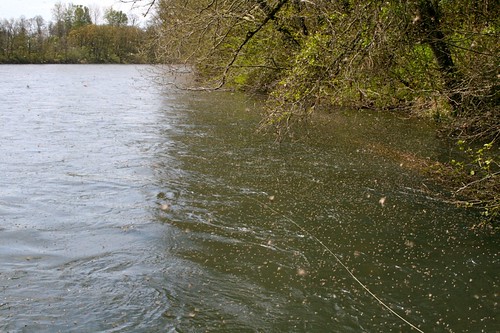
Fishing the Lower McKenzie River: A rainy day in early March, the McKenzie is much lower than normal spring flows. Ethan Nickel, Chris and I put in on the lower river after lunch, and the fish are rising at the boat ramp.

The action starts on river left before we’re even ten feet from the put in. Trout are already plucking at Ethan’s swung flies, while he is anchored up. We string up rods with softhackle wet flies, two flies per rod on a dropper set up and start to make our way downriver.

The fish seem to be everywhere. They’re not really rising yet and the hatch hasn’t quite started, but every spot we swing we get a tug or a nip, or a big pull. I’m farming more fish than I’m hooking. Several months of fishing the thingamabobber or giant leech program have ruined my ability to deal with delicate trout takes. Chris hooks and lands enough fish for me to confirm that it’s my abilities that are in question. Next time out, I’m bringing my bamboo four weight to slow down my casting and my hook set!

McKenzie River Wild Trout

At a bend in the river where a major tributary dumps muddy water into the McKenzie, the cutthroat population shows up in earnest and there are doubles – two fish on a single swing, on multiple casts. There are too many grabby trout for me to not hook fish, and eventually my trout hooking skills start to slowly come back to me.

McKenzie River Wild Trout

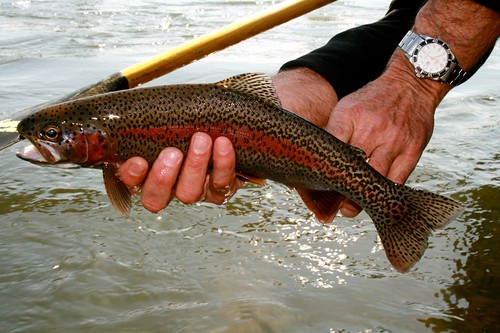
Far out in the heavier flow on the inside bend, Chris hooks one of the big native redside rainbow trout this river is famous for, and after a short but strong fight, he brings it in. The fish is gorgeous, spawning colors blazing on its sides. But it has a huge hole in its back with scratches down both sides – probably narrowly escaped the talons of an osprey.

McKenzie River Wild Trout

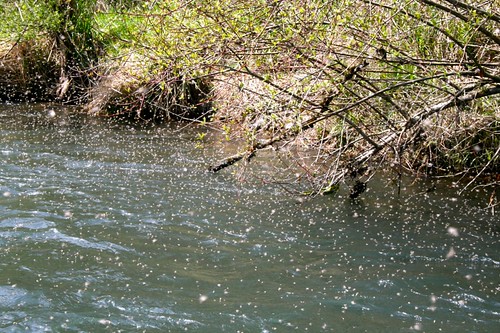
At this point the March Browns show up on the water’s surface. Big dark brown sail boats with tan segmented bodies. The first major hatch I’ve seen this year, and the bugs are huge. Close to size 10. The fish react accordingly and start to pop on the surface all down both sides of the river. We push on, skipping the froggy water where the smaller fish like to feed and look for prime holding spots with big risers.

McKenzie River Wild Trout

Anchored in the middle of a big flat, we start to see some splooshing big takes on the surface, and we’re picking up fish on nearly every cast. Then something blows up six feet from our right oar. A huge trout for sure. Chris hands Ethan a rod and he dead drifts the two wet flies over where we’d seen the rise, and I watch a red flash that looks like a two-liter Coke bottle break the surface and run upstream.

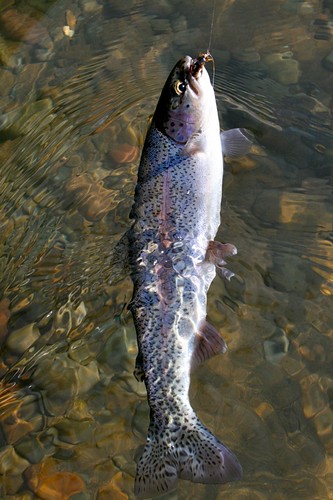
The trout is massive, and it runs around the big flat while Ethan jumps out of the oarsman seat and Chris starts to row us to shore. When the fish comes to hand, I can hardly believe it’s the same species of trout people are used to seeing on this river. It’s one of the largest trout Chris, Ethan or I have ever seen on the McKenzie, and it looks more like a steelhead.

McKenzie River Wild Trout

McKenzie River Wild Trout

McKenzie River Wild Trout

Ethan quickly frees the huge trout while I snap photos like crazy. It’s a gorgeous fish, but it’s clearly an old buck, you can see the age in its fins and its slightly sunken in eyes. The body is like a football, round and deep and the bright red stripe runs all the way from its tail to its jaw.

McKenzie River Wild Trout

Soon after we release the fish the hatch tapers off, probably around 2:30. We catch a lot more fish swinging wet flies, but that huge trout effectively ended the day for all of us.

Notes from the guides: How to swing flies on the McKenzie

While we were fishing, I ran my tape recorder and got the following advice from Chris and Ethan:

Why swing two flies? Sometimes you get doubles. Sometimes on the upper fly I’ll put a bead head on to keep the flies from skating on top in the faster water. But honestly, two flies give you two chances. Even though the upper fly is on a much heavier tippet, the fish don’t seem to mind much.

A team of flies is always better. The other thing is you can experiment with different patterns. Sometimes on a bright day a drab fly works better, and on a cloudy overcast day you want to specifically match the hatch.

What is the leader set up? Leader length is 9-10 feet, tapered leader cut in half. Tie a blood knot and run the upper fly off the blood knot with a 2x loop to loop dropper. This is the most tangle-free way to go. See Chris’ explanation in the video below:

By setting it that way, you can replace the dropper as often as you want. Vary the fly very easily. If you get into a good hatch and want to go dry really quick, you cut the dropper off and you have a standard nine foot leader. You can also cut off the dropper, tie a dry fly onto the end of the leader, and you’re in business.

Fly patterns for swinging in early spring? March brown are the first major hatch of the year. Start early in the hatch with bigger bugs, size 12. By later in March you might be using a smaller size 14 fly. There are a lot of productive patterns and it pays on certain days, when you’re favorite thing isn’t working well to experiment.

What are the water conditions you’re looking for? The lower McKenzie River can fish very well quite high or pretty low like it is now. You can have great fishing down here when the water is as high as 7000 cubic feet at Springfield, and today it’s half that – 3,500 cfs and conditions are great.

Medium to shallow riffles and flats are prime water, but if the fish are on emerging bugs, anywhere you see a fish coming to the surface to a fly is swingable. Out of a drift boat, larger flats and longer riffles are great. But you can have a lot of success swinging off short drops and gravel bars too.

March Browns are a clinger nymph, and they live in the highest concentration in small gravel that is fairly well oxygenated. You see a ton of them at the tops of riffles where there’s a little current. You’ll see duns all over the place.

Why swing wet flies? There are a lot of fish that feed just below the surface that may not be keyed in to the duns on top yet. Oftentimes, if we spend a full day fishing this time of year you start out nymphing when its colder, later in the morning you start to swing and later you can have dry fly fishing after that.

You can also cover more water. You’re not trying to get a dead drift in a single lane. You’re getting big sweeps across spots that are very broad. It’s a very effective way to cover water.

Rod selection for swinging flies? I love a nine foot four weight for the McKenzie. I would argue that a very stiff, heavy rod is not a good choice for swinging wet flies. We’re not using really light tippets, but you want a medium action rod that will bend more, offer more tippet protection. Fish are eating this on a tight line.

It’s a dry fly presentation. You’re trying to land it softly with a classic wet fly swing. Down and across, you’re tight with the swing. You want to be in touch with your fly, medium to short, trying to keep a straight line between your rod and your fly. If you get big bellies in the line, you’ll be less successful.

The other issue, when the fish tugs at it, you’re tugging back at it fairly hard. Just like swinging a wet fly for steelhead, the fish is bringing the line tight. Before setting the hook, you want to hesitate and then just give it a really soft little lift. If you set it a lot harder, you’ll find that you’re missing the majority of them.

Top march brown patterns at the shop:
Partridge and pheasant soft hackle
Beadhead Partridge and pheasant March Brown
Beadhead March Brown emerger
Hare’s Ear Softhackle
March Brown Wet
March Brown Softhackle Spider
March Brown Sparkle Dun
Klinkhammer March Brown
March Brown Parachute

Fly Tying Videos: Top March Brown patterns
March Brown Soft Hackle
March Brown Wet
March Brown Sparkle Dun
March Brown CDC Emerger
Klinkhammer March Brown Emerger
March Brown Parachute
Dark Cahill Wet Fly
Hare’s Ear Soft Hackle

Half-day guide trips are available at a $250 preseason rate. Call the shop for details 541-342-7005 or book online.

-MS

Posted in McKenzie River | 12 Comments

McKenzie Update: Trout tagging training, postcard signing lunch party tomorrow

Lower McKenzie River Trout Census Training tomorrow!

McKenzie River

As part of the 2010 trout stocking plan for the McKenzie, ODFW will open up an additional five miles of river to native fish management on the Lower McKenzie River. The McKenzie Flyfishers spearheaded a population study of the wild fish in that section to see how the natives bounce back now that stocking is removed. The project was funded by our Trout Unlimited Chapter through a $5,000 grant from the Flyfishers Club of Oregon.

The wild trout population study will involve catching and tagging (or recording data on previously tagged fish) in the lower river between Hendricks and Bellinger. To kick this off on a solid footing, we are asking all participants to take part in a training session which will cover tagging procedures, data recording and study logistics. The sessions will be held at the ODFW Springfield Field Office at 3150 E. Main Street, Springfield, OR 97478 (the phone # is (541) 726-3515.

Yesterday’s session had around 20 participants and the next one is tomorrow, Thursday, March 4th at 6:00 PM.

As there may be fisherman who wish to participate, but cannot make either session, let me know and if we have enough interest, we will schedule another session. Alternatively, buddy up with someone who has been through the training session and fish with them.

We will have participants from several clubs, so that we hope to make a big dent in the target tagging during the month of March. Please feel free to contact Dave Thomas regarding any questions you might have.

Dave Thomas
McKenzie Fly Fishers
Email: dthomas@sierraware.net
Phone: (541) 505-7213

McKenzie River Native Trout Coalition Postcard lunch party tomorrow!

Trout Unlimited, The Caddis Fly Shop, The Native Fish Society and a host of volunteers and concerned anglers sent out postcards, asking influential Oregonians to reach out to ODFW in favor of wild fish management on the McKenzie River two weeks ago. We’re hosting another postcard signing party this week, Thursday March 4th at 12:00pm. If you haven’t’ filled out postcards yet, please come down to the Caddis Fly Shop Thursday. Midtown Cafe has provided us with a giant party sub and we will have some other refreshments as well, for people who take their lunch break to defend wild fish. See you at the Caddis Fly Shop on Thurs. See video from our previous postcard signing party:

Meeting reminder 3/10/10: Speaker Ethan Nickel on spring trout tactics

Veteran fly fishing guide Ethan Nickel will be speaking at the Trout Unlimited meeting next week, presenting on spring fishing tactics for trout. The meeting starts at 7pm and is free and open to the public. The meetings are held on the second Wednesday of the month at the Eagles Aerie, 1375 Irving Rd, Eugene.

Donate to the FCO Fly Box Auction!

Trout Unlimited McKenzie-Upper Willamette chapter secured $5,000 to fund a five-year population study of the newly non-stocked section of McKenzie River. The study will begin next month, and will be administered by ODFW and the McKenzie Fly Fishers. The funds came from our Portland supporters and benefactors, the Flyfisher’s Club of Oregon.

You can show your gratitude for this amazing funding by helping us fill a fly box for the FCO auction in May. TU’s Cris Abbot is currently staining a wooden box, with a steelhead fly etched on the glass cover by our friend Kathy McCartney. If you’d like to help fill this fly box for the FCO’s auction, please drop them off at the Caddis Fly with an envelop labeled “FCO auction fly box”.

McKenzie Watershed Council meeting with Jeff Ziller

Join the McKenzie Watershed Council on Thursday, March 11, 5:30 p.m. in the Training Room, Eugene Water & Electric Board, 500 E. Fourth Avenue for ODFW district biologist Jeff Ziller’s presentation on McKenzie River trout management options. Ziller will present a short history on trout management in the McKenzie River, a review of what is known about the status of the three native species, and summarize results of recent creel and preference surveys conducted by ODFW. He will also describe the public planning processes used by ODFW to assist in the management of fish species and fisheries. Public comment is accepted at each meeting, and public attendance and participation are encouraged.
-MS

Posted in McKenzie River, Oregon Conservation News | 1 Comment

Fly tying materials: Everything you ever wanted to know about Rabbit Strips

Rabbit strips are one of the fishiest fly tying materials around. In these two videos, Jay Nicholas talks about the various kinds of rabbit strips available and what they should be used for. In the second video, Jay talks about the new two-toned bunny strips from Hareline Dubbin. You’ve got to check out these whole hides, great if you’re getting into production mode on MOAL leeches.

Also, for the next 48 hours, all rabbit strip fly tying materials are 10% off at CaddisFlyShop.com.

Posted in Fly Tying | 4 Comments

Chewee Skin Stone Fly Nymph

Another storm is pounding our local waters today and river levels are likely to jump up for the weekend. Must be time to tie some more spring bugs.

We love to fish Golden Stone nymphs early in the season on the McKenzie, Willamette, Deschutes, N. Umpqua and numerous other fine rivers. The Golden Stone nymphs are an ideal size to get down to the bottom, be castable, and the perfect nymph dropper “heavy” fly. In this video Barrett demonstrates how to use a new material called Chewee Skin for the stonefly wing case. Chewee Skin is really easy to work with and we see it having numerous applications in the fresh and saltwater fly tying realm. The pliable material can be used for wing cases, bodies, shell backs, minnow bodies, ribbbing and beyond. Chewee Skin is available in numerous UV colors. UV reflective materials are highly visible to fish in low light conditions and penetrate further so fish can see them from afar.–CD

Chewee Skin Stone Fly Nymph

Chewee Skin Stonefly Nymph

Hook: 5262: # 6 or Daiichi 1710 # 6
Lead: .020 or .025
Bead: 5/32 Tungsten
Tail: Barred Crazy Legs Golden Yellow/Pearl Flake
Rib: Ultra Wire Med Copper or Brown
Body: STS Trilobal Golden Stone
Wing Case: Chewey Skin UV Brown
Legs: Barred Crazy Legs Golden Yellow/Pearl Flake

Posted in Fly Tying | 1 Comment

Event reminder: George Cook and Jon Hazlett spey casting class

Spey Casting Class March 6th 9am-4pm 2010

George Cook and Jon Hazlett on the same stage. This class for beginners or advanced casters promises to be a blast. Excellent instructors with vast experience and an entertaining approach. Bring your own rod or try one of the new weapons on hand.  Lunch included $150. Call the shop to book, 541 342 7005.

North Umpqua Spey lesson

Posted in Oregon Fly Fishing Clubs and Events | 3 Comments

Los Roques Venezuela bonefish and flats trip report

IMG_1156

IMG_0944

IMG_1077

This past week 12 Oregon anglers escaped the cold and spent a week fly fishing for bonefish at Los Roques Venezuela. We had a spectacular week of weather, good fishing and good times. Our food, lodging, and service were all top shelf. The lodge staff did a fantastic job of tending to our every need and more.

IMG_1068

IMG_1096

IMG_1139

IMG_1098

The food at the lodge was superb. We were served fresh fish for dinner every evening including Wahoo, Tuna, Barracuda, Snapper and Lobster. Lunches were packed by the lodge and eaten on the water during our fishing days. Lunch was simple, fresh fruit, sandwiches, fried rice, pasta, cookies, crackers and plenty of water. Breakfast was pancakes, eggs to order, arepas (corn dodgers) fresh fruit and a different fresh blended juice daily.

Our fishing day began around 8:30. One guide and one boatman accompanied two anglers out to the flats. Having one man in charge of the boat is really a bonus. After anglers and guide have walked the beach or flat, rather than trudging back through fish-less water, the boatman moves the boat to meet you and get you on to the next spot. This is a huge time saver, giving anglers more time to fish rather than walk.

IMG_0942

IMG_0943

IMG_0982

Los Roques offers a huge variety of bonefish habitats and water types.  White sandy beaches and flats, pancake flats (round patches or high spots inside the lagoon) with mottled sand and turtle grass,  lagoons, cuts and back bays are all present. Near island flats are immense and anglers can walk for miles hunting bonefish, permit and other species.

Our trip focused on bonefish for the most part but there are numerous other species to chase while fishing at Los Roques. Tarpon, Snook, Permit, Snapper, Jacks and Barracuda are all present in good numbers. Our guides did there best to accommodate angler requests. The group had Permit “shots” none landed, jumped a Tarpon, caught Barracuda, jacks, snappers, and numerous bonefish.

IMG_1113

IMG_1041

IMG_1130

The tremendous variety of water types and species options makes Los Roques an outstanding saltwater fly fishing destination.

IMG_0927

Other Trip Notes

Los Roques is a great spot for couple who fish together or not. Most of the tourist traffic on Los Roques is not angling related. Hanging out on the beach, snorkeling, diving and sailing are some of the activities available.

Getting to and from usually involves staying in Caracas, our group stayed at the Euro Building Express. Our rooms were clean and the hotel felt very safe.

Gear Notes

The New Sage Xi3 rods performed fantastically on this trip. The rods are amazingly light and have a fast action allowing you to get out in front of fast moving saltwater species. I found the rods to load quickly at any distance.

I found the Scientific Anglers Saltwater Sharkskin line to perform fantastically. The line shoots great, floats high and can rip your fingers up without some protection to the creases in your stripping finger tips.

The new Nautilus G7 fly reel was an awesome match to the Sage Xi3. The reel is ridiculously light for a reel possessing an incredibly smooth and strong drag system. The G7 has a retrieval rate as good as any reel on the market. Most importantly the reel looks fantastic.

Must have fly patterns are the Gummy Minnow in #2,6 and 8. Gotcha Pearl, Gotcha Pink, Permit Crab,  and Bonefish FX Shrimp. Numerous other patterns are sure to work, our best are listed.

Rio Bonefish Taper leaders worked very well turning over the Gummy Minnow and heavier patterns with ease.

Quality wading boots with very thick bottoms are very important at Los Roques. Walking on very sharp coral flats is part of the program. The Patagonia Marlwalker and Simms Flats Sneaker performed well.

To learn more about this trip please call or email me at 541 342 7005 and caddiseug@yahoo.com.–CD

Posted in Fly Fishing Travel | 3 Comments

2010 Northwest Fly Tyer and Fly Fishing Expo Coming Soon!

The 2010 Northwest Fly Tyer and Fly Fishing Expo is set for March 12-13, 2010 at the Linn County Fairground and Expo Center in Albany Oregon.

The NW Fly Tyer and Fishing Expo brings together the social network of fly fisherman throughout the Northwest, Northern California, and Idaho. Over 2,000 people attended last year’s Expo. The NW Expo has been heralded as the “largest fly tying event west of the Mississippi”, with over 80 classes. Class choices include: fly tying techniques, fly casting (single and two handed), and fly fishing techniques. The NW Fly Tyer Expo is sponsored by the non- profit organization, Oregon Council of Federation of Fly Fishers (FFF). All proceeds are dedicated to education and conservation efforts within the state.

Nearly 200 tyers will be demonstrating in shifts all day, both days (March 12 & 13, 2010), plus 59 different vendors of products peculiarly of interest to fly fishers, “where & how to” programs, raffles, and silent and oral auctions of quality merchandise. Federation of Fly Fishers (FFF) members get free admission, non-members pay only $5.00. If you attend and are not yet an FFF member, you can join, and then get in free, basically a $5.00 discount for your membership!

Also, there is no charge for parking at the Linn County Fairgrounds facilities. Good food is available within the Exposition area. Tying classes are conveniently just down the hall from the main hall, and casting classes are in an adjacent building.

On Saturday evening, after the close of the show, there will be an opportunity to meet and mingle with fly tyers and instructors with a no-host bar, followed by the annual banquet and oral auction to conclude the festivities. It is not necessary to buy a dinner ticket to attend the auction. You may learn more about the Expo and sign up for classes or purchase banquet tickets here.

LV

Tags: Oregon Fly Fishing Clubs and Events

Posted in Oregon Fly Fishing Clubs and Events | Tagged | Leave a comment

Reminder: Sign up for Dave Hughes class — Elements of Fly Fishing for Trout

Dave Hughes, co-author of Western Hatches, author of Trout Flies, and 20 other titles will be at The Caddis Fly on Feb 27th.

Dave Hughes Fishing

Dave will be putting on a workshop on the Elements of Fly Fishing For Trout from 9am-3pm for $50/person, 20 person maximum. From 4pm-5pm Dave will be doing a book signing and tying demo, free and open to the public following.

Elements of Fly Fishing for Trout (a 4- to 5-hour workshop).
Includes the following three slide shows and a casting demonstration if space and weather permit.

Reading Trout Water: Learn to read water and find trout in creeks, streams, rivers, plus lakes and ponds. The initial skill in trout fishing is learning to focus your fishing in water where trout hang out, and to eliminate time wasted fishing water where they do not. Based on Dave’s books Reading Trout Water.

Selecting Trout Flies: Learn how to select the right type of fly—dry, emerger, nymph, wet fly, or streamer—for the situation you’re in: the type of water you’re fishing, and the naturals, or lack of them, that trout might be taking. Based on Dave’s books Handbook of Hatches, Trout Flies and Essential Trout Flies.

Tactics for Trout: Learn the most effective rigs, casts, and methods to present dry flies, nymphs, wet flies, and streamers to trout on waters moving and still. Based on Dave’s books Dry Fly Fishing, Nymph Fishing, and Trout Rigs and methods.

Casting Demonstration (weather permitting): Covers appropriate tackle selection for all types of trout fishing. Demonstrates the parts of the basic casting stroke, variations on the basic cast, and casts to apply the methods covered in the workshop. This is not a distance casting demonstration, rather a presentation of practical fishing casts that actually catch trout.

Dave Hughes: Dave is author of more than 20 books about fly fishing. They include the classic Western Hatches with Rick Hafele, American Fly Tying Manual, Handbook of Hatches, Reading Trout Water, Dry Fly Fishing, Nymph Fishing, and the massive reference Trout Flies. His latest book, published in 2009, is Nymphs for Streams and Stillwaters.

Call the shop to reserve your spot ASAP: 541-342-7005.

Posted in Oregon Fly Fishing Clubs and Events | 1 Comment

Backcountry Steelhead (mis)Adventure

Warning: This post contains a fairly graphic image.

This isn’t the post I wanted to write about this trip. I wanted to write a love song about a remote backcountry stream somewhere between northern California and southern British Columbia, a place that has never been logged, where the runs of salmon and steelhead of decades and centuries past sway in the old growth sitka Spruce and douglas Fir and the younger alder and maples that stand along the stream banks. This place has strong runs of coho, chinook and steelhead.  I make several pilgrimages a year there, where I always feel my spirits restored, my hopes renewed and my commitment to conservation of indigenous, self-sustaining coldwater fish populations reinvigorated.

I hiked in, greeted by the smell of death and stumbled on the poacher’s camp. A dead cow elk lay near an abondoned tent, debris and a igloo-esge wigwam constructed of douglas Fir boughs. The meat had been stripped of the side of the elk and much (to my untrained eye) had been wasted:

Poached Cow Elk

Near the corpse lay a calling card that completed the scene and gave a glimpse into the poacher’s mind. Not only unashamed but genuinely proud . . .

Poacher's Calling Card

There were also signs of “fishing.”  Abandoned bags of cured roe . . . my mind spun with the possibilities, poached hen salmon eggs used to poach steelhead in a pernicous cycle of waste and abuse. Somehow, the world felt cheaper and crueler, like the when unattainable girl you idolized from afar as a youth threw herself at some dumb jock who dumped her immediately and bragged to everybody who’d listen, relaying the story of conquest, sneering, laughing and coarse.  Disgraceful.  I strung up my rods.

The strategy was simple. Swing the swinging water, bobbercator the indicacator water and if the flies didn’t work, show ’em the spinner. I worked upstream fast as is my way without touching any fish and saw a flyfisher just ahead vacating a deep pool. Figuring he had thoroughly worked it with his flies I skipped mine, cast a spinner and retrieved slowly. A sea run cutty grabbed my lure but didn’t stick and I repeated the cast, retrieving even slower and a bucky buck, dual striped with a deep glowing red gill plate grabbed me and ran us up and down the pool before sucumbing. Of the fish I hooked or caught there is only this shot:

Bucky Wild Steelhead Buck

There were other hopeful signs. A log jam that started three years ago has continued to grow, accumulating habitat enhancing debris:

Natural Log Jam, Year 3

The stream was full of steelhead redds, I stopped counting at well over twenty in less than three miles:

Steelhead Redd

I moved a steelhead with a swung intruder and it took position behind the fly, grabbed and I set too soon. There was no connection. Then it happened in this pool:

Sage TCX

As my tandem offering drifted into the gut of the run my indicator plunged down and I was connected to the hottest steelhead I’ve ever hooked. The big buck went on a rampage, first running down toward the bouldery tailout I was able to turn him and he jumped in displeasure. He ran towards the top of the run, turned and reached full speed running downstream and again broke the surface, this time with the most impressive leap I’ve ever personally witnessed from a hooked steelhead, easily four feet. He came upstream one last time and powered down toward the tailout again, I tried to stop him from reaching the rapids below . . . . I put on the brakes and held on-but but leader didn’t and it was over. No great loss. My only regret is that I had been unable to locate the tripod or you’d be watching video of this ass-kicking instead of reading about it.

I continued to work upstream not doing any more good with the flyrod. I pitched my spinner just below a rapid and as soon as it hit the water a chrome hen grabbed it, breaking the surface I saw her silvery head and flanks as she spit my spinner back at me in disgust. I fished the next run with the flyrod and then caught a bright hen on a spinner. In this small water she also ran toward the downstream rapid and I knew I couldn’t stop her. I stopped fighting, opening my bale and she held in the tailout for several minutes under minimal tension.  Lulled to sleep I moved her into deeper water and began the fight again, a quick tailing and she was off. A couple casts later, a buck who must have been courting her chased down my offering, took a swipe but wasn’t hooked.

Hiking out thorough the old growth in the moonless night, a small circle of light thrown by my headlamp, I wondered if the cougar and bear used the trail once darkness had fallen and I thought of the big steelhead trout in the small stream below and whether they too felt a tinge of fear at the wildness of it all.–KM

Posted in Oregon Winter Steelhead Fishing | 6 Comments

Jay’s Marabou Simplicity Steelhead Fly tying video

Jay Nicholas’s Marabou Simplicity is an easy-to-tie steelhead pattern for winter and summer fish. Jay demonstrates how to palmer marabou in this video and puts together a great pattern for swinging up big steelhead.

Jay's Marabou Simplicity

Jay’s Marabou Simplicity steelhead fly
Hook: TMC 7999 sizes 2-4
Thread: Lagartun x-strong 150 denier
Rib: Lagartun small oval silver tinsel
Body: Dubbed STS purple or Hareline custom blend purple
Colar: Hot Pink and Purple Extra-select Marabou
Wing: Flashabou Mirage

Be sure to check out our Steelhead Fly Patterns library for more steelhead fly tying instructions.

Posted in Fly Tying | 1 Comment

McKenzie River Wild Trout population study starts in March

As part of the 2010 trout stocking plan for the McKenzie, ODFW will open up an additional five miles of river to native fish management on the Lower McKenzie River. The McKenzie Flyfishers spearheaded a population study of the wild fish in that section to see how the natives bounce back now that stocking is removed. The project was funded by our Trout Unlimited Chapter through a $5,000 grant from the Flyfishers Club of Oregon.

McKenzie Native Rainbow Trout

The wild trout population study will involve catching and tagging (or recording data on previously tagged fish) in the lower river between Hendricks and Bellinger. To kick this off on a solid footing, we are asking all participants to take part in a training session which will cover tagging procedures, data recording and study logistics. There are two sessions scheduled, so pick the most convenient and just show up. The sessions will be held at the ODFW Springfield Field Office at 3150 E. Main Street, Springfield, OR 97478 (the phone # is (541) 726-3515. The currently scheduled sessions are:

Session 1: Tuesday, March 2nd at 1:00 PM

Session 2: Thursday, March 4th at 6:00 PM

Each session will cover the same material so just pick one. As there may be fisherman who wish to participate, but cannot make either session, let me know and if we have enough interest, we will schedule another session. Alternatively, buddy up with someone who has been through the training session and fish with them. I will maintain training logs so if you need to know who you might fish with, give me a call or email me.

We will have participants from several clubs, so that we hope to make a big dent in the target tagging during the month of March. Please feel free to contact Dave Thomas regarding any questions you might have.

Dave Thomas
McKenzie Fly Fishers
Email: dthomas@sierraware.net
Phone: (541) 505-7213

Posted in McKenzie River, Oregon Conservation News | 4 Comments

Attention Steelheaders: Metalhead is here!

If winter steelheading is kicking your butt and you need some gratuitous action, Metalhead is just what the doctor ordered. The sickos who brought you the Trout Bum Diaries (New Zealand & Patagonia) and Fish Bum Diaries (Mongolia) have turned their lenses to British Coumbia. Based on the trailer we saw a the Drake Film Tour, the film should be immensely entertaining. Enjoy!

Posted in Fishing Porn | Leave a comment

How to make sink tips for Skagit spey lines

Jay Nicholas demonstrates his methods for building sink tips for his Skagit spey lines using bulk T-14. Building the loop-to-loop connectors can be tricky, and Jay shows you his method for securing loops.

Posted in Oregon Fly Fishing Tips | 4 Comments

Attack on Sacramento Salmon

Last week Dianne Feinstein (D-CA) unveiled a legislative rider, “The Emergency Temporary Water Supply Amendment” that would would weaken pumping restrictions designed to protect delta smelt and migrating salmon in the San Francisco Bay and Delta.

As most in Oregon are painfully aware, the collapse of the Sacramento salmon (40,000 last year down from 750,000 in 2002) has led to the cancellation of much of Oregon’s commercial salmon fishing the last two years. This collapse, due in large part to water diversions for agriculture has had significant adverse economic impacts up and down the west coast.

The good news is that west coast members of Congress, including Peter DeFazio, David Wu and Earl Blumenauer are fired up about Ms. Feinstein’s actions. In a letter addressed to Feinstein they urge the withdrawal of the rider pointing out that it is drought, not environmental protections that have exacerbated water problems and that in any event irrigators have obtained all or nearly all of their contractual water supply. The letter also expresses concern that the rider preempts science in order to legislate unsustainable water exports out of the Bay-Delta.

Ms. Feinstein has heard from her colleagues, but it can’t hurt to hear from you. It might also be a good idea to write Senator Wyden and Senator Merkely since as far as I can tell, they haven’t entered the fray–KM

Posted in Oregon Conservation News | 4 Comments

Middle Fork Willamette Report: It’s Still Good

With promising reports streaming in from the lower Mckenzie, I decided some subsurface sampling on Middle Fork of the Willamette was in order.  I’m a misanthrope like that and besides, I resolved to fish the MFW at least once a month this winter and I already skipped January.  I caught the warmest couple hours of the day and saw a bunch of BWOs that interested me more than the fish.  Fortunately, a few trout couldn’t pass on my nymphs.  The biggest rainbow of the day (16″) ate a #12 Copper John tied on a 1X long hook.  The Mega Prince also produced but the Copper John was definitely hotter.–KM

Middle Fork Willamette Rainbow (February)

Posted in Middle Fork Willamette River fishing | 2 Comments