Help support the Devil’s Staircase wilderness

Earlier this summer, . DeFazio (D-OR) and Sen. Wyden (D-OR) introduced companion bills, H.R. 2888 and S. 1272, designating the 29,650-acre Devil’s Staircase Wilderness, protecting a large section of the Smith River tributary Wassen Creek. The watershed supports wild coho, Chinook, steelhead and sea-run and resident cutts. Check out the video below.

Devil’s Staircase from Cascadia Wildlands on Vimeo.

This is one gnarly section of coast range old growth. Three times this summer already, rescue crews have gone looking for hikers that have tried to find their way in and out of this area. From the recent article:

The Devils Staircase area has no developed trails into the falls and most roads are not signed. All search missions have been due to people over estimating their ability to get in and out of the area in one day.

The Douglas County Sheriff’s Office advises hikers who visit this area that it may take an overnight trip to complete the route; that GPS units do not work very well in the area due to heavy timber and steep canyons; there are no developed trails; and people need to be prepared for an overnight stay and be well equipped and experienced in land navigation.

Cascadia Wildlands is raising money to make sure this legislation gets passed. You can donate here.

Posted in Oregon Conservation News | 3 Comments

Prince nymph variation fly tying video: Ice dub prince

This variation of the classic Prince Nymph uses Ice Dub from Hareline Dubbin and is a great pattern for imitating green drake nymphs in the Willamette Valley, McKenzie River region of Oregon.

IMG_1754

Ice Dub Prince
Hook: TMC 5262 Size 6-10
Thread: 6/0 unithread
Bead: 3/16 gold bead
Weight: .025 lead
Tail: Brown biot
Rib: Small oval gold tinsel
Body: Ice Dub — olive and peacock
Wing case: White biot
Hackle: Brown hen

Posted in Fly Tying | 3 Comments

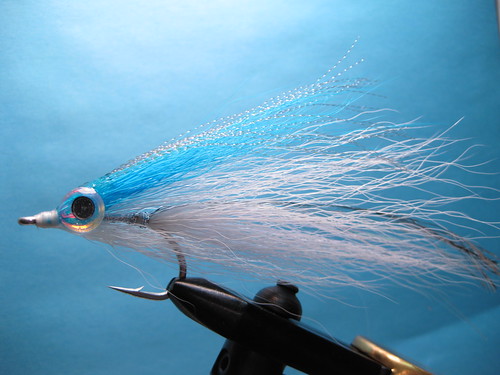
Barrett’s Pelagic Baitfish: Bluewater streamer for Oregon Albacore

In this new fly tying video, check out Barrett’s Pelagic Baitfish, a great pattern for offshore saltwater fly fishing. This fly has all the action to imitate a variety of pelagic baitfish — match the bait with different sizes and colors.

Barrett’s Pelagic Baitfish: Fly tying video from Matt Stansberry on Vimeo.

IMG_1755

Barrett’s Pelagic Baitfish
Hook: 3/0 SC152H Gamakatsu
Thread: 6/0 Unithread
Tail: White Bucktail
Flash: Pearl and Silver Flashabou
Body: Flat holographic silver braid
Wing: White bucktail, Blue Bucktail, UV Herring-back
Throat: White bucktail
Eye: 3/8 Mirage Eye
Head: Epoxy

Use the Flex Coat Cordless Big Wheel epoxy fly turner from Hareline to turn your epoxy heads.

Posted in Fly Tying, Oregon Saltwater Fishing | 1 Comment

The Strange Case of the Mystery Hatch

Arlen Thomason lives on the McKenzie River and is  the author of BugWater, scheduled for release by Stackpole Books in January. Oregon Fly Fishing Blog thanks Arlen very much for this discussion of a very underrated emergence. We look forward to the release of Bugwater. Arlen’s photographs and “angler perspective” of aquatic insects will make Bugwater a must have reference.

Come walk with me now, down to the shores of our local river. I’m going to show you some clues left there for us by a mysterious denizen of its flowing waters. Let’s see if you can identify the creature that left this calling card.

Mystery_Hatch-01
Mystery bug shuck

You get partial credit if you said “stonefly.” But what kind of stonefly? It’s a big one—with a body length up to about 1.5 inches. Golden stonefly, perhaps you say? Close, but no cigar. It does belong to the same family, though—Perlidae—and it bears a strong family resemblance.

The hatch started on south Willamette Valley rivers several weeks ago, about mid-July, and will continue off and on through September and into October in the upper reaches of some streams. Observant fly fishers will have noticed the nymphal shucks, like the ones in the picture above, on half-submerged rocks along the banks of the McKenzie and Willamette rivers lately. But the great majority of anglers have no idea that a hatch of big stoneflies is underway locally, nor have they ever heard its name—neither the official scientific designation, Claassenia sabulosa, nor the “common name” of shortwing stonefly. What’s more, you will rarely see a magazine article about it, nor is it even mentioned in most fly fishing books.

 
Yet shortwing stoneflies are found all across the western states, with the highest numbers in certain rivers of Idaho, Montana, and Wyoming. Most larger rivers in Oregon and the Pacific Northwest contain at least decent populations. The McKenzie has moderate numbers in its lower reaches, increasing as you proceed upstream. Every fall I run into adult shortwings above McKenzie Bridge. Adults are only occasionally observed below Leaburg, not only because they are less abundant, but mostly because of their rather secretive daytime habits. Nymphs, on the other hand, are rather easy to find—if you know where to look—in most sections of the McKenzie and southern Willamette. The places to look to find the greatest numbers of these bugs are riffles with cobble predominantly in the range of 3-6 inches in diameter.
Mystery_Hatch-02
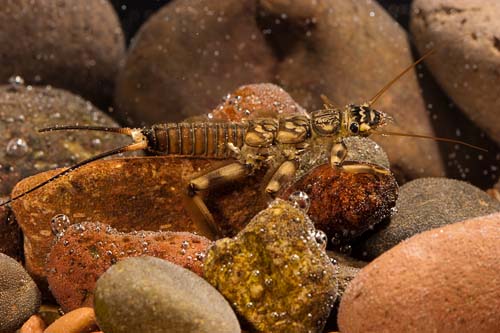
Shortwing stonefly nymph

You may be thinking that this looks an awful lot like a golden stonefly nymph, and indeed it does. Here’s how you can tell the difference. We have two species of golden stoneflies locally—the “true” golden stonefly, Hesperoperla pacifica, and the western stonefly, Calineuria californica. They hatch at the same time—late spring to early summer—in mostly the same places, and are both called goldens by nearly everyone. H. pacifica is a little larger, and the adult is slightly different in color (along the yellow-to-orange spectrum) than C. californica. (Note that the bugs in the photo below are not dead, just chilled to inhibit their tendency to scamper off the photo set.)

Mystery_Hatch-03
Golden stonefly adults

The nymphs of both kinds of golden stoneflies have light-colored, feathery gills at the base of each leg; while lacking gills along the abdomen. H. pacifica nymphs have an additional pair between the tails, and that’s how you can easily tell them apart.

Mystery_Hatch-04
Golden stonefly C. californica nymph: no gills between tails

Mystery_Hatch-05
Golden stonefly H. pacifica nymph: gills between tails, hourglass on head

But if you carefully check the photo above of the shortwing stonefly nymph, you’ll see that it also has a pair of light gills between the tails, just like H. pacifica. So how do you distinguish a shortwing stonefly nymph from a golden stonefly H. pacifica nymph? By the marks on their heads. An H. pacifica nymph has a white mark shaped like an hourglass on top of its head. The mark in the same position on a shortwing stonefly nymph is in the shape of the letter W—or an M, depending on the angle you view it.

Mystery_Hatch-06
The “W” on the head of a shortwing stonefly nymph

Luckily for us, when the shortwing stonefly hatches, it leaves behind that tell-tale W / M insignia on its nymphal shuck. If you look back at the shuck in the first photo of this article, and squint a little, you should be able to see it there. So now whenever you’re out on the river and you spot big stonefly shucks bearing that mark, you’ll know that shortwing adults are out and about, prowling the banks.

 
But where are they? Unless they are really plentiful, you may not see any adults, or just a few. That’s because they don’t fly around like golden stoneflies, for the most part they don’t climb vegetation, and they are mainly nocturnal. During the day, they hide under stones along the banks.

 
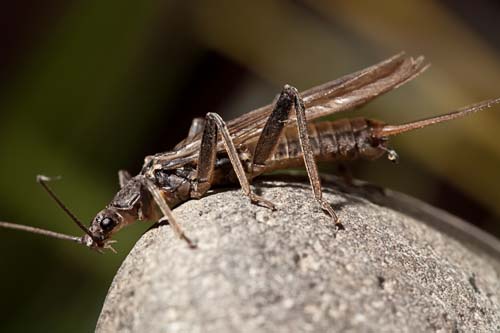
So what do adult shortwing stoneflies look like? Females are about the same size as—or slightly larger than—golden stoneflies, and have a similar shape. But the color is different—they are brown to gray above, and light tan on the bottom.
Mystery_Hatch-07
Adult female shortwing stonefly

When you turn one over and look at its ventral side is when you’ll really appreciate the difference from golden stoneflies.

Mystery_Hatch-08
Adult female shortwing stonefly, ventral view

Notice that the wings of the female extend well past the posterior of the abdomen, just like a golden stonefly. Now let’s take a look at a male shortwing adult, which has a body length only about 2/3 that of a female.

Mystery_Hatch-09
Adult male shortwing stonefly, a few hours after hatching

Now you can finally see where this bug gets its common name. The wings of male shortwing stoneflies are strangely stunted, extending only about half way down their abdomens. As a result, males can’t fly. Female shortwings can fly, but they rarely do. But both sexes can run like the dickens. Not only on land, but across the water surface. As you can imagine, a big bug like that skittering across the water is going to drive fish mad.

 
Your best chance of seeing adult shortwings is at dusk and a few hours immediately following. The best places? Those same spots where you found the discarded nymphal shucks. Adults that have been on land a while will be running around looking for mates, especially the males. Females run out on the water to lay eggs, and males will scamper across the water from rock to rock seeking females. Newly arriving nymphs will be crawling out of the water to hatch. They never go far, like some stoneflies do, before starting to emerge. Often, they hatch when the nymph is half in and half out of the water.

 
When you go looking, arrive near dusk, and bring a flashlight. If you’re lucky, you might see something like this.

Mystery_Hatch-10
Hatching female shortwing stonefly, and a visitor

This hatching female has so far pulled herself only half out of the nymphal shuck. But the waiting male is overanxious, and has already climbed on her back. Shortwing stoneflies are known to be exceptionally libidinous, for whatever reason. As soon as her abdomen is exposed, he will mate with her. He may stay and guard her from other males, mating with her repeatedly. Or he may go off looking for other females. Real playboys, these guys.

 
Notice how pale—actually quite yellow—the emerging female is. Both sexes look like this at first, then gradually darken over the next few hours after hatching. Males generally hatch first, then patrol the shoreline waiting for the females. That’s why the male on her back is considerably darker, because he hatched earlier, possibly even on a previous night.

 
When adult shortwing stoneflies are around, trout know it. They may see them mainly just before dark, but they seem to remember them all day long. In places where these bugs are really thick, like the South Fork of the Snake in Wyoming and eastern Idaho, big stonefly dry flies are prime producers during the shortwing season. And the great thing about the shortwing season is that it is so long, lasting several months. In that region, a favorite fly during late summer and fall is the big foam Chernobyl Ant. With its realistic stonefly silhouette and wiggly rubber legs, trout really smash it.
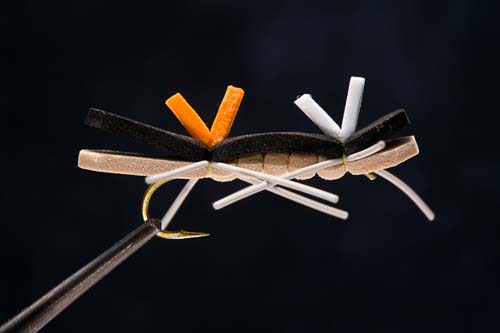
Mystery_Hatch-11
Size 6 Chernobyl Ant

You don’t see many anglers in western Oregon employing that pattern, but I can attest that it works here too when the shortwings are hatching.

Mystery_Hatch-12
Upper McKenzie native redside that fell for a shortwing stone imitation

So give it a shot. You just may find that fishing the hatch of the strange bug with the mysterious habits that no one knows about can pay off.

Posted in Oregon Fly Fishing Tips | 10 Comments

Trout Unlimited Meeting Tonight: 8/12/09

Tonight our local Trout Unlimited Chapter will be holding our monthly meeting at the Eagle’s Aerie off Irving Road in north Eugene at 7:00. Joining us will be Doug Larson, Fish Biologist for the Willamette National Forest Middle Fork Ranger District. Doug will be speaking on the District’s joint project with Trout Unlimited to restore Bull Trout to the Upper Middle Fork Willamette. So far, those efforts have been succesful. Bull Trout have now been documented spawing above Hills Creek reservoir for the first time since 1964.

Everyone is invited to attend–even if you aren’t an official Trout Unlimited member. Hope to see you there!

Posted in Oregon Fly Fishing Clubs and Events | 1 Comment

Light cahill wet — fly tying video

This fly tying video shows one of the great mid-summer patterns for fly fishing in the Willamette Valley. Check out Karl’s Light Cahill Wet fly — easy to tie, deadly on fish.

Karl's Wet Light Cahill

Light Cahill Wet:
Hook: Size 14-18 TMC 101
Thread: 8/0 Light Cahill Uni-Thread
Tail: Wood duck flank or dyed mallard
Body: Hareline Dubbin, Light Cahill or cream color
Hackle: Ginger hackle
Wing: Wood duck flank or substitute

Posted in Fly Tying | Leave a comment

Northwest Steelheaders forming Central Oregon Chapter — FREE BEER

If you’re in the Bend Area on Thursday August 13th, stop by the Deschutes Brewery and check out the launch of the Central Oregon Chapter of the Northwest Steelheaders. Festivities begin at 5:30pm. The door prize is one day fishing and lodging on Idaho’s Clearwater River. RSVP: Call Sharon Schaub at 503-653-4176 or E-mail sschaub@anws.org.

Northwest Steelheaders Logo

Posted in Oregon Fly Fishing Clubs and Events | Leave a comment

An Epic Battle and a Boy’s First Steelhead

I was unhooking the drift boat Friday evening, when the neighbor kid ran over in his bare feet and announced “Me and my Dad are going fishing all day tomorrow!”

“That’s great, Sam!” I said, imagining how long he would really last. Sam’s a great little angler at seven years old, but he rarely lasts a whole day.

“You should go with us, Rob. Wanna go with us?” He looked more hopeful than usual. He really wanted to go fishing, and I had the morning open.

“Sure, Sam. That sounds grea…” my voice trailed off as Sam ran back to his house screaming for his Dad. In just seconds my weekend had taken on a new shape. A minute later, Sam was back on my lawn firing off questions faster than I could answer them. “Do you think we’ll catch a steelhead? Should I bring my waders? Did I tell you about the steelhead I hooked once? It got away…”

That night I talked it over with Sam’s Dad. We agreed to take my boat and get an early start. I went to bed early.

The next morning was silent and heavy with cloud cover. In the predawn stillness, I poured hot water over a filter full of fresh ground coffee. The incredible smell was flipping on the lights behind my eyeballs with each deep breath, Then I heard the familiar slapping of tiny bare feet on the pavement. Sam broke through the front door and chased my cat out the back. “Hi, Rob!”

“Hi, Sam. Ready to go fishing, I see.”

“Yeah, Dad forgot something at the warehouse, so we’ll meet you at Valley River. Okay? See you there!” And zoom, he was gone.

We launched at D-Street and fished the main pool and tailout for trout, catching some beautiful wild cutthroat on small soft hackles. I showed off my new fly-trolling skills, learned from some of Eugene’s fishiest guides. I swung the boat from side to side, Sam casting occasionally. ZzzZzzZzzzzzzzz! And another nice one! Sam was on fire, and Dad was happy to watch and give pointers. We dropped through the Pez Dispenser, a complex of rapids with little islands dotted throughout, over-arched by a high span of Interstate 5. The intense white noise of the rapids drowned out the sound of traffic overhead. Between shutes, I made a random cast and a strong steelhead grabbed ahold. It’s tail arched out of the water and away it went.

“Sam, take this rod!” Line zinged off the reel a top speed. The fish was leaving the little tailout and heading into the main rapids. “We’re going down with him!” I yanked in the anchor too hard. “Boom!” And we were running the rapids. Sam had control and was doing great. I pulled hard right, seeing a place where we might be able to land the fish. But the fish had other plans, heading down and away, and around the wrong side of a large protruding boulder. Line peeled. The fish was still there! I tried wading up and out, lifting the rod tip, hoping to free the line. No dice. Then, back in the boat, we pulled her up the river until we were again above the boulder. We rowed out and around the rock, the line came free, and we were riding the final drop of the rapids, fish still far below us.

As we slid into the next pool, I pulled hard left into a back eddy. The fish was circling around with us. Sam kept reeling, and the beautiful summer hen came to the surface. Gorgeous! I jumped out and slowly eased the fish to hand. A perfect, spotless summer steelhead, between six and seven pounds. I looked up and saw big grins all around. Sam’s eyes were fixed on the steelhead. His dad leaned over his shoulder and beamed, “Your first steelhead at seven years old? I didn’t catch my first ’til I was fourteen!”

Sam finished the day with a couple more trout on his one-weight, including a nice rainbow pushing thirteen inches. “This is my best fishing day ever!” He exclaimed as we hit the landing. He ran across a patch of wild mint, sending the fresh scent into the air. I turned to admire the Willamette River, then gazed down river at the next corner. I wondered how many other steelhead were sprinkled through the tailouts and riffles below, and how many kids in Eugene might never know the river that runs through their home town-RR

Sammy_007

Posted in Summer Steelhead | 3 Comments

Mckenzie River Honey Hole: Still Holding Nice Native Redsides

It was with some trepidation I headed to one of my favorite bank fishing spots on the Mckenzie River to get in an hour or so of fishing before cocktail hour (beer thirty actually). I’ve fished the spot only three times this year and it hadn’t produced native rainbow trout for me on any of those occaisons. Last time through, I saw someone else fishing it. Fishing it with bait. In ten years I’ve never seen anyone else fishing there and I was horrified. At least he’s an old timer . . . .

“I wonder if he gut hooked my pet trout,” I thought to myself as I turned down a narrow dirt lane. My feeling of forboding heightened when I reached the end of the line. Someone had completely trashed the area with the assorted detrius and debris of a roughneck car camping trip. You know what I’m talking about. Crushed styrofoam coolers, scattered empty “king” cans of Busch, half-burned cans of pork and beans, broken bottles shattered in dioneysian drunken revelry. Ugh. Not a good sign.

A couple trout came up to my dries but missed as I fished up towards the native zone. Then a pretty good fish ate my nymph as it swung and as I leaned into it feeling the the strength of the trout, I thought, “This might be a real fish.” Then the trout came to the surface and I saw it’s wonderfully proud dorsal and his bronze hue and blazing deep pink sides.

Mckenzie River Redside

It was a real fish. I didn’t see any evidence of his bigger brother but now I have hope he too suvived the scourge of worm drownings.

Arriving at the barbece I was asked, “did you catch any fish?”

“One.”

“Just one?”

A smile crept across my face. We know that one trout’s worth.–KM

Posted in Fishing Reports, McKenzie River | 6 Comments

The North Umpqua Chronicles: Book excerpt by Pat McRae

If you’re in love with the North Umpqua, you need to read Pat McRae’s new book about fly fishing 12 months a year on Oregon’s finest wild steelhead river. You can pick up The North Umpqua Chronicles at the shop. Read our recent Q&A with Pat. Excerpt below:

In this modest book of personal experiences McRae has endeavored to share with you his relationship to the Umpqua. He has made a timeless statement that lives on from one generation to the next. When we read Clark Van Fleet’s Steelhead to a Fly, Roderick Haig-Brown’s A River Never Sleeps, Russell Chatham’s The Angler’s Coast among many others, we are introduced to a time and perspective that has influence over us and shapes our experience as well as our lives.
-Bill Bakke

August 22, flow 414 cfs, water temp. 60 degrees F.
Yesterday I stayed home and rested my tired legs and today I head upriver later than normal, arriving at Steamboat a little after 5 p.m. The Camp Water is packed with fishermen from top to bottom, including two of the three guides working the river this summer…

Howell has a client in the Station and Finnerty has two in the Mott water. I hardly slow down while making a U-turn at the Mott Bridge and head back down river to Split Rock. The evening sun is just sliding below the ridge top when I step into the pool and the river is at the lowest level of the summer. The flow seems perfect, but try as I might, (four fly changes) I can’t raise a fish. I’m not sure there was one there. The current is always wrinkled around the large rock that is the principal holding lie, but sometimes you can see a grayish hue in the vicinity of the rock when one is there. No hint of that today.

When I am nearly through, out of the corner of my eye I see a strange apparition downstream and for a brief childhood instant, a chill runs up my spine…some horrifying aquatic creature from a science-fiction movie is swimming out from the bank! Then I realize it is just George Crandall, lying on his little brown raft and breast-stroking across the river in Upper Burnham. This is yet another sign that the river that is not fishing well…people are beginning to take desperate measures.

I too am growing desperate. I head up river in the sunny afternoon and start at Interference. As I approach the large rock outcropping there is a flock of turkey vultures gathered around the remains of some unfortunate creature no more than twenty feet downstream of the lower end of the sweet spot. All their blood red heads turn my way and clearly they aren’t happy to see me. One by one they leave, until only one is left and he flies into a nearby tree. When I get to the head of the pool, he returns, either braver or hungrier than the rest.

The river has dropped in the last two days and now only the lower third fishes very well. The stench is awful, so I do not linger, but give the vultures another day or two and it’ll all be gone.

I cruise slowly on up river, thinking briefly about Swamp Creek, but pass it by and don’t stop again until I reach McDonald. Nothing’s there. Further upstream I make another stop to check the Okie and I am stunned…there is a huge fish…it’s so large that it nearly fills the lower lie!!

From the upper trail, I sneak down along the bank, being careful not to scritch my caulks on the rocks or make any other noise that the fish might be able to hear and then at the lower end of the ledge I lower my feet into the water ever so slowly, so there will be no ripples to alarm it.

On the second cast the fish grabs my Bendix Bug, I see a big flash and the monster is on! It bullies its way upstream, over to the rocks on the other side and sticks its nose down behind one. I have a good feeling…I am going to get this thing.

I glanced at my wristwatch…it is 5 p.m. and I begin trying everything I know to get a sulking fish to come out from under a rock…yanking, pounding on the rod, upstream pull and slacking off. Through it all I can still feel life at the end of the line.

Twelve minutes agonizing minutes later I feel the fish move and then suddenly it is running straight at me. I strip in furiously and exhale only when I come up tight on it…it is still on. When it feels the pressure, it barges its way further upstream and over to the other side again and sits down behind another jumble of rocks. I am back in the same situation…I have a fish on that I simply cannot budge. I try climbing higher up the bank, trying to see what it is doing…can’t see it. I scramble way upstream to get a different angle on it but that doesn’t work either. Then I try way downstream…reality begins to dawn on me…I am not going to get this thing!

Now when I pull on it, I’m not sure that I feel life anymore…is the trembling I feel the fish or is it simply the current? I don’t know.
At the 30 minute mark I have a decision to make: (1) should I foolishly stay the course, waiting till total darkness to see to see if it ever comes out, or (2) foolishly assume that it has already thrown the hook and is gone, leaving me hopelessly hung up, until I break it off myself?

I choose (2).

It takes a moment for me to break it off…the remnant of the blood knot is at the end of the 15 pound section. I’ll never know if the big fish was still on the other end…could have been, but on the other hand, how dumb would it have been to sit there till dark on a fool’s errand…that fish could have been gone shortly after it got its nose down behind that second rock.

Posted in Fly Fishing Books, North Umpqua River Fishing Reports | Leave a comment

Fly Tying Contest Winners Announced

Thanks to everyone who participated in our Summer Steelhead Fly Tying Contest. The top three patterns are listed below. First prize received the entire color spectrum of Krystal Flash, second prize is a Marc Petijean Magic Tool Set, and third prize a “Stonfo” Magnetic fly box, bobbin and hackle plier. All those that sent in a pattern will recieve an oregonflyfishingblog.com sticker and a Hareline Dubbin Gold Brooch Pin. Tyer’s should start working on their fall trout patterns, we will announce the next fly tying contest shortly. Special thanks to Hareline Dubbin for prizes and judging.–CD

First Prize Chad Potter for “The Brooksy”

Hook: Tiemco 202SP
Thread: Fluorescent Green Ultra-Thread for rear half/ Wine 6/0 Uni for front half
Tip: Fine Copper Oval Tinsel
Tail: Peacock Sword Fibers
Rear Body: Pearl Mylar over a base of fluorescent green thread (thread base coated with zap-a-gap prior to wrapping mylar for durability)
Front Body: Peacock Herl (4 or 5 strands spun on fine silver wire to make chenille)
Rib:Pearl Mylar counter wrapped with copper wire.
Underwing: Sparse flash of choice ( flashabou, krystal flash, lite brite, etc..)
Wing: Natural Gray Squirrel Tail
Collar: Claret Hackle

IMG_1839

Second Place to Rocky Maley for “Green with Envy”

Hook: Daiichi # 5
Tag Blue Oval tinsel
Tail: Burgundy hackle fibers
Body: back 3/5 green tinsel front 2/5 black seal dubbing
Rib: Small gold oval over green flat gold tinsel over seal
Collar: Black Hackle
Wing Chartreuse PB
Head: Black

IMG_1840

Third Prize to Cameron Derbyshire for his “Cummings Special”
Hook: Partridge CS10/1 # 2
Thread: Black 8/0 unwaxed
Tag: Small flat gold tinsel
Rib: Small oval gold tinsel
Body: Rear 1/3 yellow floss, front 2/3 claret rabbit dubbing
Hackle: Brown ringneck pheasant flank
Wing: Brown bear hair
Cheeks: Jungle cock nail feather, one per side.

IMG_1841

Posted in Fly Fishing Contests | Leave a comment

Rick Allen’s Alaska West, Kanektok fly fishing madness

One of our good friends, Rick Allen, just returned from a week at Alaska West’s fly-fishing camp on the legendary Kanektok River. Rick was looking for a trip-of-a-lifetime where he could enjoy great fishing and learn how to Spey fish. Alaska West had just let me know about a last-minute opening, and I knew that was the answer. Following is a trip report from Rick. Keep in mind as you’re reading his report and admiring the photos, that we are putting together a small group for next year. If you would like to join us, drop and email to rob@anglersbooksupply.com. Credits to Rick Allen, Brian Niska, Al Huger and Cameron Miller for the photos. Here’s Rick’s story:

When you work hard, it’s good to play hard. So when I heard those glorious words from my wife this past May, “You should go on a fishing trip,” I smiled ear to ear and said “Good idea.” She smiled back.

After weeks of weighing my options, I decided on Alaska. I was told about an outfit called Alaska West on the Kanektok River by friend and fellow steelheader Rob Russell. Three short weeks later, I set off solo for a dream fishing trip. After four flights and a 25-minute boat ride up the Kanektok, I was in the right place at the right time. With only one Spey casting lesson under my belt, I began the first of six full fishing days, spending twelve hours on the water, chasing ocean-fresh salmon and monster leopard rainbows.

Rick Allen's Alaska West Trip 2009

Rick Allen's Alaska West Trip 2009

When I arrived, I was fed and led to my quarters, which I shared with one other guest. The river was full of salmon. And I mean full. Kings and sockeye were everywhere. It was like standing in an aquarium, with fish bumping into my legs, along with the occasional chunk of tundra breaking free from the permafrost banks. There were so many sockeye you could almost walk on their backs.

Rick Allen's Alaska West Trip 2009

Rick Allen's Alaska West Trip 2009

The first day fishing I hooked and landed seven chum, two sockeye and one jack chinook. Great start considering I wasn’t much of a caster. I was pumped, ready to put my skills to the ultimate test: fighting a big king! That night I couldn’t sleep so I put my waders back on and took a 10 min hike up river with my 10-weight single hander. I found a slough that was teaming with fish. I felt like I’d hit the jackpot. More sockeye and chum, but still no kings. I wasn’t complaining. We don’t get this kind of action where I’m from. Chum are a kick in the pants! Strong fighters. I hooked ten and landed six that night. When my brain told me it was time for bed, I looked at my watch: 11:30PM. Still one more hour till sundown. What a place!

Rick Allen's Alaska West Trip 2009

Rick Allen's Alaska West Trip 2009

It took a while to get used to the midnight sun but it sure worked to my advantage. Day two was more of the same, with lots of fish to the bank and all day to work on my Skagit casting. Each day my casting improved with the tireless help of my guides. In addition to the Alaska West guides, our crew included Brian Niska, owner of Whistler Fly Shop, and a super nice guy. He had some mad casting and teaching skills. We where very fortunate to have him with us. He would literally spend hours helping those who were interested in improving their casting, day and night. Another expert Spey and Skagit caster, Jerry French, was my guide on day four. He was one of the key players involved in the development of the Intruder fly. He was very cool to be around and he kept us in the fish all day. He also really helped with my casting.

Rick Allen's Alaska West Trip 2009

Rick Allen's Alaska West Trip 2009

I keep bringing up the casting. Those of you who have tried Spey casting know that every time you think you’ve got it, your cast falls apart. It is very much like a golf swing, in that the more relaxed you are the better the end result. As soon as you try to muscle it, the ball goes off course. It is the same with Spey casting. Try to muscle it and you’ll end up with a pile of line in front of you. So I learned to take it slow and it made a huge difference.

Rick Allen's Alaska West Trip 2009

On the fifth day I fished with Alaska West’s head guide, Ed Ward. The Skagit casting guru himself! Fishing with Ed pretty much made my trip. He kept real quiet, taking me to great spots, giving me pointers. Then I asked him for some casting help. The once quiet guide took me through a crash course in Skagit casting that I will never forget. It was awesome, and I am looking forward to seeing his upcoming movie Skagit Master, due out this August.

I could go on and on about all the fish we caught, the incredible rainbows and monster kings, but I’ll let the photos do the talking (thanks, Cameron!). Suffice to say that I give Alaska West a big Siskel and an Ebert. I plan on going back next year for more world class fishing.

Rick Allen's Alaska West Trip 2009

Rick Allen's Alaska West Trip 2009

Rick Allen's Alaska West Trip 2009

Rick Allen's Alaska West Trip 2009

Rick Allen's Alaska West Trip 2009

For more info and advice on swinging flies for salmon and fishing with Alaska West, check out the Deneki Outdoors blog.

Posted in Fishing Porn, Fly Fishing Travel | 5 Comments

Fly fishing opportunities remain strong around Eugene area

The Middle Fork of the Willamette near Oakridge is fishing surprisingly well despite low water and high sun conditions. Today would have been fantastic with the clouds, tomorrow as well. Try hopper dropper set ups fishing the fast water and deep runs. In the evening look for Little Yellow Stones, Small Caddis and straggler large Golden Stones and Green Drakes. Try our new favorite nymph to drop off a dry the Tungsten Peacock Ice Prince. The Tungsten Ice Prince gets down in a hurry and is very durable. Sizes #12 and #14 seem to be the best so far but fishing these two in #16 and #18’s on the Deschutes will be murderous.

The McKenzie has also been fishing very well. Steelhead between Leaburg Dam and the town of Leaburg have been willing the past couple of weeks. Today’s the freshet of rain up the river today should improve fishing further. Trout fishing today was outstanding with more the half of the fish eating the large dry fly holding up the Possie Bugger. We had a steelhead turn on the dry and lost track of the number of fish (always a good sign for a day out).

 The Lower Willamette is fishing well for Steelhead as well. The town run and the Willamette on up to Dexter Dam are producing decent numbers of fish.

Here are a couple of highlight shots from the past week. Including blog contributor Rob Russels first steelhead on a single handed rod in two years. And one of the largest rainbows of the season on the McKenzie.–CD

IMG_1828

IMG_1003

Posted in Fishing Porn, Fishing Reports, Lower Willamette, McKenzie River, Middle Fork Willamette River fishing | 1 Comment

Ocean fishing trips now available!

For those who might be interested in ocean fly fishing and light tackle opportunities your time has arrived! We are now booking trips for rockfish and limited offshore species. The Oregon coast is a spectacular setting and something new to many. Please inquire about rates and custom trips are available. The fishing is hot right now, but this is a year round fishery as conditions allow.–CD

DSCN1249

double

oregoncoast

rockfish

Posted in Oregon Saltwater Fishing | 2 Comments

Local Steelhead Grab picking up

The McKenzie River between Leaburg Dam and the town of Leaburg’ as well as the Willamette between Dexter Dam and Valley River Center have seen much improved Steelhead fly fishing over the past week. Swinging tactics, using Moal Leeches, RT Stone Fly Black and Green Butt, and Starlight Leeches have been catching fish.  Concentrate on the tail-outs just above breaks and rock gardens. Try to fish early and late but don’t give up mid-day, a few clouds can really improve mid day steelhead fishing.

summerfish2

Nymphing tactics have also been successful on our local steelhead. When fish get “pinned” to the bottom or sighted but not really reacting to a swung fly. Dead drift a more drab “trouty” nymph by them and see what happens. Try Tungsten Black Beaded Possie Buggers or Tungsten Black Beaded Prince Nymphs in sizes 10 and 12. Other medium sized caddis or stone nymphs will work as well. Dead drift them under a Thingamabobber in likely slots, riffles and boulder gardens.

summerfish3


Other Steelhead related news: The Williams Creek Fire continues to reek havoc on the North Umpqua fly water section,  and all the folks around Steamboat Inn. Road closures are limiting options in this area. Expect to fish lower in the river for the time being. We’ve heard a few decent reports from the North Umpqua of late and August and September are the very best months to get these great fish to the surface on a skated dry fly.–CD

I am very pleased with my first order from the price to the check out to the shipment. Cheap propecia canada. You should be able to talk with a human being, including a licensed pharmacist, to answer questions about your prescription.
Posted in Summer Steelhead | 3 Comments