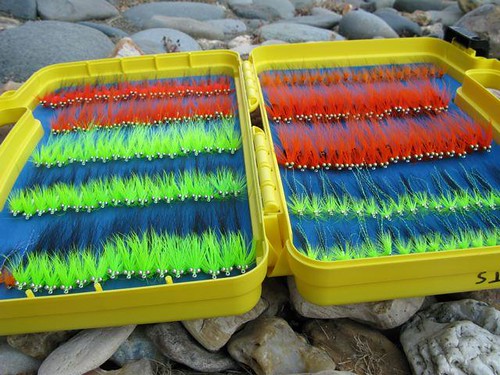
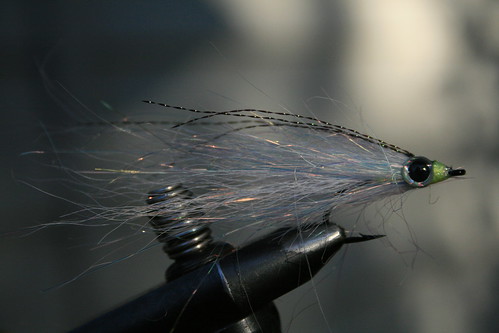
The fall chinook version of the Cliff Bugger Beast, courtesy of Jay Nicholas.


Send us picks of your Bugger Beast.


The fall chinook version of the Cliff Bugger Beast, courtesy of Jay Nicholas.
Send us picks of your Bugger Beast.
Cancel your plans and join badass steelhead guide Jeff Hickman for a river clean up this weekend on the Wilson.

1st annual Wilson River Clean-Up Event, by Sierra Club and SOLV
Saturday September 26th
9am –meet, sign in, coffee, snacks, break into teams
10am-1pm – River Clean-Up!
1pm Free Lunch Party!!!
Meet up at Tillamook Forest Center
45500 Wilson River Hwy, Tillamook, OR 97141 (Mp 21 Hwy 6)
RSVP to jeff.hickman@sierraclub.org (503) 238-0442 Or visit the Oregon Sierra Club site.
This is the third installment of The Fly Fishers Glossary: Snippets From the Underbelly of Fly Fishing, Fly Tying, Fish Biology, Dusty old Facts, Hallucinations, and the Plain Truth as I know it.
Baby seal
Obsolete fly tying material. Grim to admit it, but we salivated over this stuff back in the old days. It was highly sought after to tie nymphs. Tyers hoarded this stuff. Some idiots still sneak it in from Canada just to say they use it. Modern materials are superior replacements for this material. See also Temple dog Fur and don’t use this stuff either.

Backing
The financial support begged from friends/parents/girlfriends/wife so one can retire and buy a Fly Shop. As in, “I know that I can make a go of this Fly Shop if you’ll just give me your financial backing.” Provision of said backing is a generous but futile act –- an unadvised leap of faith. Every dolt remotely familiar with the Fly Fishing Industry knows that this is a doomed proposition.
Alternate
A string of white lies and evasions woven by your fishing buddy who was with you when you had a two-hundred-and-thirty-seven fish day on the Siuslaw River in 2002.
Fly fishers who have shared outlandishly successful fishing events 1) are sworn to secrecy; 2) have learned to rehearse their stories so as to provide semi-credible backing when separated, drunk, and interrogated by sober friends who attempt to pry the truth out of them; and 3) head straight to their cell-phones to call fifty-three of their closest friends.
These phone calls begin with, “ Dude, you’ve gotta promise not to tell this to ANYONE”.
Alternate
A form of small-diameter fishing line, usually braided Dacron or Super Braid, attached directly to a fly reel spool before the fly line. Actually seeing one’s backing because a large salmon/steelhead/Great White Shark has pulled out a all the fly line is the goal of every fly fisher. Ninety-nine percent of fly anglers NEVER see their backing in the water unless a Poagie attaches a small Alder tree to their line, sending it off downstream to simulate a monster steelhead. Backing is engineered to mold and disintegrate after 2.5 days cooking in any truck parked in front of a Wal-Mart. Damaged backing should therefore be replaced often, just in case a big fish accidentally provides an opportunity to shout,”Dude, like he’s got me into my backing”. Backing costs about twenty-bucks per yard.
Bang
Noun. Bang is a term that refers to fish-camp beverage – composed by adding Bourbon to Tang, or Tang to Bourbon. Regardless of the order of adding, it is essential for the bourbon volume to exceed the Tang volume. The best operational method to achieve this balance is simply to add the Tang powder to straight Bourbon. Bang is a simple, pleasing, and effective libation at breakfast, lunch, or supper.
Barbless
The state encountered by Barb’s husband when he returned from a spur of the moment fly fishing trip to the Skeena in 2007; as in: “Like Dude, I’m Barbless and I have no idea why!”
Alternately – a hook that had had the barb squeezed so hard in the jaws of needle nose pliers as to smash the barb flat and make the hook look like it is without a barb (i.e., barbless). Said barb smashing has been known to weaken the tempered steel at the juncture of the barb and the hook shaft, occasionally resulting in the hook shaft breaking when fighting a really big salmon or steelhead. These hook shafts never ever break when fighting logs, rocks, Pogies, trout or small salmon or steelhead. Only when fighting the big boys.
Bear grease
See fly poo.
Big Gun
A very long fly rod. Formerly, ten-foot rods were referred to as big guns. Since the arrival of Spey rods as a common fishing tool, a fly rod probably should be twenty-feet or longer to be referred to as a big gun.
Alternate
A big gun is a famous fly fishing personality with a huge ego, as in, “Dude, all the big guns were there at The Fly Show – it was effing-awesome.”
Big Tides
The greatest tide exchanges of each month are referred to as Big Tides. For example, a seven-foot high tide followed by a minus one-foot low tide yields an 8’ exchange; this would be considered a Big Tide. Big Tides coincide with the full and the dark of the moon and therefore occur about twice monthly.
Salmon tend to migrate into estuaries and from estuaries into rivers during Big Tides. Popular lore suggests that salmon tend to bite better during big tides.
The hormonal cycles (mood swings) of many women are similarly affected by the moon. Thus, Big Tides are associated with the best fishing and the WORST times to leave the girlfriend/family at home.
-JN
Last weekend my six-month old son Paul and I attended the North Umpqua Fall Fly Tying Festival and it was a blast. I put Paul in his playpen behind me and tried to tie flies and talk to folks about everything from this blog to Pacific Stripers, to childcare tips. I got to pass out a lot of stickers and flies — most people wanted the shark flies to put on their wall, not to fish. And got to say hello to great folks from the area like Frank Moore, Pat McRae and Dean Finnerty. My host Les and his wife helped me manage Paul — along with some of the ladies from Casting for Recovery and we managed to pull off the day without too much of a problem.
I didn’t have much time to take photos of the flies while I was there, but I took some photos of my filled-up Cliff Bugger Beast and some hot flies for the Oregon Coast. And for the Strait of Juan de Fuca — I’m headed north this weekend!




Do you think it’s easy to tie flies with this guy behind you?

Do you have a badass collection of big flies? Send us photos of your Bugger Beast!
-MS
Eugene summer steelhead report from Greg Hatten
We fished purple and we fished deep on Thursday evening out on the river “close to home”. Dr. Dan Phillips was in the boat and while we’ve covered a lot of water together, we’d never done this little stretch before.
Since we only had a few hours of daylight (evening floats are getting shorter and shorter these days), we went directly to one of my favorite spots.
Twenty minutes after launch we were positioned perfectly on the up-river side of a unique bedrock break that stretches all the way across the river. At low water it resembles a small irrigation dam. At higher levels, like now, it creates a series of chutes and ladders and provides great cover for returning Steelhead.
The purple leach was swinging in a perfectly lazy arch just in front of the Table Rock when a powerful Steelhead came blasting out from beside the rock to rip it apart. Violent.

Dan took the rod and I dropped the anchor as the Steelhead moved, a little slower than most, right for the boat. For such a wicked take we were a little surprised by the whitefish tactic.
It didn’t last long. When he got close to the boat, he turned down river and shot, like a bullet directly for the break. I assured Dan “he’ll turn at the rocks and you can recover some line.”
Not this fish.
He didn’t stop or even pause at the rocks and Dan was already into backing. This fish was through the chute and on the other side of the break before I could even get the anchor up.
We followed quickly and Dan recovered line as fast as he could reel. The fish finally turned and our boat was a hundred yards down river from where we started. Dan continued to apply steady pressure and we finally brought the fish to the net. Quite a fight, quite a fish!

Since we caught that fish on the first pass – we did what any sensible fishermen would do… jumped out, roped up and drug the boat back up through the break so we could fish it again… but first, we had a
beer and a toast!
-GH
This is the second installment of The Fly Fishers Glossary: Snippets From the Underbelly of Fly Fishing, Fly Tying, Fish Biology, Dusty old Facts, Hallucinations, and the Plain Truth as I know it.
Jay W. Nicholas
Amnesia
A state of mind that overcomes fly anglers who are contemplating the merits of going off on a fishing trip versus staying home, going to work, or the like, and fulfilling whatever virtual or contractual commitments they may have made. Said anglers are likely to suffer from amnesia in the form of “I promised to do what”?
Any recent or longstanding obligations to family, employers, neighbors, medical professionals, and the like are likely to be obscured by amnesia at these times. Amnesia is most likely to occur during salmon and steelhead season. Trout-season amnesia is not particularly common, and is far less severe. This medical condition is not treatable with FDA approved medications; however, Twelve-step Programs have occasionally offered temporary relief.
Alternate: Amnesia is an obsolete fishing line. This line was manufactured by Sunset Line Company and when stretched, was promoted as suitable for use as a shooting line when fishing shooting heads. Stretching the monofilament line by hand, laying in loose coils on the floor of a boat or in a shooting basket was a pre-casting ritual practiced by salmon and steelhead anglers. Amnesia was offered in black, red, and chartreuse colors. Salmon anglers, especially, had preferences for one color or the other, believing that color choice increased their catch rates.

Although not manufactured these days, it is common to find old-time salmon anglers who have hoarded somewhere around a thousand spools of the junk. Amnesia is both loved and hated. Typically fished in #30 and #40 pound test, with a double surgeons loop joining it to the shooting head, Amnesia typically has a breaking strength of somewhere between three ounces and four hundred pounds, depending on whether it is wrapped around a harbor seal (#400 Lbs) or if the angler has hooked a big King salmon (3 oz.).
Anti-Trust law Violation
Investigative reporting has revealed that an international conspiracy exists among fly shop owners, a conspiracy intended to bring the fly fishing industry back from the brink of economic disaster during the current global meltdown. This conspiracy involves introduction of the “Dental Floss Fly” as a replacement of the Tube fly, which replaced the Waddington Shank, which replaced the Tungsten Bead fly, which replaced the Skunk.

Market research predicts that the average fly fisher’s arsenal of fly boxes will reach full capacity of these current and historically popular fly-types during spring of 2010; full capacity as in “stuffed to the gills”. Therefore, the fly fishing industry is busily writing articles, garnering pro-angler testimonials, laying-out ads for magazines and fly fishing catalogs, and stocking up on these Dental Floss Flies in preparation of the strategic unveiling. The bodies of three investigative reporters were discovered last week, victims of drowning in the North Umpqua, wearing fly vests weighted-down with jigs.
Information gleaned to date hints that the Dental Floss Fly will incorporate space-age polymers derived from melted balls of Spey tips pilfered from jockey boxes of trucks parked along the North Umpqua. Dental Floss Flies will be retailed as a discrete unit including Spey leader and fly. Pure marketing genius. As planned, the Dental Floss Fly will retail for $27.95 but will only cost about a twenty-three cents to manufacture. Hypnotic subliminal advertising is already convincing fly fishers that the Dental Floss Fly has superior fish catching abilities. I believe it, and soon you will too. Really.
Aquaculture, salmon farming
This is a heinous practice of raining salmon or steelhead in net-pens in oceanic or estuarine environments, for the intended purpose of making boat-loads of money for the owners of these companies. Let’s get to the point. These are nothing short of nasty, are not ecologically sustainable, pose huge threats to wild salmon, and should be outlawed.
These indisputable assertions are usually ignored by the prospect of providing jobs in small communities, providing cheap protein in the marketplace, and an aversion to interfere with capitalism, and the untoward influence of highly paid lobbyists.
Experience has demonstrated that these salmon farming operations do in fact provide local employment opportunities in economically depressed rural communities, for a while, that is. Then the dang salmon farms become horrific hotbeds of sea lice infested, antibiotic-resistant, PCB-laced, dye-loaded, flaccid chunks of meat that isn’t fit for cat food. So there. I read it in Scientific American, I think.
Eventually, these ecologically sick operations see the chickens come home to roost. But by then the damage has been done to wild fish and the local community suffers the most in this game, while the big corporations move on to pull the wool over the eyes of some new gullible nation.
The only thing to do is pester your legislators to prohibit these monsters ever having an opportunity to be approved anywhere within three light-years of your home waters and to positively and always refuse to eat farmed salmon or steelhead.
Automatic fly reel
Obsolete fly fishing product. What were they thinking? Someone got all enthused with technology and decided to add a big spring to the side of a perfectly good single-action fly reel and market the doo-dad as an Automatic. Ridiculous. The things weighed four times more than a single action reel. Anyway, these were spring-loaded wind-up toys that many innocent fly anglers fell prey to back in the old days. These reels had a lever that, when depressed, caused the spring brake to release and wind the line in. When executed without a trout attached, the line would come shooting into the guides at mach-three, often pulling in all the line and stripping off all the guides from the rod before the hook embedded itself in the angler’s hand.
Another common but unfortunate performance issue involved in releasing the spring brake with a smallish trout attached to the fly. This usually caused said trout to be flung over the angler’s shoulder and into the trees behind, where it would wrap several times around a branch, the leader would break, and the crows would begin to dine on lunch.

I had an automatic fly reel back in the sixties. It was black and was really fancy because it had one lever to release the spring break and a separate lever to apply friction to the spool, theoretically slowing the rate of line retrieval. I don’t remember who the manufacturer was. I do remember having trouble remembering which lever did what, and alternately having the line shooting in or not shooting in, trout launchings aborted mid-arc. Flies hooked in my nose, and crows complaining by my failure to provide their lunch. I also remember that it was necessary to pre-wind the spring before stripping line from the reel. Too little pre-wind would result in being unable to retrieve a trout within twenty feet of the shore. Too much pre-wind would result in speeds exceeding mach 4 and trout achieving escape velocity, thus denying crows any food whatsoever.
These are now collector’s items, Duh.
-JN
Today the Register-Guard ran a guest editorial we wrote, calling for a reduction or removal of hatchery rainbow trout in the McKenzie River. Now it’s your turn to tell your personal story. Write a letter or email to the Register-Guard. Fisheries managers will hear from the counterargument — and they need to hear from you.
The Register-Guard welcomes letters on topics of general interest. Our length limit is 250 words; all letters are subject to condensation. Writers are limited to one letter per calendar month. Because of the volume of mail, not all letters can be printed. Letters must be signed with the writers full name. An address and daytime telephone number are needed for verification purposes; this information will not be published or released.
Mail letters to:
Mailbag
P.O. Box 10188
Eugene, OR 97440-2188
E-mail: rgletters@registerguard.com. If you email, copy ODFW fisheries biologist Jeff Ziller: jeffrey.s.ziller@state.or.us.
And thanks for the support.
-MS
North Umpqua Fall Fly Tying Fesitval
Glide Community Center-Glide, OR
Sept. 19th 2009 9am-4:30pm

There will be 25-30 tyers, misc. displays, Frank Moore and Dean Finnerty are featured guest speakers, John Matthews will be painting flies on vehicles. Presented by the Umpqua Valley Fly Fishers Of Roseburg.
This weekend, the Deschutes Chapter of Trout Unlimited with Orvis Store in Bend are pleased to announce the First Ever North American Fly Casting Tournament at the Bend Orvis store and Casting Course. You can follow along on Facebook as well.

This will be 3 days worth of events and programs including Amateur and Team Events on Friday, a Professional Men’s Tournament on Saturday, and a Professional Women’s Tournament on Sunday.
Overview
The 2009 Orvis National Casting Competition at the Old Mill in Bend, Oregon will be held on the first-of-its-kind 18-hole fly casting course completed last year and located adjacent to the Orvis Bend retail store. The course was designed to test and improve fly casting skills in a variety of settings much like those you’d find in actual fishing conditions. The 2009 National Casting Competition will use selected holes on the course but each competition hole will be modified from its current format challenge for this competition.
Dates
The 2009 National Casting Competition dates are September 18-20, 2009.
• September 18 Men’s and Women’s Amateur Casting Division
• September 19 Men’s Advanced Casting Division
• September 20 Women’s Advanced Ladies Casting Division
Entrance Fee – Maximum Number of Competitors
A $25 entrance fee is required for all entrants. Entrants are also required to fill out the required entry form. Entry forms can be sent via email to mylert@orvis.com or included with your check and sent to this address.
76 competitors are allowed per division and are entered on a first-come, first-served basis until all slots are filled.
Prizes
Amateur Fly Casting Event
1st Place Prize – 12’ Pearl Native Ultimate 12’ Kayak ($969 value)
Advanced Fly Casting Event
1st Place Prize – $3000 Cash Prize
2nd Place Prize – $1000 Cash Prize
3rd Place Prize – 12’ Gold Native Ultimate Kayak ($969 value)
4th Place Prize – $500 Cash Prize
5th Place Prize – $250 Cash Prize
6th Place Prize – $100 Cash Prize
Ladies Fly Casting Event
1st Place Prize – $4,200 trip for one to the Zancudo Lodge – an Orvis Endorsed Lodge in Costa Rica.
Prize includes 3 days and 3 nights stay at the lodge and includes 3 days of inshore or offshore fishing (your choice), all ground transfers, food and alcoholic beverages at the lodge, and hotel and flight from San Jose, CA to the lodge.
2nd Place Prize – $500 Cash Prize
Cooking and Casting for Conservation
Orvis donates 5% of pre-tax profits annually toward conservation efforts throughout the U.S. As part of the Orvis conservations mission, part of the proceeds from the 2009 National Casting Competition and other donations from Orvis will go to the local Bend Trout Unlimited Chapter to aid in local conservation projects. In addition, the evening of September 18 the Bend Trout Unlimited Chapter will be hosting a dinner and auction to help kick off the casting competition event and raise additional funds for local conservation work.
For more information on the casting course, visit www.orvis.com/bend for a full course description.
If you have more questions regarding the event please contact Gabe Parr at deschutestu@gmail.com.
Next week begins the first day of Fall 09. The fall is one of the best times of the year for Oregon fly anglers. The Deschutes is hot with steelhead, the Cascade lakes are producing as water and air temps cool. October Caddis are beginning to fly around streams. The Mckenzie native Redsides begin to increase in numbers as the water temps cool and the river level begins to rise slightly.
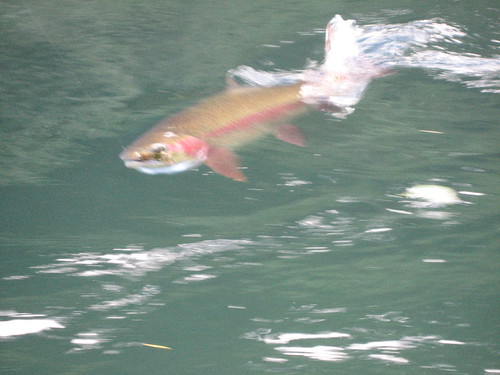
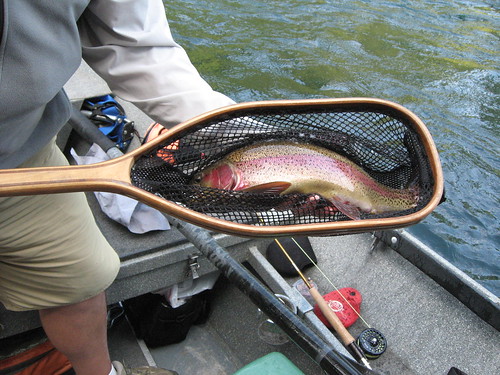
Meanwhile, on the coastal streams, Alsea, Siletz, and Siuslaw; the sea run cuts are entering the tidewater areas. Sea runs fall prey to the Borden Special and Spruce patterns. The sea run angler awaits the passage of summer days for those foggy and wet early days of fall. “Tis the Fall Season”. Get out there!
LV
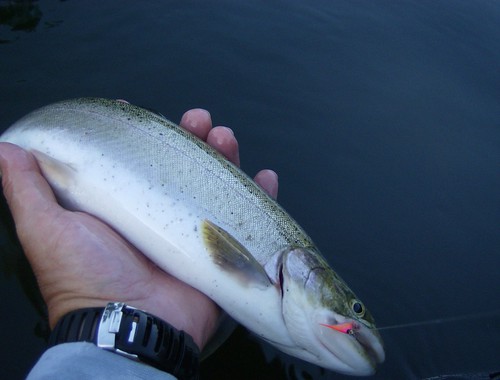
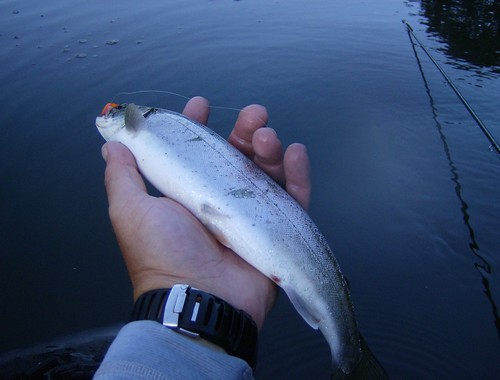
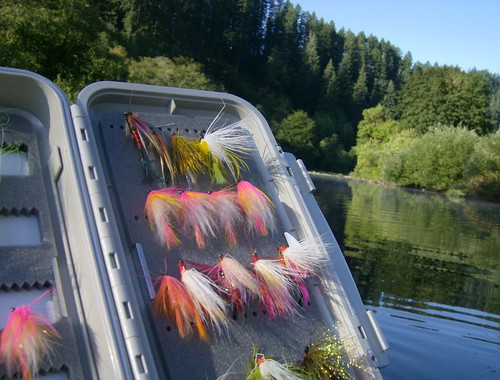
Two weeks remain to get your October Caddis pattern entered. Hareline Dubbin is sponsoring the contest and we have had some excellent bugs mailed in and dropped off.
The October Caddis emergence is occurring on our local waters. Currently there seem to be more bugs on the upper McKenzie than anywhere else. As the weather cools and September moves on, the October Caddis adults will be present in nearly all of Oregon’s rivers. Check out some of the entries so far.–CD
Harsey Octobolator Caddis
Hook: TMC 2302 size 8
Body: Hareline Dubbin Angora Fl. Fire Orange
Rib: Ultra wire gold small
Wing: Elk Hair
Hackle: Brown
Thread: Fly Master Plus Orange

October Caribou Caddis
Hook: TMC 2312 # 10
Thread: Orange 6/0
Body: STS Trilobal Golden Stone mixed with Caribou
Under wing: CDC Super Select Mahogany Brown
Wing: Brown Swiss Straw Clipped to shape
Head: Body Mix with a few less Caribou fibers

October Caddis Adult
Hook: Mustad 79580 #10
Thread: Uni Mono
Abdomen: Latex
Thorax: Gray Dubbing
Legs: Paint Brush Fibers
Eyes : Burnt Mono
Antennae: Hackle Stem
Wing: Mottled Turkey Feather

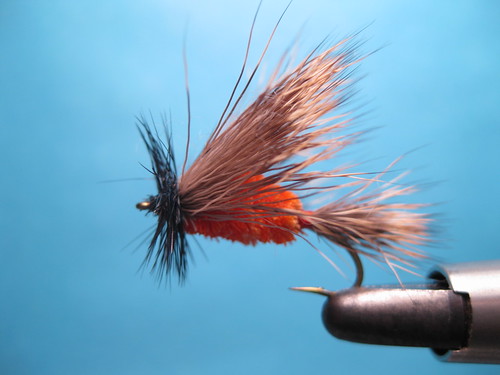
Irresistible October Caddis
Hook: TMC 200 # 8
Thread: Black 6/0
Tail: Natural Brown Deer
Body: Dyed Orange Deer Belly Hair Spun
Wing: Natural Brown Deer
Hackle: Black
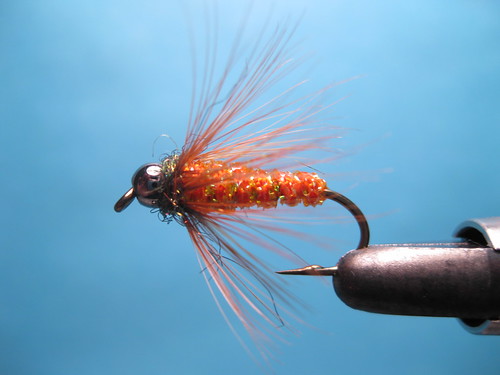
MT’s October Caddis
Hook: 2x long Nymph Hook #6,8
Bead: Black Nickel
Under body: .20 lead wrapped from hook point and the wrapped back to mid shank
Body: Orange Pearl Core Braid
Hackle: Brown Strung Saddle
Collar: Peacock Ice Dubbing
V.O. Caddis (Voltaic October Caddis)
Hook: Alec Jackson # 7
Thread: Ultra GSP
Under body: Flymaster A (for building up body shape), white
Under rib: Ultra Holographic Mylar, Copper
Rib: Medium Ultra Vinyl Rib Orange
Thorax: Ice Dubbing Peacock
Wing Pads: Medallion Sheeting Gray
Legs: (4) Golden Pheasant Tail fibers over CDC fibers, Black
Head: Spun CDC black

We’ve all been there before. The hope that a fresh face will bring needed changes and make our lives better. So it was in the Columbia-Snake basin. Hopes ran high as the Obama administration declared that it would place science before politics.
Not so. Instead, they decided to go forward with the Bush era plan for Snake River recovery, really a laughable exercise in cynicism rather than anything that has even a remote chance of recovering four endangered Snake River stocks. Perhaps most disapointing is the intentional repackaging of the most odious part of the Bush plan, the “trending toward recovery” standard while retaining the substantive content which could mean that if so much as one additional fish makes it to its natal waters the plan adequate.
We could have seen the administration move towards a solution that protects vested interests in the Snake basin, develops a clean energy economy, delivers and protects jobs and recovers endangered salmon and steelhead.
Instead we get this. It is a sad day for those of us who hoped for better-and more importantly, for the endangered fish of the Columbia basin.–KM
This is a breaking story-the Obama administration announced its intentions today. Read more here.
Steelhead are tough to catch on a swung fly. We who live for this soulful pursuit are fighting big odds. So why would we want to make it even harder on ourselves by skating dry flies? Because seeing a big, sea-run rainbow chase down a dry fly is freakin’ cool, that’s why!
So when I had a chance to guide my friend Les Martin on his third consecutive day of fishing the lower Deschutes with Larimer Outfitters, I asked him if he had any interest in trying a dry.
“Well….” he said, sounding reluctant, “I’ve heard about that. It sounds neat, but I like to hook up!” Then he added, with some trepidation,”Whatever you think, Jeff. You’re my guide.” I told him there was only one way to get ‘em on a dry and that is to try.
“Lets try it then!” he said, finally sounding enthusiastic. I tied on a Claret Shade Chaser, one of my favorite skaters, and we walked down to a sweet little break where I’ve gotten fish up on dries many times before. The spot is a shallow wade, only ankle deep on a large flat basalt ledge, and a very short cast. I instructed him carefully how to present the fly. Often times the fish are so close, and they take the fly so quickly, it startles people and they pull the fly completely out of the water.
“Don’t set the hook until you feel the weight of the fish,” I instructed.
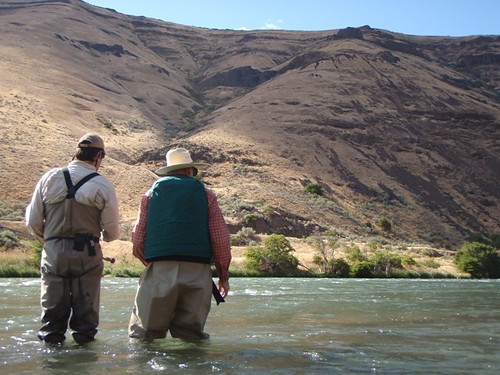
We moved to just the right spot and Les pulled few feet of line from his reel. He flipped the fly into the choppy seam. I told him it was very important to guide the fly all the way over onto the shallow bedrock ledge before re-casting, as the fish sometimes will eat the fly just as it comes up over the ledge. Almost instantly there was a chrome explosion right in front of us! Both of our hearts stopped, waiting for the pull, but the fly was unscathed by the burst, still skating across the surface. Then, just as the fly came up onto the ledge, the fish shot out of the water and engulfed the fly with half of its chrome body high-and-dry on the rock! With the fly in its mouth, it turned and wriggled back into the water, taking off with the fly. I couldn’t contain my excitement and let out uncontrollable screams. “Oh my…SET THE HOOK!!!” To say that Les was caught off guard would be a gross understatement. He arched the rod back so that the tip went straight up into the air. But tension was lost as the fish did a 180 and came screaming straight back towards us. In a flash, it thrashed one more time on the surface and threw the hook.
I tried to regain my breath but just broke into laughter as what we had just witnessed set in. A kamikaze steelhead! I patted Les on the back and brushed off the fact that the fish was gone.
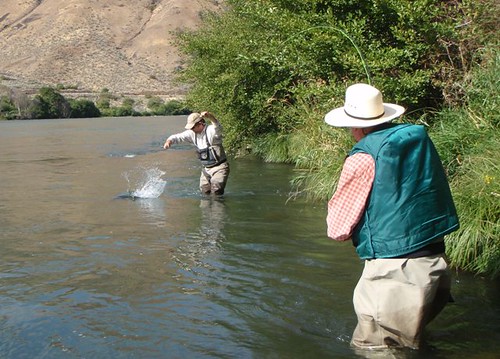
“Throw it back out there!” I urged. Les flipped the fly out and worked it through the narrow seam again. We both calmed down as the fly made several swings without reaction. Then four steps down from our starting point, “BOOM!” Another explosion on the fly, but no connection. Then again, “BOOM!” in the same spot. Then another cast, followed by another explosion. Again and again. I was laughing hysterically! The fish came to the surface five times, but kept missing the fly. Maybe it was just trying to throw the fly from the water with its tail, or maybe it was just near-sighted. But after five attempts, the fish quit coming up.
We switched flies, tying on a smaller purple Silvey Steelhead Caddis. The first cast in the same spot brought another violent slash from the steelhead. And this time the fish got the fly and Les hooked up! We both screamed for joy as the line came tight. The rod bent hard and the fish took off into the rapids.
Later, back at the boat, Les and I recalled the action over coffee. He admitted that his expectations had been low.”But seeing is believing!” he said with a big smile.
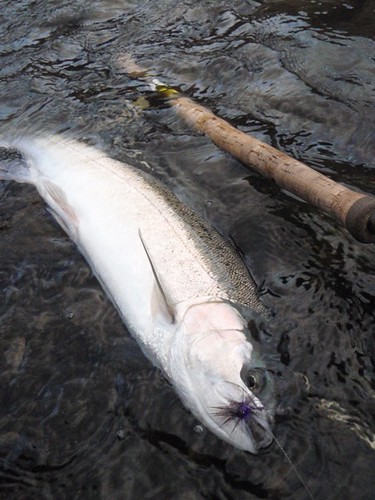
We caught plenty of fish that day, switching to wet flies as the sun beat down on the canyon. All the fish were great, but none could top our dry-fly kamikaze steelhead.
-Jeff Hickman
This Monday through Thursday only, bring in our plastic fly cups and get 10% off any fly purchase of any size. Online orders for ship or in store pick up will receive the 10% off automatically.

We also have great deals online on remaining summer clothing, bags, rods, reels and many other items, including a $15 table that has Mountain Khaki Cords (normally $75) on it.

Come by and check things out.–CD
Don’t get me wrong, I’m eager for October Caddis hatches, coastal salmon in our rivers, and football on TV. But it’s great to get a last blast of summer.
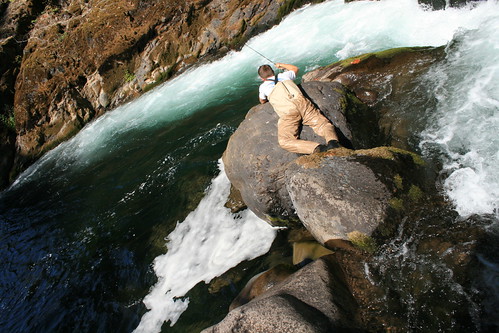
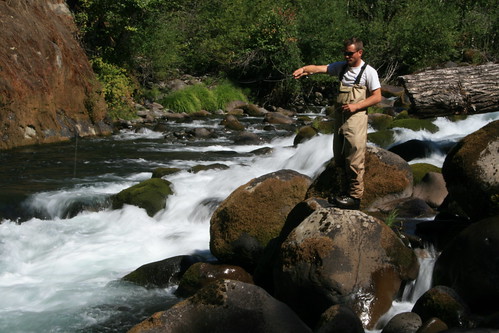
Nate and I hiked a few miles of an Upper Willamette Tributary yesterday, fishing plunge pools and riffles for wild redsides. The fish were small but plentiful, with a few in the 12-inch range.
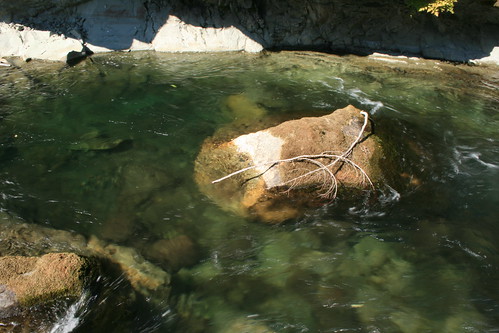
I caught the majority of my fish on a size 10 yellow stimulator, in an attempt to match the current “termite hatch” going off in the area now. Termites are trout candy, according to a Westfly article by Hafele and Hughes:
Once a year each colony produces thousands of winged reproductive adults that mate and search for new nesting sites. This is the most important time to fly fishers, since these swarms of flying ants and termites often end up in the surface of lakes or streams.
Trout seem to have a high preference for these hapless creatures, and the fishing can be fast during an ant or termite “fall.” The exact time swarms take to the air depends on local species and conditions. Several falls of ants or termites may occur in an area during a season, and you should be on the lookout for them anytime from May through September.
I didn’t see any termites on the wing yesterday, but have seen a lot around town.
The fishing on these small streams will get much better over the next several weeks, but the school-hating kid in me is still sad to see summer go. Not many weekends left when you’ll be able to vent finicky trout frustrations by cannon-balling the pool.
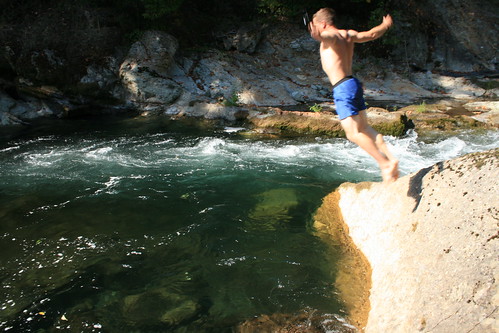
-MS