Pacific City Dory Fly Fishing, August 19 2012

The Black Rocks are on top, my friend Tom told me. They were boiling and feeding all around us, he said. We got our limits and released fish constantly, sometimes we had triples on at the same time, he said, with a straight face. You are going to have a fantastic day tomorrow, he said.

Well, it was a clear example of how to make sure that things won’t quite go the way you think they or should, or might, or could.

I met my friends, Jack and John Harrell, at their home in Pacific City at 7 AM, a nice civilized hour of the day. I had been up and telecommuting since 4 AM. Four Blacktail (3 does and a young spike) wandered through the yard around 6, and when I sat down on the front porch to slip my waders on, the sun was up.

John had the Dory hooked up already, and Jack was running the outboard in a tank of water to get it warmed up for the morning. I slid my two fly rods into the port side channel along the gunnel of the Dory, with a couple of John’s rods on the starboard side. We piled into John’s brown Ford Pickup, strapped in, and headed down to the beach at Cape Kiwanda.

The ocean was good that morning, with modest swells of maybe 3-4 ft to greet our launch in the surf. Jack got us pointed in the right direction, then pushed us off and slogged back through the water; he had work to do ashore that Sunday, so he sent John and me off to our anticipated Rockfish rendezvous.

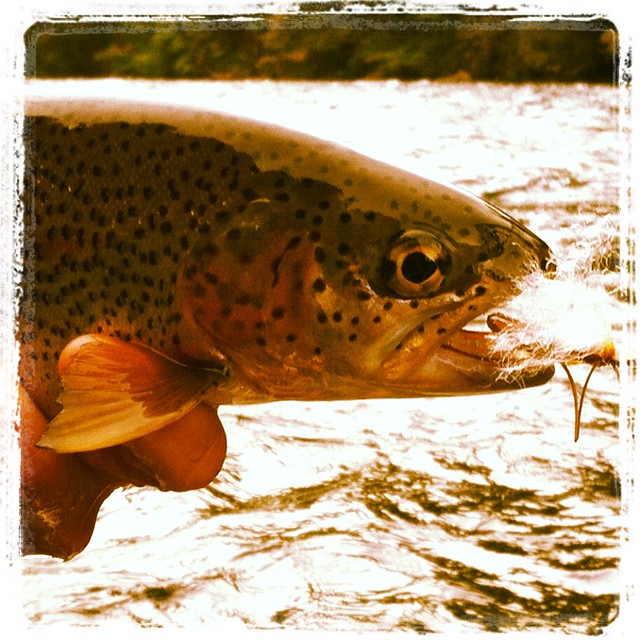
Let’s just get it out. The “easy” Black Rockfish were anything but easy that day. Plenty of fish on the graph, some as shallow as 12’ and some as deep as 40’ where we fished. Only the rare fish splatting the surface, and very few fish willing to take our flies. Under calm grey skies, we coaxed only a few grabs this day, where yesterday the fish must have been rushing to take the fly on most every cast.

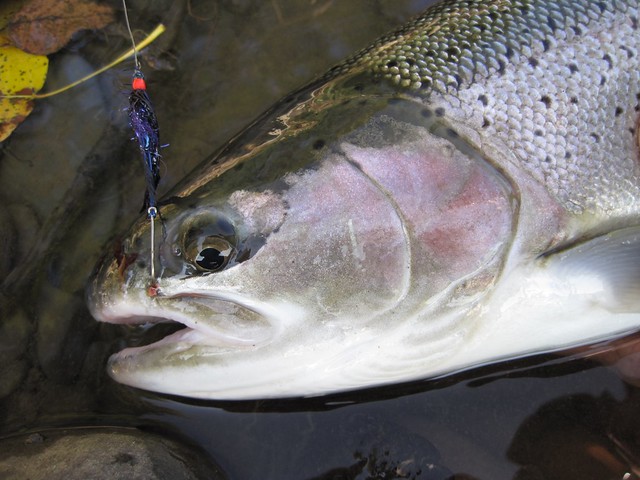
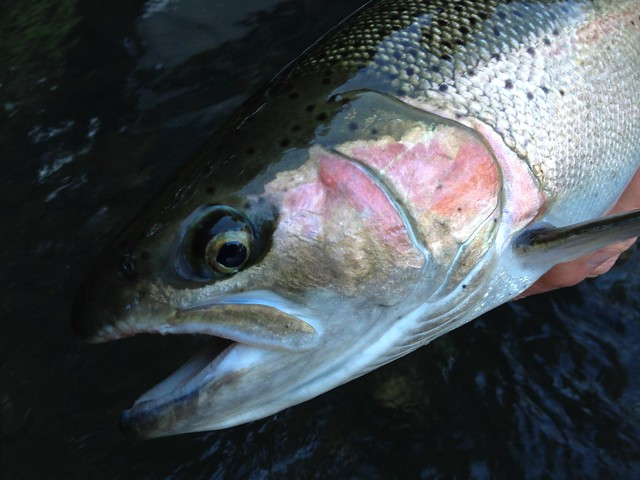
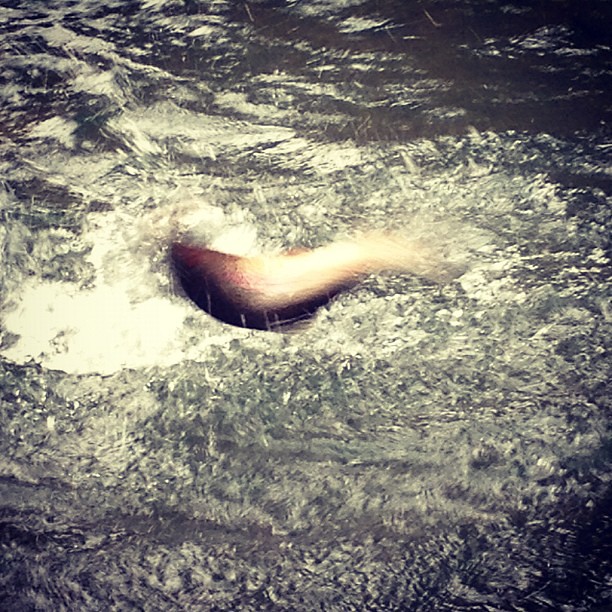
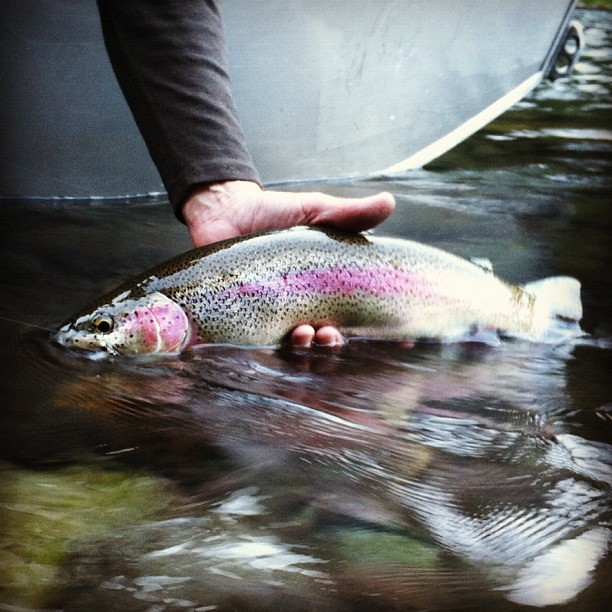
Not to worry, even if the fishing is sloooooow, because every day on the ocean is a marvel, and simply launching a small boat in the surf is excitement in its own right. We fished and fished, finding an occasional Black to take our Clousers, and we changed flies and experimented to see if we could find the key to consistent fishing. The fish above is what John calls a “Sea Trout” and one never quite knows what might pull on the fly next cast.

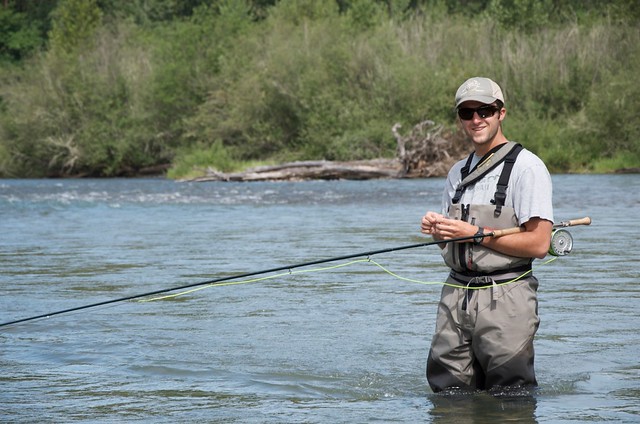
I was fishing an Echo 3 Freshwater rod, 7 wt. – 10’. My winter steelhead single hander, with an Airflo 40+ Type 3 sink tip loaded on an ION fly reel. The outfit cast well, and the slow sinking line was altogether sufficient to get my fly down to the fish-holding depth, based on the graph, even though only now and then did a fish prove that the graph wasn’t a big joke on us.

On one of these casts, I hooked a fish. As my friends know, I am often messing around with a camera in these situations, doing my best to find ways to ruin yet another (camera) with immersion in salt or freshwater. This fish was pulling hard and I tried for the rod-at-arm’s-length shot that shows the excitement of the pull through the arm. At some point, my line seemed to slack a little, and the pull felt much lessened.

I put my camera aside and resumed my retrieve, finding the strain now much heavier than before. I’m in the kelp, I thought. No. There is a fish wiggle. My river-perfect rod was bent more than it ever has, and my thoughts shifted to Bull Kelp again, but the fish wiggle was still there, so I kept pulling as hard as I thought reasonable. OK, maybe a little more than I thought reasonable. Sorry Tim, I just pulled and pulled for the sake of pulling.

Eventually, there was a fish shape apparent in the depths. The shape was, I thought, much too big: a long brown shape with maybe a half-Rockfish still hanging out of its mouth. This discovery was followed by a fair amount of confusion, excitement, instructions being issued, falling down (on my part), reaching (on John’s part), and a quick swipe with a far too small gaff-hook.

Goes to show, you never quite know what the ocean will bring you when you drop a fly under the surface.

Thanks John, for another great day in your Dory out on the Pacific.

JN

August 2012

Posted in Fishing Reports, Oregon Fly Fishing Tips, Oregon Saltwater Fishing | 6 Comments

Steelhead October Caddis Wet Fly Tying Video

Fall Caddis are soon to be a key insect for anglers fly fishing for trout. Summer Steelhead, some that may have been in the river since May also dine on October Caddis. In this video Mike Brooks demonstrates how to tie a killer traditional Steelhead fly that works well September-November.

IMG_4633

Steelhead October Caddis Wet Fly

Hook: Gamakatsu T10-6H #4-8
Thread: Danville 6/0 Red
Tail: Red Golden Pheasant Crest
Body: Orange Angora or STS or Ice Dub
Rib: Holo Gold Tinsel
Hackle: Wood Duck Feather
Wing: Gadwall or Bronze Mallard

Posted in Fly Tying, Fly Tying Materials and Supplies, Summer Steelhead | Leave a comment

New Intruder Tying Materials from Fish Skull and Greg Senyo!

Fish Skull and Greg Senyo have taken tying intruders to the next level with a line of shanks, articulated hook wire, and some other new products that just arrived in the shop. Senyo’s Articulated Shanks come in five colors and two sizes, making customizing your favorite steelhead and salmon flies a breeze. We like these shanks because of their rigidity (ala old-school Waddington shanks) and their up-turned loop eye.

WHFLIES

25SA

Senyo’s Intruder Trailer Hook Wire serves as the perfect compliment to the new Articulated Shanks. Available in eight colors and two sizes, this new product replaces all the do-it-yourself solutions we’ve been using in the past (bye bye Firewire). Trailer Hook Wire is ideally suited for flies using a size 6 hook or larger, while the Thin Intruder Trailer Hook Wire is perfect for those smaller articulated flies employing a hook smaller than a size 6.

SIWTHIN

WH3

Add in some of Senyo’s Wacko Hackle and some Grizzly Flutter Legs and you’ll be tying the fishiest intruders around. Wacko Hackle is a new fiber material and fills a unique niche, somewhere between ostrich herl and krystal flash. We like how the stuff swims in the water and the flashiness of the material makes it an ideal way to add a touch of pop to your favorite pattern. Grizzly flutter legs are new from Hareline Dubbin and are the buggiest rubber legs we’ve seen yet. Smaller in size than previous legs from Hareline, Grizzly Flutter Legs have superb movement underwater and the grizzly-barred finish will be sure to make fish go nuts.

Products are all available on the Caddis Fly Shop website and we will be posting some tying videos for intruders and other shank-style flies from Barrett and Tony soon!

Posted in Fly Tying, Fly Tying Materials and Supplies | Leave a comment

Sea Run Cutthoat Fly Fishing Report

Selitz Elk 006

With the weather man giving “heavy fog and chance of drizzle” predictions and a good afternoon high tide, I swiftly made plans for a well known coastal stream with a couple of members of the Men’s Technical Conference. Gleefully, I packed a light weight rain jacket and fleece pants. Another member of our group wore shorts and brought sun screen!
From the pictures, you can see shorts and sunscreen was the correct attire. It was a long sunny day, but we brought some fine sea runs to hand. Borden Special type fly’s proved to be the answer for most of the day. Anglers should look to fish incoming tides or head up river above tide water for success. Oh, and hope for some “heavy fog and chance of drizzle”?
Another rare treat was catching an “elk hatch” going across the river. We did not have the appropriate elk fly’s and just enjoyed the hatch

Selitz Elk 010

Selitz Elk 011

LV

Posted in Fishing Reports | 1 Comment

ACTION ALERT: McKenzie River Angling Regulations Hearing Update

McKenzie River Redsides need your help! Public testimony is being accepted by ODFW until August 23rd on two regulation proposals that will have significant effects on the health and viability of McKenzie Trout. See below and please consider sending an email to express your support for McKenzie River Redsides. Emails can be directed to Rhine T. Messmer, ODFW Recreational Fisheries Program Manager, at Rhine.T.Messmer@state.or.us. If you’d prefer to send a form-letter to ODFW, send us an email at caddiseug@yahoo.com and we’ll get you a letter developed by the McKenzie Fly Fishers.

Mckenzie rainbow trout

As we reported earlier, on August 3rd ODFW held a public hearing on a number of proposed changes that will affect angling on the McKenzie River. Turnout from wild fish supporters at the meeting was superb and a number of local anglers spoke out on behalf of McKenzie River Redside Trout. Strong testimony on both sides of the issues caused the Fish and Wildlife Commission to delay ruling on either proposal until their September 7th meeting in Hermiston.

F&W Commission Meeting

Proposal 6P would change the definition of soft plastic lures from “bait,” as they are currently classified, to “lures.” Soft plastic lures have been shown to cause severe constipation when ingested by trout, resulting in anorexia-like symptoms. In short, the change in classification would allow soft plastic lures to be used on more sections of the McKenzie, thereby increasing the harmful effects created when trout ingest soft plastic lures.

Additionally, the Fish and Wildlife Commission took public comments on regulation proposal 31S, which would prohibit the use of bait in the section of the McKenzie River between Hendricks Bridge and Hayden Bridge. This section of the McKenzie is intended to be a wild trout production area, and is not stocked with hatchery fish with the intent of providing an increased number of larger, high-quality wild trout for the river. Bait fishing on this section of the river serves little to no purpose, as wild trout cannot be harvested. Further, bait fishing has been shown to cause hooking mortalities of up to 64%… that means more than one out of every two fish caught with bait dies after being released by the angler!

The September 7th F&W Commission Meeting will determine the fate of McKenzie River Redsides for generations. We’ll post info on time and location of the meeting closer to the date. While Hermiston might be far for you to travel individually, we urge supporters of wild, native fish to send an email expressing your views to ODFW before the August 23rd public comment deadline.

Posted in McKenzie River, Oregon Conservation News | 3 Comments

Deschutes Steelhead Fly Fishing Report

With temperatures nearing 100 degrees, steelhead fishing has been slow to moderate across the state. Out of town friends made for inflexible Deschutes plans, so we stuck with our Monday through Friday float from Macks Canyon to Heritage. Five days for such a float left us with plenty of time around camp, ducking the hot weather and avoiding the myriad bugs and rattlers that were our constant companions on the D.

Camp at Lockit

Fishing was luke warm, with reports from guides and ODFW personnel giving less than stellar numbers. We saw plenty of fish during the float, but most of them looked pretty lazy, and the fish we did hook put up mediocre fights before coming to hand. Temperatures are fore-casted to drop next week, so this is a great time to book a few days as fishing will continue to improve as the water gets cooler. Lower Water Green Butt Skunks and Signal Lights got the job done.

Watermaster through Colorado

We also took along a Watermaster Grizzly, and it far exceeded expectations and held its own through all of the class IIIs on the lower D. It also pulled double duty as a river ferry when the fishing was best on the opposite bank from camp. With one on the oars and angler on the back, we were able to make it across without issue. A great addition to our float and it was clear the Watermaster could hold its own or work well for a solo trip.

Driftboat on the Deschutes

Posted in Fishing Reports | Leave a comment

Dean River Trip Slated for July 2013

Big runs on the Dean

Join the Caddis Fly at B.C. West July 6th-13th 2013. We will be swinging flies to fresh from the tide Steelhead and Chinook in one of the most spectacular settings that North America has to offer.

fly fishing for Steelhead on the DEan River

The Dean River has a reputation throughout the fly fishing community as being a “bucket list” destination for any avid Steelhead angler. Imagine swinging flies in runs that are within view of the Dean Channel, over fish that surfed in on that tide. Steelhead and Chinook that were pushing saltwater through their gills, while you were eating breakfast.

Clay on the dean

Chinook Salmon Fly Fishing on the Dean River Canada

B.C. West has an exceptional fishing program and is geared toward optimizing time on the water. Breakfast/Coffee at 5:15 a.m. fishing from 6-noon. Lunch (main meal of day) is served around 12:30. After lunch guests usually take a short siesta before the evening session of fishing from 4-8. Then it’s back to the clubhouse for dinner at 8:30. The food is off the charts. This schedule ensures that you will be swinging your fly during the most productive hours of the day.

Chinook on the Dean

Dean post 8

The river is divided into an upper and lower, with a treacherous canyon section separating the two. With B.C. West being the only lodge that offers fishing on both sections, I am absolutely convinced that they offer the most diverse and rewarding Dean River fly fishing experience. On the lower river you are fishing via a jet boat piloted by exceptional guides. With the canyon only being a 1 1/2 mile from the salt, all of the fish caught on the lower river are as fresh as can be. Most are sea lice ridden. The upper river is self-guided, using ATV’s to access the prime runs.

tye on the dean

My family and I were fortunate enough to experience the Dean this past July 7-14th, and the experience we had is beyond words. This is the first week that fishing takes place on the upper, and lower river. It is also one of the few weeks where fresh Steelhead and Chinook are available on the lower river. Stepping through a run with the opportunity to hook either a shiny Steelhead or Chinook doesn’t exist too many places.

What’s included?
Helicopter/Float Plane transportation to and from Bella Coola, B.C.
6 1/2 days fishing
7 nights at B.C. West, with amazing food, wine and beer.
Flies and tackle if needed.
Cost is $6250+HST

Space is limited reserve your spot now.

Questions? Call the shop (541) 342-7005

TH

Posted in Fly Fishing Travel | Leave a comment

Is Fall Fishing Here Yet?

McKenzie Wild Trout

It’s been hot lately and fishing has slowed a bit locally. Steelheading on the McKenzie and Willamette has been a first light endeavour and even then it’s been a bit tough. Trout fishing has been best in the evening with small Elk Hair Caddis and Pale Morning Duns. On the Upper River Half Down Goldens and Possie buggers continue to produce but larger fish have been been tougher to come by.

Dick Fraser and Jeff Carr on the North Umpqua

The North Umpqua has been it’s usual tough self with anglers putting in their time being rewarded. It’s a great time to skate a dry fly down on the North. Ska-Hoppers, Muddlers, Curb Feelers and the like have been good choices.

Hopefully this weeks cooler temps will improve local Steelhead and Trouting. Fall shadows, cooling temperatures and better fishing are soon to come.

boat landing troubles

Posted in McKenzie River, Summer Steelhead | 3 Comments

Shedlock Spider Fly Tying Video

We continue to work on our favorite late Summer and Fall Steelhead patterns. Mike Brooks shows off a fly he has caught fish with on the swing or dead drift. The fly has a combo “egg/October Caddis” representation that fish love.

IMG_4630

Shedlock Spider

Hook: Gamakatsu T10-6H # 6-8
Thread: Danville 6/0 Red
Body: Orange/Pink/Red/Purple STS Trilobal Blended
Hackle: Two to Three Turns of Teal Flank
Butt: Silver Tinsel
Underbody: Silver Tinsel

Posted in Fly Tying, Fly Tying Materials and Supplies, Summer Steelhead | Leave a comment

Big Water Little Boats Presentation: Learn about the first McKenzie Dory Through the Grand Canyon September 5th

Big water little boats photo

Please join us as we host Tom Martin for a presentation based on his new book, Big Water, Little Boats; Moulty Fulmer and the First Grand Canyon Dory on the last of the Wild Colorado River.

This 45-minute program features original photographs from various 1940’s through 1960’s Grand Canyon River trips, including Boulder Narrows at 126,000 cubic feet per second in 1957. The presentation tells how Fulmer happened upon the McKenzie River hull design of today’s Pacific Northwest boats, and how he used that design to build his boat the Gem, Grand Canyon’s first decked dory. Martin will also touch on the building of a full-sized replica of the Gem and taking the replica through the Grand Canyon. He will show photo re-matching of original pictures from the 1940’s and 1950’s river trips. The program will be followed by a book signing.

Tom will have the full-sized replica of Moulty Fulmer’s 1955 GEM, the first Grand Canyon dory, with him at the shop. We will be serving “Apps” and Ninkasi at “6pm ish” and the presentation will start at 7pm on the 5th of September.

I will remind you again as we get closer.

More info about the presentation.

Moulty Fulmar was bitten by the river running bug during a San Juan River trip in 1942. After a chance meeting with a McKenzie River dory builder, Fulmar constructed his first dory and rowed the San Juan in 1947. Traveling through Grand Canyon in 1948 on a Norm Nevills expedition, Fulmar met Colorado River historian Dock Martin and they went on to run rivers together and correspond for the next thirty years. Fulmar built his second dory, the Gem, specifically for big water. Joining forces with Pat Reilly in 1954, they ran the Grand Canyon five times in home-built boats. Their adventures included rowing the wild Colorado River in 1957 on 125,000 cubic feet per second, one of the highest flows in the last century. Using historic photos, river logs, letters and interviews, author Tom Martin recounts the voyages of a number of unsung river runners during the transformation from Grand Canyon expeditionary river running into today’s whitewater recreation. Big Water Little Boats chronicles the start of the park’s river running permit system in 1955, the construction of Glen Canyon Dam, and the explosion of river running that occurred after the completion the dam in 1963.

About the Author:

Author of the award winning Guide to the Colorado River in Grand Canyon and Day Hikes from the River, Tom Martin has hiked the backcountry and run the Colorado River in Grand Canyon for much of his life. He recently built a replica of the first Grand Canyon dory, the GEM, based on the wreck of the original boat and the journals, photos and notes of Moulty Fulmar, Dock Marston, Pat Reilly and their friends. He has now run the GEM through the Grand Canyon four times and has only flipped it a couple of times.

GEM below Panchos medium size

Posted in Oregon Fly Fishing Clubs and Events, Shop Sales and Specials | 1 Comment

Silver Hilton Spider Fly Tying Video

Mike Brooks demonstrates how to tie a simple Silver Hilton Spider Summer Steelhead pattern. We like this pattern on the Willamette and Deschutes from July on through the Fall.

IMG_4631

Silver Hilton Spider

Hook: Gamakatsu T10-6H # 6
Thread: Danville 6/0 Black
Rib: Holographic Silver tinsel
body: Black STS Dubbing
Hackle: Teal, Widgeon or Gadwall
Wing: Pair of Hen Grizzly Wing Tips

Posted in Fly Tying, Fly Tying Materials and Supplies, Summer Steelhead | Leave a comment

Desert Trout Fishing Report: Summer on the Big D

deschutes canyon shot

I was lucky to spend even more time than usual this summer guiding the Lower Deschutes for trout. Anyone who pays attention to such things knows that the Deschutes is one of Oregon’s best rivers, with a robust population of resident trout, and generally a strong return of summer steelhead. The spring salmonfly hatch and the late summer and fall steelhead seem to get all the press. However, there are a lot of great trout fishing opportunities over there throughout the summer months that are worth some attention.

deschutes rainbow Continue reading

Posted in Central Oregon Fishing Report | Leave a comment

Sandy River Hatchery Program Lawsuit Update

stlhd tag_2 small-thumb-608x414-33425

The lawsuit challenging hatchery practices on the Sandy River, east of Portland, continues in court, with our own local McKenzie Flyfishers joining other conservation groups in the action. Native Fish Society, McKenzie Flyfishers, the Federation of Fly Fishers, and the Wild Steelhead Coalition were asked by the National Marine Fisheries Service to submit comments on the draft Environmental Assessment (EA) relating to the Oregon Department of Fish and Wildlife’s Hatchery and Genetic Management Plans (HGMPs) for the management of wild anadromous fish on the Sandy River. The McKenzie Flyfishers comments on the proposed EA are available on the club’s website here.

By now, you should be well aware that fish enhancement programs (hatcheries) have demonstrated negative effects on populations of wild fish. Hatchery fish compete with wild natives for food and spawning grounds, have lower survival rates and lower return rates than wild fish, and can interbreed with wild populations thereby weakening the genetic fortitude of wild fish. When the wild fish populations being considered are listed as threatened under the Endangered Species Act, as they are on the Sandy River, it means that NMFS and ODFW have a responsibility to plan for the recovery of listed species. On the Sandy River, ODFW’s HGMPs assume that there is no serious threat to the status of listed Chinook, Coho, and winter steelhead on the Sandy, despite a well documented decline in the numbers of remaining wild fish in the system. NFS and McKenzie Flyfishers have much more comprehensive information on the status of Sandy River Salmon, so check their websites for the full story.

If you’re interested in learning more about the fight to save wild Sandy River salmon, point your browser to Native Fish Society’s website, spend some time reading McKenzie Flyfishers comments, and consider supporting the groups involved in the lawsuit.

Posted in Oregon Conservation News, Oregon Salmon fly fishing, Oregon Winter Steelhead Fishing | 5 Comments

Underhand Casting Tips with Andre Scholz

Early this week we visited Seattle to hang out with our friend and Patagonia/Winston/Fishpond/Outcast sales rep Jon Covich. We did some crabbing which was amazing, had another look at the new for Spring Patagonia Fishing line up, and shot this video of Winston Pro Advisor Andre Scholz. Andre covers a few of the simple but critical aspects of using your underhand when casting a two handed rod.

Jon with Dungis

Widbey Island Crabbing

download-2

Posted in Oregon Fly Fishing Tips | 2 Comments

Sage Circa Fly Rod Review: Retro Excellence at hand…

Caddis Fly Shop Reviews new Sage Circa Fly Rods.

Just a quick note to announce the pending arrival of the new Sage Circa fly rods here at the Caddis Fly Shop. Sage has incorporated its new Konnetic Technology into several new fly rods (ESN, ONE, and Circa) for the 2012 and 2013 seasons. Setting aside all the sales promos, we think each of these vastly different rod types is well worth your time to cast, evaluate, and fish. Each of these rods features densely packed carbon fibers that are precisely aligned and embedded within a Sage proprietary resin – materials and processes that combine to produce slim profile, tough-as-nails, beautiful to behold fly rods – each with entirely different casting actions.

The Sage Circa is the first rod we have fished that blends the finest casting performance of slower tempo glass and cane rods. For years now, we have been enjoying the benefits of progressively lighter and faster fly rods, improving our game in wind, increasing our distance envelope, and allowing us to fish big nasty nymphs under indicators.

The Circa takes us back to our fly fishing roots, where slower actions of glass and cane were the norm, but the Circa offers genuine improvements over the best that glass and cane deliver, because Sage’s Konnetic technology produces a rod that is slimmer, lighter, with crisper recovery that increases casting accuracy over short and modest range presentations.

Circa Fly Rods are offered in line weights from 2 to 5, and in lengths of 7 ft. 9 inches and 8 ft. 9 inches. The Circa was voted ‘Best new fly rod in 2012”; this is a big and well earned “hello” in a time of innovation among the great rod makers across the fly fishing industry.

Sage Circa rods are beautiful, cast and fish like a dream, and are available for delivery any day now. Come on down to the Shop to experience these rods. I believe that you will find – like several of our guides and customers have – that these rods deserve a place in your fly-rod quiver.

Jerry Siem, Sage’s primo fly rod designer, says that the Circa will help educate and hone the casting skills of most anglers by providing clear feedback on each casting stroke. I can endorse the fact that Circa rods do more than bend into the cork. My perception was one of absolute connectedness from my fly reel through the line to my fly. Was it trick of my imagination? Give a Circa a few casts and decide for yourself.

We expect Circa Rods to arrive in the shop any day.

CD

Posted in Fly Fishing Gear Review | Leave a comment