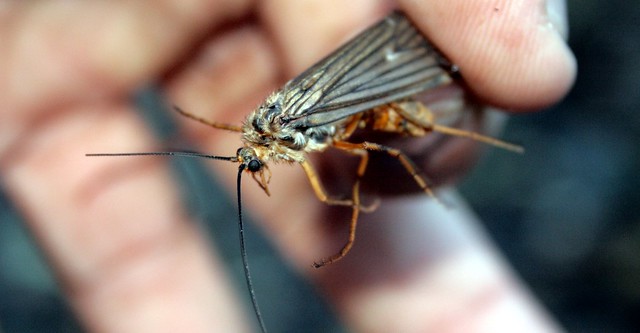
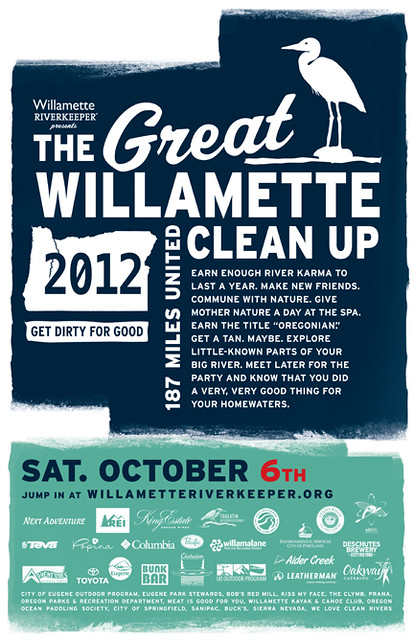
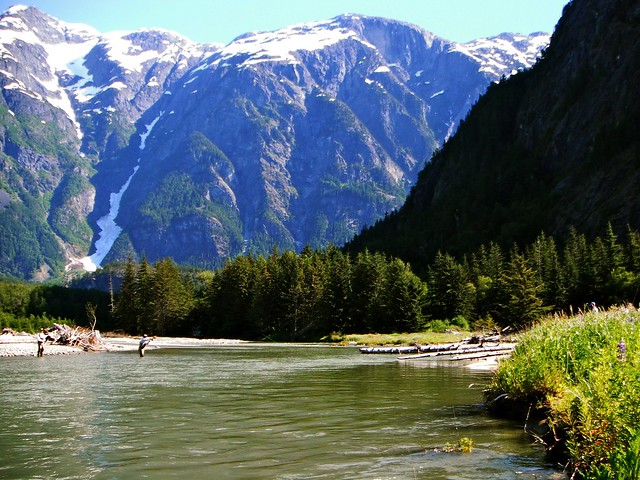
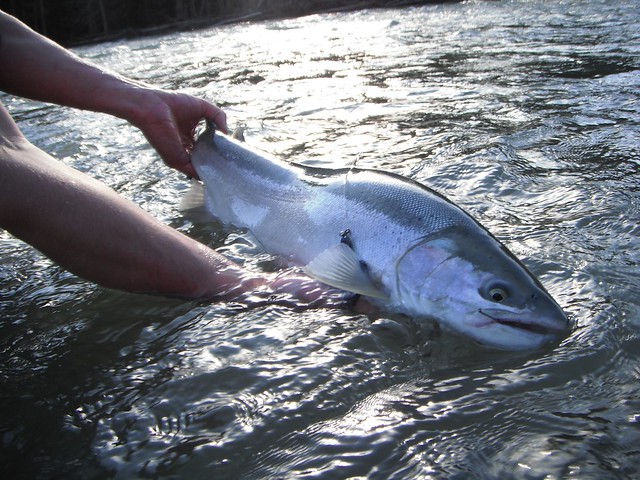
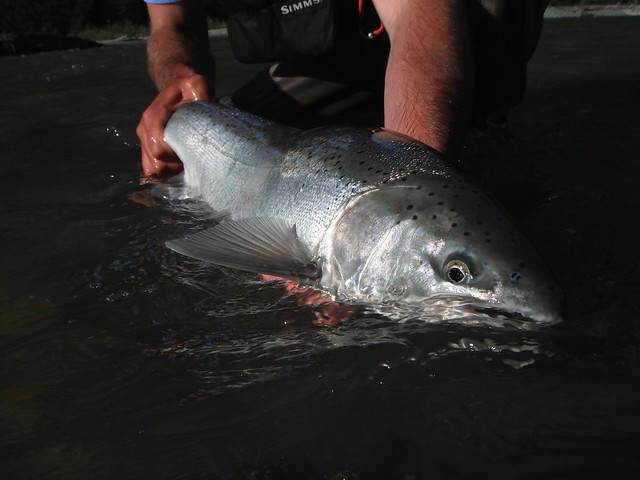
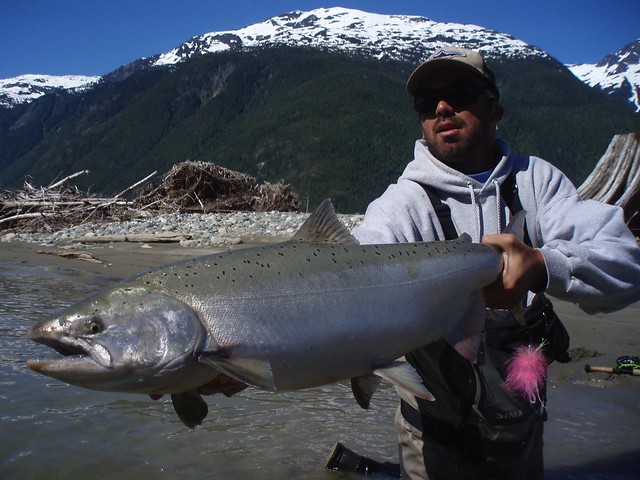
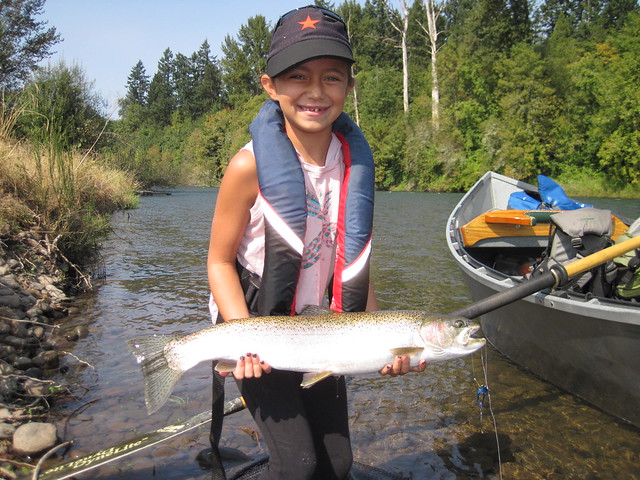
It’s been hot lately and fishing has slowed a bit locally. Steelheading on the McKenzie and Willamette has been a first light endeavour and even then it’s been a bit tough. Trout fishing has been best in the evening with small Elk Hair Caddis and Pale Morning Duns. On the Upper River Half Down Goldens and Possie buggers continue to produce but larger fish have been been tougher to come by.
The North Umpqua has been it’s usual tough self with anglers putting in their time being rewarded. It’s a great time to skate a dry fly down on the North. Ska-Hoppers, Muddlers, Curb Feelers and the like have been good choices.
Hopefully this weeks cooler temps will improve local Steelhead and Trouting. Fall shadows, cooling temperatures and better fishing are soon to come.
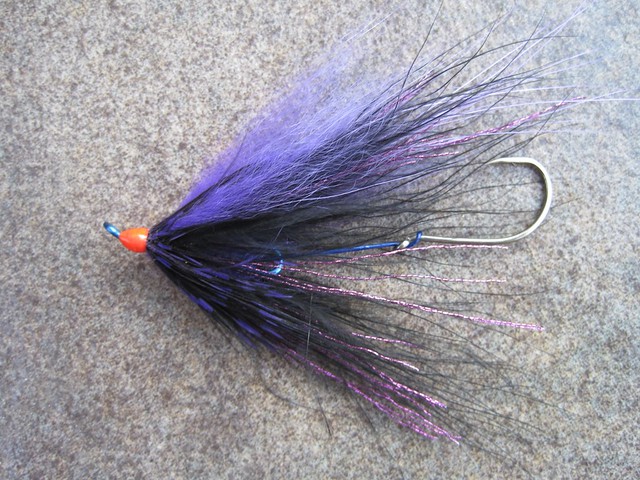
We continue to work on our favorite late Summer and Fall Steelhead patterns. Mike Brooks shows off a fly he has caught fish with on the swing or dead drift. The fly has a combo “egg/October Caddis” representation that fish love.
Please join us as we host Tom Martin for a presentation based on his new book, Big Water, Little Boats; Moulty Fulmer and the First Grand Canyon Dory on the last of the Wild Colorado River.
This 45-minute program features original photographs from various 1940’s through 1960’s Grand Canyon River trips, including Boulder Narrows at 126,000 cubic feet per second in 1957. The presentation tells how Fulmer happened upon the McKenzie River hull design of today’s Pacific Northwest boats, and how he used that design to build his boat the Gem, Grand Canyon’s first decked dory. Martin will also touch on the building of a full-sized replica of the Gem and taking the replica through the Grand Canyon. He will show photo re-matching of original pictures from the 1940’s and 1950’s river trips. The program will be followed by a book signing.
Tom will have the full-sized replica of Moulty Fulmer’s 1955 GEM, the first Grand Canyon dory, with him at the shop. We will be serving “Apps” and Ninkasi at “6pm ish” and the presentation will start at 7pm on the 5th of September.
I will remind you again as we get closer.
More info about the presentation.
Moulty Fulmar was bitten by the river running bug during a San Juan River trip in 1942. After a chance meeting with a McKenzie River dory builder, Fulmar constructed his first dory and rowed the San Juan in 1947. Traveling through Grand Canyon in 1948 on a Norm Nevills expedition, Fulmar met Colorado River historian Dock Martin and they went on to run rivers together and correspond for the next thirty years. Fulmar built his second dory, the Gem, specifically for big water. Joining forces with Pat Reilly in 1954, they ran the Grand Canyon five times in home-built boats. Their adventures included rowing the wild Colorado River in 1957 on 125,000 cubic feet per second, one of the highest flows in the last century. Using historic photos, river logs, letters and interviews, author Tom Martin recounts the voyages of a number of unsung river runners during the transformation from Grand Canyon expeditionary river running into today’s whitewater recreation. Big Water Little Boats chronicles the start of the park’s river running permit system in 1955, the construction of Glen Canyon Dam, and the explosion of river running that occurred after the completion the dam in 1963.
About the Author:
Author of the award winning Guide to the Colorado River in Grand Canyon and Day Hikes from the River, Tom Martin has hiked the backcountry and run the Colorado River in Grand Canyon for much of his life. He recently built a replica of the first Grand Canyon dory, the GEM, based on the wreck of the original boat and the journals, photos and notes of Moulty Fulmar, Dock Marston, Pat Reilly and their friends. He has now run the GEM through the Grand Canyon four times and has only flipped it a couple of times.
Mike Brooks demonstrates how to tie a simple Silver Hilton Spider Summer Steelhead pattern. We like this pattern on the Willamette and Deschutes from July on through the Fall.
I was lucky to spend even more time than usual this summer guiding the Lower Deschutes for trout. Anyone who pays attention to such things knows that the Deschutes is one of Oregon’s best rivers, with a robust population of resident trout, and generally a strong return of summer steelhead. The spring salmonfly hatch and the late summer and fall steelhead seem to get all the press. However, there are a lot of great trout fishing opportunities over there throughout the summer months that are worth some attention.
The lawsuit challenging hatchery practices on the Sandy River, east of Portland, continues in court, with our own local McKenzie Flyfishers joining other conservation groups in the action. Native Fish Society, McKenzie Flyfishers, the Federation of Fly Fishers, and the Wild Steelhead Coalition were asked by the National Marine Fisheries Service to submit comments on the draft Environmental Assessment (EA) relating to the Oregon Department of Fish and Wildlife’s Hatchery and Genetic Management Plans (HGMPs) for the management of wild anadromous fish on the Sandy River. The McKenzie Flyfishers comments on the proposed EA are available on the club’s website here.
By now, you should be well aware that fish enhancement programs (hatcheries) have demonstrated negative effects on populations of wild fish. Hatchery fish compete with wild natives for food and spawning grounds, have lower survival rates and lower return rates than wild fish, and can interbreed with wild populations thereby weakening the genetic fortitude of wild fish. When the wild fish populations being considered are listed as threatened under the Endangered Species Act, as they are on the Sandy River, it means that NMFS and ODFW have a responsibility to plan for the recovery of listed species. On the Sandy River, ODFW’s HGMPs assume that there is no serious threat to the status of listed Chinook, Coho, and winter steelhead on the Sandy, despite a well documented decline in the numbers of remaining wild fish in the system. NFS and McKenzie Flyfishers have much more comprehensive information on the status of Sandy River Salmon, so check their websites for the full story.
If you’re interested in learning more about the fight to save wild Sandy River salmon, point your browser to Native Fish Society’s website, spend some time reading McKenzie Flyfishers comments, and consider supporting the groups involved in the lawsuit.
Early this week we visited Seattle to hang out with our friend and Patagonia/Winston/Fishpond/Outcast sales rep Jon Covich. We did some crabbing which was amazing, had another look at the new for Spring Patagonia Fishing line up, and shot this video of Winston Pro Advisor Andre Scholz. Andre covers a few of the simple but critical aspects of using your underhand when casting a two handed rod.
Just a quick note to announce the pending arrival of the new Sage Circa fly rods here at the Caddis Fly Shop. Sage has incorporated its new Konnetic Technology into several new fly rods (ESN, ONE, and Circa) for the 2012 and 2013 seasons. Setting aside all the sales promos, we think each of these vastly different rod types is well worth your time to cast, evaluate, and fish. Each of these rods features densely packed carbon fibers that are precisely aligned and embedded within a Sage proprietary resin – materials and processes that combine to produce slim profile, tough-as-nails, beautiful to behold fly rods – each with entirely different casting actions.
The Sage Circa is the first rod we have fished that blends the finest casting performance of slower tempo glass and cane rods. For years now, we have been enjoying the benefits of progressively lighter and faster fly rods, improving our game in wind, increasing our distance envelope, and allowing us to fish big nasty nymphs under indicators.
The Circa takes us back to our fly fishing roots, where slower actions of glass and cane were the norm, but the Circa offers genuine improvements over the best that glass and cane deliver, because Sage’s Konnetic technology produces a rod that is slimmer, lighter, with crisper recovery that increases casting accuracy over short and modest range presentations.
Circa Fly Rods are offered in line weights from 2 to 5, and in lengths of 7 ft. 9 inches and 8 ft. 9 inches. The Circa was voted ‘Best new fly rod in 2012”; this is a big and well earned “hello” in a time of innovation among the great rod makers across the fly fishing industry.
Sage Circa rods are beautiful, cast and fish like a dream, and are available for delivery any day now. Come on down to the Shop to experience these rods. I believe that you will find – like several of our guides and customers have – that these rods deserve a place in your fly-rod quiver.
Jerry Siem, Sage’s primo fly rod designer, says that the Circa will help educate and hone the casting skills of most anglers by providing clear feedback on each casting stroke. I can endorse the fact that Circa rods do more than bend into the cork. My perception was one of absolute connectedness from my fly reel through the line to my fly. Was it trick of my imagination? Give a Circa a few casts and decide for yourself.
We expect Circa Rods to arrive in the shop any day.
Update from the Middle Fork Ranger District today that fire suppression crews will be bucket dipping from the Middle Fork and North Fork of the Middle Fork Willamette until further notice. If you plan to fish the Willamette, keep an eye out for Forest Service helicopters!
Our friend and Caddis Fly Customer, Brad Emery, sent us some photos and a report from a recent trip he took down the main stem of the Umpqua River for smallmouth bass. Brad is part of Central Oregon Project Healing Waters and had a vet and mentor along with him for his float on the Umpqua. Project Healing Waters works to assist in the physical and emotional rehabilitation of disabled active duty military personnel and veterans through fly fishing and fly tying education and outings. The Central Oregon Chapter focuses its efforts on one-on-one outings with veterans, rather than larger group trips that many other PHW chapters run. If you know a veteran who might be interested in some relaxing time on the water, drop Brad a line at bdemery1@aol.com or visit the website of Central Oregon Chapter of Project Healing Waters for more information. Brad’s report and photos are below.
Fished James Brown to Osprey – Monday Aug 6th
Coming from Bend to fish the Umpqua for a day is something I used to do when I was younger, but sometimes we just don’t learn. We left the Bend/La Pine area around 5 AM to hit the tunnel at 6…only to learn that they don’t work on weekends so it was open. We made it to the Tyee store around 8 and were fishing by 8:30. For our first trip in this section it was a success… we caught fish (but we don’t have one of those clickers to count fish) – we also started experimenting to see what they wouldn’t hit. All in all they liked Clouser Minnows in white/orange and Rainbow and Crystal buggers, but they didn’t like poppers or anything on top (yet).
I was told to watch out for the rapid above Osprey (I didn’t know where we were so by the time we were at Osprey it was too late), but anyway stay right because we painted some rocks on the left with a couple hangups. If you don’t know where Osprey is mark it in your mind when you go by – there are two houses (green and red) just before on the right and the chute is heading toward those houses….right now it looks OK either way but in the very near future it won’t be.
It was an amazing drift with lots of fish, eagles and kingfishers, what somebody calls vitamin N. I am part of Central Oregon Project Healing Waters and had a vet and mentor along with me, and we are trying to get vets out into nature on a one on one basis regularly instead of big outings for a lasting experience.
Hope this helps the drift……go enjoy – it’s worth it.
Brad Emery
Shuttles for floats on the Umpqua are available through Arlene’s Cafe and General Store (they also serves up some tasty pre- and post-trip grub) at 541-584-2555, or through the Tyee Store & Landing at 541-459-7705.
The Micro Polar Peril is a Deschutes inspired Summer Steelhead Pattern. Fish it down and across on a floating line or short sink tip. Various color combinations using a floss body and Micro Polar Chenille look great.
Using a Cautery tool Tony demonstrates how to keep a tidy Steelhead Fly head finished.
Earlier this week Barrett and I floated from Finn Rock to Ben and Kay with long time friends/clients Ed and Sally and Jim and Jeannie. Summer is here and with the warmer temperatures the fishing has definitely slowed down a bit but we still managed a good day. We picked up quite a few fish on the dry/dropper rig. The hot flies continue to be Half Down Goldens for the dry with a Possie Bugger dropper. Size #10 Mega Princes have also been producing good results.
Mornings and evenings are best on the McKenzie this time of year. If you are fishing during the day fish fast water with slender nymphs for best results.
Join us this Wednesday, 8/8, for beer and fly tying. We’ll handle
chapter business, go over our upcoming events, and talk about the
results of the Marten Creek stream crawl. Bring stuff to tie your
favorite pattern and look over the shoulders of your fellow members to
learn how to tie their favorite flies. As always, the meeting is open to
anyone interested in participating. We can even organize a quick fly
swap for those who are interested.
Where: Vets Club, 1626 Willamette Street in Eugene
When: Wednesday, 8/8/12 at 7:00 pm
What to bring: Your vise, materials, and a couple of bucks for a beer or two
Just got back from a fun trip on the lower 40 miles of the Deschutes River with family and friends. I spent both early mornings and evenings swinging flies with my new Echo 3 6126 and really liked the way it performs, however I didn’t pick up any fish with that method. But on the second day at our lunch spot in the bright midday sun on my first cast with a spinning rod I got slammed by this chrome beauty. This was a super hot early native that put up a great fight.
In floating down I spotted several fish in tail outs and other lies. In talking with other guides and fisherman, fish are being caught but at this time the mouth of the Deschutes is still warmer than the Columbia, so until they start letting colder water out of the gates most fish will remain out in the Columbia. I can’t wait to get back over there as it is an amazing fishery.
So me and Nate just launched Great Lakes Fly Fishing Blog, so if you’re in the Midwest and are looking for some entertainment, hit us up.
The site is modeled on the Caddis Fly Oregon Fly Fishing Blog, and is dedicated to Great Lakes fishing reports, conservation and biology of the Rust Belt region, fly fishing gear reviews and fly tying videos.
Speaking of videos…
Word of warning, mute your computer if you don’t like heavy metal.
Each fly tying video will have a different theme and we’re planning to get a little nuts. For example… I’m working on a “Cult of Dahlberg” video, where I tie a Dahlberg Diver surrounded by a half dozen “acolytes” wearing Larry Dahlberg masks with chanting music. Like I said… weird. But we have to entertain ourselves out here in Ohio. Send me your craziest ideas.