Well, it’s finally happened. We here at The Caddis Fly have decided to come clean about this whole Bigfoot thing, in a new tell-all article in the latest edition of The Flyfish Journal.
Pick up the latest copy and get the real story on the McKenzie River Sasquatch footage, the subsequent fame and fortune, and the curse of the man-ape that still haunts all involved to this day. Plus, some of the best photography and writing in the fly fishing biz.
It’s pretty amazing to share a masthead with John Geirach, but I doubt the feeling is mutual. I shared some pizza and a few beers with him while he was fishing for Chinook with Rob on the North Coast a couple years back. He was a class act.
We heard from Tom Wolf recently that Trout Unlimited hired Dean Finnerty as the new Southwest Oregon field representative for the Sportsman’s Conservation Project.
Per Dean’s blog: I’ll be working with a wide variety of stakeholders on issues related to high quality habitat for Salmon, Steelhead, Trout, Deer, Elk and other wildlife throughout the region. I’ll be primarily focused on working with groups on the “Copper/Salmon Wilderness area” in the upper Elk River Water Shed as well as the “Elk River Salmon Enhancement Area” (ERSEA) near Port Orford, Oregon. I’ll also be working on the “O&C Lands” issues as that legislation moves forward in the coming months.
OK, so what if Father’s Day is just a ploy to sell ties and was actually signed into law by Richard Nixon. Try to sit back and enjoy a day dedicated to manly pursuits and pleasures. And if you’re really lucky, you’ll spend it with your kids, your dad or both fishing.
Last week, I got to spend a week taking my son on his first dedicated fishing vacation — a short ferry trip to the Lake Erie islands — the Key West of Canada. Three generations of Stansberrys spent the week unhooking thousands of sheephead (freshwater drum), deep frying walleye, and teaching my four-year-old new vocabulary my wife won’t appreciate. Some photos:
Sunburn. Hail. Wind. did i mention wind? Lonely open waters. Brutally long days on the water. Three days, one grab. Adrenaline and exhaustion. Imagination and hope. Feathers in the dust bunnies. Hooks in all the usual places. Try to quit. Can’t quit. Want it. Need it. Hitch up the Pram and go. Again. You meet the new Boss. Same as the Old Boss.
Jay Nicholas, June 2013
Jay Nicholas shows how to tie yet another locally effective trout fly on a tube – this time a McKenzie Special Caddis. This is a fly that has been fished in the Willamette Valley for many decades in one form or another, and is one that will often take the largest wild trout on the surface.
Incidentally, we think that this fly or this style of fly could be fished in BC Lakes for big Kamloops trout when giant sedges are hatching after ice-out. Think about a Carey Special tied on a tube too. Hummmm, maybe we will give that one a try soon.
Given that this is an experiment, we think that this tube caddis should float nicely, be fairly durable and catch a bundle of big trout when we catch the hatch this year. June is a great time to fish this hatch, and it usually starts in may so get ready whatever fly style you choose to fish.
Be ready to see the wonders of an October caddis tube trout fly shortly, as well as a green McKenzie caddis emerger too.
Our adventures tying tube trout flies is just beginning, and we are going to enter the bass pike and musky world shortly so hang on folks.
Key materials of this McKenzie Special Tube Trout fly are noted as follows:
The Mckenzie-Upper Willamette Chapter of Trout Unlimited will be hosting our monthly membership meeting Wednesday June 12, 2013 at 7:00 pm at the Bier Stein’s new location at 1591 Willamette Street. We will be recapping some the exciting results of our trout trapping study on Marten Creek, and guess what, some of these fish weren’t there for the caddis larvae folks.
We’ll be planning the next stages of that project, getting down to brass tacks on planning our annual Mckenzie Study Section clean-up/ banquet scheduled for this fall, starting to plan the high lakes trip, swapping fishing lies and perhaps, ahem, enjoying a few frosty beverages.
If you’ve been wanting to get involved and wanting more abundant native trout, this is a great chance to come out and meet some of the great people who volunteer with TU to conserve our wild fish and find out what they do to help make this a reality …. And a darn good reason to enjoy a cold one. Hope to see you there!
Tony Torrence ties a gurgling and popping Bass/Snook/Tarpon fly pattern. The fly requires numerous steps but is very durable and active on the surface. If you decide to use the pattern in salt water try a saltwater hook like a a S12S Gamakatsu in larger sizes. The techniques for front portion of the fly can be adapted to many of your steelhead skater style patterns.
So the EPA extended the Bristol Bay Comment period till June 30th. What does this mean? It means as fishermen we still have a chance to let our voice be heard. It means if you TAKE ACTION between now and June 30th you can get a chance to win a trip for two to Crystal Creek Lodge in Bristol Bay. Yeah this place, Crystal Creek Lodge .
So why are you not Taking Action? Why are you not Telling Friends? This is just the largest intact salmon and rainbow trout fishery left on the planet. If you do not believe me watch this great video from longtime Bristol Bay guide and Lodge owner Dan Michael’s. He will tell why to protect Bristol Bay.
Jay Nicholas shows how to tie a trout fly on a tube – featuring a Clark’s Stone, originated by Lee Clark and proved effective wherever golden stoneflies are on the trout menu. This fly style is very effective fished in lakes and many rivers and is often tied on a long shank hook.
As a dry fly, it seems like this little tube should float well and be easier on the little fish we sometimes encounter when fishing the stonefly hatch on our local waters.
Jay discusses the reasons for giving this traditional fly a try on a tube as a break from our usual style. In addition to being easy on the fish, the fly should last a little longer, we hope, because it should slide up the leader and be away from the sharp fish teeth.
Tying tube flies for trout is new to us, but we are having fun experimenting. It seems like some patterns will be more effective on tubes but some other patterns should be kept to the traditional hook shanks. We guess that time will tell the story.
Key materials of Clark’s Stone Tube Trout fly are noted as follows:
Water levels have dropped back down close to Summer levels on the McKenzie River. We are likely to see them come down even further with the lack of snow pack in the Cascades. This is going to be a great year for wading anglers on the McKenzie and it’s tributaries, it’s been a few years since water levels have been this low at this time of the year.
Throughout the day yesterday Little Yellow Stones and small caddis emerged, a few larger Golden Stones were present and Pale Morning Dun mayflies hatched and quickly left the stream. There were so many small stones emerging that swallows and crows were actively feeding on them over the water and near shore. Swallows are not surprising but when you get a large crow feeding on emerging insects then you are really looking at some significant numbers of bugs.
What flies and techniques should I use given lower water and bright sunny weather you ask?
Some decent mid-day fishing is still possible. Use mid-sized dries like Half Down Golden Stone and Yellow Stimulator in size 12 and drop a smaller possie bugger, prince nymph or pheasant tail in size #14 off of the dry, a scaled down hopper dropper set up if you will. You may find fish moving into quicker water, during the day. Afternoon and evenings will be solid bets throughout the Summer (it feels like Summer now). There are still some Green McKenzie Caddis around late afternoon and evening. You will be able to count on Little Yellow Stones, Parachute Adams and small soft hackle wets as standard producers over the next few weeks.
Jay Nicholas shows how to tie a trout fly on a tube – featuring a simple lake leech fly. This fly style is very effective fished in lakes and many rivers and is often tied on a long shank hook.
Tied on a small classic tube by Pro Sportfisher, this style offers the option of fishing with a small short shank hook that will be easier on the fish in addition to being less prone to pulling free given the leverage of a long shank.
In addition to being easy on the fish, the fly should last a little longer, we hope, because it should slide up the leader and be away from the sharp fish teeth.
One possible feature of this fly tied on a tube is the likelihood that it will sink less than a traditional lake leech on a long shank hook. Using a slow sinking fly line and fishing over weed beds keep our flies in the trout zone instead of dragging up seaweed.
Key materials of Brown Lake Leech Lake Tube Trout fly are noted as follows:
McKenzie and Willamette Steelhead anglers are having mixed results so far this season. Fish counts over Willamette Falls are about one half of last years numbers as of the end of May. Although the numbers are not fantastic there are fresh Summer Steelhead in both the McKenzie and Willamette Rivers. Concentrate on the McKenzie from Leaburg Dam to Hendricks Park. Willamette fish seem to be spread thinly throughout the system from Dexter and on into town.
Water conditions are ideal on both the McKenzie and Willamette Rivers. Looking forward a bit, fish numbers are likely to improve and our local rivers are likely to get lower and lower. While flies like the Moal Leech and Signature Intruders have been solid producers over the years this years lower water will give cause for lighter flies, floating and slow sinking tips and longer lighter leaders. This year smaller and lighter traditional steelhead flies are good to have in the arsenal, along with Living Leeches ( a more slender “snaky” MOAL style leech ).
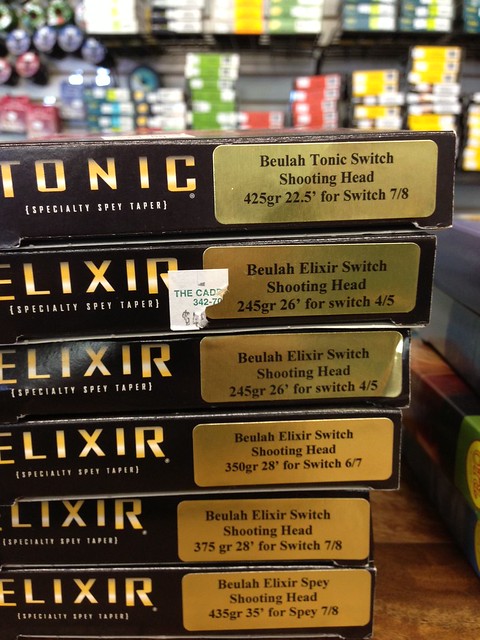
Every once in a while a truly innovative product comes to the fly fishing market and really changes the way we do things. The proliferation of fly lines in the single hand and spey line world have created havoc in some of our gear bags, man cave cupboards and garage corners. If you want your fly lines to be organized, easily “swapable” and easily cleaned have a look at the Switchbox System by Omnispool.
The Switchbox is easy to label and spools snap together. The are great for travel because the box is light in weight and transforms into an impromptu line winder for easy on and off when you are on the water. Switchbox stores lines and organizes lines better than anything we have seen.
Many fly lines are now in excess of $70. Why not take care of them rather than losing track of them. How many different spey heads, lake lines, saltwater lines do you own? Switchbox keeps them at the ready.
Switchbox is available as a set that includes a Switchbox, Linecare Box and Crank Handle.
Me and Cap’n Nate have been running around in the warm weather, mostly chasing bass up and down the local watersheds, in ponds, in Lake Erie.
In the Cuyahoga River Valley, bluegills are spawning. Lilacs and locust are blossoming. Iris and phlox are up, trout lily and trillium are gone. Wood ducks have babies. Spiny soft-shell turtles are hanging out on the muddy banks.
On the Rocky River, water snakes are on the hunt. Carp and river chub are schooling up and spawning. Smallmouth bass are holing up on spawning beds, chasing after baby Canada Geese.
Last week, we stumbled onto a school of hundreds of carp in a single pool, and couldn’t convince a single one to bite. Ran a fly in front of a bunch of spotted gar and couldn’t get a take. Went to the bait shop, put nightcrawlers on our six weights, and still couldn’t get anywhere.
Heading out to the Lake Erie islands (Middle Bass) this weekend for a shot at some smallmouth in shallow, clear water. There’s a party town, flats — it’s kind of the Key West of Canada. Stay tuned for more photos.
What’s new in the world of the fly fishing blogosphere? Lots! It’s the beginning of summer and people are getting excited and weird. Just look at this fly “Legs for Days” by Brian Wise at Fly Fishing the Ozarks:
I always say you can NEVER have too many rubber legs, and this pattern could allow an elephant to bungee jump.
John Montana from Carp on the Fly shares a great tale on the hardships and rewards of carping on the Columbia River with a gang of pros.
We work for the fish. Nothing on the big C is handed over freely…she is a fickle mistress that will stone you with an upriver wind just when your cast to a 25 lb tailer is unfurling, blowing your fly off course and lining the fish. She will murder you with waves, and crush you with slippery rocks that force you to massage your feet each night, wondering just how you are going to cram your swollen heels inside your wading boots the next morning (but knowing full well that YOU WILL stuff those feet in there). But if you put in the time, and take the ass kicking she offers in stride…she will love you too. Y
Moldy Chum pointed us to a group called “Save the Tarpon” who posted a report from their protest at a giant tarpon tournament in Florida.
Speaking of the Chum, the just posted a great photo essay by our bud John Covich who was just down in Los Roques. Check it out.
And lastly, but certainly not least, I must post my obligatory link to a post on Fishbeer . Matt Dunn is arguably the best writer in the fly fishing world, even if the content may have zero relation to the act of fly fishing:
It didn’t work out with the foot fetish model. I picked her up in New York City in line for the bathroom while she was on a date with some other guy. Things seemed so promising… I think I flew too close to the sun with that one.