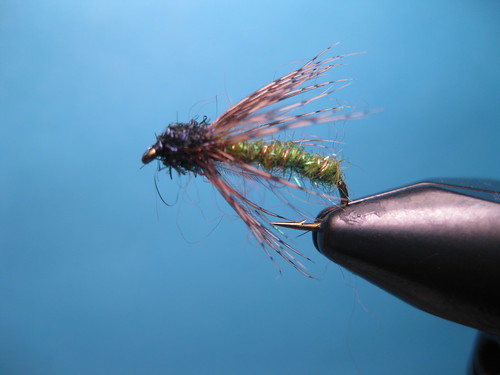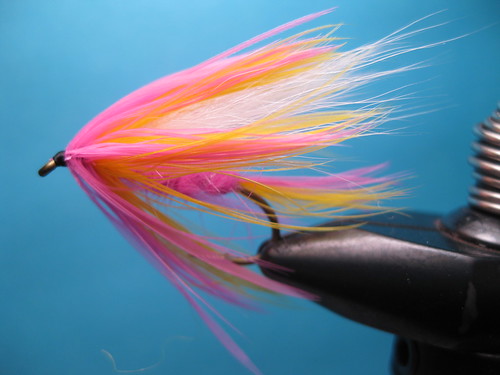
This instructional fly tying video, Jay Nicholas demonstrates the use of thread dubbing loops for coarse dubbing materials, a great Daiichi hook and two tone Crosscut rabbit. This shorty-leech is very easy to tie and very effective.
Tonight, the Mckenzie Watershed Council will be meeting at the EWEB facility in downtown Eugene. From 5:30-7:00. Jeff Ziller, District Biologist will be presenting on the Status and Managment of Mckenzie River Trout. He will be taking questions from the public and the Council members.
This is a great opportunity to gather information and to show the Council just how many of us care about the severe depletion of wild trout in 35 miles of the Mckenzie. Our last showing at the ODFW public meweting made a positive impression on ODFW senior staff. Let’s do the same thing for the watershed council and keep our momentum going! Hope to see you there.–KM
Veteran fly fishing guide Ethan Nickel will be speaking at the Trout Unlimited meeting next week, presenting on spring fishing tactics for trout. The meeting starts at 7pm and is free and open to the public. The meetings are held on the second Wednesday of the month at the Eagles Aerie, 1375 Irving Rd, Eugene.
We’re also featuring two new activities at tonight’s meeting
FLY SWAP
RULES:
-Tie or purchase 6 flies.
-Bring those 6 flies to the meeting.
Each participant will bring 6 flies to the meeting. These flies can be tied by you, by someone else or purchased. The 6 flies you bring will be presented as a “set”. These flies do not have to be identical or even the same pattern, you simply have to have six flies to participate.
After all the sets are submitted, you will draw a number from the bucket.
The number you draw will determine the order that you get to choose your flies. Example: If you are number one, you get to choose any set of flies. If you are number two, you can choose the set you want from the remaining sets of flies. Etc.
You are then instructed to fish those flies and have fun.
BROWN BAG SPECIAL
Objective:
This is an exercise that will stimulate your imagination. The goal is to make you think “outside the box”.
Overview:
Each bag contains exactly the same materials. Your goal is to tie one fly from the materials in the bag. Imagination is the key here.
Rules:
• You must use at least a small amount of every material provided in the bag.
• You may not add, subtract or substitute any materials from the bag.
• The only thing not provided in the bag is thread. You may use any
color thread you desire.
• You must return the completed fly to the meeting the following month
for it to be placed in the competition.
General Information:
You may purchase a “brown bag special” before the meeting or during the break. Funds go toward TU room rental costs. When you return the tied fly to the meeting the following month, the flies from all participants will be displayed and the members will vote on the best fly tied.
The winner will receive a fly tying related prize. This prize will change monthly. The flies that are tied and submitted for judging will be collected throughout the year and will be used as a donation, auction item or fund raiser for the chapter.
The Middle Fork of the Willamette river is currently flowing at about 400 cubic feet per second, this is super low and makes the river extremely accessible on foot. The water below Black Canyon Campground normally slow and lake influenced, is now miles of water flowing into Lookout Point Reservoir. All of this water is walk-able from Hampton Campground on the Hwy 58 side or by heading towards Lowell from the Westfir side and walking in the lake bed. This section sees very little pressure but is well worth a look.
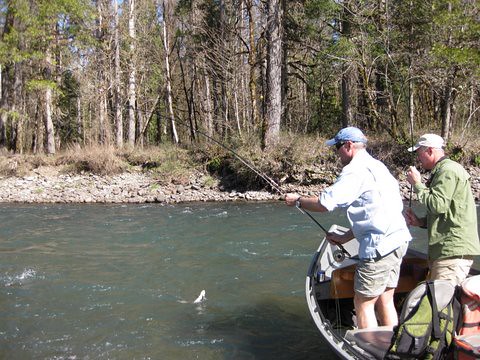
This past Saturday I floated the stretch between Greenwaters Park and Black Canyon. What little Gluvit left on the bottom of my boat was pretty well scraped off. The sun was out and we saw zero surface activity. However we did find some fish on nymphs, fishing shorter off the Thingamabobber than I usually do, just 3-4 feet. The runs are pretty obvious with the lack of water so cast to the dark green stuff and get a nice dead drift.
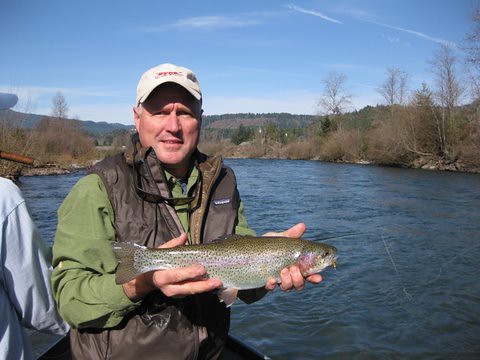
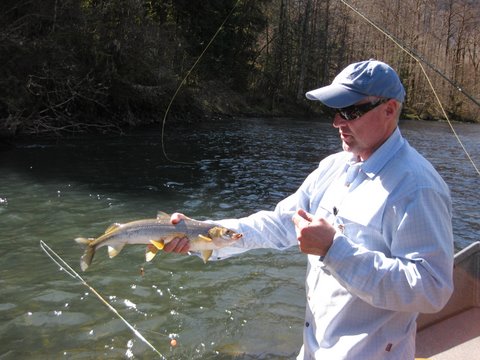
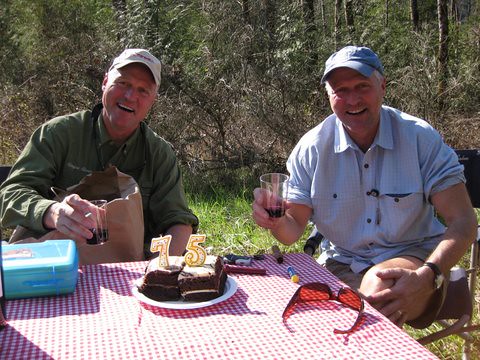
I had a couple of young guys in the boat sharing their birthday. Jim Becker started the day off with a Salmon Creek Hatchery escapee.
Tim stuck this gorgeous whitefish just below Oakridge
For the 2010 trip fly fishing for Northern Pike in Canada, I’ve take a more utilitarian approach to tying. Two of my good friends are coming along, and neither tie flies so I’m getting started early. You can check out the 2008 pike trip and 2009 write ups.
Here are some of this year’s patterns that I’ve been putting into production:
I’m mostly fish only two kinds of flies, Icelandic Sheep Hair and rabbit strip. I vary the patterns — lead eyes and unweighted, and have been playing with different hooks from the ultra heavy duty Gamakatsu SC17 tarpon hook when I want the fly to sink, to the Gamakatsu B10S Stinger for lighter weight bugs. A couple new materials for me this year on the rabbit strip side — bunnybou is a great replacement for cross cut rabbit. It will definitely pulsate in the water — see the big chartreuse unweighted bug above. And magnum rabbit strips. The number one reason I don’t fish rabbit as much is because pike can bite off a tail too fast. But the magnum strips might slow them down.
The McKenzie River is the birthplace of the Federation of Fly Fishers, and the first club was our own McKenzie FlyFishers. The MFF has been rigorously studying the issue of hatchery trout negatively impacting wild fish on the McKenzie River. And after four months of debate, and research into the biological and social implications of the McKenzie River hatchery trout program, the Fisheries Committee developed an excellent position statement that is excerpted below:
The McKenzie Flyfishers’ Policy on Native Fish Conservation in the McKenzie River:
The following is the policy text: The McKenzie Flyfishers support and encourage enhancement of native, naturally reproducing fish populations wherever possible. While there may be a role for artificially propagated fish in some situations, when their presence significantly conflicts with wild, native fish, the welfare of native fish should take precedence.
This position is consistent with the Federation of Fly Fishers’ Native Fish Policy as well as the Oregon Department of Fish and Wildlife’s (ODFW’S) Native Fish Conservation Policy.
After a thorough review, the McKenzie Flyfishers conclude that hatchery-reared trout are likely exerting a substantial negative impact on the McKenzie River’s native redside rainbow trout, and possibly other native fish populations. Since the public statements of ODFW staff support this conclusion, the McKenzie Flyfishers urge that agency to take corrective actions.
Corrective actions, including modification of planting practices, should be guided by the best available science and occur at a pace that allows businesses and members of the fishing public who have come to depend on hatchery fish to make adjustments.
In the long run, the McKenzie Flyfishers believe that a robust McKenzie River wild-trout fishery will benefit all stakeholders in the community.
We recognize that establishing a robust, wild-trout fishery will take time and require cooperation with other groups. We also believe that it will be necessary to educate the public about the benefits of a strong wild-trout fishery, the disadvantages of the McKenzie hatchery fish program, and why changes are needed. The McKenzie Flyfishers stand ready to work with others, including the ODFW, to protect and increase our precious McKenzie River fishery resources.
You can read the whole article in their Newsletter here, which explains how the committee came to its decision.
Join Barrett Christiensen’s Beginning Fly Tying Class for five consecutive Mondays 6-8pm starting March 8th. No experience is necessary to take the class. Attendees will learn basic fly tying techniques centered around local fly patterns. All materials and tools are provided for in class work. The class meets at the shop five Mondays in a row starting March 8th.–CD
In this new video, Jay Nicholas demonstrates the Total Domination Egg, a pattern named on the fly after Eugene’s favorite IPA from Ninkasi Brewing. This offbeat egg pattern fishes well under an indicator with a heavy stonefly nymph in tandem. It looks a little like an alevin fly.
Fly fishing purists, do not press play on this video unless you want to catch a lot of steelhead. Fly fishing with a jig under an indicator is freaking deadly and Jay Nicholas shows you how to tie a basic marabou pattern using one of the Gamakatsu 90-degree bend hooks. These are the fish-grabbing-est hooks around. Get over your fear of the jig hook and catch some steelhead this winter.
Fishing the Lower McKenzie River: A rainy day in early March, the McKenzie is much lower than normal spring flows. Ethan Nickel, Chris and I put in on the lower river after lunch, and the fish are rising at the boat ramp.
The action starts on river left before we’re even ten feet from the put in. Trout are already plucking at Ethan’s swung flies, while he is anchored up. We string up rods with softhackle wet flies, two flies per rod on a dropper set up and start to make our way downriver.
The fish seem to be everywhere. They’re not really rising yet and the hatch hasn’t quite started, but every spot we swing we get a tug or a nip, or a big pull. I’m farming more fish than I’m hooking. Several months of fishing the thingamabobber or giant leech program have ruined my ability to deal with delicate trout takes. Chris hooks and lands enough fish for me to confirm that it’s my abilities that are in question. Next time out, I’m bringing my bamboo four weight to slow down my casting and my hook set!
At a bend in the river where a major tributary dumps muddy water into the McKenzie, the cutthroat population shows up in earnest and there are doubles – two fish on a single swing, on multiple casts. There are too many grabby trout for me to not hook fish, and eventually my trout hooking skills start to slowly come back to me.
Far out in the heavier flow on the inside bend, Chris hooks one of the big native redside rainbow trout this river is famous for, and after a short but strong fight, he brings it in. The fish is gorgeous, spawning colors blazing on its sides. But it has a huge hole in its back with scratches down both sides – probably narrowly escaped the talons of an osprey.
At this point the March Browns show up on the water’s surface. Big dark brown sail boats with tan segmented bodies. The first major hatch I’ve seen this year, and the bugs are huge. Close to size 10. The fish react accordingly and start to pop on the surface all down both sides of the river. We push on, skipping the froggy water where the smaller fish like to feed and look for prime holding spots with big risers.
Anchored in the middle of a big flat, we start to see some splooshing big takes on the surface, and we’re picking up fish on nearly every cast. Then something blows up six feet from our right oar. A huge trout for sure. Chris hands Ethan a rod and he dead drifts the two wet flies over where we’d seen the rise, and I watch a red flash that looks like a two-liter Coke bottle break the surface and run upstream.
The trout is massive, and it runs around the big flat while Ethan jumps out of the oarsman seat and Chris starts to row us to shore. When the fish comes to hand, I can hardly believe it’s the same species of trout people are used to seeing on this river. It’s one of the largest trout Chris, Ethan or I have ever seen on the McKenzie, and it looks more like a steelhead.
Ethan quickly frees the huge trout while I snap photos like crazy. It’s a gorgeous fish, but it’s clearly an old buck, you can see the age in its fins and its slightly sunken in eyes. The body is like a football, round and deep and the bright red stripe runs all the way from its tail to its jaw.
Soon after we release the fish the hatch tapers off, probably around 2:30. We catch a lot more fish swinging wet flies, but that huge trout effectively ended the day for all of us.
Notes from the guides: How to swing flies on the McKenzie
While we were fishing, I ran my tape recorder and got the following advice from Chris and Ethan:
Why swing two flies? Sometimes you get doubles. Sometimes on the upper fly I’ll put a bead head on to keep the flies from skating on top in the faster water. But honestly, two flies give you two chances. Even though the upper fly is on a much heavier tippet, the fish don’t seem to mind much.
A team of flies is always better. The other thing is you can experiment with different patterns. Sometimes on a bright day a drab fly works better, and on a cloudy overcast day you want to specifically match the hatch.
What is the leader set up? Leader length is 9-10 feet, tapered leader cut in half. Tie a blood knot and run the upper fly off the blood knot with a 2x loop to loop dropper. This is the most tangle-free way to go. See Chris’ explanation in the video below:
By setting it that way, you can replace the dropper as often as you want. Vary the fly very easily. If you get into a good hatch and want to go dry really quick, you cut the dropper off and you have a standard nine foot leader. You can also cut off the dropper, tie a dry fly onto the end of the leader, and you’re in business.
Fly patterns for swinging in early spring? March brown are the first major hatch of the year. Start early in the hatch with bigger bugs, size 12. By later in March you might be using a smaller size 14 fly. There are a lot of productive patterns and it pays on certain days, when you’re favorite thing isn’t working well to experiment.
What are the water conditions you’re looking for? The lower McKenzie River can fish very well quite high or pretty low like it is now. You can have great fishing down here when the water is as high as 7000 cubic feet at Springfield, and today it’s half that – 3,500 cfs and conditions are great.
Medium to shallow riffles and flats are prime water, but if the fish are on emerging bugs, anywhere you see a fish coming to the surface to a fly is swingable. Out of a drift boat, larger flats and longer riffles are great. But you can have a lot of success swinging off short drops and gravel bars too.
March Browns are a clinger nymph, and they live in the highest concentration in small gravel that is fairly well oxygenated. You see a ton of them at the tops of riffles where there’s a little current. You’ll see duns all over the place.
Why swing wet flies? There are a lot of fish that feed just below the surface that may not be keyed in to the duns on top yet. Oftentimes, if we spend a full day fishing this time of year you start out nymphing when its colder, later in the morning you start to swing and later you can have dry fly fishing after that.
You can also cover more water. You’re not trying to get a dead drift in a single lane. You’re getting big sweeps across spots that are very broad. It’s a very effective way to cover water.
Rod selection for swinging flies? I love a nine foot four weight for the McKenzie. I would argue that a very stiff, heavy rod is not a good choice for swinging wet flies. We’re not using really light tippets, but you want a medium action rod that will bend more, offer more tippet protection. Fish are eating this on a tight line.
It’s a dry fly presentation. You’re trying to land it softly with a classic wet fly swing. Down and across, you’re tight with the swing. You want to be in touch with your fly, medium to short, trying to keep a straight line between your rod and your fly. If you get big bellies in the line, you’ll be less successful.
The other issue, when the fish tugs at it, you’re tugging back at it fairly hard. Just like swinging a wet fly for steelhead, the fish is bringing the line tight. Before setting the hook, you want to hesitate and then just give it a really soft little lift. If you set it a lot harder, you’ll find that you’re missing the majority of them.
Lower McKenzie River Trout Census Training tomorrow!
As part of the 2010 trout stocking plan for the McKenzie, ODFW will open up an additional five miles of river to native fish management on the Lower McKenzie River. The McKenzie Flyfishers spearheaded a population study of the wild fish in that section to see how the natives bounce back now that stocking is removed. The project was funded by our Trout Unlimited Chapter through a $5,000 grant from the Flyfishers Club of Oregon.
The wild trout population study will involve catching and tagging (or recording data on previously tagged fish) in the lower river between Hendricks and Bellinger. To kick this off on a solid footing, we are asking all participants to take part in a training session which will cover tagging procedures, data recording and study logistics. The sessions will be held at the ODFW Springfield Field Office at 3150 E. Main Street, Springfield, OR 97478 (the phone # is (541) 726-3515.
Yesterday’s session had around 20 participants and the next one is tomorrow, Thursday, March 4th at 6:00 PM.
As there may be fisherman who wish to participate, but cannot make either session, let me know and if we have enough interest, we will schedule another session. Alternatively, buddy up with someone who has been through the training session and fish with them.
We will have participants from several clubs, so that we hope to make a big dent in the target tagging during the month of March. Please feel free to contact Dave Thomas regarding any questions you might have.
Dave Thomas
McKenzie Fly Fishers
Email: dthomas@sierraware.net
Phone: (541) 505-7213
McKenzie River Native Trout Coalition Postcard lunch party tomorrow!
Trout Unlimited, The Caddis Fly Shop, The Native Fish Society and a host of volunteers and concerned anglers sent out postcards, asking influential Oregonians to reach out to ODFW in favor of wild fish management on the McKenzie River two weeks ago. We’re hosting another postcard signing party this week, Thursday March 4th at 12:00pm. If you haven’t’ filled out postcards yet, please come down to the Caddis Fly Shop Thursday. Midtown Cafe has provided us with a giant party sub and we will have some other refreshments as well, for people who take their lunch break to defend wild fish. See you at the Caddis Fly Shop on Thurs. See video from our previous postcard signing party:
Meeting reminder 3/10/10: Speaker Ethan Nickel on spring trout tactics
Veteran fly fishing guide Ethan Nickel will be speaking at the Trout Unlimited meeting next week, presenting on spring fishing tactics for trout. The meeting starts at 7pm and is free and open to the public. The meetings are held on the second Wednesday of the month at the Eagles Aerie, 1375 Irving Rd, Eugene.
Donate to the FCO Fly Box Auction!
Trout Unlimited McKenzie-Upper Willamette chapter secured $5,000 to fund a five-year population study of the newly non-stocked section of McKenzie River. The study will begin next month, and will be administered by ODFW and the McKenzie Fly Fishers. The funds came from our Portland supporters and benefactors, the Flyfisher’s Club of Oregon.
You can show your gratitude for this amazing funding by helping us fill a fly box for the FCO auction in May. TU’s Cris Abbot is currently staining a wooden box, with a steelhead fly etched on the glass cover by our friend Kathy McCartney. If you’d like to help fill this fly box for the FCO’s auction, please drop them off at the Caddis Fly with an envelop labeled “FCO auction fly box”.
McKenzie Watershed Council meeting with Jeff Ziller
Join the McKenzie Watershed Council on Thursday, March 11, 5:30 p.m. in the Training Room, Eugene Water & Electric Board, 500 E. Fourth Avenue for ODFW district biologist Jeff Ziller’s presentation on McKenzie River trout management options. Ziller will present a short history on trout management in the McKenzie River, a review of what is known about the status of the three native species, and summarize results of recent creel and preference surveys conducted by ODFW. He will also describe the public planning processes used by ODFW to assist in the management of fish species and fisheries. Public comment is accepted at each meeting, and public attendance and participation are encouraged.
-MS
Rabbit strips are one of the fishiest fly tying materials around. In these two videos, Jay Nicholas talks about the various kinds of rabbit strips available and what they should be used for. In the second video, Jay talks about the new two-toned bunny strips from Hareline Dubbin. You’ve got to check out these whole hides, great if you’re getting into production mode on MOAL leeches.
Another storm is pounding our local waters today and river levels are likely to jump up for the weekend. Must be time to tie some more spring bugs.
We love to fish Golden Stone nymphs early in the season on the McKenzie, Willamette, Deschutes, N. Umpqua and numerous other fine rivers. The Golden Stone nymphs are an ideal size to get down to the bottom, be castable, and the perfect nymph dropper “heavy” fly. In this video Barrett demonstrates how to use a new material called Chewee Skin for the stonefly wing case. Chewee Skin is really easy to work with and we see it having numerous applications in the fresh and saltwater fly tying realm. The pliable material can be used for wing cases, bodies, shell backs, minnow bodies, ribbbing and beyond. Chewee Skin is available in numerous UV colors. UV reflective materials are highly visible to fish in low light conditions and penetrate further so fish can see them from afar.–CD