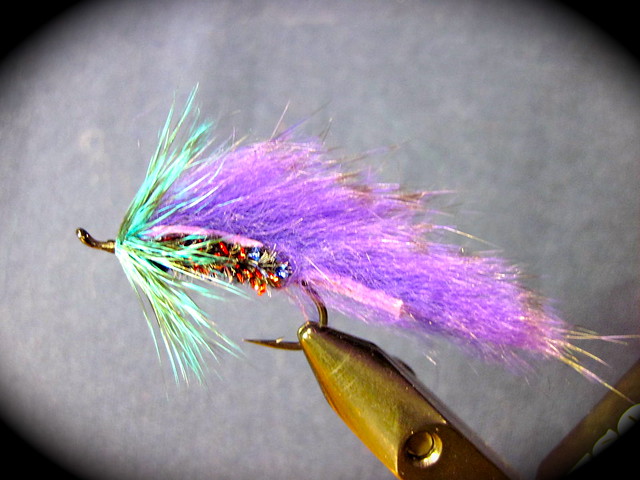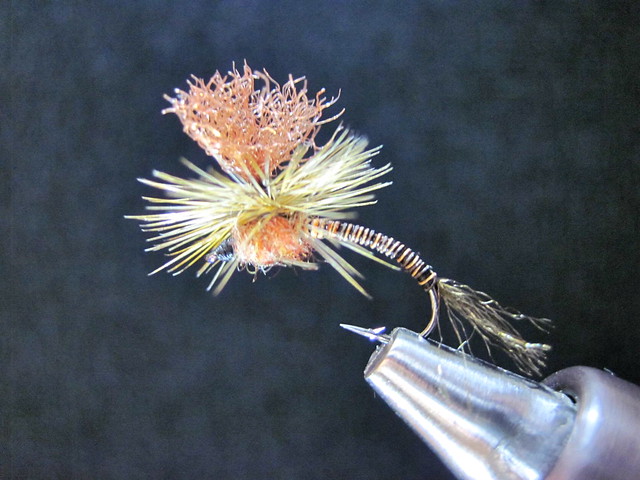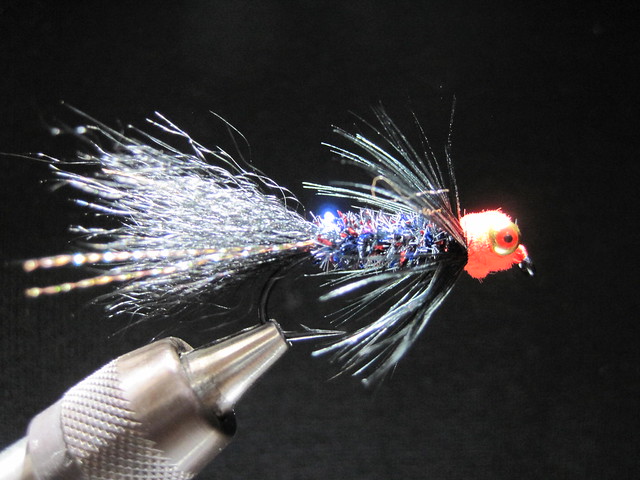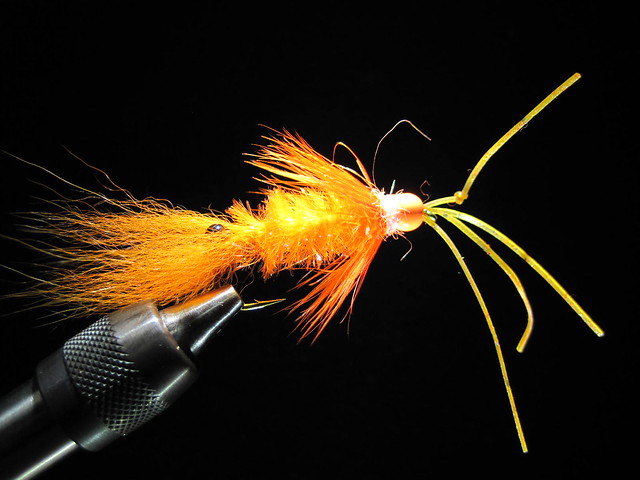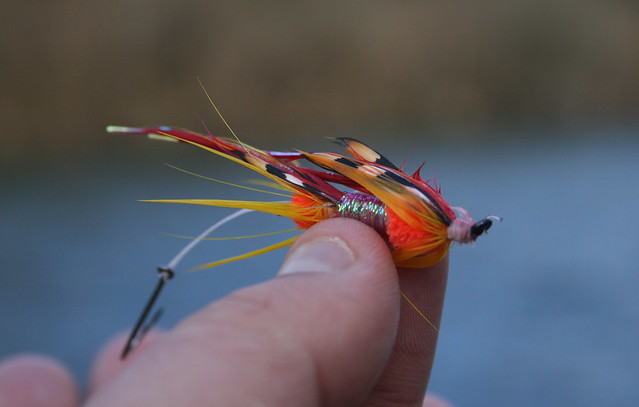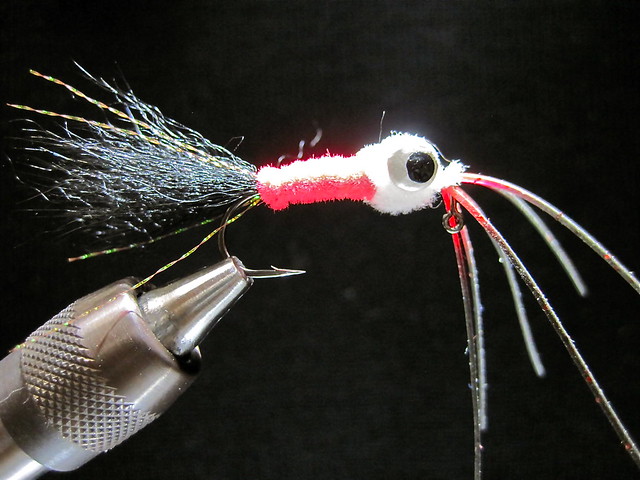
This is my favorite winter steelhead prawn fly. Just is. I like the lines and the fact that it reminds me of the days when I tied hundreds of dozens of TDCs (Tied Down Caddis) for Randall Kaufmann. That was then and this is . . . . .
I have tied this Prawn fly with the Softex firmed tail and here are a few notes on this feature of the fly.
When tied to a leader and soaked in a steelhead stream, the semi-firm feature of the fly usually does one or both of the following: 1) sometimes it makes the fly spin, and 2) sometimes it just folds back on the back of the fly and makes a blob. This leads to the conclusion that it would be better to either clip this material off and tie a thread head, or just trim the tail/head of the fly like you would if tying an Elk Hair Caddis, and leave an un-cemented puff of Arctic Fox to finish the fly.
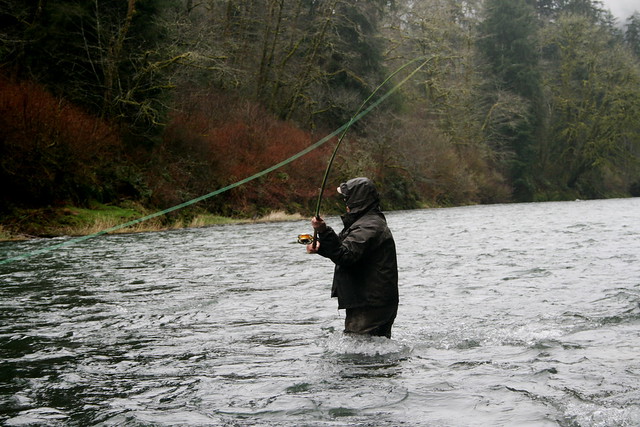
January, 2012. Here we are in full-frontal winter steelhead mode, watching our rivers raise and fall, sneaking off to ply the waters whenever and wherever we can, swinging, jigging, and dredging for chrome.
Chris asked me to share a few of my favorite winter steelhead flies and shoot videos for our fly tying fanatics on the blogosphere. I peeked into my fly boxes and was not pleased. Too much energy has been devoted recently obsessed with salmon, and not nearly enough on steelhead. My best ready to go boxes held only a modest assortment of tube leeches and simple marabou flies – my always dependable and ever-so-simple to tie steelhead flies.
Fact is, I gave away all of my steelhead egg, jig, and nymph flies two years ago. Gave ’em to my friends, and fly tying buddies. All of my incicarot flies plus about four hundred hooks with chrome dumbells already lashed on, ready to whiz on some chenille and egg yarn to make deadly efficient, pocket probing, steelhead catching flies. Figured that I wouldn’t need ’em cuz i was going to be swinging leeches and tubes and intruders and besides my fly boxes were full anyway and …
So here we are in 2012 and guess what? I got me a brand spankin’ new single hander and a switch rod. I got me some big plans to tromp around some old and new haunts with egg flies, steelhead nymphs, and yes, some great jig-like flies too. This is back to my usual winter steelhead year, and I am excited at the prospects. Even got a tried-and-true 15′ T-3 sink tip for the single hander to swing the soft water when conditions are just right.
Back to topic at hand: winter steelhead flies. I dug deep into my memory banks and pulled up my most favorite eggs, nymphs, jigs, and prawn-like patterns – and then i spiced them up to please my eye and re-stock my winter steelhead fly boxes. It took me awhile to find my stride, and I have a pile of not-quite-right flies to share with my friends, but I am plain happy with the flies that now fill my winter boxes.
I now have a pleasing assortment of steelhead jig flies, steelhead nymph flies, steelhead prawns, and even a modernized Polar Shrimp. Imagine that. I am poised to be humbled, with all my great flies and tackle and supposed knowledge, and return to my roots searching for winter steelhead on the Oregon coast.
So sit back, peer into your computer or iPad and enjoy my 2012 collection of absolutely-guarenteed-to-catch-steelhead flies. Yes, that was one long adjective string.
We’re starting with the Steelhead Ugly Bug Fly. A fly that combined rubber legs with chenille and lead always caught steelhead in the old days. Now we have fancy chenille, and we have tungsten hot beads, and we have really neat colored wiggly dangly rubber legs, and these flies are gonna earn their way if we have the gumption to add water.
Eleven more winter steelhead flies will follow the Steelhead Ugly Bug. My ability to name these flies is not nearly as hot as the flies are, and I invite our readers to think up some great new names. Point is, these flies are all based on patterns that I have fished effectively over the years, and each is flat out assured to catch twenty seven steelhead per, or close, or at least get a bite, pull, grab, twitch, nudge, or look of interest.
Hope you find something of interest in this steelhead fly series. And BTW, these flies fish well in spring, summer, and autumn too.
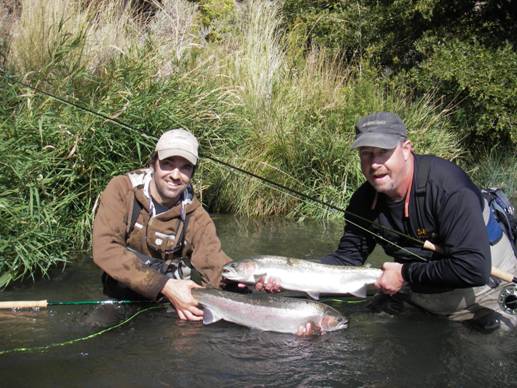
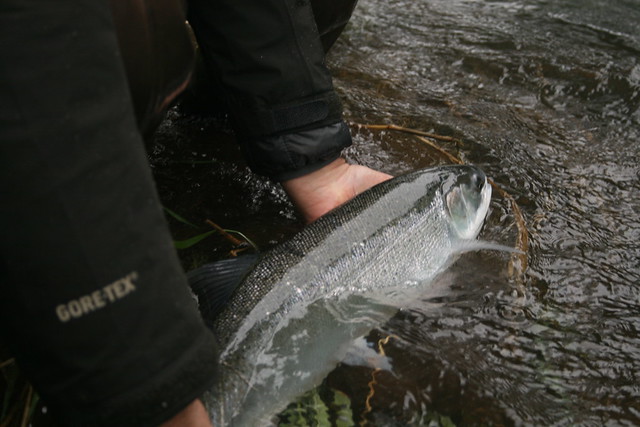
These guys put in a long day in the front of my boat last Saturday and came up big. The wild fish we encountered never left the water, while this brace of hatchery chromers met with the net just before a swift introduction to the priest. Remember people: hatchery fish are keepers. Defend our wild runs. Dispatch with extreme prejudice!
This has been a good winter of steelhead fishing so far, with a lot more to come. Right now we are on the front end of a big weather system. Things will probably blow out at least through the end of the week. Smaller systems like Lake Creek and the NF Alsea will drop back into shape before too long. When they do, get out there armed with some persistence, a thingamabobber, and a pocket full of lowly glowlies.
This is the Squidro Fly video series our fly-tying readers/viewers have been waiting for. Time to leave the messy details and the blah blathering in the dust and just get down to tie three of our Squidro fly patterns. We thank and acknowledge the creativity and fly tying skills of Scott Howell. These flies and the methods represent our best shot to date at tying a Squidro fly that is close to the fly that Scott ties. We share what we have learned so far, in order to help our fellow tiers get rocking this season. Our Squidro flies do not have the cool grizzly wings that many of Scott’s flies do, but these catch fish anyway, and we leave it to your discretion as to whether or not you add your wings, or top your Squidro with Ostrich, Fox, or Krystal flash
Chris and I invite you to browse these videos and help us build on our experience base over the coming year. A Lot of winter and summer steelhead are going to get a look at rubber legs, we think.
From the Native Fish Society: For the first time in Oregon history, the ecological and economic cost of our hatchery system will be discussed at a State Legislative hearing next week in Salem.
Beginning at 8:30 am on January 18th, Jim Lichatowich, noted author and former Assistant Chief of Fisheries at ODFW, Dr. Hans Radtke, Natural Resources Economist, and Dr. Peter Paquet, Senior Biologist and Wildlife Director of the Northwest Power and Conservation Council, will provide testimony to Senators in their fields of expertise concerning Oregon’s current hatchery operations.
Additionally, Native Fish Society’s Bill Bakke and Jim Myron will close the hearing by asking our Senators to take the necessary actions to ensure that State hatchery programs operate in an ecologically safe and economically responsible manner — the future of wild salmon and steelhead depend on it!
Members of Native Fish Society and the general public are welcome at the State Capitol for the hearing. We much appreciate the support of those able to attend!
To listen to the hearing online tomorrow click here
Mark your calendars now. It’s time to come out in support of native fish at ODFW’s public planning meeting next month.
When: Wed. Feb. 15, 7-9 pm
Where: LCC, Bldg 17, Room 308
Why: Outline the process for anglers to propose new or modified fishing regulations for 2013. Anglers will have until the end of February to submit proposals. See ODFW website for information about the regulation development process, guidelines and forms for submitting proposals, and existing staff proposals.
The important proposed regulation for McKenzie River Anglers: Eliminate use of bait to reduce hooking mortality on wild trout in a non-stocked wild trout rearing area on the McKenzie River between Hendricks Bridge and Hayden Bridge.The objective of this regulation change is to create a production area for native rainbow trout in the lower McKenzie River that will add to the sustainability of the McKenzie River trout populations. This section of the river has excellent potential for production of large rainbow trout (see photo) for non-consumptive angler use. The new rule would reduce hooking mortality on wild trout in the non-stocked area while allowing the retention of hatchery trout that drift downriver from above Hendricks Bridge and allowing salmon and steelhead anglers to use bait during the peak of these runs. (Proposed by ODFW’s Kelly Reis, Jeff Ziller)
For more information, contact Jeff Ziller or Kelly Reis, ODFW, at 541-726-3515.
Our buddy Rick asked us to post this video about the Enbridge Pipeline.
Pipe Up Against Enbridge: The pipeline would crosses some 1,000 streams and rivers, including sensitive salmon spawning habitat in the upper Fraser, Skeena, and Kitimat watersheds. Five important salmon rivers that would be impacted are the Stuart River, Morice River, Copper River, Kitimat River and Salmon River.
Canada’s Green Party: In the summer of 2010, Enbridge had two pipeline failures in the US – both of which threatened watersheds.
Our Squidro Fly feature continues the video series with demonstrations and discussion about what to tie the Sqidro on, specifically, Shank Options — and just as important, how to secure the fly shank of choice in a vise.
Scott Howell apparently uses a really cool drill-chuck gizmo to secure his shanks to tie Intruders and Squidro flies, but we had to come up with an alternative approach because we do not have one of those things and figure that most of our viewers don’t have access to this tool either.
Three alternative means of securing a Squidro Shank are as follows. First, simply use a Fish Skull Articulated Shanks. This is the simplest approach. The downside is that these shanks are constructed of fairly light wire and are therefore very springy. This requires one to support the shank while tying, using whatever spare hand is available. The fine diameter of the wire also made the process of lashing in the rubber legs a little more challenging. Continue reading →
Dubbed bodies and heads are standard fare for our flies. We still tie with chenille and floss and yarn, but dubbing has been and will forever be an essential ingredient in our tasty stew of fly tying materials.
This video offers an action packed look at how easy it can be to make dubbing brushes with the Jade River Turbo Dubbing Block. This is a new product offered by our friends at Hareline Dubbin for the 2011-2012 season.
What is a Dubbing Brush? Think about a piece of chenille about 6 or 7 inches long. Lay it out on your fly tying bench. A dubbing brush is an analog to your piece of chenille, only it is composed of your dubbing material of choice (Ice Dub, STS, Rabbit Fur, Arctic Fox Tail and so on). You can add short sections of Krystal Flash, Flashabou, Rubber legs, Marabou Fibers, Pheasant tail fibers, and any special additive to make the Dubbing Brush of your choice. Instead of thread, our Dubbing Brushes typically employ a core of wire, usually copper but sometimes stainless steel. The wire core keeps the Dubbing Brush intact and allows it to lay straight and neat in a pile or in a baggie – ready for use at your convenience. Imagine now, twenty or so nice straight dubbing brushes laid out on your bench. Imagine your dubbing brushes in any single color or color combination, and you have a very nice supply of body materials, a stash that will make your fly tying more efficient.
Our experience with the Jade River Turbo dubbing Block is that it can take a little practice spreading an appropriate amount of dubbing material on the base wire. Too much makes the brush lumpy – too little allows the wire core to show through (not necessarily a bad thing).
HarelineHareline Ice Dub is super easy to use with the Jade River Turbo Dubbing block, and and Hareline STS Trilobal Dub is also a favorite, although it requires a little more finesse than the Ice Dub. Creating a nice pile of fuzzy dubbing brushes has proven to be a great time saver when tying flies like Scott Howell’s Squidro, and it has also served us well tying other patterns of late, like Jeff Hickman’s Flash Taco.
Lake Nymph fly tyers should note the possibility of creating dubbing bushes with relatively sparse, long, whispy materials and allowing the wire core to show through liberally. Using red copper wire with brushes like these has great potential for tying scuds and lake leeches.
Sparse summer steelhead flies, too, should benefit from the wire show-through technique to make buggy, slim, bodies with just a hint of gold, copper, red, green, or purple wire showing through. Exciting possibilities.
Look out, you slightly crazy fly tyers out there. It is so much fun making these brushes that you might be tempted to spin up a hundred at a time. Just sayin.’
Scott Howell is an innovative guy. When it comes to fly fishing for steelhead, and we mean swinging flies for chrome, Scott is a solid mass of creativity and persistence. His imaginative exploration of the world of steelhead fly fishing includes development of cutting edge fly patterns as well as fishing and casting techniques.
The Squidro Fly is but one example of the signature Scott Howell Steelhead Mojo we have come to admire. This is a fly that pushes the boundaries between the feathered world of the traditional steelhead fly and the arcane rubberized world of the Bass Danglers. (Anglers who dangle are Danglers, duh).
In this tutorial, Jay Nicholas shares his observations on the composition of a Squidro fly. Keep in mind, that he had never seen one of these flies until I asked him to work on these videos. Weeks later, Jay emerged from his den, eyes all blinkey-eyed, and said he was ready to begin shooting videos. This is the first in our Squidro video series. Jay and I hope you find something interesting and a few helpful tips to ease your journey down the path of rubber legged flies.
Expect two more posts on the Caddis Fly Blog with hands-on details of our Squidro adventures, from shanks, attaching stinger hooks, dubbing materials, how to secure shanks while tying the Squidro, types and colors of rubber legs, and start-to-finish videos showing three different Squidro Flies.
Trout Unlimited Chapter 678 will be holding it’s monthly membership meeting the Vet’s Club at 7:00 PM. This month the meeting willl be held upstatir in the green room. Fly fishing guide Matt Ramsey will share some stories and images with our membership from outer Mongolia. Matt has guided for Sweetwater Travel’s fly fishing camps in Mongolia since 1998 in pursuit of taimen, the world’s largest salmonid. Matt’s presentation will focus on Mongolian culture, taimen conservation efforts and fishing for taimen. Naturally, the presentation will include liberal doses of fish porn.
As always, membership meetings are free and open to the public. Hope to see you there.–KM
Water conditions are back to ideal for trout and Steelhead. The weather has been mild, we are pretty lucky to have year round fishing opportunities.
Rick Bocko sent us this report from this past Weekend.
Recently my fishing ventures have included attempts to catch the elusive Winter Steelhead. Alas, winter steel escaped me again last weekend. Thankfully the Eugene area is home to some wonderful Winter fishing opportunities, for fish that are more cooperative and can still put up a great fight on a 4 wt. rod. Though the coastal fish skunked me, there was comfort in visiting with the resident trout of the Cascade side of town”
Rick
P.S.: the biggest trout caught on size 20 green beadhead zebra midge, trailing a Gus Bugger; the second biggest trout took a size 18 BWO looking nymph/emerger trailing an ultra wire golden stonefly nymph.
I spent some time with Captain Nate over the holidays reminiscing about his time on the Oregon Coast over a bottle of Captain Morgan Reserve. Here are some excerpts:
So what do you miss most about fishing the Oregon Coast?
What I miss most is the variety and diversity of fish. There are 200 species of rockfish alone, and then there are the fish that eat those fish! I miss the whales and dolphins, catching salmon in open water on flies. There’s an offshore scene for sharks and tuna, and a deep water fishery where you can get into 500 feet of water and catch God-knows-what. The diversity and amount of fish are unlike anywhere else.
While a lot of it has been fished for before, there aren’t many people doing it. Nobody is going to be out there with you. That’s good and bad. From a guide’s perspective it’s hard, because there aren’t any supporting industries around a recreational fishery. But fly fishing is one of the best ways to catch these fish. I’ve out-fished people with gear rods, and have been out days when fish won’t bite anything else.
So why isn’t anybody guiding the Oregon ocean?
It’s the most underutilized light tackle fishery I’ve come across. When you fish in Florida, there are people everywhere. Montauk, people everywhere. Great lakes, people everywhere. No one is fishing off the Oregon Coast and they’re not coming
Guides can’t charge enough to offset the costs, and there is a limited amount of times you can go out. Let’s say you charge the same rates as a drift boat, around $400. I’d spend $100 minimum in fuel, $100 for a mate, $50 in gas for the truck, $100 in gear and food. That leaves me $50 for 15-hours work.
People have done it, and people will do it again. But it’s physically demanding. Big water, scary conditions, brutal. Most clients aren’t ready for a 12 hour day of getting their asses beat.
What was your best guide trip?
The first time I took the boat out 45 miles offshore for tuna. I’d never really tried to catch tuna, never been offshore. It’s so scary in a 19 foot boat with a 60 gallon tank. I took the seats out of the boat to cut down on weight, and kept the RPMs between 3500-4000 or we’d run out of gas before we could get back. Continue reading →
Don’t miss a special presentation from famed angler/photographer Brian Okeefe this Jan 19th at the Oregon Electric Station6:30-8:30 pm. Brian’s program will be 6-8 Catch Magazine videos, with behind the scenes insight – the boo boos, the adventure, the fun, the unexpected, etc. Then a short break and a power point show on Oregon Fly Fishing.
Catch Magazine and The Caddis Fly will be providing Steelhead Brew. The Event is FREE.
Please send me an email if you plan to attend, I would hate to run out of Beer. Email to caddiseug@yahoo.com