This Monday through Thursday only, bring in our plastic fly cups and get 10% off any fly purchase of any size. Online orders for ship or in store pick up will receive the 10% off automatically.
We also have great deals online on remaining summer clothing, bags, rods, reels and many other items, including a $15 table that has Mountain Khaki Cords (normally $75) on it.
Don’t get me wrong, I’m eager for October Caddis hatches, coastal salmon in our rivers, and football on TV. But it’s great to get a last blast of summer.
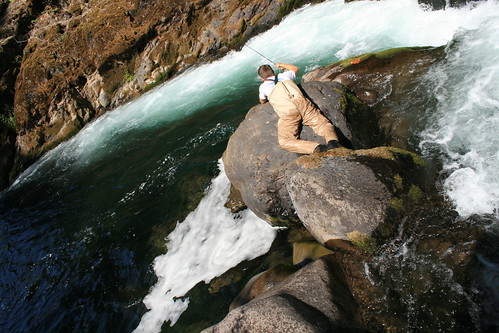
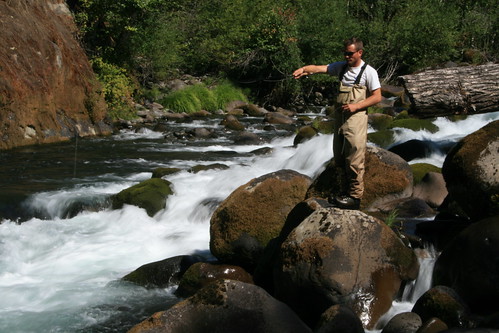
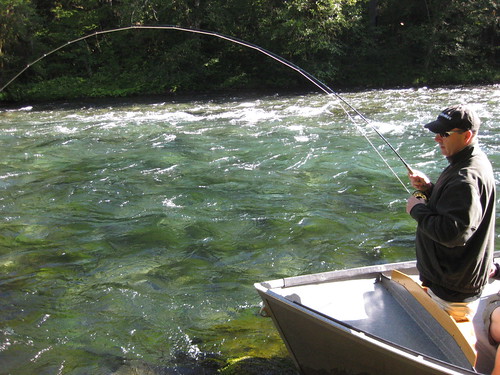
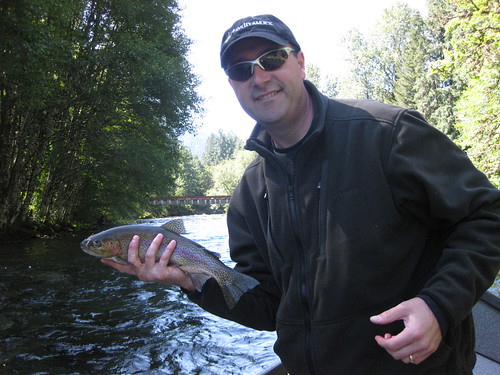
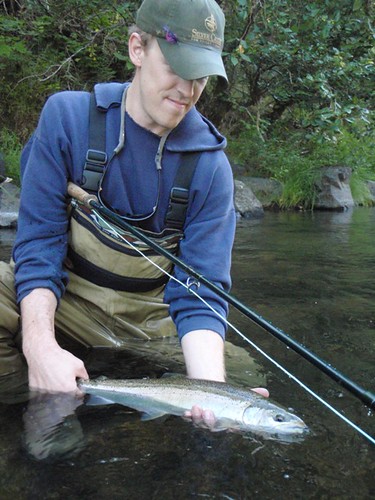
Nate and I hiked a few miles of an Upper Willamette Tributary yesterday, fishing plunge pools and riffles for wild redsides. The fish were small but plentiful, with a few in the 12-inch range.
I caught the majority of my fish on a size 10 yellow stimulator, in an attempt to match the current “termite hatch” going off in the area now. Termites are trout candy, according to a Westfly article by Hafele and Hughes:
Once a year each colony produces thousands of winged reproductive adults that mate and search for new nesting sites. This is the most important time to fly fishers, since these swarms of flying ants and termites often end up in the surface of lakes or streams.
Trout seem to have a high preference for these hapless creatures, and the fishing can be fast during an ant or termite “fall.” The exact time swarms take to the air depends on local species and conditions. Several falls of ants or termites may occur in an area during a season, and you should be on the lookout for them anytime from May through September.
I didn’t see any termites on the wing yesterday, but have seen a lot around town.
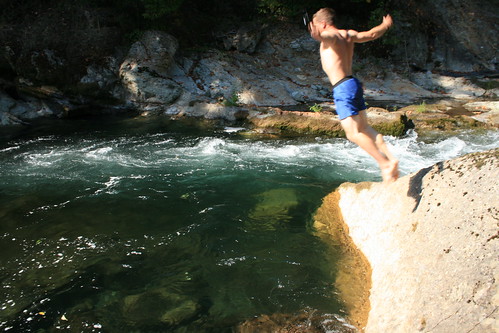
The fishing on these small streams will get much better over the next several weeks, but the school-hating kid in me is still sad to see summer go. Not many weekends left when you’ll be able to vent finicky trout frustrations by cannon-balling the pool.
Bob Hunter, founding board member of WaterWatch and the Oregon Water Trust, recently came to Eugene to speak with our local Trout Unlimited Chapter about removal of Rogue River Dams.
In an effort spanning more than 20 years, Hunter and WaterWatch have fought entrenched state and local bureaucracies to save one of the largest salmon and steelhead runs in our state. And now we’re on the cusp of reaping the rewards of WaterWatch’s hard work.
Savage Rapids Dam is the first man made obstacle on the Rogue River between the Ocean and Grants Pass. The dam is 39-foot high, 500-foot long and spans the mainstem of the Rogue River at river mile 107.
According to Hunter, there are over 500 miles of salmon and steelhead spawning habitat upstream of Savage Rapids Dam, including 50 miles on the mainstem of the Rogue River. All spring chinook salmon spawn upstream of the dam, and the dam impedes passage of significant portions of the four other runs of salmon and steelhead in the Rogue
The dam has long been considered the biggest fish killer on the Rogue. The dam harms and delays returning adult fish, but the pump turbine system has never been properly screened and it kills a lot of fry heading downstream. The 3.5 miles of reservoir flood prime fall chinook spawning habitat.
From WaterWatch:
The dam is strictly an irrigation diversion dam and is being replaced by pumps. It does not provide any flood control, storage, navigation, or hydropower function. The structure has been a considerable problem for salmon because the facility’s fish ladders and screens do not meet current legal standards. There is also increased predation of juvenile salmon in the seasonal reservoir pool created by the dam and after juveniles pass through the dam’s bypass systems. Additionally, the reservoir pool covers over 3.5 miles of fall chinook salmon spawning habitat. This habitat could be reclaimed when the dam is removed.
According to a 1995 Bureau of Reclamation Planning Report and Environmental Statement (PRES), removal of the dam would increase fish escapement at the site by 22%. This translates into approximately 114,000 more salmon and steelhead each year (87,900 that would be available for sport and commercial harvest and 26,700 that would escape to spawn) valued at approximately $5,000,000 annually. Reclamation’s PRES also found removing the dam and replacing it with pumps to be more cost effective than trying to fix the ladders and screens.
History: The dam was built by the Grants Pass Irrigation District in the 1920s. By 1988, the GPID had 100 miles of open leaky canals and was asking for more water. The district attempted to secure additional water rights to the Rogue in 1988, and that’s when WaterWatch, The Rogue Fly Fishers raised the issue of fish passage.
The U.S. Bureau of Reclamation had determined that dam removal and irrigation pump replacements would be cheaper than fixing the dam, and the GPID was onboard. But state politics got in the way and the GPID reneged on the dam removal deal.
Through the Endangered Species Act listing of Oregon Coho, WaterWatch, EarthJustice and Trout Unlimited locked down an agreement through litigation, and finally got to work on how to remove the dam. OWEB stepped up and pledged $3 million – the most they’ve ever spent toward dam removal, and that made the project real. In October 2006, the first dam removal equipment arrived on site.
This is going to be the last year of a fish trying to pass Savage Rapids Dam. You can see the gallery of Savage Rapids dam removal images. The removal project is expected to be completed by late 2009.
While Savage Rapids is the biggest fish killer, WaterWatch has coordinated with other groups to facilitate the removal of Gold Hill Dam, Gold Ray Dam and Elk Creek Dam.
Gold Hill Dam, which was identified as the 2nd greatest hindrance to fish passage in the Rogue Basin, after Savage Rapids Dam, was removed in Summer 2008.
The dam, which was built in the early 1900’s, once served as a diversion to a power generation facility, and was the source of the City’s municipal drinking water. The power facility is no longer in use, and the City removes water through a new water supply intake built in 2006.
Gold Ray Dam is a 38-foot high, 360-foot long defunct hydropower dam located in Jackson County, Oregon on the mainstem of the Rogue River at river mile 125.7. Its removal represents one of the largest dam removals ever undertaken in the United States.
Upon removal in late 2010, Gold Ray Dam will represent the fourth significant dam removed or notched in the Rogue Basin in three years, and mark the end of the largest number of significant dam removals ever to occur within a single river basin in so short a time span.
With Gold Ray Dam removed, there will be 157 unhindered river miles from Lost Creek to the ocean.
According to WaterWatch, Elk Creek Dam has been sitting partially constructed and serving no useful purpose for decades. The dam blocked Elk Creek and its inadequate fish passage facilities caused major problems for salmon and steelhead. Historically, an estimated 30% of the Rogue Basin’s coho salmon spawned in Elk Creek.
They blew a notch in the dam with dynamite in July 2008.
Despite petty political grandstanding and bureaucratic stonewalling, after twenty years we’re laying TNT and backhoes into these dams and that’s got to be one of the most satisfying outcomes I can imagine.
Fall is definitely is the air. Even when high temperatures reach towards 90 degrees this week, it’s only for a hour out of what is perfect early fall weather. The only problem is it doesn’t last for 6 months!
The McKenzie has been fishing very well of late. The Corps of Engineers have started their annual draw down on both the McKenzie and Willamette Rivers. This push/flush of cold water freshens our local waters, and they will fish well in their entire lengths through the fall.
This flush also moves steelhead around, expect fishing below Leaburg Dam on the McKenzie and Dexter Dam on the Middle Fork to be very good. Spring Chinook Salmon will be on their reds over the next couple of weeks and this never hurts fishing for large trout and steelhead looking for an easy meal of Salmon Eggs.
Low light conditions and the higher water will improve the lower McKenzie. Anglers will find shaded water throughout the day. The upper McKenzie is going to be tougher to wade below Blue River and the South Fork confluence because of the water release, but above on the McKenzie River trail fishing can be awesome mid day.
The Science of Restoring Rivers: Floodplain Restoration on the Willamette
Rivers and their floodplains provide homes for salmon and other aquatic critters, as well as drinking water, recreation, and rejuvenation for humans. Floodplains also produce “ecosystem services,” such absorbing our pollution, providing water for irrigation, detaining and storing floodwater, and providing favored places to build. Yet, with climate change, a growing population and crashing salmon runs, how can “science” help? At this Science Pub, Chris Orsinger will speak about how to apply knowledge from the sciences of hydrology, the geology and shape of rivers, climate predictions, and native plants to restore healthy rivers.
Chris Orsinger has been executive director of Friends of Buford Park & Mt. Pisgah since 1995. He has led floodplain restoration projects on the Coast Fork of the Willamette, restoring flow to “abandoned” side channels, controlling invasive weeds, and restoring native habitat and floodplain functions on over 250 acres. Chris participates in inter-agency Willamette Basin floodplain restoration planning. As the leader of Friends of Buford Park, he oversees a native plant nursery growing over 85 species, prairie and oak savanna restoration, and trail enhancements. The organization involves over 600 volunteers annually. Chris is also leading the organization’s initiative to add 1200 acres with six miles of river front to Buford Park.
The text message came at 1:59 p.m. on Sunday afternoon… “Give er another go this eve?” After a little “convincing”, we agreed on a short float down a familiar stretch (Rick and I had gone out the night before and all we got was a couple of bumps).
We launched at about 6 and rowed right through good water to get to some great water for summer steelhead. It is a “go-to” spot — particularly productive early in the day or at last light.
Rick was on the oars and we had two flies out in front of the boat. We worked the tail-out methodically, swinging both flies in slow graceful arcs right in front of these huge flat slabs of rock that more often than not hold a Steelhead in September.
On about the second pass through the tail-out a Steelhead came from beside the boulder in the center of the tail-out and hit Rick’s black and blue leech like he hadn’t had a meal in months. Rick’s 8 wt. almost left the boat, but he grabbed it just in time and dropped the anchor to fight the fish. I checked my watch – 6:15 p.m… awesome.
After a rum toast we took a few more passes and then pushed through the break. Fishing below the tail-out is usually even more productive in this stretch and we weren’t disappointed. Minutes after boating the first Steelhead of the night, Rick’s rod tip hit the water when another Steelhead hit the blue and black leach. No “hook-up” on that one but “close” very very close.
We reeled up and pushed through fishable water to get to a favorite place to end the day. I considered switching from purple to black and blue but didn’t, instead – I took the oars, figuring it must be the “hot seat”.
Anytime Rick offers to let me row, I take it – his boat is easy to row and his Sawyer oars are light as a feather. We made a pass through water that looked magical – light was fading fast and it put such a nice touch of “darkness” to the reflection on the water, we just knew we were going to hook up. We didn’t. It was 7:45 and we had time for only one more pass through this “fishy looking” stretch before total darkness.
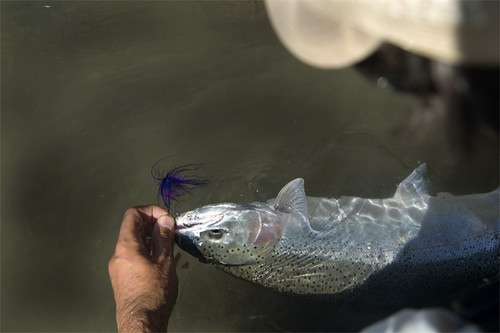
On the second time through, my rod jumped from where it was laying peacefully by my side and I grabbed the reel as it went sailing by. It was a feisty Steelhead that hit my purple leach and using the current to it’s advantage, gave us a great fight and a wonderful show.
When we landed the second fish it was dark and we were late. We both scrambled for cell phones to let “significant others” know we were out of the water and had fish to clean… plural.
We had another toast of rum and cleaned our fish… man I love this time of year!! If Rick sends you a text – jump on it… but only if he let’s you row his boat – that was one “hot” seat last night.
Jeff Hickman and other anglers are attending the Board of Forestry meeting in Silverton today — 8am to 12pm. The Board is trying redefine “Greatest Permanent Value” of our state forests as maximum timber, mudslides and decimated rivers.
Jeff Hickman, an angler and advocate with the Sierra Club, challenged Marvin Brown, the state forester, on a statement he made in June that recreation in the Tillamook and Clatsop state forests generated about $800,000 in revenue.
Hickman cited a study funded by Travel Oregon that found fishing, hunting and other activities in the forests proved tens of millions of dollars in economic benefit for Tillamook and Clatsop counties.
Brown responded by saying that he had erred back in June.
“I do stand corrected on the recreation figure,” Brown said. “I sometimes get things wrong; I got that wrong.”
Last week I had the pleasure of taking some of the awesome Idylwilde Fly team out for a day on the Lower Deschutes. It was going to be Matt, Patrick, Zach and me. All three of them are very experienced anglers. Matt however had yet to spend anytime swinging a fly in search of chrome. We had a clear mission that day: get Matt (the trout slayer) into his first steelhead on a fly. He was excited to say the least, I don’t think he slept for at least two nights leading up to the trip.
I didn’t know what to expect with the day, as just two nights before, the clarity of the river went to chalk. Something had happened up on the White River Glacier and the White began spitting glacial till into the Deschutes just upstream of Sherars Falls. With cooler evening temps, I made the call to go forward with the trip despite the lack of clarity. I dumped the boat in that morning 20 minutes before first light and the water didn’t look good. Chalk with no more than a foot and a half vis. I did my best to remain confident but it was fading quickly. We jetted up river as the first hints of dawn revealed the path. We started with dry lines and some very proven classic style flies, an Idyl’s Postman and Silvey’s Pool Cleaner. After working through several of the known buckets in the first piece the score was low. Nothing but one subtle bump without return.
We made our way up to the next piece and made the call to switch to larger profile flies on sink tips. Matt with 12ft of T-11 and a Purple Fish Taco for the head of the run, and Patrick with a short 7ft section of T-14 and a weighted Black Party Boy Leech for working the boulder strewn tailout.
I walked Matt up to the top and coached him as he worked slowly down to the sweet spot. When he started to get in the real good section I had him slow down even more. When the first swing came in behind the magic boulder I could almost countdown to when the line would stop and come tight. 3… 2… 1… One bump… drop… Second bump… drop… and here comes the, CRAP! Premature hookset!!!!
I kept Matt calm and we continued to work the fish. I told him sometimes they will drop back 15ft or so from that spot to the next hold, and I walked down to the tailout. Just as I came to the edge of the tall grass at the tail I watched Patrick’s line mid-swing get crushed. Fish on! It jumps, cartwheels, runs, jumps, cartwheels, runs more. All in all it jumped 7 times as it went to deep into the throat of the fast water and eventually popped off. Awesome fish, a perfect, hot chrome, wild, hen and perfectly executed LDR.
It took a few minutes for Patrick to catch his breath and allow his heart to return to a safe beat. But before he could relax, we heard a scream of joy and terror all at the same time come from up stream. At the same instant a chrome explosion broke the surface directly in front of us. The distinct sound of knuckles on reel handle followed by various shouts and mutterings of $#&% @ &$#% @%#. Matt’s hooked up!!!
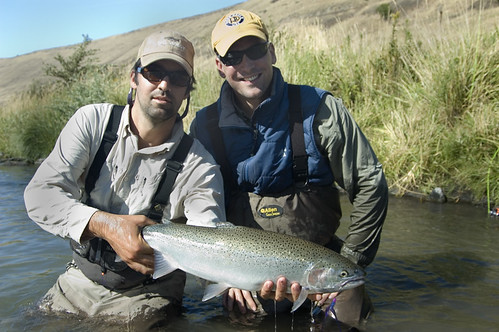
I ran up there to coach him through the epic butt kicking he was receiving. I think mostly I just offered moral support as the fish flew through the air, ran down stream, back upstream, across stream and amazingly stayed pinned through it all. We walked it down into the softer water and brought it in to be tailed. He did it!!!! He brought his first chrome native buck to hand on a swung fly!
It was truly an awesome event to witness and be a part of. Nice work Matt!!! May it be the first of many awesome fish you bring to hand throughout your new career as a steelheader. The day continued strong with everyone bringing a fish to hand and many other opportunities. And the best part was we had most of the river to ourselves. Seems the glacial color kept most other folks off the water. This was one day that will go down in the memory book for me of special days on the river.
-Jeff Hickman,
Sierra Club Hunter/Angler Organizer
Steelhead Guide
Native Fish Society River Steward Guide Service Blog
Trout Unlimited Meeting Wednesday, Sept 9th, 7pm at the Eagles Aerie, 1375 Irving Rd, Eugene, OR
Featuring guest speaker Bob Hunter: Free the Rogue River!
The Rogue River in Southwestern Oregon is one of the nation’s most outstanding rivers. Because of its scenic beauty, world-class whitewater, and internationally renowned salmon and steelhead fishery, it was one of the original group of rivers designated as “wild and scenic” with the passage of the Wild and Scenic Rivers Act in 1968.
The Rogue’s salmon and steelhead have long suffered from a series of dams that are now coming down at an unprecedented rate. Removal of Savage Rapids Dam, known as the biggest fish killer on the Rogue, is nearing completion. Last year, the Gold Hill Diversion Dam was removed and Elk Creek Dam was notched. Gold Ray Dam may be removed as early as next year.
Bob Hunter, a staff attorney for WaterWatch of Oregon, will discuss these dam removals and WaterWatch’s “Free the Rogue Campaign”. WaterWatch is a statewide river conservation organization devoted to restoring and protecting natural flows in Oregon’s rivers and has played a leading role in these dam removal projects for the past twenty years. The goal of the campaign is to have a free flowing Rogue River for 157 miles from Lost Creek Dam to the ocean. The goal is now within reach.
Bob Hunter is a past president and honorary life-member of the Rogue Flyfishers, and founding board member of WaterWatch and the Oregon Water Trust. He is also an avid flyfisher.
Even if you’re not a TU member, this is guaranteed to be an outstanding presentation. Please come on by. -MS
In a “tongue in cheek” nod to the North Umpqua, our good friend Greg Hatten came up with names for several pools and tailouts on the McKenzie and Willamette Rivers
These names aren’t part of legendary river lore and won’t evoke images of Zane Gray fishing the camp water in pleated wool pants and hip waders… quite the opposite. My names are earthy and practical — anything but romantic and mystical — but they’re helpful.
Charting and naming over 100 pools with boulders, bars and riffles in my Steelhead logs is the best way for me to keep track of the home waters where I catch most of my Steelhead.
I don’t know how the “Sawtooth”, the “Sweetheart”, or the “Confluence” holes got their names on the “North”… but I know that my “motor hole” on the Willamette got it’s name when I pulled a small block engine out of it with the winch on my Toyota.
I know why the “Kitchen Pool” was named on the Umpqua and I also know that my hat goes around in a circle when I lose my footing in the “Whirlpool” on the Willamette (how I wish I would’ve named it “Toilet Bowl” – I visit it regularly and have dumped a phone, a camera, and more than a few flies in it).
I can relate to “Upper” and “Lower Mott” – but I like the “Upper” and “Lower Homeless” pools of my home waters because I often find someone sleeping amongst the alders a foot off the trail on summer mornings as the sun comes up and I have caught so many Steelhead from those two runs.
Every time I catch a Steelhead, I draw a picture, name the features, put a dot on the map, and make notes about the temperature, flies, leaders, wind, cloud cover etc… It’s a natural progression of an obsessive fly fisherman, I suppose. After six years of this activity, I have become very familiar with two great rivers that run through our backyard here in Eugene.
I make notes about many things – water temperature, water level, weather, length of leader, color, size & weight of fly … and when I hook up, I put a dot on my “section map” to more clearly visualize where steelhead cluster and hold. What I’ve captured along the way is a hundred little details about steelhead in the rivers I fish.
I can’t say for certain if any of this makes me more successful in my “steelhead pursuit”… after all, it’s steelhead we’re talking about,
but it has certainly changed the way I fish for them – in the rivers I know and the rivers I don’t.
If nothing else, I’ve got a lot of personal data to draw from. Here are a few stats:
* 95% of the steelhead I’ve caught were on “the swing”
* 5% of the steelhead I’ve caught were on “the strip” and the “take”
is usually on the first couple of strips
* 0% of the steelhead I’ve caught were dead drifting a nymph
* 0 = times I’ve tried to catch a steelhead dead drifting a nymph
* 85% of the steelhead I’ve caught hit the fly about 10 yards before
the end of the swing
* About 80% of the steelhead I’ve caught were “fin-clipped”
* I use 12 lb tippet on the Willamette and 10 lb everywhere else
* Managing line and fly depth through the swing is an art and the key to success in swinging flies for steelhead
My quest for North Umpqua chrome continued last weekend, this time with the help of an experienced young steelheader named Rob Kirschner. He was determined to guide me into a fish, and our first morning was a greatest-hits tour of the lower river. When North Umpqua steelheaders say “lower river,” they’re usually referring to the water from Wright Creek to Rock Creek, still 100-plus miles from tidewater. That’s weird, but I can get with the program. When in The Valley…
Rob knows the river, and he’s racked up a lot of fish in his relatively short Umpqua career. A longtime Clearwater steelheader, he credits others for his Umpqua knowledge, including Lee Spencer. But he owns it now, and he’s an excellent guide’s guide. Rob’s a muddler guy, and his confidence is contagious. We started low in the river, and we both felt the anticipation as I worked through an incredible tailout. No dice. Then a quick drive to the next “money” spot. Again, nothing, but great scenery and sweet skating.
Our third spot was a small, unassuming riffle between two pools. It had the look. Being a gentleman, Rob offered it up, but I insisted he fish it. On his second or third swing he got railed, but it didn’t connect. He waved me over anxiously. I gave him the bird. “Catch the $%^& fish, dude.” He didn’t take much convincing.
Pow! His Burkie doubled over and his Marquis screamed. I stupidly called out “Nice fish!” thinking it had to be a bruiser. Hot, yes. Large, no. But what a fighter!
“That should have been your fish,” he said with a smile. Not a chance, buddy!
With a fish to the bank, it was time for biscuits and gravy in Idylyld, topped with a 1/4 pound smoked sausage for added rib-sticking power. Rob chugged a Rockstar and dug into one of the Idylyld Store’s gigantic breakfast burritos.
With that out of the way, we fished our butts off until dinner time, but no grabs. Our friends Jason and Ed had fished the upper river all day without a sniff. Poor Jason was crestfallen. You know you’re spoiled rotten when you complain about a fishless morning on the Umpqua. Jeez, man. Pull it together! That kinda punk-ass attitude is hard to take since I’m eleven years into a skunking!
The evening was equally slow, and soon we were huddled in front of an electric campfire, sipping beers, swapping stories, and passing the guitar around. There were no mosquitoes, a brilliant waxing moon, and an ocean of stars. Ed nodded off in his chair for the second night in a row.
Rob and I repeated our lower river program on day two, but Scott Howell was parked in the magic spot this time. We went down to Famous and The Flats, then jumped back to Baker. A whole bunch of nothing, not even a trout. We hit the store for another breakfast break, then explored the “upper river.” It was my first time in Frankie’s and Pat Lee’s, both of which were religious experiences. Spring chinook frolicked in both spots, making me feel very much at home. I even switched out to a mega-tip and dredged the deep water, in case a chrome steelie was hanging in the salmon water.
We snuck into Pinky’s, which usually doles out a few nice trout, but I was drawing blanks everywhere. Rob took off to be with his wife and child, and soon Jason, Ed and I were sharing a long run. The light was low, the water shaded. It was social steelheading at it’s best, and while were were talking, Ed’s muddler got drilled and spit out. A few minutes later he stuck another fish on his change-up fly. Ed was about 75 feet upstream of me, which placed his fish a couple of arm lengths away. I watched it go into a death-twist, flashing and yanking on his fly. A second later Ed’s line went dead. He pulled in the fly and exclaimed “Look what that fish did to my fly!”
The hook was bent, twisted and straightened, all at once. Awesome! Then Jason got a bump, his only of the weekend. Poor fella. I approached the choicest part of the run, the last several swings at the end of a broad tailout. I felt like it was about to happen. My body was tense. I was in the zone. But the light faded and was gone.
It was a quiet ride back to Eugene, all of us exhausted. We reflected on the weekend, another satisfying pilgrimage to the hallowed waters of the North Umpqua. I had added a long list of named pools to my list of favorites, and I was starting to see the forest through the trees. It occurred to me that it was time to go back alone and have a one-on-one with the rivers. Time to take off the training wheels.
Yesterday, Captain Nate took Barrett, Greg and I offshore out of Charleston, Coos Bay. We had decent ocean conditions, so we headed out in Nate’s 20-foot Boston Whaler. As soon as we crossed the bar, we started looking for slicks — areas on the ocean surface where the oil from salmon dismembering baitfish causes flat and shiny patches. We started trolling the slicks just outside the jaws of the jetties with both divers and flies, and quickly hooked up with a wild coho, which we released in the water. Hatchery coho salmon are fair game, and there are a huge number of coho coming back this year, but we didn’t find any other players right away and decided to skip salmon fishing and start the trip offshore for our real quarry — sharks on the fly rod.
I’d spent the week tying a bunch of shark flies with 8/0 Gamakatsu saltwater hooks, oversized eyes and red Icelandic Sheep wool — basically my northern pike pattern on steroids. We also had 12-14wt rods and heavy wire leaders. We wanted to be prepared, after some 200lb-plus salmon sharks kicked Nate and Cody’s ass last week out of Newport.
We headed out due-west from Coos Bay, looking for bait balls and surface commotion that would indicate predators nearby. We were about 12 miles out when we started seeing huge surface commotion — a large pod of Risso’s DolphinGrampus griseus were headed straight for the boat. It was amazing to see such a huge pod of these cetaceans.
After the pod of dolphins had passed, we started to see large flocks of birds working bait at the surface nearby. There were multiple places on the horizon where the surface commotion and bird action indicated baitfish being corralled and devoured.
The Rissos Dolphin were in the mix, along with a bunch of other marine predators, including Striped Dolphin and Sea Lions. And on the outskirts of all the commotion, blue sharks were cruising.
Smaller than the salmon sharks Nate had run into the week before, these blue sharks were closer to 65lbs. They swam lazily by on top, serpentine fins breaking the water’s surface. I quickly got up on the bow of the boat and got ready to make a cast to one of these beautiful, spooky-looking fish.
Adrenaline pumping, I flailed a bit before making a decent cast with the heavy rod and 8/0 fly, but eventually landed one in front of the cruising shark, and it was immediately interested. It followed my fly, coming right up behind it and then… nothing. The fish skulked off, turned away. We tried a few more times, and the fish turned, interested, and then I couldn’t seal the deal.
Barrett was up next, and the next shark was also interested in the red fly, and it looked like it had even taken it when the fly disappeared, but it never stuck. We had another dozen opportunities to cast to sharks that day, and I’m pretty sure I figured out the problem. The sharks were not aggressively feeding or running down bait. They were picking off the injured and scraps on the surface. These flies were sinking too fast. We needed a fly with more neutral buoyancy that would twitch near the surface. Back to the vise.
All of the action was on a temperature break — water temps had been steadily increasing as we went offshore and we were nearing that special 60-degree point where the pelagic predators like albacore hang out. We decided to push on, into a fogbank and warmer waters to see if we could run into more bait, sharks or even albacore. We ran to about 15 miles through a fog bank that cut visibility down to 100 yards. We found some sharks finning in the water, but no major bait action, and the waves had kicked up — swells looked like rising hills on the horizon through the fog. We decided to turn back to shore to spend the rest of the day on bottom fish.
On the way back, Striped Dolphins ran alongside the boat.
We headed to Simpson’s Reef where the bottom fishing was really hot. We caught loads of large black rockfish and I landed my first lingcod on the fly. We fished with clousers and high density shooting heads, as well as a special “Agressive Taper” sinking tip that Barrett had made specifically for fly fishing bottomfish 30-50 feet down.
While we were fishing the reef, we saw a gray whale surface 20 yards from the boat. We finished up for the afternoon with a few fillets for home and left as the waves near shore were kicking up.
Fall fishing is upon us and Oregon offers so much to do it’s often difficult to decide which magnificent water to visit. My personal favorite is the upper McKenzie River. Clear water, gorgeous fish, and light conditions that make all hours of the day productive from here on out.
Rogue River: Currently “half pounder” and adult steelhead are racing into the Lower Rogue. Reports are that fishing is best from Mule Creek Canyon to tide water. It looks like 2009 will be an excellent year for half pounders on the Rogue. Best patterns for these active juvenile steelhead are Mega Prince, Rogue River Red and Silver Ants,Steelhead Coachman, Tungsten Ice Prince # 8 and Septober Soft Hackle andDelectable Egg-head CDC Prince. The entire Rogue River system will be fishing well by mid September.
The Lower Deschutes was hampered by cloudy (White River blew out) and warm water this weekend. Fishing was reported as very slow. However there are great numbers of fish and things will be outstanding as the fall continues.
The North Umpqua has quietly been producing some good fishing. Fish have spread themselves out in the river and angling pressure has been moderate. Light conditions are improving daily for spotting fish and finding shade to fish all day long on the North Umpqua.
Best bets for local walk and wade fishing.
Salmon Creek, Salt Creek, and the North Fork of the Middle Fork are as accessible as they get. Fish a hopper or Royal Wulff as you walk up-stream from pool to pool.
The upper South Fork of the McKenzie and Upper Middle Fork of the Willamette — above Cougar and above Hills Creek Reservoirs offer a chance at a really big fish. Hatches similar to the main McKenzie this time of year.
Other waters to consider: Waldo Lake, Hosmer Lake, Craine Prarie Reservoir. In search of the 7lbs brookie pictures in those fishing magazines touting Quebec and Labrador. We have them in Oregon, although they are hard to catch, September and October are the months these fish begin to get active and available.
Town Run Steelhead, The McKenzie Below Leaburg, and The Middle Fork below Dexter. Fishing has been surprisingly consistent throughout the Summer and as usual will pick up with cooler nights, less pressure and spawning Chinook Salmon. Egg Sucking leeches, Moal Leeches, and Egg Patterns will do the trick on our local hatchery run Steelhead.
So many other areas to fish, have fun wherever you find yourself on the water.–CD
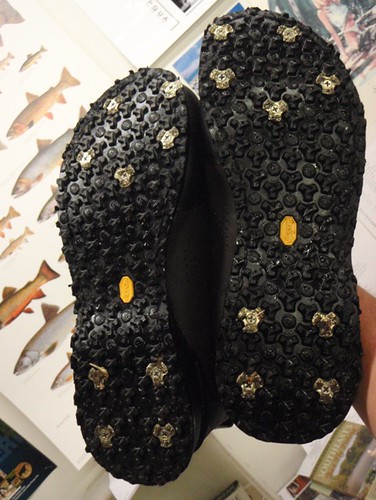
Now that I’ve crossed the 40-year threshhold, I consider it my duty to be resistant to all things new and different. So when Chris Daughters showed me the new “Vibram” boot soles from Simms, I immediately started into the reasons they had to suck. My ass is still sore from the last time I fell for the “no-slip-rubber” marketing ploy. Then Chris showed me the new Star Cleats that screw into the rubber. I had to admit they looked killer, but I was still cranky on the rubber soles.
Instead of just shaking his head and writing me off as he usually does, Chris challenged my assumptions:
“How do you know? You haven’t even tried them?”
“Yeah, but…”
“Look, take this pair, these cleats, and try them out? And don’t lose these cleats–they’re the only ones I have.”
“But they…(heavy sigh)…okay.” I owe Chris at least that much since he so graciously puts up with my constant complaining.
That weekend I brought the boots and cleats to the North Umpqua to try out. I figured out a good configuration for the cleats, got them all lined up and ready to screw in, and realized I didn’t have a screwdriver. Nice. Way to go bonehead.
Fast forward another week: I screwed the cleats into the soles as Hickman’s jet boat slammed against tight wind waves. My hands cramped a little on cleat number seventeen, but thankfully there were only eighteen total, nine per boot. They looked awesome, but my natural super-human resistance to everything kept me from pulling them on.
Finally, this very morning, I tightened the laces on my feet and took the new boots for a test drive on the Willamette River. The Willamette in Eugene is like a slightly sleazy version of the Umpqua–her naughty older sister. But the substrate is the same mix of gravel and sculpted basalt bedrock. In other words, it could soak you and/or crack your tailbone if you got careless.
The first thing I noticed was how quiet and soft they were as I walked across the asphalt parking lot to the boat ramp. Not the usual crunching sound that makes me cringe. Simms cleverly designed the sole with a billion little rubber cleats that stick out slightly farther than the metal cleats. Plus the rubber is soft, so the cleats just press up into their recess in the sole. It’s slick, I gotta admit. Then I got in the water and ran around like a big idiot, trying to slip and fall. But I couldn’t. They actually worked. They worked great. And they were super comfortable.
I never thought I’d say it, but I have to admit that the new soles, in combination with the triple-cleats, are a step up from the standard studded felt soles. They are environmentally friendly since they can be dried and/or cleaned between rivers to avoid the transmission of invasive species. They are removeable, so an angler can choose whether or not to destroy the floor of his buddy’s jet boat. And, maybe best of all, I can sneak into the Idylyld Store with my cleats on for a mid-day glazed doughnut—quiet as a mouse. That’s just plain bitchin!
The Angel Hair baitfish is one of the hottest East Coast saltwater fly patterns around. It’s a killer on striped bass and false albacore, but it’s also an excellent pattern for Pacific pelagic predators. This easy-to-tie fly is a killer baitfish imitation for any saltwater fly rod quarry.