An interview with Jay Nicholas by Matt Stansberry. This is a huge document, so please use the table of contents below to navigate.
CONTENTS
1. Introduction
2. North Umpqua Fishery Management Proposal
3. Native Fish Conservation Policy
4. Unique Biology of North Umpqua Winter Steelhead
5. Historical Abundance
6. Winchester Data Set
7. Historical Harvest Rates
8. Can Wild North Umpqua Winter Steelhead Sustain Harvest?
9. Hatchery Fish Impacts
10. Wild Salmon and Steelhead Harvest
11. Economics of Harvest Fisheries
12. Time-out?
13. Not-in My-Backyard?
14. Fish Management in Perspective
15. Conclusion
Introduction
M: Tell me a little about yourself, your professional qualifications, who you work for, and so on.
J: I devoted 30 great years working for The Oregon Department of Fish and Wildlife – doing field research on the coast; creating the Oregon Plan for Salmon and Watersheds under Governor Kitzhaber leadership; and working on ESA Recovery Plans. I began work with the Wild Salmon Center in 2007, focusing on efforts to protect the best-of the-best remaining salmon and steelhead populations – The Salmon Stronghold Partnership – in effect, the complement to ESA.
I’m also a passionate angler. I love all things about salmon, trout, and steelhead.
The remarks that I make in this interview are my professional judgment and opinion – I will strive to distinguish between the two. I am not representing the Wild Salmon Center in this interview. I remain open to correction regarding any of my remarks, in the spirit of encouraging constructive discussion of issues presented here.
North Umpqua Fishery Management Proposal
M: I’d like to begin this interview by asking you to describe the wild steelhead harvest proposal that ODFW has been working on. This management proposal strictly concerns North Umpqua winter steelhead, right?
J: Actually Matt, there is no formal proposal on the table, yet, for North Umpqua winter steelhead. What’s generating so much discussion is a rumor that ODFW might recommend a rule change to allow harvest of wild North Umpqua winter steelhead. At the present time, however, there is no formal proposal, period.
M: OK, so there is no formal proposal yet. But something is brewing. Can you describe the essential aspects of the harvest proposal I’ve heard people buzzing about?
J: There are many possible management options that could be proposed, but I’ll describe two here. Remember, please, that this is my effort to describe two hypothetical proposals, not actual options being proposed by ODFW and considered the Oregon Fish and Wildlife Commission (OFWC).
“Option A” would change current management regulation to allow harvest of wild North Umpqua winter steelhead on high run years. ODFW would limit harvest on a year-by-year basis, depending on the run forecast, and would conduct creel surveys to cap harvest at quota.
“Option B” would maintain current regulation requiring release of wild North Umpqua winter steelhead.
Both Option A and Option B could be tailored to include many variations, like stocking hatchery winter steelhead in the North Umpqua; setting a size limit to protect three-salt fish; setting a deadline for wild steelhead harvest at Rock Creek; and the possibility of eliminating the lures-only regulations above Rock Creek. As I said before, these are hypothetical elements of a proposal that has not been presented yet.
M: Didn’t the OFWC decide on a no-harvest regulation just last year? So why would ODFW try to reverse the commission’s decision now?
J: Yes, however, any of the decisions by the Oregon Fish and Wildlife are open to reconsideration at any future Commission meting, depending on whether ODFW has new or additional information and whether or not the Commission is willing to re-visit their previous decision. Emergency rule changes can be set between regular Commission meetings also, if ODFW staff make a compelling case. I am not the best source of procedural rules, but I think these basic concepts are correct.
M: But the Commission just agreed to protect North Umpqua from harvest of wild winter steelhead in 2008. Regulations are supposed to be in effect for four years. Some commissioners expressed a clear opinion that the current wild steelhead harvest prohibition deserved an opportunity to be evaluated.
So again, I ask you, why would ODFW push harvest of wild steelhead so soon after the Commission’s 2008 decision?
J: The situation is complicated and I have to rely on my intuition in answering this question.
First, I believe that ODFW staff are actively engaged in finding places where wild fish harvest fisheries can be justified biologically. I think that they believe that these wild fish harvest fisheries would increase angler participation. You and I can agree or disagree with the scenario, but I think that’s the general motivation.
Why the North Umpqua? If I was completely impartial; if I did not consider the heritage of this place and its international reputation; and if I was asked to identify places where wild steelhead harvest was biologically feasible, the North Umpqua would immediately rise to the top of the heap for analysis. Here’s why: a) the North Umpqua data set (from the fish ladder at Winchester dam) is unsurpassed on the coast, b) staff believe the North Umpqua winters are among the healthiest steelhead populations on the coast, and c) the data set might be suitable for making pre-season run forecasts.
The prospect of a harvest fishery for wild steelhead on the North Umpqua strikes me as wrong-headed, considering everything I know about the river, its history, and its steelhead.
But based strictly on the availability of data to analyze, the North Umpqua would be among the first places I would study to evaluate potential for a harvest of wild winter steelhead.
Again, I don’t know the motivation and thinking among ODFW staff or Commissioners, but I do know that they have the authority to revisit the 2008 decision, and a data set exists that may be used to advise wild steelhead harvest decisions. At this point, you need to pose these questions to ODFW and Commissioners to improve on my attempts to intuit their thinking.
M: OK, thanks, that helps. At least this gives us something to talk about. Why did you agree to participate in this interview?
J: I saw this interview as an opportunity to help ensure that all the science and policy aspects of management of North Umpqua are considered fully before a decision is made.
I hoped also to set a constructive tone for public discussion leading up to this decision. North Umpqua steelhead management is an issue that a lot of people are passionate about. I have seen similar discussions generate a lot of mean-spirited and misleading rhetoric. If that occurs in this discussion, everyone loses. The fish lose. The anglers lose.
It’s important for all concerned to understand the full range of policy decisions available to the Commission under the Native Fish conservation Policy (NFCP), the biological information we have about these fish, and how a decision about North Umpqua winter steelhead could be integrated into a regional management framework.
M: Please visit the North Umpqua Wild Steelhead Coalition for more information.
Native Fish Conservation Policy and North Umpqua Winter Steelhead
M: I have heard you refer to the ODFW Native Fish Conservation Policy and suggest that it should play a pivotal role in any decision regarding management of North Umpqua winter steelhead. Can you describe the policy and why you think it is so important?
J: This interview isn’t the best place to try to describe the NFCP in the level of detail the policy deserves. Instead of trying to interpret the policy, let me quote three paragraphs that set the stage for both conceptual intent and implementation of the policy – and provide a link to the policy.
The intent of the Native Fish Conservation Policy is to provide a basis for managing hatcheries, fisheries, habitat, predators, competitors, and pathogens in balance with sustainable production of naturally produced native fish. The policy has three areas of emphasis. The first is defensive to ensure the avoidance of serious depletion of native fish. The second is more proactive to restore and maintain native fish at levels providing ecological and societal benefits. The third ensures that, consistent with native fish conservation, opportunities for fisheries and other societal resource uses are not unnecessarily constrained. This approach will allow Oregon to play a vital role in the recovery of ESA listed species and the prevention of future listings.
The policy embraces the case-by-case application of a wide range of conservation and utilization strategies tailored to individual watersheds and situations. Policy implementation will likely illustrate a variety of management approaches across the landscape, such as areas focused on hatchery programs complemented with areas where hatchery influences are avoided.
The policy shall be implemented through conservation plans. Plans shall be developed in collaboration with management partners and the public, and will identify the desired and existing status of native fish, key limiting factors, management options to address these factors, and monitoring required to evaluate success. The Oregon Plan for Salmon and Watersheds, as well as other local and regional forums, shall provide the context for development, implementation and coordination of these plans. Existing rules shall guide management until conservation plans are completed.
North Umpqua winter steelhead are part of a species management unit (SMU) that extends from the Necanicum River to the Sixes River and contains something like 23 populations. Unfortunately, the conservation plan for Oregon’s Coastal Steelhead SMU has not been written yet. Species conservation plans require a significant commitment of staff resources to develop.
I believe that a conservation plan is the best place to iron-out a diverse set of river-by-river management options to protect specific populations, recover specific populations, emphasize hatchery fisheries in some basins, allow harvest of healthy wild populations in specific basins, conduct monitoring and research, address key limiting factors for specific populations, and identify a few of the signals we expect to observe if these management goals are (or are not) achieved in the future.
M: Is the OFWC commission bound by NFCP or other policy to approve a wild steelhead harvest fishery on the North Umpqua, or any other river for that matter, if scientific analysis demonstrates that the population can sustain a particular level of fishery mortality?
J: No. The Native Fish Conservation Policy provides the Commission and ODFW staff considerable latitude in use of hatchery fish and application of various harvest management options for wild fish. Native fish conservation policy is still fairly new and ODFW is in the process of figuring out how to implement it statewide in a manner that adequately considers available science, risk management, and social conditions.
M: Is the OFWC compelled by NFCP or other policy to establish a hatchery steelhead program on the North Umpqua if wild fish harvest is not approved?
J: No.
M: I have seen a Power Point slide suggesting that ODFW is offering Smith River as a wild steelhead sanctuary in the Umpqua basin. What do you think about that suggestion?
J: On an SMU perspective, I would not suggest that the Smith and the North Umpqua represent any sort of parity in terms of their ecological, genetic, and social values. Suggesting that Smith River could serve as a wild steelhead sanctuary for the Umpqua basin would be sort of like offering a fishing rod as a straight-across trade for a world-class sporting goods business – not a fair trade – in my opinion.
M: Does the ODFW have the authority to start a new hatchery program on the North Umpqua without formal OFWC approval, public hearings, an environmental impact study, and the like.
J: I think they do.
M: I have heard that the ODFW Roseburg district office is planning to start a hatchery program for North Umpqua winter steelhead – your reaction?
J: I suppose there have been such discussions among ODFW staff. That’s the normal kind of lunch-room, fishing trip, and car-ride conversation that occurs all the time. When I was working for ODFW, I had plenty of conversations with colleagues – what-if scenarios – regarding hatchery and harvest policy. That’s how ideas get aired and critiqued in their early stages of development.
I would be greatly disappointed, however, if a hatchery program for North Umpqua winter steelhead is initiated before a conservation plan is completed for the SMU.
M: You seem to be proposing that certain rivers in the coast winter steelhead SMU could be formally zoned for wild fish harvest, catch and release of wild fish, hatchery emphasis, or no hatchery introductions. How about sharing your ideas regarding which rivers should be zoned for each of these management options?
J: Well, that’s the crux of my suggestion, which, by the way, is not an original idea. The NFCP leaves all of these options open under the overall umbrella of a conservation plan for the SMU. I’ve heard support for this approach from scientists, fishery managers, sport-fishing industry representatives, and fish conservation representatives. Has everyone been supportive? Nope. But most have.
The strength of this approach is that it provides a strategic road-map to achieve wild fish conservation and providing for biologically sustainable fishing opportunities for wild and hatchery fish.
As far as making specific suggestions on a river-by-river basis, I won’t do that. These decisions should be based on a thorough assessment of science, policy, and social information. As an individual, sure, I have some ideas. Everyone does. The positive aspects of developing this sort of road-map for management of wild and hatchery fish is that it will be the product of many good minds and consider many options for different rivers, with the species’ biology as a foundation.
Unique Biology of North Umpqua Winter Steelhead
M: There are both summer and winter steelhead in the North Umpqua – are these considered as different populations, distinct races, genetically?
J: The genetic differentiation between summers and winters, or between anadromous and resident O. mykiss for that matter, is slight. Still, these are considered as distinct populations.
M: I have heard you say that North Umpqua winter steelhead express rare life history characteristics – could you list some of the ways you think these fish are different, some of the reasons they merit special consideration, special protection?
J: Sure. Here are a few of the rare traits of North Umpqua Winter steelhead.
Migration distance
Most coastal winter steelhead migrate 30, 50, or maybe 70 miles to reach spawning areas. The migration of North Umpqua winters is more on the order of a hundred-and-fifty miles. Why is this a big deal? Distinct populations of steelhead carry the genetic programming that regulates energy storage, the amount of fat they accumulate in their bodies prior to making a spawning migration. Although I do not have data to support this case on the North Umpqua, I bet you that these fish store more fat in their bodies than the majority of steelhead in the SMU – and see this as a genetic stock difference that makes these fish especially important to protect.
Smolt age diversity
North Umpqua steelhead generally live two or three winter seasons in freshwater before they smolt and migrate to the ocean. The data I remember, reported in a National Marine Fisheries Service status report, indicated that roughly forty percent of North Umpqua winter steelhead smolted at age 3+. This is, I think, the highest representation of older steelhead smolts observed across Oregon, California, Washington, and even Idaho. This report (Busby et. al. 1996) is over ten years old, so ODFW may have access to more recent information. As it stands, though, the high representation of 3+ smolts among North Umpqua winter steelhead should pique everyone’s interest in these fish.
Ocean age at maturity
North Umpqua winter steelhead include a significant proportion of three-salt (three seasons in the ocean) adults – big fish that may be twenty pounds, twenty-five pounds, or even larger. The sample of North Umpqua winter steelhead noted in the NMFS status report indicated that about thirty percent of the fish were three-salt fish at first spawning migration.
M: How rare is rare? Are there three-salt winter steelhead in other Oregon coast populations?
J: Yes, three-salt winter steelhead are represented across the range of this species. That said, the combination of older age at smolting, plus the high incidence of three-salt ocean residence – these two factors result in a preponderance of five and six year old adults. Steelhead populations with such a high percentage of five- and six-year old first-time spawners is relatively rare across the range of winter steelhead in California, Oregon, and Washington. Winter steelhead in a few Olympic Peninsula rivers also may exhibit this older age structure at first spawning migration, but North Umpqua winter steelhead really seem to be unique in Oregon.
M: Aside from a larger percentage of big fish, and some distinct life history differences, what’s so special about North Umpqua winter steelhead?
J: Matt, these are absolutely wonderful wild fish. I use the phrase wonderful in the sense of being full of wonder. Think about the distances they migrate upriver. That’s really pushing the envelope for a coastal winter steelhead. This characteristic, alone, should stimulate us to go to great lengths to keep the population healthy.
The size of these fish… I sound pretty abstract, pretty calm when I say North Umpqua winters have a somewhat higher representation of three-ocean adults.
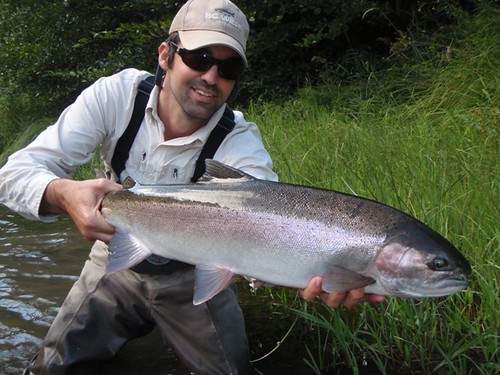
Hah! Here’s what makes my blood boil – the dream of hooking a twenty pounder here in Oregon. Twenty pounds – heck, let’s talk thirty! These aren’t just older fish, not just fish that can weigh more than fish we usually see in coastal streams here in Oregon. They are gorgeous, deep bodied, heavy shouldered fish like we usually only see in photos from exotic destination rivers like the Skeena. These are wild steelhead to take an angler’s breath away – giant sleek fish that burn a place in our memories for a lifetime. Fish to remember when we are being spoon-fed in a wheelchair in the nursing home.
I look at North Umpqua winter steelhead and I see a population that we can’t adequately describe with science. We have little if any information about genetic characteristics of these fish that governs timing of river entrance, maturation rates, storage of energy reserves, upriver migration rates, potential burst speed, ability to surmount rapids, selection of mainstem or tributary spawning areas, distribution of spawning dates, thermal units required for eggs to hatch, and so on. These un-quantified characteristics are among the many reasons that we should marvel at these fish and do our best to protect the productivity of the population.
That’s what my heart tells me when I think about wild North Umpqua winter steelhead.
Historical Abundance
M: Do you have any idea about what the historical runs of wild winter steelhead were like in the North Umpqua – I mean before the dams, before the mining, before the gillnetting – how abundant were these fish?
J: I don’t. This question should be posed to ODFW and USFS biologists with focused expertise in the Umpqua basin. I would note that the reduction in productivity for salmon and steelhead has been far more devastating on the South Umpqua than on the North. I’ve had conversations with local historians who tell me that the South Umpqua was historically considered the “Mother Lode” for salmon and steelhead, not the North.
Generally, though, the productive capacity of un-dammed coastal rivers is probably on the order of five to twenty percent of historical production. Humans have been busy little bees changing these rivers – changing them in ways that have not been good for salmon and steelhead. Given those general observations, if we see a contemporary run of fiver or ten thousand wild winter steelhead to the North Umpqua, it’s possible that a corresponding historical run could have been on the order of twenty to forty thousand fish.
Winchester data set
M: Getting back to possible regulation changes, it seems that a proposal to harvest wild winter steelhead depends on fish population counts. Is the data set from Winchester Dam reliable?
J: It depends on how you define reliable. There is a long data set representing the abundance of fish passing upstream over Winchester dam – a six-decade data-set of summer and winter steelhead, spring and fall Chinook, cutthroat, and coho. The Winchester data set, without interpretation, doesn’t tell the whole story.
People, scientists included, usually refer to the Winchester data set as portraying fish counts – the true numbers of fish migrating upstream over the dam. Today, the term fish count is probably fair, because we have the technology to operate video cameras 24/7, creating a visual record that can be reviewed in stop action. But that technology wasn’t available in the past.
The Winchester data set contains estimates based on methods that varied over time, involved different observers, in different water conditions, and so on. When a fish zipped by the window, it required a split-second decision, sometimes, of what an individual saw. It was common for people to count fish for a certain number of hours per day, or days per week, and then expand the counts into an estimate of the total number of fish passing the dam. Methodologies were sometimes well documented, but the numbers you see in a table today don’t reflect the fact that there was error associated with all of those estimates. Muddy water, differences in the hours or the days when fish passed the ladder, and identification of species and hatchery fish all represent sources of error that are often overlooked if we examine a 60-year and assume that the point for each year is correct.
M: It seems like ODFW depends on these fish counts as fact. Are you saying that we don’t know what to make of the Winchester data set?
J: Not at all. The Winchester dataset makes a huge contribution to our understanding of the anadromous fish migrating into the North Umpqua – and to our ability to correlate regional trends in abundance of anadromous fish across Oregon.
I simply want to make the point that there are a lot of caveats involved in interpreting these so-called counts. I’m only saying that it is important to do the difficult work of digging deeper before we make broad-brush conclusions based on assuming that the Winchester data-set is the truth, the whole truth, and nothing but the truth.
ODFW fish count data.
Historical Harvest Rates
M: What do we know about the harvest rates that North Umpqua winter steelhead have been subjected to in the past – harvest rates in recreational fisheries in the river?
J: I defer to the ODFW biologists to answer this one. It’s fair to ask about direct harvest rates as well as mortality of wild fish that have been caught and released.
If my recollections are in the right ballpark, ODFW has developed estimates of North Umpqua winter steelhead that have ranged from less than ten percent to over twenty percent. I think that those values depended on punch card estimates and the Winchester dam data set. Looking at the Winchester data set suggests that winter steelhead runs are typically in the five to ten thousand fish range. I do not know how precise the harvest rate estimates are, or whether there is a correlation between harvest rate and run strength or water conditions.
Punch card estimates are found at the ODFW website.
I will mention an interesting observation that relates to this question. In low water years, especially in cold low water years, Umpqua winter steelhead move into the mainstem and hold there. These are fish destined for the North and South forks and for many smaller tributaries, all schooled up in the mainstem. People have figured out how to catch these fish – very effectively. If these low water periods go on for weeks or months, these holding fish get hammered day-after-day in the same pools. This is, in effect a mixed-stock fishery because it harvests fish destined for small mainstem tributaries, the South and North fork, all holding in the mainstem together.
Guides fishing this area under these conditions have commented that they sometimes must release a dozen wild steelhead to find a couple of hatchery fish to harvest. Some guides have expressed concern about catch-and-release mortality on the wild fish. I don’t know what the mortality on these released wild fish is, but there must be some.
Some level of fishery mortality on North Umpqua winter steelhead is already occurring in the mainstem. How much? I don’t know. Is there enough of an OSP presence to deter people from harvesting wild steelhead on the mainstem Umpqua? I don’t know. I doubt it. Resources for fish biologists and OSP enforcement are limited. We rely on the goodwill of anglers and on peer pressure to encourage people to be responsible, to live up to the rules.
Can Wild North Umpqua Winter Steelhead Sustain Harvest?
M: How can ODFW go about deciding if the North Umpqua winter steelhead can or can not sustain a harvest of wild fish?
J: One approach ODFW scientists could take is to analyze the Winchester data set to estimate the natural equilibrium level (NEQ) for the winter steelhead population. NEQ is the average spawner abundance a population will achieve, given average environmental conditions and absence of fishery impacts. Runs above NEQ tend to be followed by lower runs; runs below NEQ tend to be followed by higher runs.
M: Would a NEQ harvest model consider all of the necessary factors in determining if winter steelhead can sustain harvest?
J: I don’t know. NFCP requires explicit consideration of life history diversity in the development of a species conservation plan. The contribution of various life histories to the productivity of a stock surely merits consideration in a harvest management plan, but I think the issue is rarely addressed because it is scientifically difficult to do so. Disproportionate harvest of different run segments throughout the season, of older age classes, or of fish destined for different parts of a basin could all have the effect of degrading productivity of the population. I do not think that equilibrium yield analyses are generally capable of considering these factors.
M: Could selective harvest of three-salts degrade productivity of wild population?
J: Without data to support my belief, I think so. The three-salts fish are there for a reason. Significant reduction, via harvest, of their representation in the spawning population is probably not a good thing for this wild population.
M: I have heard that ODFW scientists have already developed an equilibrium yield model, and that this model indicates that the North Umpqua winter steelhead can support a harvest of wild winter steelhead. Reaction? Is the model reliable? Is the model conservative? Do you believe it? Can North Umpqua winter steelhead support a harvest of wild fish?
J: Pass. I haven’t seen a model, I don’t know if it could incorporate the conservative precautions I would propose, if it could account for life history diversity, how annual harvest quotas would be crafted based on run-strength forecasts, and if an opportunity to make in-year adjustments would be part of the harvest proposal. I see little value in speculating about so many undetermined issues.
Hatchery fish impacts
M: Before we go further into this interview, could you tell us what your overall assessment is regarding the impact of hatchery fish on wild fish?
J: Sure, that’s easy – It’s not good. By that answer, I mean that it could be neutral, it could be just a little bad, it could be a big bad, but it probably is not good. It isn’t fair to assume that all the possible negative effects will occur every year, in every place, or to the same extent for every species. Make sense?
I believe that it’s fair to say that real-world situations where hatchery fish have actually benefited native wild populations are rare. So rare, in fact, that I cannot think of a single example in the scientific literature, except perhaps for situations where hatchery intervention seemed necessary to prevent the extinction of a population.
If there are examples of situations where hatchery fish have benefited otherwise healthy, wild, native salmon or steelhead populations, someone will certainly set us straight on this point. Then we could discuss the specifics of those examples and see if they inform our thinking about potential impacts of hatchery fish on North Umpqua salmon and steelhead.
I have looked around the Pacific Northwest at the thousands of places where we have moved salmon and steelhead around from on basin to another, and I don’t see that the hatchery fish have increased runs of native wild fish in the places where they have been stocked.
M: Given that hatchery summer steelhead have been stocked in the North Umpqua for a long time are you aware of a detectable change in the traits of the summers, the life history, the age at return, timing of return, or so on?
J: No. That is a question best answered by ODFW biologists.
M: The ODFW district office has suggested that the abundance trend of North Umpqua summers is positive over the last six decades, i.e., the summer steelhead population is actually improving over this time period. Are you aware of this assertion?
J: The graph we are discussing shows a regression line drawn through the Winchester Dam summer steelhead data set. The line drawn through the points has a positive slope. The implication of the regression line on that graph is that the productivity of the summer steelhead has improved over the six decade time-frame.
The key issue is that the graph has no bearing on evaluating what the productivity of North Umpqua summer steelhead would have been in absence of a hatchery program. Overall, I don’t see this graph as prima facie evidence for a good, bad, or neutral interaction between hatchery and wild steelhead.
M: OK, all that cerebral objectivity aside, what do you believe? Do you think the Umpqua hatchery steelhead program has been neutral in the North Umpqua given a history of non-native introductions and the length of time the program has been operated?
J: Gut level, professional judgment – I would be surprised if hatchery fish have not had an adverse impact on productivity of wild summers, and maybe on productivity of winter steelhead too.
And now we have stray hatchery winter steelhead crossing Winchester dam – about ten percent of the winter steelhead spawning in the North Umpqua in the last several decades, I believe, have been stray hatchery fish. And we also have Smith River coho salmon passing Winchester dam. I don’t think that ODFW has had the resources or made it a priority to examine the possibility that these hatchery programs, individually or collectively, have had an adverse impact on productivity of the wild runs. I think there has been an assumption that taking broodstock from wild fish captured in the ladder has eliminated risk of adverse impacts. The latest research we have seen on Hood River seems to indicate that even a single generation in the hatchery carries a fitness reduction that is concerning, at the very least.
Wild Salmon and Steelhead Harvest
M: How do you feel about allowing harvest of wild salmon and steelhead?
J: Great. I totally support providing harvest fisheries on wild salmon and steelhead populations – in fact, that would be job-1 of fish management in for Oregon if the productive capacity of so many of our habitats were not already severely degraded. Remember that wild chinook supported coastal fisheries for over five decades –world-class recreational harvest fisheries.
I think similar, more modest, opportunities exist with coho and steelhead too, but it’s important to base harvest fisheries on data rather than simply on tradition. ODFW has shown a legitimate and unprecedented level of conservation intervention by restricting or closing Chinook harvest fisheries in 2008 and 2009. This is the sort of responsiveness a regulatory agency must be prepared to execute. If the runs are expected to be up, let’s go fishing. If the runs are expected to be down, we’d better ease-up or not fish at all.
My preference is to have ODFW set harvest quotas for individual species and populations, based on exceeding equilibrium yield. Unfortunately, some species like sea-run cutthroat are difficult to monitor, so data to manage a fishery are likely to be scant. In these cases, again, I prefer keeping some populations off-limits to harvest of wild fish, providing a biological insurance policy.
M: As a scientist, how could you recommend against harvest of wild North Umpqua winter steelhead if the ODFW’s analysis supports the harvest?
J: I believe in the scientific method, but I’m not a slave to what we think science might be telling us. Fishery management is a blend of science, judgment, policy, and art. Fishery management decisions are rarely made strictly on the basis of experiment and hypothesis testing. As scientist/managers, hatcheries were promoted as an infallible, low-cost alternative to protecting wild fish habitat. That was wrong. Fish ladders were promoted the perfect solution to fish passage at dams. Nope. Exotic breeding, hybrids, and super trout were promoted as superior to native fish. Wrong again. Using native broodstock was promoted as the way to create hatchery fish indistinguishable from a wild fish. Ooops. Triploids were going to save fisheries all over the world and create 200 pound salmon. Didn’t happen. Chemical imprinting to reduce straying? Imperfect.
The point is not to discredit science, but to put fishery science and management decisions in perspective. We know a lot, but there is much we do not understand about Pacific salmon. My desire to keep some healthy wild populations off limits to harvest and hatcheries is partly a plea to exercise humble management, exercise the precautionary principle, balance risk, and preserve options for the future – and partly a plea to respect the international reputation of the North Umpqua. Nothing about my recommendation contradicts support for harvest fisheries supported by healthy wild salmon and steelhead populations.
M: Is there any possible downside if the commission retains the current no-harvest management for wild winter steelhead – if science says that the population can sustain a modest harvest?
J: There is a potential problem, and whether it is little or big depends on one’s perspective. We have better data on wild winter steelhead on the North Umpqua than for any other population in the SMU. If analysis suggests that this population can sustain a modest harvest, but the Commission declines to approve a wild fish harvest fishery here, based on the precautionary principle, the unique biology of the fish, and on the social values associated with the river – what then?
Would that decision set the bar so high that the Commission couldn’t approve a harvest fishery for wild winter steelhead in other populations in the SMU? Would fish conservation advocates rally against harvest of wild winter steelhead in all the other populations because they lack a five or six decade data set and the ability to count spawners every year?
Personally, I still recommend against harvest of wild North Umpqua winter steelhead. I would feel fine using regional run-strength forecasts to support wild steelhead harvest fisheries on other populations spread across the SMU, and propose using creel surveys and escapement monitoring to evaluate those fisheries. But that’s just my personal evaluation. Others might well say that the North Umpqua is the best place to conduct a harvest fishery for wild winter steelhead, because it is such a large population and has, for the present, the best assessment of escapement in the SMU.
This is a dilemma that can best be resolved by rolling out the road map for the entire SMU rather than taking on the North Umpqua by itself. That’s why I recommend leaving the catch-and-release regulation for wild winter steelhead in effect for the present.
Economics of Harvest Fisheries
M: I understand that ODFW sees a management to harvest wild winter steelhead on the North Umpqua as an opportunity, if a small one, to reverse a decline in angling opportunity and maybe even license sales, that has been occurring over the last twenty or thirty years. Would you share your thoughts on both the general and specific assumptions embedded in that statement?
J: I have strong feelings on the subject of angling opportunity and the relationship between the opportunity to fish versus the opportunity to harvest fish.
It’s important to note that what you just said about ODFW is largely based on assumption. Maybe some folks in ODFW think that allowing harvest on wild North Umpqua winter steelhead would increase participation in angling, increase license sales, and increase economic income to the local area. I’m guessing that there is a diversity of opinion on this matter within ODFW, just as there is outside the agency. It’s awkward, at best, to paint everyone in any organization with too broad a brush, don’t you think?
I want to have data to inform people’s ideas about how some of these regulation changes might affect angler participation, license sales, and the cash flowing into local businesses. Aside from speculation, that kind of information is elusive. In absence of data, how do you evaluate one person’s opinion against another person’s contrary opinion?
One person says that opening the North Umpqua to harvest of wild winter steelhead would increase participation and bring more money to the local economy. Another person says nonsense, maintaining the North Umpqua as a wild catch-and-release fishery is what brings in the biggest dollars, angler participation, and license sales.
Show me the data.
Personally, I believe that opportunities for the average angler to actually catch fish have declined in the last twenty or so years. But I don’t think that a general decline in angling (or harvest) opportunity, if real, can be strategically resolved by calling for the question on the North Umpqua.
Providing more fishing and harvest opportunity merits a thoughtful, regional assessment. That sort of assessment could be accomplished within the framework of a coastal winter steelhead conservation plan, but it should incorporate a comprehensive assessment of the fishing and harvest opportunities for all the species. That sort of comprehensive survey should identify places where wild fish zoning, hatchery fish zoning, wild fish harvest zones, and wild fish release zones could be proposed – and evaluated – on the basis of science, social factors, economic factors, and policy consistency.
If my answer wasn’t clear enough, let me try shorthand. Focusing on the North Umpqua is not an effective strategy to fix a statewide problem.
Time-out?
M: Jay, you seem to be calling for postponing decisions regarding both wild fish harvest and hatchery enhancement of North Umpqua winter steelhead? Why delay a decision that could be made sooner rather than later?
J: If ODFW and the Commission choose to open the North Umpqua to harvest of wild winter steelhead and/or stock hatchery winter steelhead in the North Umpqua before developing a conservation plan for the SMU, they run the risk of perpetuating a management legacy of enacting piece-meal, river-by-river decisions. I believe that NFCP was designed to provide the strategic framework for species conservation, creating harvest opportunities, and decision-making transparency.
Making this decision without taking a comprehensive look at the biological status, genetic characteristics, existing harvest regulations and hatchery programs, economic analyses, and so on, across the 23 winter steelhead populations in the SMU creates a lot of contention and presumes that these decisions can stand alone. I disagree with the one-population-at-a-time approach; I believe it deals wild fish, hatchery fish, fisheries, and the anglers – everyone – a disservice.
M: If the consequences of piece-meal management decisions like we’re discussing are as dire as you suggest, why would the OFWC forge ahead?
J: Tradition calls for getting-on with management decisions in a real world where science and the big-picture isn’t available – and might not be available for some time. While the Commission waits for the staff to produce data, management goes on. Seasons must be set. Constituents make demands that the OFWC believes must me answered promptly. People get passionate about their issues. They pack Commission meetings. They assail the biologists. I wonder if that pressure sustains a tradition of making patch-work management decisions rather than be accused of foot-dragging.
I believe that North Umpqua steelhead management, for the reasons previously noted, is a situation where the OFWC would be well justified in waiting for completion of a conservation plan for the Oregon coastal winter steelhead SMU. That plan would provide the framework for a comprehensive management strategy consistent with the stock status, science, policy options, and social factors – from the Necanicum, to the Sixes.
Not-in My-Backyard?
M: Playing Devil’s advocate for a moment, convince me that your position on the North Umpqua Winter steelhead isn’t just a case of NIMBY – not in my back yard – protectionism for your home water and your preferred fishing methods.
J: Good question. Here are my responses, point-by point.
• As a fish biologist and scientist, I believe that North Umpqua steelhead represent precious genetic resources that deserve the highest level of conservation management.
• I welcome a comprehensive approach to zoning wild fish catch-and-release, wild fish harvest, hatchery emphasis, and hatchery free zones across the SMU and the state.
• I can imagine some places where we are stocking hatchery fish now – but shouldn’t be. I can also imagine some places where we are not stocking hatchery fish now – but should be.
• I support harvest of wild salmon, steelhead, and trout, in areas that represent a strategic portfolio of populations consistent with fish conservation and recognition of diverse social values.
M: Given that you would prefer to see a no-harvest management option for wild North Umpqua winter steelhead, can you envision any circumstances under which you could accept an OFWC decision to allow a measured harvest of these fish?
J: Intellectually, yes. If that decision were based on a SMU-type of assessment that’s described in the NFCP (i.e., a conservation plan for Oregon coastal winter steelhead) and if that assessment was vetted thoroughly with the public – yes. Under those circumstances I would bite my tongue and shake everyone’s hand.
Emotionally? No, not really. I would regret that decision, but I could live with it.
M: Let me ask you the same question about hatchery winter steelhead: Can you envision any circumstances under which you could feel comfortable with an ODFW/OFWC decision to stock hatchery winter steelhead n the North Umpqua.
J: No. Never. We already know a lot about the effects of hatchery fish on wild fish; we’ve already got hatchery summers, spring chinook, and coho passing upstream over Winchester dam into one of the richest assemblages of anadromous fish on the Oregon coast. Given that I believe that the best-of-the-best remaining wild Pacific salmon runs should be protected at a higher level from threats to their productivity – I would disagree strenuously with a decision to increase risk from hatchery fish on North Umpqua winter steelhead.
Fish Management in Perspective
M: We have been focusing on harvest and hatchery management of North Umpqua winter steelhead. You have made several sidebar remarks about other issues limiting these fish – would you like to mention these now?
J: Yes! There are thousands of people lining up to debate the merits or shortcomings of harvest and hatchery management options, but many of these people remain complacently silent about other activities that impact the habitat that supports these fish. How silly is that?
That’s a critical oversight many passionate fish-management advocates make: we wrangle about the imperfections of fish management while habitat continues to degrade. It frustrates me no end. People pick and poke at ODFW over fish management decisions – then just go fishing while decisions are being made about water use, land development, timber harvest, dams, and the like. If habitat continues to degrade, the North Umpqua will be producing fewer and fewer wild steelhead and our heated debates over the scientific and social aspects of wild steelhead harvest will be irrelevant. Think about this – if contemporary runs of wild steelhead to the North Umpqua were forty or fifty thousand wild fish, the whole nature of this discussion would be different, I think.
The Conclusion
M: OK, Jay, what would you say if I gave you two minutes, only two minutes, to make your case?
J: I urge the OFWC to defer a change in the current management of North Umpqua winter steelhead until staff have developed a Conservation Plan for the coastal winter steelhead SMU, as encouraged by the NFCP.
I also recommend the following actions, concurrent with development of a conservation plan for the SMU:
1. Establish a moratorium on stocking hatchery winter steelhead in the North Umpqua.
2.Develop alternate methods to estimate fish runs into the North Umpqua. Right now, perfect or not, we rely heavily on the Winchester data set to evaluate the strength of runs into the North Umpqua each year. What if Winchester joins Savage Rapids on the list of dysfunctional and better-off-without them dams? What then. My guess is that it would be good for the fish but would also complicate our ability of estimating run-strength. We need to develop alternative population assessment methodologies for the North Umpqua, starting right now.
3. Conduct angler catch surveys throughout the Umpqua basin, coupled with genetic sampling of steelhead caught-and-released to evaluate interception rates of fish destined for various Umpqua tributaries, including the North Fork.
4. Conduct research to evaluate interactions between hatchery fish on productivity of wild North Umpqua salmonids.
5. Establish a forum where representatives of fishing, conservation, and business interests can meet to discuss strategies for evaluating and establishing a variety of angling and conservation options across the coastal winter steelhead SMU.
M: Do you have any general concluding remarks regarding fish management that you would like to make?
J: I believe that it’s important to keep some of our healthiest wild stocks off-limits to impacts of hatchery fish and direct harvest. At the same time, let’s also identify some places where we will allow a higher risk to wild fish, places where we decide to emphasize harvest of hatchery fish, and maybe wild fish too.
While we work on fish management, let’s also identify the healthiest remaining wild stocks, figure out why they are in relatively good condition, and take real, significant action to protect these fish from habitat degradation.
It’s a balancing act. I believe we can have healthy, economically vibrant fisheries without and with harvest in specific places – we also can have economically vibrant fisheries on hatchery runs in different places. There is geographic and social space for gear restrictions on some rivers. We have an environmentally diverse landscape in Oregon and we have plenty of places where we can provide diverse fishing opportunities for wild and hatchery fish.
I have recommended a lot of work that ODFW is not funded to accomplish. If people think that these are good ideas, I suggest that they find ways to support ODFW’s budget and maybe even get involved in private fund-raising to support this work. If there aren’t budgeted funds to support the work, it either won’t get done or something else will have to be sacrificed to fund these activities.
M: This seems like a good place to open up the discussion to others. Thanks for getting this exchange started. To sign a petition to ODFW and sign up for email updates on this issue, join the North Umpqua Wild Steelhead Coalition.