I was embarrassed to admit it, even to my closest friends. But I went back. Again. Two sunny, warm weeks since I had supposedly called it a season. But all it took was one enticing report from the Tillamook underground to rekindle the fire: “There are still a handful of fish in the bay, mostly natives, and I heard a bunch of jacks shot through the rivers over the last few days.” The report was intended to steer me away. “Nothing worth the drive,” was how the report ended. Jacks consistently come at the end of the spring run on the coast. They typically show in decent numbers, and there are usually a few shiny adults lurking nearby.
I hung up the phone and pondered the situation. Could I handle another three-day weekend chasing chinook on the coast? The clever voices in my head flipped the question around: “Could I handle a weekend in town, knowing there were fresh chinook in the bay?” Amazing how an obsession develops a personality. That little devil on your shoulder is such a great salesman. The angel on the opposite shoulder didn’t have much to offer: “Or you could stay home and catch up on house-cleaning, maybe hit the town-run?” Lame, and easily ignored. Gas up the truck.
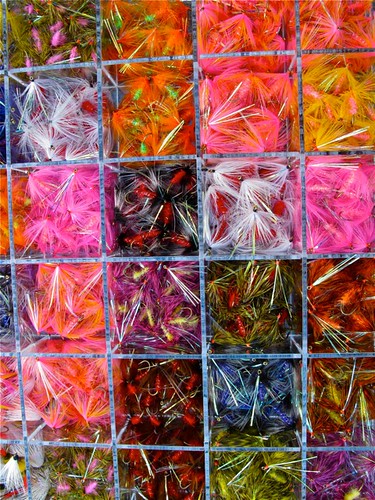
This time it was just me, my boat, my fly poles, and every fly in my arsenal. Nobody to entertain. Nobody to reassure. No guilt over sitting in a pool for six hours waiting for the grab. No pressure. The more I thought about it, the faster I started packing. Here was my chance to go full-dirtbag for three straight days, sleeping on the beach, roasting fillets over a wood fire, and working on my sea-bird calls. So what if I would face ridicule from my friends? Let them kneel at the alter of the North Umpqua. There would be plenty of time for that. I would much rather work on my personal relationship with the fish god, tschawytscha.
That Friday was a pleasant grind. The occasional rolling salmon helped to keep me motivated, but from 6AM to 1PM, I felt nothing resembling a grab. As the tides shifted, the “salad” got bad, causing me to check my fly between each cast. Many times that day I came to realize no sane person would keep up such a hopeless charade. There was a perfectly good reason I was all alone out there. But I couldn’t imagine anywhere I would rather be. I cracked a tall beer, stretched my arms and shoulders, and kept up the rhythm. My eyes remained fixed to the water’s surface, while my mind’s eye scanned the underwater world. My little fly searched for danger, for a big black mouth and a flash of silver. And as I fell deeper into my trance, as my eyes began to roll back into my head, there was a soft grab, then slack. I instinctively stripped line as fast as I could, feeling the mushy resistance of a fish moving toward me. The fish paused, then turned away. The line tightened, and I stripped hard to set the hook. Twice. Game on.
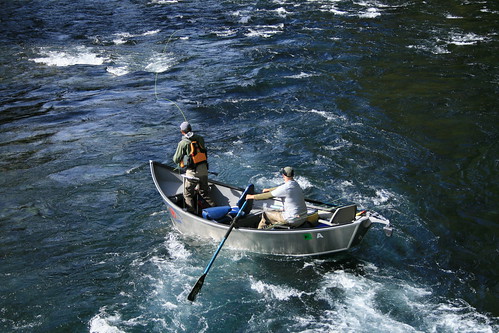
I learned my next move watching an old-timer: with two good sets of a barbed hook, I stepped to the bow and hoisted the anchor with one hand, keeping pressure on the fish with the other. Then two big steps back to the rower’s seat, set the hook one more time and crank the drag a little tighter. Hoist the stern anchor and row to shore with alternating hands, switching the rod back and forth, and applying maximum pressure all the while. As the boat backed up to the beach, I gave the oar a big pull, and the soft sound of sand on fiberglass told me it was time to jump ship. Once on dry land, my final move was to give the anchor another foot of scope. Easy to lose one’s boat to a stiff breeze while attending to a fish.
The final phase of the fight was to become very familiar over the next couple of days: the salmon appeared to tire out, its runs becoming shorter in distance and duration. Then, as I relaxed a little, the fish paused and appeared to survey its surroundings. It found its reserves, and bolted toward the only root wad for 100 yards, way out in the tailout. I did my best to slow him down, but no drag in the world can stop a determined king salmon. Could he actually see that far in his pea-soup world? Was I imagining this intelligence? Whatever the truth, the fish made it to the stump, and I felt my leader stop cold. It was over, my fly stuck forever in an ancient spruce stump. But I was triumphant. I let out a whoop that sent the gulls into an aerial lap around the pool. My heart was racing.
Moments later I was back on the water, anchored up and swinging a new offering through the mid-section of the pool. Before the fly could finish its first swing, another king bit hard and set the hook on himself. I fought him on anchor for a minute, then muscled my way to shore. This time I was determined to either stop the fish from running to the wood, or break him off trying. Sure enough, there came the same pause, the imagined survey of the pool, and a dead run for the wood. I cranked the drag tight and yelled as I dug in my heels. This time he came to the surface and made a sloppy splash. It was his last run. We were down to the final bull-dogging, the part that can really wear you down. Kings rarely quit. They’re bodies just give out, no longer able to take them where they want to go. They lose their ability to right themselves, and then they just seize up. Some recover very quickly, and those are the hard ones. This one hit the beach with finality.
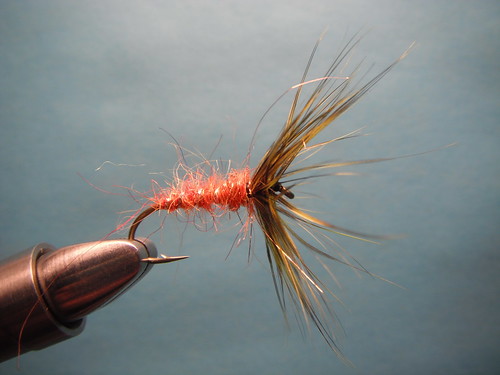
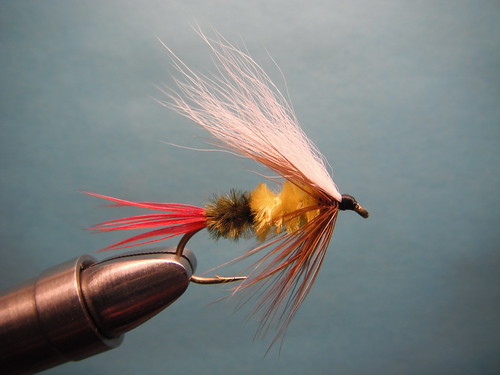
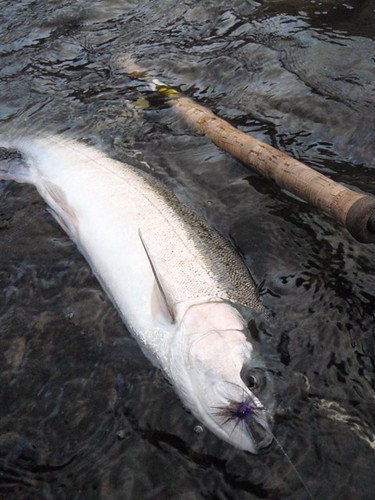
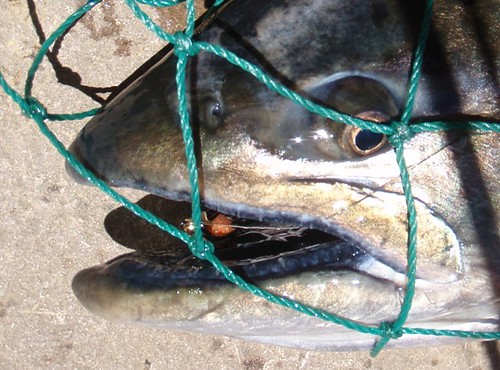
A bronze buck slid over the sandy cobbles at my feet, gasping for breath. I snapped a photo, my orange fly imbedded in the curve of his upper jaw. My elation evaporated as I saw the fish laying there, struggling in vain to recoup his oxygen deficit. No time for gloating over the demise of a great animal, hatchery or no. I thanked him for his sacrifice, clubbed him hard, and bled him on the beach.

The rest of the afternoon melted away without a grab, and well before dark I rowed out and headed for camp. I ate a quarter of the salmon for dinner, roasting it in foil over driftwood coals, my feet digging into cool Pacific sand. I fell asleep to the sound of waves and gulls, and the reassuring smell of wood smoke.
Dawn was hard to discern. First it was dark and misty, then it was gray and misty. I never looked at the time. It didn’t matter. I launched, rowed, searched, and anchored in the same pool as the day before. True to form, I didn’t have a sniff until mid-afternoon. Then, the bites came easily. I lost four fish in a row on the same damn root wad. One bolted for it immediately, while the others waited until they were almost on the ropes. But all were able to force their way into the wood pile. I chased down the next fish, anchoring directly over the snag. I tried different angles and probed around with my rod tip, reeling when I could. The fish stopped fighting, and I eased her out of the mire. Her nose was touching the tip-top of the rod as she emerged. I fumbled for my net, and scooped up a gorgeous hatchery hen. Applause broke out from behind me, and a pair of sea kayakers pulled up, totally amazed to find someone flyfishing in the middle of nowhere. We exchanged pleasantries, and I explained there was only a narrow window of activity, and I had better get back to it. “You mind if we watch?” they asked. “Feel free,” I said, “But I hope you aren’t expecting much. That may have been it for the day.”
I repositioned and fired off another cast. Something told me it would happen, and it did. A big grab, slow head shakes, and the flash of a heavy salmon zig-zagging his way to the top. A chrome-plated head tore the surface. There was a bright swirl, then the fight began. The yakkers were in for a show, probably at my expense. They provided play-by-play commentary as I made it to shore and worked the fish.
“If I can get this fish in, you’re welcome to have it,” I offered.
“Really? Yeah! We’d love it!”
I explained my little root wad problem so they wouldn’t be too disappointed when the fish tied me off. At the appropriate time, the fish made his move. I refused to give in, jamming the entire rod and reel under the water and stopping the spool with my palm. He turned briefly, then took two more shots at it. My 12-pound Maxima held, and we played out the rest of our drama at the head of the pool. Near the end, as he paced the shore, refusing to enter the shallows, I saw an adipose fin.
“Native!” I blurted, a little too happily. “Sorry guys, but this baby is going to swim free.” I was pumped to see a native springer. Truly a unicorn in these dark days.
“Awesome!” they said, earning my heartfelt thanks and respect.
In my arms, the fish was spellbinding. Perfect in every way. One of my new kayaker-friends snapped a photo, and we cheered as the beast shot off into the depths.

It was hard to fish after that. I found myself poking around the boat, then decided to row out. The next morning I went through the motions, but I was done. Satisfied. For a few days, at least.
So, do you think I have a problem?