Steve Farrar’s Blend: Review and list of Must-Have Colors to tie this season

OK fellow baitfish fly-tyers, here is a questin answered, as in – Hi Jay, I’m interested in trying some of the Steve Farrar’s synthetic wing materials you have mentioned in your fly tying videos, but am a little unsure as to where to start.

Having had the opportunity to look at and handle virtually every color of the Farrar synthetics to date, I have had a ball experimenting with these.  I first note that there is a Steve Farrar Blend, and then there is also a UV Steve Farrar Blend, and not all colors are available in the UV material.  There are also, naturally other materials offered that make great fresh and saltwater baitfish patterns, but i am going to focus this product review on the Farrar’s Blend in the colors that I find myself most often incorporating into my flies.

One point of note, I have found the perceived barriers or distinctions I formerly drew between ocean flies and freshwater flies dissolving.  Pretty much gone.  I now fish my river flies in the sea and my sea flies in the river.  Nice.

Texture assessment:  this material is a synthetic and it relatively fine.  Similar to Bucktail but a little slimmer fibers, I would say. The fibers are somewhat “translucent-ish” if that makes sense, because they range from very solid in the dark colors to the translucent in colors like the pink and chartreuse and mackerel.  Most of the fibers have a little crinkle in them – that is to say they are not necessarily arrow shaft straight like we expect with Fish Hair.  The SF Blend fibers are firmer than Craft Fur (by far) but have more wiggle and flex than Fish Hair.

Typically NOT boring: these SF Blends usually but not always have a variety of colors mixed together to make the overall color appearance.  Not so with some colors.  The Bleeding Black and Midnight Blitz are strictly black fibers with added metallic sheen fibers in the red or blue range to enhance the appearance.  Point is, with many synthetic fibers you get a single color and stiffness in all of the fibers, but with SF you have a blend of fibers that I think make the product fishier to both tier and the intended eaters of our creations.

Slightly compressible.  Think they are anyway.  Less to than bucktail and Craft Fur, and EP Fibers and other related products.  More so than Fish Hair.  Maybe about the same as with Yak hair, but I honestly have only a passing acquaintance with the Yak.  I tie with Clear Cure Goo and traditional cement like Penetrator (addicted to the sniff of the good old stuff) and have good results with both.

Length and tips character:  the bundles of fibers are roughly 9 inches long.  because these bundles consist of  blended loose fibers, the bundles have an appearance that is much like hair because the tips are not squared-off.  Wings constructed by simply clipping off a pinch of SF Blend and tying it in look great and require no effort to create a taper like we would need to do if using a different product that consists of equal length fibers.

After creating natural looking wings/flies using the fibers cut directly from both ends of the hank, one may create a taper by systematically messing up the squared-off bundle of fibers remaining in the center of the hank.

Overall, SF Blend and SF UV bend is excellent stuff to work with at the fly bench.  It comes in hanks of loose fibers with the sparkle and color variation blended in.  I sometimes cut a hank in two equal sections to tie with.  Other times I will separate off a section of fibers thick enough to tie a single fly and then tie it in using the double-back-over technique.

This material has earned my respect and absolute devotion over a full season tying fresh and saltwater flies.

Here are my most reached-for Steve Farrar’s Blend colors.  Obviously this list is shaped by my quirks and the local environments i fish.  The synthetics are offered in a color range that is probably four or five times longer than my list, and you should certainly browse the full list to see if some of the colors would better suit the bait-fish imitations you tie for different geographic regions and fish species.

But if you fish Pacific Northwest Salt or Fresh waters, I frankly think you could not go wrong with an assortment that includes the following palate.

Bleeding Grey: I use this for bellies, lateral lines, and backs on different flies.  it has sheen and hints of red and will find its way onto your bench I’m betting.

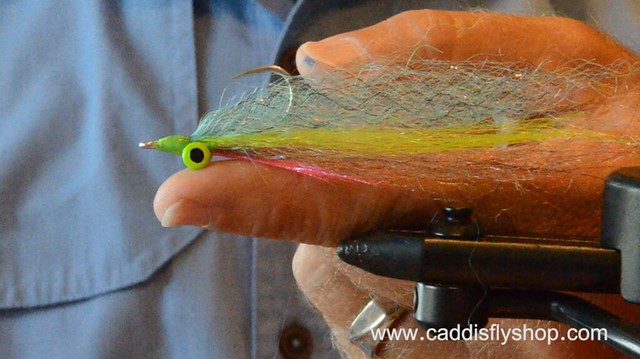
Chartreuse: one of several color shades, this is my favorite middle of the road pick for the white and green Clouser, a catch everything anytime fly.

Dark Green:  use this instead of the Chartreuse for a switch up.

Herring Back:  When ya gotta have a blue herring back on your fly, this one can’t be beat.

Bleeding Black:  I use this shade for backs of Sea Flies tied for Ling Cod, Chinook Clousers, and also for tails on Comets.  Think it will find its way into my Intruders eventually too.

Midnight Blitz:  Much like the above shade, but this one has blue sparkle hints instead of red.  Bait-fish backs and Comet Tails.

Bucktail White:  This is the brightest of the white shades offered and a bit more crinkly, with lots of shiny fibers blended in.  I tie with all the white shades, but this is my choice when I want the white to POP.

Pink:  forgot to put pink in the photo but this is my choice for my pink and chartreuse Chinook clousers and my coho bucktail offshore flies.  Steelhead had better look out when I fish my Bleeding Mackerel and Pink Clouser this winter.  Hah!

Fl. Chartreuse:  Rather pale compared to Fl Chartreuse Bucktail, this will still light up a fly in tidewater and ocean environments, and I tie with it regularly.

Electric Yellow:  ya want bright?  Here you go.  Almost Fl Yellow Chartreuse, I tie in a pinch of this color if i want my fly to really shine in low light conditions.

Bleeding Orange:  A favorite offshore rockfish and Ling Cod color, also used in my Chinook Comets.

Hot orange:  Darker and hotter and mottled like most of Steve’s blends, this is another offshore bottom fish selection that I will fish for Kings in 2014, soon as I catch my breath

Mullet Brown:  If you tie bottom fish flies, you gotta try this stuff.  Mottled and sparkly with browns and hints of black.  Smallie Clousers should be irresistible with this, but never tried it myself yet.

Bleeding Red:  Perfect mottled dark red with sparkly hints for my Patriot Clouser pattern.

Violet Night:  An awesome purple beauty for backs of unweighted offshore flies, including Albacore flies, and my dark day Clousers.

Bleeding Purple:  Adds the hint of red sparkle and

Bleeding Mackerel: Among my top 6 colors.  Difficult to describe.  This is a greenish, bluish, got some black and some sparkle and some red and some fluorescence and it works for backs and bellies and is just amazing stuff.  YOU MUST GET SOME OF THIS.

Top six Farrar Blend colors:  Bucktail White, Bleeding Mackerel, Bleeding Black, Bleeding Grey, Fl Chartreuse, Chartreuse, Pink, Dark Green.  OK, that’s eight top colors, but hey, I’m just say-in’ these are fantastic assets on the tying bench.  You literally can not go wrong if you start with these colors, remembering you will need several packs of the white to tie your bellies with different color backs……

Jay Nicholas, December 2013

Posted in Fly Tying, Fly Tying Materials and Supplies | 6 Comments

Saltwater Deceiver Fly Tying Video for Pacific Rockfish

Continuing Jay’s series on Saltwater Fly Tying: Black Rockfish are opportunistic predators and sometimes feed voraciously on a variety of baitfish – making them vulnerable to a cast-and-strip presentation with a wide range of baitfish fly styles. I wanted to create a fly in the Lefty’s Deceiver style that Rockfish would eat with gusto. Experience with these fish and other flies informed me that these colors should be effective, and indeed Rockfish do eat this Deceiver. I like the big eyes, but you can tie the fly with painted-on eyes if you wish, and that is more in keeping with the original Deceiver fly style.

Tie and fish this Deceiver with confidence. And have fun on the water and at your fly bench.

Jay Nicholas

Rockfish Deceiver

Fly 4

Overall Length = 4”
Thread: Clear Mono fine
Hook: #2/0 Mustad 3407
Tail: White & Purple Saddles splayed out
Body: Pearl Flat Diamond Braid
Baitfish Belly: EP Sparkle Brush Miracle Pearl
Wing: Steve Farrar’s Blend – Chartreuse & Purple
Eyes: 5/16” Adhesive Holographic – Super Pearl
Cure Goo: Tack Free & Hydro

Posted in Fly Tying, Fly Tying Materials and Supplies | Leave a comment

Register-Guard: Writing is on the wall for McKenzie Hatchery Springers

A Register-Guard editorial last week predicts the the recent decision in the Sandy River hatchery lawsuit will make way for changes on the McKenzie River that will protect endangered Upper-Willamette Spring Chinook Salmon.

Haggerty’s ruling is handwriting on the wall for the McKenzie hatchery. The alarming downward trend in the river’s wild chinook population, along with the high rates of introgression, made it appear from the start that the plaintiffs had a strong case. Haggerty’s decision reinforces the message that a fundamental changes in the McKenzie hatchery’s operations are on the way.

Chinook Spawning McKenzie River

Read more on the Sandy River Lawsuit here.

Posted in Oregon Conservation News | Leave a comment

Saltwater and Estuary Bend Back Fly Tying Video – Virtually Weedless Chartreuse Chinook Salmon Bendback

The Chinook Bendback is a fly style that has been popularized in saltwater and estuarine waters where anglers fish flies in shallow waters where weeds and muck could easily foul hooks on traditional patterns.

The process of bending the hook is crucial because it will impact the ability to hook a fish when it takes the fly. Make sure that the hook point is above the plane of the new axis of the hook eye. Using a Mustad 3407 saltwater hook is a good idea because the hook has a great balance of toughness and retains modest pliability. I have had great success fishing this hook and think you will too if you give it a go. You will need to sharpen this hook, but you can re-sharpen it too.

Jay Nicholas

Estuary Bend Back Minnow

Fly 3

Overall Length = 3”
Thread: Fine mono
Hook: #1 Mustad 3407 Bend as required for traditional Bendback fly style
Wing: Chartreuse over White Bucktail
Eyes: 7/32” Adhesive Holographic
Cure Goo: Hydro and Tack Free

Posted in Fly Tying, Fly Tying Materials and Supplies | 5 Comments

Fly Fishing Film Tour, Corvallis Feb 15th

The Blueback Chapter of Trout Unlimited is bring the Fly Fishing Film Tour to Corvallis on February 15th at the Whiteside Theatre. Tickets are available online here, $10 advance or $15 at the door. Ninkasi, Nectar Creek Honeymead, 4 Spirits Distillery, Lumos Winery, Vivacity Spirits, and others will be on-hand to make sure everyone has a good time.

Proceeds from the event will go to support the Bluebacks steelhead monitoring efforts on the South Fork of the Siletz River. Make the drive to Corvallis to see some of this year’s best fly fishing footage, drink some beers, and support a worthwhile cause. For questions about the event or to sponsor the Bluebacks, email bluebacksTU@gmail.com or check their website at www.bluebacks.org for other upcoming events and restoration projects.

Posted in Oregon Fly Fishing Clubs and Events | Leave a comment

Hot links! PhotoTaxidermy, radioactive salmon, nasty carp and more

Well folks, the weekend is almost here! Enjoy some hot links to get you through your workday.

Don’t cry for me, Captain Ken in Argentina
Our buddy Capt Ken Jones just got back from a great week fishing for trout in Patagonia: This is the biggest trout our guide has ever witnessed on the Rio Grande and he swiftly grabs the giant landing net in preparation of landing this beast. Carefully and slowly, but with maximum pressure, I inch the massive trout closer and closer. Now, only the leader is out past the rod tip, but the fish is 4-5 feet straight down where we cannot see it and directly under the boat. What happened next is tragic and disheartening, but I must have put too much pressure on the fish when trying to lift its head up so that Leo could get the net under it and I pulled the hook from the gaping jaws of this seemingly prehistoric trout.

And that was it folks… this trout was “THE ONE” that got away. I got everything back, the line, the leader and even the fly with the hook still intact and in good shape. The fish escaped and that’s just how I like it. Swim free my pretty. The World is yours, as much as you want, and as much as you can handle.

Like those Fathead stickers, but for fish!
The folks at PhotoTaxidermy sent me a sample product last week, a larger than life-size vinyl static sticker of my little guy holding his mega-crappie from last year. I think its a great product. The colors are solid, the image is crisp, and it’s huge. I’d be interested to see how it looks with just you and the fish (no background) which is a product option they offer apparently.

PhotoTaxidermy

From the press release on the recent launch of the company: While traditional taxidermy takes months and needs the physical animal to create the replica, PhotoTaxidermy customers can simply snap a photograph of their trophy, upload it to PhotoTaxidermy’s website and have an exact replica printed and sent to their doorstep in a matter of days. Plus, the animal can be released back into the wild while hunting and fishing enthusiasts can still have a beautifully detailed memory to enjoy for generations.

Preventing a zombie carpocalypse in the Great Lakes
Capt. Nate and I are back in the mix with fisheries conservation out East — showing up at public meetings with the Army Corps of engineers to rant about the Corps’ inaction on a pending Asian Carp invasion.

Asian Carp

You can check out an interview with Nate from our local NPR station here.

Fukushima radiation not showing up in Pacific Salmon
From the Seattle Times: Is it safe to eat fish from the Pacific Ocean in the wake of the Fukushima nuclear disaster? The consensus since the 2011 power plant failure has been a yes, but Seattle’s Loki Fish Co. found customers remained concerned. The fishing company, a local institution, went on to do its own testing for radiation levels in its fish, and shared the laboratory reports online. (The short version: The fish were fine.)

NFS call to action on ODFW’s Coastal Management Plan
The Native Fish Society is running a petition to improve native fish protections in the comprehensive CMP currently under discussion around the state. They’ve got a form online to send your comments in to ODFW leadership and the governor’s natural resource dept here. The basic message is this:

The CMP is a status quo hatchery and harvest management plan, not a conservation plan, and it is unlikely that this draft plan will ensure these salmonid populations are viable in the future.

MS

Posted in Oregon fly fishing links | Leave a comment

Introduction To Fly Tying Class

069

Introduction to Fly Tying Class Begins

We will be putting on our second class of the Winter season. Class begins Monday, January 27th and will continue to February 24th.

6-8 pm at the Caddis Fly Shop

The class takes place over five consecutive Mondays, with each class building off of the previous nights instruction. Each night includes approximately 2 hours of instruction with at least three patterns tied. Patterns tied are locally proven flies and will incorporate techniques and materials that are used in all facets of fly tying.

Top quality materials are provided, as are all necessary tools. Class Fee is $55

Call 541 342 7005 to reserve a spot, or if you have any questions.

-TY

Posted in Classes and Instruction, Fly Tying | Leave a comment

Steamboaters comment on ODFW Coastal Management Plan

ODFW is currently seeking public comment on the Coastal Multi-Species Conservation and Management Plan. The commentary below was sent to us by Joe Ferguson of the Steamboaters on the North Umpqua.

North Umpqua

The draft Coastal salmonid Management Plan (CMP) is available for comment until February 10. The CMP was developed by ODFW staff with limited public input, and is primarily a hatchery and harvest plan that is designed to continue most of the current management practices. It is scientifically suspect, and represents a high risk for wild fish on much of the Oregon coast. A more detailed article will appear in the Osprey soon.

A series of public meetings on the coast begins in late January.To review the CMP, the 25-page Executive Summary, the schedule of public meetings, and the IMST report discussed below, go to: http://www.dfw.state.or.us/fish/CRP/coastal_multispecies.asp

Comments can be emailed to ODFW at: ODFW.CoastalPlan@state.or.us

I will acknowledge here that ODFW is under considerable pressure from elected officials and a large segment of the sport fishing population to provide fish for consumption and not to focus on protection and recovery of wild fish. I also recognize that hatcheries are absolutely necessary; we’re not going to return to conditions that existed 200 years ago.

However at some point Oregon must move towards protection/recovery of wild fish, and the draft CMP fails in this regard. The draft CMP was reviewed by two separate scientific groups, with parallel findings: The Independent Multi-Disciplinary Scientific Team (IMST), authorized by the Oregon Plan for Salmon and Watersheds (15 pages, available on ODFW’s CMP website); and a separate Panel assembled by Steamboaters and the Native Fish Society consisting of Steven Cramer & Associates, Chuck Huntington, and Dr. Chris Frissel (30 pages, key points are itemized on pp 3 & 4). NFS will post on their website shortly, or email me at J-FergusonPLS@comcast.net for a copy.

From the IMST report (p 1): “However, we have major concerns that the CMP places excess faith in hatcheries, makes multiple assumptions with minimal data if any, (and) limits discussion to the pressures that ODFW can regulate thereby omitting major land use and socioeconomic pressures….”

Key issues with the plan:

1) There is no comprehensive plan designed to benefit wild fish.

2) Hatchery impacts are not considered a primary or secondary limiting factor for wild fish populations. Hatchery planting increases from 6 million to 6.3 million.

3) Impacts to wild fish habitat from climate change (both freshwater and ocean), O&C legislation, and human population increases on the coast are ignored.

4) There is no plan for habitat protection or improvement. Impacts to habitat are not defined; habitat improvement is left for others to accomplish with little guidance.

5) The monitoring plan lacks both specificity and the necessary funding.

6) Chum salmon and spring chinook are at risk, and anadromous cutthroat populations are depressed. The CMP devotes minimal effort to their recovery.

I urge you to read these scientific reviews and contact the department and the Commission with your concerns.

Posted in Oregon Conservation News | 1 Comment

Victory for Wild Fish on the Sandy River

From the Native Fish Society: “It is undisputed that hatchery operations can pose a host of risks to wild fish…it is clear that the Sandy River Basin is of particular importance to the recovery of the four [Endangered Species Act] listed species and is an ecologically critical area” wrote federal Circuit Court Judge Ancer Haggerty in his ruling yesterday that the National Marine Fisheries Service violated the Endangered Species Act and the National Environmental Policies Act when it approved the State of Oregon’s management of the Sandy River Hatchery.

Grant's Outdoor Tip of the Week: Sandy River Hatchery

Native Fish Society, an Oregon City-based conservation group working to recover self sustaining populations of wild fish throughout the Northwest, along with Eugene-based McKenzie Fly Fishers, sued NMFS in a last ditch effort to prevent the extinction of Chinook, steelhead and coho in the Sandy River. The populations had declined to less than 1000 wild steelhead and coho and only 1300 wild spring Chinook. The State of Oregon had received NMFS’ blessing under the Endangered Species Act to continue to drown the river with over a million hatchery fish.

The judge found fault with NMFS because it “treats the success of the [hatchery] programs as a given, an issue called into doubt by ODFW’s miserable track record of containing stray rates.”

“The science is irrefutable. The law is irrefutable. And, Judge Haggerty affirmed this. It is the most significant decision benefiting wild fish in Oregon in over a decade,” said Mike Moody, Executive Director of Native Fish Society after hearing the ruling. “Hatchery fish cause significant ecological and reproductive problems for wild fish. There is no evidence that hatcheries have been effective in the recovery of wild populations. In fact, the evidence shows they foster a slow march toward hatchery induced extinction. The Oregon Department of Fish and Wildlife cannot claim ignorance of this when some of the most significant studies were authored by past and current employees.” Moody added, “The actions brought by Native Fish Society focus solely on the hatchery on the Sandy River. Its objective is the recovery of native, wild fish on the Sandy River. Native
Fish Society is not trying to close down fishing of any kind, but rather to ensure recovery of wild fish.”

Bill Bakke, Director of Science and Conservation for Native Fish Society said, “As a grassroots advocacy organization, we see it as our responsibility to ensure that laws such as the Endangered Species Act are followed. We have spent the 17 years of this organization’s existence working with ODFW to restore wild fish runs to sustainable, harvestable levels in the Sandy River. Instead, our efforts were met with plummeting fish populations while ODFW and NMFS pumped out hatchery fish and papered over the problem. Someone had to step up and say we are not going to allow you to push these fish into extinction.”

The Native Fish Society and McKenzie Fly Fishers argued that NMFS should have analyzed a broad range of alternatives and prepared an Environmental Impact Statement under the National Environmental Policy Act. The groups also argued that the agency allowed too many hatchery fish to interbreed with the wild fish, and that weirs and acclimation ponds man made structures in the river that were supposed to prevent the interbreeding were not likely to succeed so NMFS was wrong to approve them under the Endangered Species Act. JudgeHaggerty agreed.

“Today is a great day to be a wild fish in the Sandy River” said Bakke.

“As anglers and as citizens, we take the long term view that the top priority of fishery managers should be to preserve and enhance our native fish populations so they remain available to future generations. The science is clear that this goal won’t be achieved using current hatchery practices. We are gratified that the court agreed that business as usual is not only unacceptable, but as we maintained, in this case violated the law,” said Arlen Thomason, Conservation Chair for the McKenzie Flyfishers.

Native Fish Society and McKenzie Flyfishers are represented in this case by Portland lawyer Dave Becker and Pete Frost of the Western Environmental Law Center in Eugene.

NFS Fact Sheet
Native Fish Society launched the “Save Sandy Salmon” campaign in 2011 and asserts:
• Historically, runs of native fish in the Sandy River basin once ranged as high as 20,000 winter Steelhead, 10,000 spring Chinook, 15,000 Coho, and 10,000 fall Chinook.
• Today, the numbers of wild native fish in this system have declined precipitously. Wild winter steelhead average less than 970 spawners annually, wild spring Chinook now average less than 1,300, and wild Coho now average approximately 900. The runs of fish returning to the Sandy River basin are now dominated by artificially bred fish produced by the hatchery.
• Hatchery bred fish cause significant ecological and reproductive problems for wild fish. Hatchery fish occupy habitat and compete for food needed for wild fish to survive and to spawn, they attract predators and prey on smaller wild fish (both of the same species and of other species), transmit diseases, and compete for spawning grounds.
• Also, when hatchery fish interbreed with wild fish it reduces the genetic fitness of the wild fish for generations afterwards. Steelhead born of hatchery parents in the wild might produce only one eighth to one third of the offspring that two breeding wild fish would produce.
• Programs at the Sandy hatchery are not conservation programs, but rather are harvest programs used to 1) mitigate loss of fishing and harvest opportunities due to loss of habitat and migration blockage resulting from the Columbia Basin hydropower system, and 2) augment fishing and harvest opportunities on the Sandy River.
• The goal of the hatchery program is to produce artificially bred fish that will contribute to commercial and sport fisheries in the Columbia River Basin and Sandy River. In no instance has a salmon hatchery restored a depressed wild population to the point where it is self sustaining.

Posted in Oregon Conservation News | Leave a comment

Pacific Rockfish Fly Pattern: Purple Surf Candy, Fish Scale and Cure Goo

The Purple Rockfish Candy is another Pacific Saltwater fly inspired by the Bob Popovics’ Surf Candy fly style.  Our Pacific Bottom-fish, including Black Rockfish, have teeth and a chomping ability that can wreak havoc with our flies.

The Use of Fishient Fish Scale synthetic material makes it relatively straightforward to create a slim, shimmery baitfish profile with this fly.  I prefer Tack Free Cure Goo versus Thick, because I like a very slim profile fly.  This color combination is but one of several I have fished successfully for Black Rockfish off Oregon.  This is a relatively subtle color combination and the fly is relatively long.

Jay Nicholas

Fly 2

Purple Surf Candy

Overall Length = 3”
Thread:  Fine mono
Hook:  #2 Mustad 3407
Body:  Purple over Olive over White Fishient Fish Scale
Eyes: 5/32” Adhesive Holographic Super Pearl
Cure Goo:  Hydro and Tack Free

Posted in Fly Tying, Fly Tying Materials and Supplies, Oregon Saltwater Fishing | 1 Comment

Puget Sound and Saltwater Cutthroat Fly Tying Video – Pink Shimmer Fringe Surf Candy

This is the first video in Jay Nicholas’s series on Saltwater Fly Tying.

The Cutthroat Shimmer Fringe Surf Candy is inspired by the Bob Popovics’ Surf Candy fly style. Whereas Bob created his original Surf Candy to enhance the durability factor of flies he was fishing in the salt, my use of the fly style is principally intended to offer a very slim, transparent baitfish profile to West Coast species including Sea Run Cutthroat, Black Rockfish, and Coho salmon.

The Use of Ice Dub Shimmer Fringe makes it relatively simple to create a slim, shimmery baitfish profile with this fly. I tend to prefer Tack Free Cure Goo over the Thick Goo, only because I like a very slim profile fly. If you want a thick body, I definitely suggest using Thick or Thick Fleck Goo.

Jay Nicholas

Fly 1

Pink Shimmer Surf Candy

Overall Length = 2”
Thread: Fine mono
Hook: #4 Mustad 3407
Upper Body: Hot Pink/Shell Pink Shimmer Fringe Minnow Back
Belly: Chartreuse Ice Dub Shimmer Fringe
Eyes: 5/32” Adhesive Holographic Super Pearl
Cure Goo: Hydro and Tack Free

Posted in Fly Tying, Fly Tying Materials and Supplies, Oregon Saltwater Fishing | 1 Comment

Cedar Lodge New Zealand – Summer Season Underway

Christmas break brought wet weather day after day on the South Island. Most of the rivers we frequently fish from Cedar Lodge were out of shape until the second week of January. Instead of fishing and camping we stayed around the lodge and continued with lodge and property improvements.

Recently the weather has come around and the rivers are looking very good. We have managed a few reconnaissance missions. A few photos follow.

IMG_1358

IMG_1406

IMG_1387

IMG_1403

IMG_1385

IMG_1326

IMG_1309

IMG_1317

IMG_1321

IMG_1300

IMG_1285

IMG_1287

Cedar Lodge pizza oven has arrived

Posted in Fishing Porn, Fly Fishing Travel | 1 Comment

Jim Lichatowich on OPB

Great interview with salmon biologist Jim Lichatowich on OPB:

By relying more and more on hatcheries we’re creating a charade of sorts where the river that can’t support a salmon becomes a stage prop where fishermen and fish play out their respective roles, reenacting something, an important part of our past, that now is sort of a hollow empty memory of it.

Posted in Oregon Conservation News | Leave a comment

Steelhead patterns page updated

We’ve updated our best steelhead fly patterns. These links take you to a page with a YouTube fly tying videos demonstrating how to tie the fly, a high resolution image of the finished steelhead fly, and a fly pattern recipe. Click on the steelhead fly pattern link (not the photo!). We’re closing in on about 100 here.

download-3

Posted in Coastal Steelhead Fishing, Fly Tying, Oregon Winter Steelhead Fishing, Summer Steelhead | 1 Comment

Coastal Stream Report 2014: It’s Raining!

Pic 2

With the sound of rain on the roof Tuesday night it was time cure some cabin fever. We left the beast behind and did some bush whacking and wading on the lower section of a well known coastal stream. Much to our surprise, Marc (member of the men’s technical conference) nailed a Silver. It was in surprisingly good shape as we released it.

2014-01-08 12.31.43

I followed up later with a nice hatchery hen. Egg patterns continue to work well and my Sage 99, with indicator line, continues to make me very happy with its performance on coastal streams.

Pic 3

It appears we have a series of storms approaching and perhaps they will give us some badly needed rain and get the fish moving. Lastly, the final steps for all hatchery fish; fillet and then the BBQ!

Pic 1

LV

Posted in Coastal Steelhead Fishing, Fishing Reports | 3 Comments