UV Dragon Tail Tarpon Classic Fly Tying Video

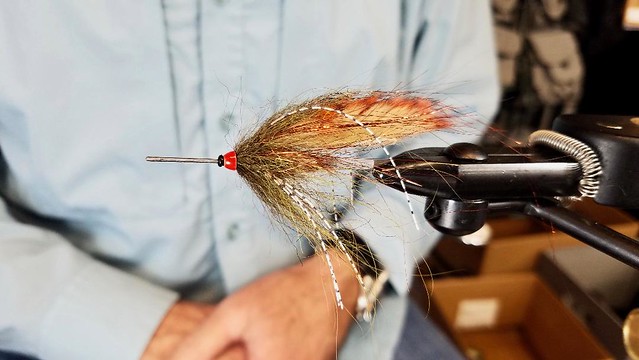
In this video, Jay ties a Tarpon Fly pattern using Mangum’s UV2 Dragon Tails. These tails are great for giving your fly lots of motion and movement in the water.

dragon-tail-tarpon-pattern

Jay’s Dragon Tarpon Classic

Hook: SC17 3/0
Thread: 210D Chartreuse
Tail: Mangum’s UV2 Dragon Tail Chartreuse
Brush: EP Craft Fur Brush Olive/Orange
Head: Senyo’s Laser Dub Orange and Red
Head: Pro Sportfisher Pro Softhead Medium
Glue: Loctite Super Ultra Gel Control
Eyes: 5/16 Holo Super Adhesive Eyes

Posted in Fly Tying, Fly Tying Materials and Supplies | Leave a comment

Ten Fall Fly Patterns to have in your Fly Box – August 2018

It’s that wonderful time of year again and fall fishing is picking up everywhere. Here are ten consistent “fall producers” you need in your fly box to fish our local waters.

Chubby Chernobyl: Short winged stones, hoppers and October Caddis are represented by a variety of chubby styles. It’s also a great “hopper dropper” pattern.

Fall flies 2018

Purple Parachute Rooster: Mahogany Duns, Beatis, “lesser drakes” are imitated by this versatile parachute pattern. This fly has been one of our favorite all around patterns.

Fall flies 2018

Hippy Stomper: Superb all around attractor fly pattern. Fish this fly during the day when you do not see any activity.

Fall flies 2018

Parachute Caddis: This pattern imitates a variety of caddis species present in the fall. Hi Vis and high floating pattern fishes great all fall.

Fall flies 2018

Heavy Hackle Moose Tail Parachute Adams: Big water no problem, this version of the Parachute Adams floats and floats. It will even float with a smaller bead head nymph under it which serves as an outstanding searching method. Fall Mayflies like Grey Drakes are well imitated by the HH Para Adams.

Fall flies 2018

Hi Vis Parachute Adams #16-18: Late in the evening and on some of those “grey days” when the blue winged olives are hatching in the fall the Hi Vis Para Adams is a great pattern.

Fall flies 2018

Kingrey’s Better Foam Caddis: We are super close to October Caddis time and the Better Foam has been a favorite of many for years. Slap in on the surface and watch them come!

Fall flies 2018

Brillon’s Lucent Jig: We have been super impressed with this fly all year. As we get towards lower light, spawning salmon and a bit more water look for these to really ramp up in the brighter options.

Fall flies 2018

Possie Bugger Jig: All time favorite Possie Bugger with Jig style hook is simply one of our best nymphs. Day in day out on our local waters you can’t beat this nymph pattern.

Fall flies 2018

Jigged CDC Pheasant Tail: This slender fly with quick decent has been great using Czech Nymphing tactics as well as under a Chubby.

Fall flies 2018

Bead Head October Caddis: These large caddis pupae will be available to the fish throughout the fall.

Fall flies 2018

Have fun on the water this Fall

CD

Posted in Fishing Reports, Lower Willamette, McKenzie River, Middle Fork Willamette River fishing | Leave a comment

Area closure issued for Terwilliger Fire – South Fork of the McKenzie

From Denise Mercer – Willamette National Forest, McKenzie River Ranger District

Blue River, OR (Aug. 21, 2018) — Fire officials are implementing an area closure order for the Terwilliger Fire for public and firefighter safety due to a combination of high fire danger, exceptionally dry conditions and unpredictable fire behavior. The area closure includes a section of Forest Service Road 19 (Aufederheide Scenic Highway) and recreation sites.

“We understand this is a disappointment to residents and visitors who patiently waited for the road to reopen after the December 2017 landslide, but unfortunately, the risk is too great,” said Forest Supervisor Tracy Beck. “Our highest responsibility must be visitor and firefighter safety.”

The size of the closure allows for safe access and work by firefighters, and reflects the rapid growth that fire managers have witnessed since the fire was initially reported on August 19. Given the weather forecast and already dry forest conditions, the fire could continue to grow and additional closures could take place.

From Hwy 126, the closure begins where Forest Service Road 19 intersects with Forest Service Road 1900-408 and continues south to Rebel Trailhead.

Closed Campgrounds:

· Hard Rock Campground
· French Pete Campground
· Cougar Crossing Campground
· Sunnyside Campground
· Slide Creek Campground

Closed Recreation Sites:

· Indian Ridge Lookout
· Terwilliger Hot Springs
· Echo Day Use and Boat Launch

Closed Trails:

• French Pete Trail #3311
• Bear Flat Trail #3301
• Quaking Aspen Trail #3332
• Lowder Mountain Trail #3329
• Olallie Mountain Trail #4100
• Walker Creek Trail #3330
• East Fork Trail #3308
• Indian Ridge Trail #3315
• Rider Creek Trail #3319
• French Pete Trailhead
• Upper Lowder Mountain Trailhead
• Upper East Fork Trailhead
• Lower East Fork/Lower Echo Trailhead
• Echo Trailhead
• O’Leary / Castle Rock Trailhead
• Lowder Mountain Trailhead
• Indian Ridge North (Upper) Trailhead
• Indian Ridge South (Lower) Trailhead

Closed Forest Service Roads (FSR):
• Sections of FSR 1900
• Sections of FSR 2618
• Sections of FSR 1927
• FSR 1900-408
• FSR 1900-410
• FSR 1980
• FSR 1985
• FSR 1986
• Sections of FSR 1993
• FSR 1994

Sources below are available to stay up-to-date on the Terwilliger Fire and current fire restrictions.

• Closure area map and details: https://go.usa.gov/xUzQC
• Terwilliger Fire information line: (541) 822.7259
• InciWeb: https://inciweb.nwcg.gov/incident/6160
• Fire information and current fire restrictions: https://www.fs.usda.gov/main/willamette/fire

Posted in Fishing Reports | Leave a comment

Jay’s Trout Clouser Jig Black Dace Fly Tying Video

In this video Jay Ties a Trout Clouser Jig “Black Dace” using an Umpqua 60 degree Jig Hook. Like many of Jay’s flies this fly is tied using a 60 degree jig hook which allows for a variety of applications. This is why Jay prefers this type of hook. This fly can be fished on the swing, cast and stripped, or fished under an indicator.

thumbnail

Jay’s Trout Clouser Jig Black Dace

Hook: Umpqua S506H Jig #4
Thread: Danville’s 210D white
Eyes: Balz Eyes medium or Double Pupil Lead Eyes
Cement: Loc-Tite Brush On
Tail: White Bucktail
Body: Lagartun Carded Flatbraid Fl. Blue
Tail: Black Bucktail
Flash: Angel Hair Peacock
Collar: Senyo’s 3.0 Live Bait

Posted in Fly Tying, Fly Tying Materials and Supplies | Leave a comment

Fall Creeps into Summer – Local Fishing Improves

caddis fly guide service

Signs of fall are in the midges and small numbers of size #16 tan caddis. Mahogany Duns and fish looking up in shallow water mean that the high sun of summer is past us. Dry fly fishing is better and fish will come to Parachute Adams, Parachute Caddis and attractors like Hippy Stompers and Royal Madam X. Nymphs are still working, possie buggers and pheasant tails have been best. Euro Nymphing tactics have been gaining steam, and those that put in the time are doing really well fishing the deeper slots of the river with longer leaders and heavy slender jig patterns. No matter how you slice it some of the best fishing of the year is coming our way in the over the next 60 days. Enjoy!

Posted in Fishing Reports, Lower Willamette, McKenzie River, Middle Fork Willamette River fishing | Leave a comment

Chinook Salmon Dragon Tail Fly Tying Video

In this video, Jay ties a Chinook Style Dragon Tail pattern using Mangum’s UV2 Dragon Tails. This is essentially a Clouser fly on steroids! Tied using classic Chinook colors – pink and chartreuse, this is a bold option for the hungriest of Chinook! Give this pattern a try next time your at the vise.

chinook-style-dragon-tail

Jay’s Chinook Style Dragon Tail

Hook: SC15 3/0
Thread: 210D Chartreuse
Tail: Mangum’s UV2 Dragon Tail Chartreuse
Body: Bucktail White
Flash: Ripple Ice Fiber Blue or Purple
Collar: EP Fibers Pink
Glue: Loctite Super Ultra Gel Control
Eyes: 5/16 Holo Super Adhesive Eyes

Posted in Fly Tying, Fly Tying Materials and Supplies | Leave a comment

Oregon needs temperature-based fishing regulations – August 2018

summer fish

From: The Native Fish Society

Across Oregon, we are all feeling the effects of hot summer weather. We seek out cool air, take a dip in our local waters, and find refuge to avoid the summer heat.

For many rivers, this hot summer weather also means warm water temperatures, which can stress our native cold-water species like salmon, steelhead, and trout.

Of all the factors that influence the health of these fish, temperature is arguably the most important. Water temperature affects almost every phase of their life histories, including their metabolisms, upstream and downstream migration, spawning, rearing, food availability, swimming speed, direct and delayed mortality, susceptibility to disease, and can alter the competitive dominance of other predators.

Many of our favorite fishing locations across the state, such as the Deschutes and North Umpqua rivers, have already seen repeated days where water temperatures have exceeded 68F, a temperature that can be stressful for salmonids.

Read more and take action by signing a petition directed to the ODFW director and administrator by clicking here: TAKE ACTION

Posted in North Umpqua River Fishing Reports, Oregon Conservation News | Leave a comment

The Last Steelhead – An Eco Rock Opera by Chris Santella

From Chris Santella – In the spring of 2017, I researched and wrote a story for “American Angler” on the plight of wild steelhead in the Columbia Basin, which impacts Oregon, Washington and Idaho. As a die-hard Deschutes River steelhead angler, I was aware that runs were shrinking—but had no idea conditions were so dire. Like so many of the world’s environmental woes, most of the factors impacting the well-being of wild steelhead have been instigated by humans. The Last Steelhead attempts to explore some of these factors, a bit of their history, and the attitudes surrounding our behaviors and policies that seem to be standing in the way of taking meaningful action to prevent another extinction. It’s my opinion that by using the best available science and re-directing resources accordingly, we can avoid a future without wild steelhead…and The Last Steelhead will be just a piece of music, not an ecological statistic.
–Chris Santella

Screen Shot 2018-08-13 at 4.57.55 AM

Click here to download/listen to Chris’s songs

Screen Shot 2018-08-13 at 4.59.18 AM

Click here to read about What you can do to Save Wild Steelhead.

Posted in Oregon Conservation News | Leave a comment

Field trial and review of OPST Commando Smooth fly line

opst commando smooth

I was looking for a short head fly line that I could cast from a dory offshore Pacific City. Many floating fly lines work well for this purpose, including most of the short head floating fly lines such as the

RIO OUTBOUND Short (30 ft)
SA MASTERY SBT (~22 ft)
AIRFLO Float (~30 ft)
WULFF Ambush (20-24 ft)

Although I have fished all of these lines successfully, I constantly fiddle with my tackle and I am something of a fly line freak. I simply wanted a shorter head and here is why. The shorter the head, within reason, the more likely I supposed that I would be able to make a cast of something like 50 – 60 ft with no more than one back cast. Casting poppers and small streamers from a dory requires fast reaction to deliver a fly quickly to fish that may be moving beyond casting range. A short head would, I supposed, be less likely to foul in antenna or other caster’s rods.

So while I fished other lines and found them satisfactory, I wanted to try the super short heads offered in the OPST Commando Smooth series.

So I set to sea on August 9th 2018, in my friend Kevin’s Breaker Dory, seeking silvers.

Most of our time was devoted to trolling but a short time was set aside to test my new fly line, and this video records my awkward efforts.

Overall, I was MORE THAN PLEASED with the line’s performance.

I fished a 200 gr SMOOTH with 7.5 ft floating tip on a 5 wt Winston B3X with Nautilus CCF-X2 reel.

One or two back casts allowed me to lay my fly out 50-60 feet, well in the zone I wanted to cover. The line laid out straight in spite of my best efforts to throw a curve into it. I did not try a 10 ft floating tip of a sink-2 tip, but will do so in the future.

I almost hooked a silver while I was stripping out line to make my first cast, but that is soooooooo typical.

I am not well versed on appropriate line weights to match to various fly rods, but the 200 gr plus 7.5 ft floater was very comfortable and cast with authority.

I will add that I tried casting the line with only a mono leader and it was HORRIBLE!

The 7.5 ft floating tip changed everything, and the line laid out straight and true.

So, here is a solid thumbs up for this new fly line.

Current line configuration is:

Length: 99.3 feet.

Head weights: 150, 175, 200, 225, 250, 275, 300 grains.

The head on the 200 gr line is roughly 13 ft.

Front and rear line loops

The running line is the thinnest I have seen  (light fly line coating over mono core) and is low memory to reduce line coiling.

I have nothing to say regarding casting this line with sustained anchor styles, but for straight overhead with or without change of direction, this line was intuitive and an instant performer for me.

Jay Nicholas July 2018

Posted in Fly Fishing Gear Review | Leave a comment

Support McKenzie River Trust – Buy a Patagonia Trucker Hat

IMG_4314

Many of you know how much great work the McKenzie River Trust does to protect, restore and expand treasured outdoor spaces. We have held our annual Two Fly Tournament to help the trust for over 10 years now and Patagonia has been a key sponsor for the last two years.

IMG_7001

We thought we would expand the partnership a bit this weekend with a promotion to help the trust through sales of Patagonia hats. This Thursday through Sunday The Caddis Fly will donate $5 towards the McKenzie River trust with each sale of a Patagonia lid.

IMG_3026

Come by and check out our new selection of Patagonia hats and update your collection for a cause!

Posted in Oregon Conservation News, Shop Sales and Specials | Leave a comment

Columbia River at Deschutes River mouth closes to all fishing beginning Aug. 9, 2018

IMG_1814

From Oregon Department of Fish and Wildlife

Columbia River at Deschutes River mouth closes to all fishing beginning Aug. 9: Action taken to help protect upriver steelhead

Tuesday, Aug. 7, 2018

SALEM — The Columbia River around the mouth of the Deschutes River will close to all fishing, including catch-and-release, beginning at 12:01 a.m. on Thursday, Aug. 9 in order to protect summer steelhead that may be utilizing the cooler water provided by this tributary.

At their Aug. 3 meeting, the Oregon Fish and Wildlife Commission directed ODFW staff to amend fishing regulations for the Columbia River near the Deschutes and in the lower Deschutes from the mouth upstream to Moody Rapids. The direction included closing this area to all fishing until river temperatures have stabilized below 68 F. ODFW staff will continue to monitor river temperatures and run sizes throughout the fall to determine when the area can be reopened. This is unlikely to occur prior to late-September.

The closed areas will be:
All waters south of a straight line projecting from the flashing red USCG light #2 upstream to the lower South Channel Range B marker located approximately 3/4-mile upstream of the mouth of the Deschutes;

The lower Deschutes River from the mouth upstream to markers placed on the downstream end of Moody Rapids.
Concerns about the vulnerability of fish to fishing pressure in the mouths of some tributaries of the Columbia River were sparked by the historically low returns of Snake River-bound summer steelhead in 2017. At that time the states of Oregon and Washington adopted unprecedented restrictions to several fisheries to reduce mortality on these fish.
In June 2018, ODFW staff outlined for the Commission a plan to take a comprehensive look at potential thermal sanctuaries throughout the Columbia River. That review process will include a series of public meetings in the fall of 2018 followed by rulemaking in early 2019.

From The Conservation Angler

For Immediate Release

The Conservation Angler Supports Commission Action Creating Deschutes-Columbia River Cold Water Sanctuary Protecting Columbia River Salmon and Wild Steelhead

The Conservation Angler, a wild fish conservation organization, applauds the Oregon Fish and Wildlife Commission, and supports the Oregon Fish and Wildlife Department (ODFW) in implementing protective angling regulations that will provide a migratory sanctuary for wild salmon and steelhead in the Columbia River and the very lower mile of the Deschutes River.

The Deschutes River plume creates a cold water refugia for wild salmon and steelhead. The fishing closure would remain in force until the Columbia River water temperatures dropped below 68f.
“Very low numbers of several ESA-listed wild salmon and steelhead populations returning to the Columbia and Snake River are facing conditions adverse to their success in reaching their natal rivers.” Said Bill Bakke, Director of Science and Conservation for The Conservation Angler.
“While current regulations require many wild fish to be released unharmed, the lethal and sub-lethal effects of encounters in the fisheries (both indirect and direct) can and does have an impact on their fitness, survival and productivity.” Said David Moskowitz, Executive Director of The Conservation Angler.
“The very low wild summer steelhead run-size and the extreme heat and its effect on water temperatures really make this sanctuary area a critical conservation action for the entire Columbia River above Bonneville Dam.” Said Moskowitz
Upriver Wild steelhead past Bonneville Dam totaled 14,827 fish which is only 28% of the ten-year average. The current 2018 return of wild steelhead is less than 1,000 fish above 2017’s low return which was the second lowest return of wild steelhead since 1999.

Posted in Eastern Oregon, Oregon Conservation News, Summer Steelhead | Leave a comment

Lower South Fork McKenzie River Floodplain Enhancement Project Notice

IMG_4865

From the McKenzie Watershed Council

Phase I of the Lower South Fork McKenzie River Floodplain Enhancement Project is nearing completion. Over the course of the last 10 weeks, the Project has placed over 1,300 pieces of large wood, and redistributed historic berm and fill material from 12.5 acres of floodplain to the incised mainstem South Fork McKenzie River channel. Once complete, the Project will reconnect over 125 acres of floodplain and several miles of relic floodplain channels.

Beginning Monday, August 6, 2018, contractors will begin slowly returning water from a diversion channel to the old mainstem South Fork McKenzie River channel and restored floodplain. The re- watering process will slowly introduce an increasing amount of flow to the project area over a 4-5 day period. This process is designed to allow fine sediment to settle out throughout floodplain surfaces prior to flows reentering the mainstem McKenzie River.
Project managers expect that the re-watering process may cause short-term turbidity impacts to the McKenzie River immediately downstream of the South Fork McKenzie River confluence. For more information please contact either

• Jared Weybright, McKenzie Watershed Council Executive Director, at jared@mckenziewc.org, 458-201-8150 (office), or 541-505-0501(cell); or

• Kate Meyer, USFS McKenzie River Ranger District Fisheries Biologist, kmmeyer@fs.fed.gov, 541- 822-7230 (office).

Posted in McKenzie River, Oregon Conservation News | Leave a comment

Emergency North Umpqua River Closure Begins Monday August 6th, 2018

north umpqua fly fishing caddisflyshop.com

From ODFW

Anglers: 2 p.m. emergency angling closure for North Umpqua River begins Monday
Closure affects fly water area through September 30.

Thursday, August 2, 2018

ROSEBURG, Ore – Beginning Monday, August 6, angling the North Umpqua River fly area is closed from 2 p.m. to one hour before sunrise. The closure extends from the fly area boundary at Deadline Falls to the marker below Soda Springs Dam near the power plant enclosure and is in effect through September 30.

This emergency regulation aims to protect wild summer steelhead in the fly waters of the upper North Umpqua River. Exceptionally low flows and higher water temperatures at this time of year combined with preliminary data indicating the wild summer steelhead run may be below average prompted fishery managers to enact the closure.

An emergency regulation was set last week in the mainstem Umqpua River to protect native fish seeking cooler water at tributaries.

Tips for hot weather angling:

Fish during the cooler early mornings.
Land your fish quickly to help increase survival rates.
Keep your fish in at least six inches of water while releasing it.
Revive the fish before release. Keep the fish upright facing into the current; if the current is slow, move the fish back and forth slowly to help oxygenate the gills.

Posted in North Umpqua River Fishing Reports, Oregon Conservation News | 2 Comments

What Should Our Ocean Flies Look Like?

Hatchery coho to the fly in the waters offshore Pacific City three days ago.

Hatchery coho to the fly in the waters offshore Pacific City three days ago.


So OK, this is a rather simplistic post but still it seems relevant, at least the question is one that i’m constantly asking myself each time I set to sea with fly rod in hand here at Pacific City, and especially when I am fishing for salmon or albacore.

The short answer is shown in the two photos following with all the bet hedging that recognizes day to day and fish to fish differences.

Contents of coho stomach, namely "crab spwwn" AKA baby crabs.

Contents of coho stomach, namely “crab spwwn” AKA baby crabs.

Congtents of chinook stomach from three days ago, namely one gooey partly digested anchovy and one barely digested squid.

Congtents of chinook stomach from three days ago, namely one gooey partly digested anchovy and one barely digested squid.

It is worth noting that the coho took a 4″ white/chartreuse/bleeding mackerel Clouser and the Chinook took a 4″ brown and tan Clouser — pointing to the possibility of opportunistic feeding behavior and quite possibly rendering our best attempts to tie imitative flies rather futile.

Anyway, I hope this is amusing and entertaining. I also hope to be able to poke around in more ocean salmon stomachs soon.

Jay Nicholas
August 1st, 2018

Posted in Oregon Salmon fly fishing, Oregon Saltwater Fishing | 2 Comments

Spruce Streamer Fly Tying Video

In this video, Tony Torrence ties a Spruce Fly. An old fly that’s been a consistent producer for Sea-Run Cutthroat, Rainbows, and Brown Trout. Enjoy!

thumbnail

SPRUCE STREAMER

Thread: Veevus 10/0, Black
Hook: TMC 5262 or TMC 5263, Sizes 2-12
Tail: Peacock Sword
Rib: UTC Silver Wire, Size Brassie
Body: Rear 1/3 Red Danville Floss; Front 2/3 Peacock Herl
Wing: Badger Hackle tips
Collar: Badger Hackle

Posted in Fly Tying, Fly Tying Materials and Supplies | 1 Comment