Reflections and Ice cream cones on Crane Prarie Reservoir

On Saturday of this Memorial Day Holiday, Lou Verdugo, Caddis Fly employee/guide and Ken Crangle, set out for Crane Prairie for an afternoon of fishing. Using Scientific Anglers “Stillwater” 5wt lines they headed out from Rock Creek launch toward Rocky Point on a gray day.

Lou V on Crane Prairie

Fly selection for the day was a mini bugger with a trailing Ice cream cone chironomid. The day began using bobbers with suspended flies, but that technique was abandoned as the results were negative. However, using a very slow trolling retrieve, they were able to hook up on a smaller size Cranebow, including one nice brookie.

Lou V on Crane Prairie

The weather proved to be the greatest challenge of the day, as wind and thunder began to increase in the afternoon. Although the results were fair at best, the scenic beauty of the surrounding Cascades created a great place to reflect on the meaning of the Memorial Day Holiday. -LV

Posted in Central Oregon Fishing Report, Oregon High Lakes | Leave a comment

Summer steelhead still swimming free in the Siletz

Matt and I decided to skip the higher water on the Mckenzie on Sunday and head up to the Siletz river where the flows are more managable. The Siletz heads in some of the highest mountains in the Coast Range and hosts runs of spring and fall chinook and winter and summer steelhead.  The summer steelhead run peaks in June so we were a little early but as summer wears on and the flows become lower you can’t float a drift boat. 

At 3.75 feet the “around the town run” from Illahee Park to Greenthumb Park is easy to float and judging from a couple other boats coming down as we launched at Illahee you can also run down from Twin Bridges to Illahee. Moonshine to Twin Bridges is not recommended. If the river is running at less than 3.5 leave the driftboat at home though locals still float the river in pontoon craft.The “around the town run” is unlike anything I’ve ever floated– there is easily enough river to provide full day of fishing but the takeout is less than one mile from the put in.  In truly disorienting fashion the river makes a long loop around the town of Silezt bringing you almost full circle.  The takeout is about one mile after a green bridge on the right. 

The only notable obstruction is a downed cottonwood that almost completely obstructs the main channel.  The tree is located a few minutes downstream of the concrete bridge right after the put-in.  Your safest bet is to avoid the whole scenario and walk your boat through a skinny side channel on the right. That’s what we did and it went much better than the boat in front of us which got pinned in the branches of the tree and was really lucky to make it through there gunwhales up. No shame  walking your boat–better to live to fish another day.

The river itself is fishy looking in that stretch with multiple riffles, nice runs and deeps pools. We didn’t observe any steelhead early but did see one that had been dressed out by someone recently. As the day wore on and we reached a long flat I decded to turn downsteam and haul getting us into fishier water.  After about a minute of really pulling through the shallow flat it was like we stepped on a steelhead land mine–a school of fish scattering in every direction.  A few were pushed a little downstream and held where we could see them.  The spooked fish didn’t want any part of our swung offerings.

There are fish in the river now and the run is still building.  If we continue to get intermittant rain the river should remain floatable into June. Another good rain could lead to fabulous fishing on the Siletz.  If the river drops, its best to focus on the Siletz Gorge which is strictly a bank fishing affair.  One more thing, when heading up to the Gorge keep an eye out for a 25 mph zone shortly after you make the left towards Moonshine–if you don’t you might be sorry, I was.–KM

Posted in Coastal Steelhead Fishing, Summer Steelhead | 13 Comments

Fishing continues to improve on the Mckenzie

Fishing was so encouraging on the lower Mckenzie River Sunday I had to get out this Monday as well. We found fewer bugs, the weather was a bit cooler, but fishing was very good. The larger fish on the lower river are really looking up more now. They are recognizing the larger caddis and taking them with “leaping porpoise” type rises. Chasing the bug up to the surface with so much aggression that they fly out of the water.

IMG_2370

IMG_2372

The day was also designed to do some testing. I just bought a Bauer Rogue 2 Reel and a Sage ZXL 9′ # 5wt Rod, add a Scientific anglers Sharkskin line and you have the perfect Mckenzie Rod. I wanted to test out a new dry fly as well. “The Jimmy Z”, it is a spun deer hair head caddis pattern that I saw in a size #14. I ordered 20 dozen #8’s thinking it would work for our local Green Mckenzie Caddis hatch. The fly was great! While it floats nicely it’s tapered spun deer hair head also dives a bit and pops back up, imitating the diving, egg laying caddis we have on the river currently. It has rubber legs and a red tail both qualities fish have a hard time passing up. Sorry about the photo, low rent light tent in the living room.

IMG_2391

IMG_2378

The River is higher than normal for this time of year, however it is in great shape. We are in prime time now, as the days warm slightly you will see the big black birds get on the gravel bars looking for the larger caddis, golden stones, little yellow stones, and even a few salmon flies. The fish are with the program as well, you will see fish in faster water, taking more surface imitations as well as nymphs and soft hackles. CD

Posted in McKenzie River | Leave a comment

Temperatures and clarity improve

I took the family out this Sunday for a few hours, floated from Hayden to Armitage on the Lower Mckenzie River near Eugene. We got in the water around noon and fishing was good immediatly. My three year old was hanging onto the rod rigged with a Possie Bugger and a Karnopps Riffle Diver both in size #10. Her rod was getting hit constantly, despite reeling backwords, bouncing the rod up and down and the fight resembling an adult struggling with a sailfish she did land some nice fish. 

IMG_2360

It was a bit windy and cold but when we found a patch of calm warmth the fish were on the surface. The dry/dropper rig of a big green Mckenzie Caddis and a Possie bugger was doing the trick. The water is still high but fishing was as good as it has been all year. This coming week is brings us ideal weather and I look for fishing to be great. Flies anglers should be prepared with include Green Mckenzie Caddis #8-10, Brown Elk Hair Caddis #12, Parachute Hare’s Ear #12, Karnopps Riffle Diver #10, Green Mckenzie Wet #10, Possie bugger #10, Pale Morning Dun Sparkle Dun # 16 and Light Cahill Wets #12 and #14.

Posted in McKenzie River | 1 Comment

Salmon Fly Hatch in full swing

Adult Salmon flies as well as Golden Stones are spread throughout the lower Deschutes. Despite cold weather fishing was very good this weekend. We spoke to several outfitters leading three day trips from Warm Springs ramp to Maupin. The overall report was that dry fly fishing was very good. Clark Stones, Giant Foam Stones in Golden and Salmon, Terranasty’s, Norm Woods and other adult stonefly patterns were effective. The flows out of Pelton Dam were good and actually came down a bit with the cooler temperatures this week. The dry fly activity was not limited to Salmon Flies and Golden Stones, Pale Morning Duns and Blue Winged Olives had fish looking up this weekend as well. It is hard to beat watching a nice wild trout rise to a giant stonefly dry in a size #6. The good dry fly fishing will continue for the upcoming couple of weeks.

Posted in Central Oregon Fishing Report | 2 Comments

Fly tying video: Ice cream cone chironomid

Get ready to catch stillwater trout in Oregon’s high lakes with this classic chironomid midge pattern, the Ice cream cone. Barrett says this staple fly for Crane Prairie is a great year round bloodworm imitation. In the spring, fish really key in on these chironomids fished under an indicator. Tie these sparse for realism.

Ice Cream Cone
Hook: Daichi 1150 size 10-16
Bead: Pearl
Thread: 8/0 Uni black
Body: Midgebodi (or red floss)
Rib: Copper wire
Collar: Synthetic peacock dubbing

Ice Cream Cone

Posted in Fly Tying | 1 Comment

Water high, dropping and clear

Fished the Mckenzie the past two days. This Wednesday and Thursday we put in a Deerhorn and ran down to Hayden Bridge. Wednesday the water was over 13,000 cubic feet per second at the Hayden Bridge gage. It was like fishing a new river. When your flies were over willows you knew things weren’t good. Surprisingly, we did find fish. Visible drop offs and softer water with 3-5 feet of depth seemed to be most productive. Thursday the river made a steep drop and came under 10,000cfs at Hayden Bridge. There were bugs out both days, Pale Morning Duns, smaller March Browns, small dark caddis.  Thursday afternoon we did see a few green Mckenzie Caddis. Very few fish were on the surface, but swinging a Mega Prince and a Possie Bugger tightline down and across was very effective. The river will drop more in the coming days and fishing should be even better.

The fish we landed, wild rainbows, wild cutthroats and hatchery rainbows were very healthy. The trout had robust stomachs, probably gorgeing on cased caddis that have rolling down the river with all the high water. Despite the high water fishing was really pretty good yesterday(Thursday).  Water temperatures ranged from 45-47 degrees. Lower and warmer water is the forecast. Concentrate your efforts on the lower Mckenzie and you will have surprising success.

Posted in McKenzie River | Leave a comment

Bauer fly reel motorcycle test

If you enjoyed the Bauer Fly Reel factory tour, you’ll love this clip from Field & Stream’s Fly Fishing Blog on YouTube. They guys hook up a Bauer MX4 to a motorcycle and run out the drag. They compare the reel against Abel, Ross, and Nautilus and the Bauer scores high.

From the Field & Stream Flytalk blog:

We tied them up to the ass end of a street bike, burned a little rubber, then watched — and felt — how each reel reacted. We paid close attention to startup drag performance, that initial acceleration a fish makes at the critical moment of going from zero resistance to outward line acceleration. Was it scientific? No. But we did do our homework, learning that a max trout burst is about 9 mph; bonefish race at around 23 mph; and big game fish like mako sharks can reach speeds of 50-plus mph. Was it fair? We tested each reel only at the top speed of the fish it was designed to handle.

Posted in Fly Fishing Gear Review | 1 Comment

Tracking the snowmelt blowout

There are several useful tools that can help an angler really see why this snow melt blowout is happening (besides all the snow of course) and understand when it will end. The Oregon State Marine Board maintains a page that shows how full the Willamette Valley reservoirs are and how much water is coming in and going out of each reservoir. The entire Willamette Reservoir system is at 96% full. Cougar is the least full at 93% of full pool. I’ve been using this page in combination with a snowpack data page maintained by the NOAA. It is pretty cool–you can animate snowpack depth, snowmelt, etc. over the season, last two weeks or just the past day. The bottom line is that there is still lots of snow in the Cascades that will continue to melt if t stays warm and in combination with the spill levels necessary due to the full reservoirs make fishing conditions in these systems difficult. Of course, if you just want to check the river levels there are a couple of really useful sites.  The NOAA breaks the state up into a few zones that don’t precisely match the statewide angling zones but  pretty close. The NOAA page I use most contains the Northwest Zone, Willamette Zone and a Couple of Central Zone streams.  The benefit of this page is that it also shows projected levels, the drawback is that there are fewer gauges. The USGS Oregon River levels page has just about every gauge in the state and is a great source of data. The only drawback is that it does not forecast levels.  These tools are all useful and can help you determine where you have the best chance of getting into good fishing. What they are telling us now is what we already knew: the high levels on the Willamette tribs are here to stay for a while.

The blog crew will continue to try to think outside the box and point you towards some good fishing.

Posted in Oregon Weekend Fishing Forecast | Leave a comment

Fly tying video: Little yellow sally traditional

This is a Little Yellow Sally, a yellow stonefly imitation — a great pattern for the McKenzie and Willamette Rivers on summer evenings. If you really want this fly to float high, heavily wrap the hackle. If you want it to lay flat, you can clip the bottom hackles off. You can also tie this fly with a red spot on the back end to represent an egg sac.

Little Yellow Sally (traditional)
Hook: TMC 100 size 16
Thread: Yellow, Uni 8/0
Body: Yellow dubbing
Wing: Bleached elk hair
Hackle: Ginger or cream

Posted in Fly Tying | 3 Comments

Cascade Lakes Fishing Update: Ice off slowly beginning

Had enough of high river levels?   You might consider a few of the ice free Cascade lakes.   Recent reports have indicated lake fishing has been “steady”.   Here is the latest information from Bend Fort Rock Ranger District: 

Lava Lake: open Thursday but snow in some areas.  Snow gate will be moved from Deschutes Bridge to above Lava Lake.

Little Lava Lake:  Open Thursday, snow free

East Lake:  60% of the facilities will open Friday, currently iced over.

order levitra

Pauline lake:  80% of the facilities will open Friday, ice free.

The road crews are working very hard to plow the Cascades Lakes Highway.  There is still 9-10 feet of snow Cascades Lakes Hwy., no news as to when it will be open

Crane Prairie, Big Cultus, North & South Twin, Little Lava and Wickiup Reservoir, may cure some angler frustration with high river levels.  Flys to consider before you go are: Baby or mini buggers (olive, black, brown), thin mints, leech patterns, and chironomids.  Please be aware that high snow levels still abound for several other lakes which may deny access or at least, difficult conditions. 

Posted in Central Oregon Fishing Report | 1 Comment

Mini “tailwater” worth a look

 Both the Mckenzie and Willamette Rivers have been off the charts high.  The object this week was to find a river to float and fish within reasonable proximity to the Eugene area. Current levels allow The Coast Fork of the Willamette to fit the bill.

This Monday we floated from the BMX track boat landing on Row River Road to Dilley Lane boat landing off of Highway 58. The drift was a bit to long, around 14 miles.  Having never floated it I had no idea how far the river left the roads I had  gaged the drifts distance with.  The fishing was decent, some very nice cutthroats and a few nice rainbows. The river looks great and has inumerable fishey looking spots. This time of year the water is cool and the fish fought hard.  About two miles up stream from the Sears Road bridge there is a nasty rapid that is a very tight fit for a drift boat, no problem with a pontoon craft. Tuesday we tried to make the drift a bit shorter. Starting at the Sears Road Bridge and ending at Island Park on the main Willamette. The fishing was not quite as good on this stretch, although we did catch rainbows both wild and stocked as well as cuts. The river slows down and has quite a few large flat sections one needs to row through.  Overall both sections of the Coast Fork offer very nice scenery, quality wild cutthroat and rainbows, and zero angling pressure. Maybe on the weekends it is different but we did not see another fisher for two days. The flows for this river have been dropping fast, Monday it was around 1600 and by Tuesdays end of day it was down to around 1000.  As the river gets even lower, the faster, broken water sections will be the majority of the trout holding water.

Posted in Lower Willamette | Leave a comment

Deschutes River levels and big bugs on the move

As of this morning, the Deschutes River was at 5690cfs and moving up. Reports from this past weekend indicate fishing was fair to good in the Warm Springs-Trout Creek area. The large stone fly nymphs are moving and anglers who are nymphing are being rewarded. Kaufman’s stones, prince nymphs, emerging caddis patterns, and beaded phesant tails are patterns anglers should carry. It is still a bit early for the adults (dry’s) in the Warm Springs area, but anglers should keep a keen eye near the banks.

Posted in Central Oregon Fishing Report | 1 Comment

Float tube doubles as bear shield on Esmond Lake hike

Last weekend the high water and even higher gas prices drove the blog crew to think outside of the box. Record snowpack and soaring temperatures blew up the Willamette and McKenzie Rivers. The Central Oregon lakes were supposedly fishing well, but it’s a hell of a drive, so we opted to try something closer to home.

We decided to head out to Esmond Lake which is a small three acre cutthroat lake, a rarity in the heart of the Oregon Coast Range. It was formed by a landslide on Esmond Creek, a tributary on the Upper Siuslaw. It’s not stocked, hard to find via a maze of logging roads, and physically challenging to hike into. It was our first time making the trip.

When we pulled up to the unmarked trailhead to the lake, we put on our waders and threw our float tubes on our backs. We were about a half-mile down the trail when I stumbled onto the first bear pie. It was big, brown and mostly grassy.
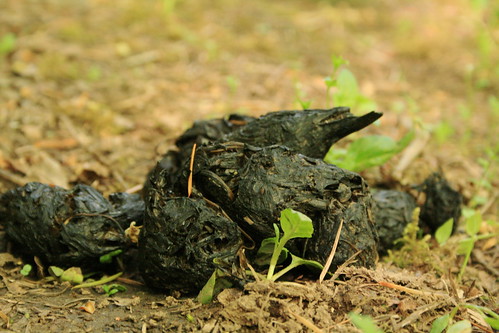
Esmond Lake Bear shit

In the second half-mile of the hike, we counted over 15 piles of bear shit and each pile seemed to get wetter and fresher as we followed the bears down the trail. I’m assuming it was a mother and cubs, because we found some big turds, but also some little paw prints. Not a good sign. I was on point, so I stuck my giant float tube out in front of me like a sheild and pushed on, trying to keep the chatter up on the trail.

We eventually got to the lake, where giant logs were spilled over the creek outlet, and it was nearly impossible to get open access to the water without balance beam walking and log rolling over several hundred yards of downed old growth stacked and floating between the end of the trail and open water. This was even more fun when you’re wearing waders and carrying a digital camera.

Esmond Lake

The impounded stream drowned the forest and the remnant trunks of that forest still stand ghostly above the water level. The lake itself was deep, cold and fishy looking. And we made the assumption that uneducated trout would go for a weighted wooly bugger stripped slowly. We didn’t count on picky fish. But picky they were. We got a few tugs on our buggers, a rise on a small caddis. Todd of TU Chapter 678 caught a couple fish on a March Brown wet fly, fished in the film, but the biggest topped out at nine inches.

Despite the slow fishing, we stuck it out till near dark, then pushed our way back through the overgrown trail , float tubes first, avoiding the bear turds.

Posted in Fishing Reports | 1 Comment

Married at the fly shop

Barrett and Leigh Christiensen were married this afternoon at The Caddis Fly Angling Shop. We always new the shop was considered a “full service fly shop”. It was an honor to add marriage to the many firsts the shops 30 year history has enjoyed. Congratulations Barrett and Leigh!

IMG_2339

Posted in Uncategorized | 6 Comments