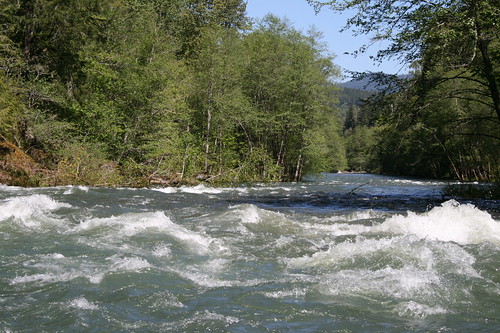
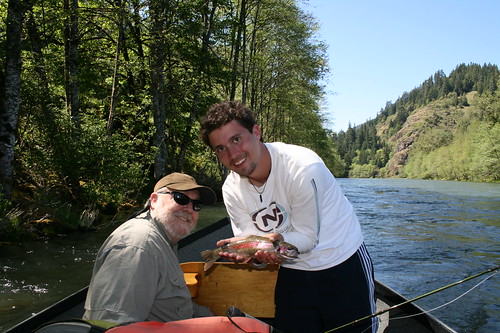
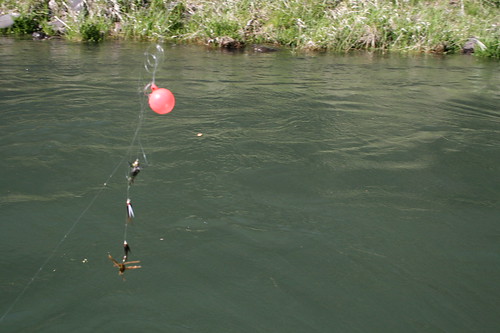
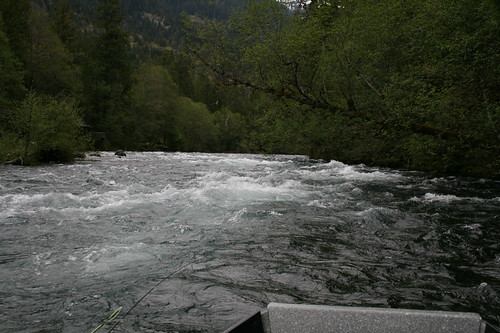
Both the Mckenzie and Willamette Rivers continue to rise to ridiculous levels. Unseasonably hot weather combined with record snow pack and already full reservoirs have meant unfishable rivers. If you were planning on fishing the Mckenzie or Willamette early this week it is time to make other plans.
There are numerous great options to explore. Here are some waters that are well worth checking out in the coming days:
Davis Lake; Bass fishing has been fair and should get much better with all the heat and warming water temperatures. Launch your tube or boat at the Lava Flow Campground, fish large heavy streamers on the bottom.
Craine Prairie Reservoir; Fishing has been great at Craine lately. Chironomids fished in Quinn and Deschutes channels have been yeilding excellent results. Use a strike indicator and suspend both a small wooly bugger and a chironomid about 5-7 feet below.
Deschutes River; Fishing has been excellent with larger stonefly nymphs fished both near shore and near depth transitions. Adult Salmon flies have been spotted around Maupin and the past few days heat have undoubtably moved the hatch up in terms of peak time.
Wickiup Reservoir; Kokanee fishing has been excellent. Pink and white flies fished “Jig” style have been pounding on them.
We will keep our ears open to other hot fisheries and try to get an idea of what access will be like this weekend at the opening of Gold Lake. Stay Tuned
The Little Yellow Sally imitates a prolific bug, the Little Yellow Stonefly. They hatch like blizzards on the McKenzie River and Willamette on Mid-summer evenings. These stoneflies freely emerge just like a mayfly and they have a skinny body. This is an excellent dry fly for fishing an evening hatch.
Little Yellow Sally CDC wing
Hook: TMC 200R size 16-18
Thread: 8/0 Uni light cahill
Egg sack: Red dubbing
Thorax: Yellow fine and dry dubbing
Wing: CDC dun, natural
Hackle: Ginger or cream
I fished yesterday despite some very high water. Since I took the boat out last night things have jumped another 2000cfs making the Middle Fork of the Willamette flat out scary near 7000 cubic feet per second. The Mckenzie is absolutely roaring, currently over 9000cfs. The optimists view is that we are going to get this snow melt over with in a hurry. If you do go on either one of these rivers today, which I don’t recommend, be very careful. There will be logs and debris flying down the river, possibly creating new hazards, as I saw yesterday.
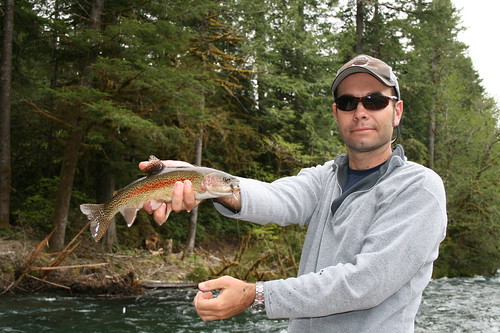
We did manage some decent fish on nymphs in the “slower” water, what little there was.
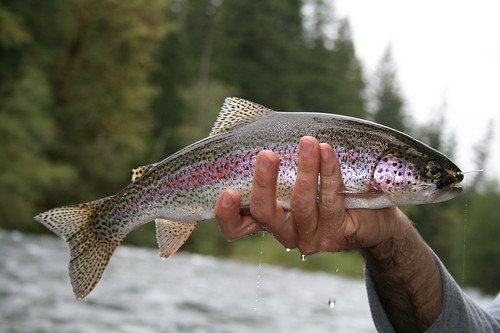
Add a little wind, a couple of two fly rigs, a thousand casts and eventually you will get one of these.
More to come on this report but we have word that fishing was great yesterday at Craine. The early game for Craine Prairie is chironomids dropped of an indicator around 5-7 feet. Fish in and around the river channels early in the season the fish seem to concentrate in those areas.
Good numbers of Green Mckenzie Caddis were out today on the lower Mckenzie. I floated from Belinger to Armitage and fishing was good. Yellow Soft Hackles, Possie Buggers and Royal Coachman Wets were the ticket early. Around 3:30 the wind laid down again and we found fish in classic big green water. Heavy current edges and riffle drop offs. Fish ate the CDC Green Mckenzie Caddis nicely. My thermometer showed a reading of 52.1 today which is optimal. It looks like the river levels is spiking up, how high will they go and how quick will they drop??
Fished the upper Mckenzie for the first time this year Tuesday. The river has been high and cold and I’ve stayed away. In addition to the high and cold, the river has had blockages in some sections near Belknap and Frissel Crossing. As of today there were no blockages, not sure what might happen if our upcoming heat wave makes the river spike up.
Boating this section is great fun but the person on the oars must be experienced, the water is cooking right now and one mistake can prove deadly. One doesn’t last long in water 44 degrees. That was the high water temp reading for the day.
When we found “slowish” water and got a slow deep dead drift with a stonefly nymph the fish were on it. Despite the cold water, it never left 44 degrees fishing was very good.
There were quite a few bugs around all day, caddis in a variety of sizes, a few darker stones and Pale Morning Duns. The bank full flow of the Mckenzie is great for the health of the river and the fish. We are in for a tremendous summer.
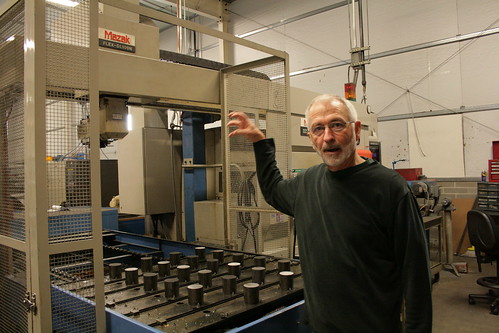
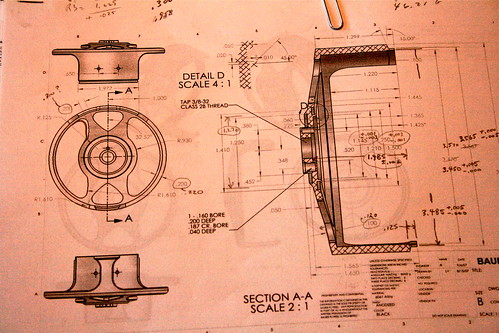
Last week we traveled down to Southern Oregon to meet up with John Bauer, founder of Bauer Fly Reels. John took us through the machine shop in Medford, where the components for the Rogue Series reels are made, to his headquarters in Ashland, where technicians assemble and finish the reels. The following video outlines how Bauer fly reels are made, from aluminum bar stock to fly shop shelf.
In the following Q&A, John explains how he went from professional race car driver (Trans Am Champion in 1980) to fly reel designer, and explains why he builds his high performance fly reels in Oregon.
How did you go from race car driver to fly reel designer?
John Bauer: I was approaching 40, and racing is a year to year deal. Some years you’re fat city, some years you’re eating peanut butter. I’d done it, I’d been there. So we started taking the kids camping and I started fly fishing in the mid-80s. And on the end of the fly rod is a mechanical device called a reel…
I did a lot of design while I was racing. You develop widgets all the time, because that’s how you win — you look for ways to make your car better and faster. The inside joke was that when I got out of racing, I’d make widgets and sell them.
My last full racing season was 1989, and the market for precision fly reels was just developing. We developed our first reel in 1995 and had no clue it would take off like it did. It just ran us over like a truck and forced us into the fly reel business. The first five years was just nuts we were growing so fast.
What’s the next big thing with fly reels?
Bauer: Carbon fiber rather than cork. The easiest way to describe it, with Carbon Fiber, we’re dealing with an engineered project. Cork is bark off a tree. It’s been used for eons and it’s a good friction material, and it’s graded for density. But all sheets of cork are not created equal. When you’re dealing with a natural product, you’re always dealing with variations. It is hard to glue cork to a surface and have it stay there 10 years.
Cork is made up of granules. They mix the granules up in a vat of resin and press it into a block They put it in a big cheese grater and slice sheets of cork off. How in the world they take a 3-foot block of cork and shave it down sheets that are within 3-4 thousands of an inch in variance? We get a sheet of carbon fiber and it’s within 1-2 thousandths of an inch.
Cork also needs some lubricant, you have to be able to maintain that lubricity in the cork to maintain that performance. You’re depending on the user to re-lube that cork, and some users have no concept of the term maintenance.
So I have to get this out of the way, because I’ve been thinking about it the whole drive down. Why does someone need a $300-$400 fly reel for trout? For steelhead, sure. I’ve got a Rogue 3 and I think it’s great. Saltwater? Absolutely. But trout?
Bauer: My answer is going to be tainted by the fact that I make $300-$400 trout reels.
We came on the scene in 1995, but since then fly reels have gotten tremendously better. Innovation spawns innovation and it changes the way you fish. I’ll be at a fly fishing trade show in Somerset, NJ and talk to a guy that is buying a MXP 1 reel. That’s 1 to 3-weight reel that costs $400. He’s fishing a 2-3 weight fly rod, 7x tippet or thinner, mostly to 10-12 inch trout in Pennsylvania, He’s putting those fish on the reel and he’s having a blast. He’s steelhead fishing like you, but downsized it to a smaller fish.
What’s the whole sport about? Fishing for meat for dinner? No, we’re having fun. It makes more sense than stripping in the fish and letting it go. Do you need a $300 reel to go trout fishing? No. Do you need to go trout fishing to eat dinner? No. Ten years ago you were fishing with your clicker reel and your $600 Sage rod. With a precision reel you’re just adding another element to the whole experience.
On the Williamson River, we put trout on the reel. It’s the first thing you do. We’re fishing with 5x.tippet and most of the trout are 4-5 pounds. But you can get a 12lb fish, and you need to have a good drag system, let the drag work the fish. So from your 2-weight to what we do on the Williamson, that drag system is really important.
Speaking of the Williamson, I understand those monster trout are part of the reason Bauer reels is located in Oregon. Can you tell us about that?
Bauer: We’ve been operating for three years in Oregon. We still work with a machine shop in Salinas, Calif. where the MXP series is being made. But we bought a place on the Williamson River in 2001. We stayed on the Williamson for thee days and I caught my first 8lb trout. That was the end of the story right there. We put an offer on a lot before we left.
The eight-hour drive from Monterey was doable, but getting past Bay Area traffic was tough. Plus, doing business down there, it was difficult to keep staff. You’re competing with wages in China. For the pay scale, people couldn’t afford to live in that area.
So why not build fly reels in China?
Bauer: You can come up with all kinds of answers, get patriotic, but if you want to get down to the nuts and bolts, it’s the business. With the manufacturing base in China or Korea, I can pick from a choice of 15 styles of reel, give an order for 2-3 thousand, put my name on it, ship it here in a container and land it here for half of what it costs to produce our reel in the states.
But when you go to those offshore markets, you’re bringing in a whole other element: language barriers, large orders for products that could be wrong or damaged. That could affect your supply chain for months on end. You can’t control how the products are built and it changes the brand of your product.
A lot of products in the U.S. you get it, it breaks and you throw it away. Or you call a manufacturer they’ll send you a new one, because they don’t make it and they can’t fix it. But someone with a Bauer reel that’s12 years old, we can upgrade it to the current specifications for $35.
How often do you do reel repairs?
Bauer: We get services in every week. Some of them are just beat to a pulp, like they drove over it in a truck. Our reels can be serviced and maintained. Some reels are maintenance free and that’s fine to a point, but someday something is going to have to be done to it. For $20 we do a general service, replace cork disks and bearings. But maintenance can be done by the customer too.
Some people never do anything to their reel than use it. But you have to remember, these are precision pieces of equipment. What would happen with your Mercedes that sat in the garage for 10 years and you didn’t service it? How long’s your car going to last? If you take really good care of it and have parts you can take care of it forever. Everything we produce, we have a total connection to it.
On Monday May 5th 2008 Oregon Department of Fish and Wildlife (ODFW) announced their proposed changes to the 2009-2012 Oregon Sport Fishing Regulations. There are eight different proposed regulations that would allow for the harvest of wild winter steelhead on the Umpqua system. A very vocal, organized group is doing their best to get the 1 wild steelhead/day, 5 wild steelhead/year kill regulation re-instated.
We need all advocates of wild steelhead from far and wide to speak out strongly and in large numbers against the proposed kill regulations if we are to see the current wild steelhead release regulation stay in place on the Umpqua. ODFW adopts the sport fishing regulations through a “public process”—it is up to the public to let ODFW know which regulations they support or oppose. This is your opportunity to speak loud and clear to ODFW regarding your stand on killing Umpqua wild steelhead. Here is how to get your voice heard:
Write a letter: Share your thoughts with ODFW on the proposed regulations. Address letters to: ODFW, Angling Regulations, 3406 Cherry Avenue NE, Salem OR 97303 or you can email your letter to Rhine Messmer (Angling Regulations Coordinator) at the email address listed above. All letters and emails will be forwarded to the Fish and Wildlife Commission as part of the public record. Anyone who is affected by the proposed regulations is encouraged to write, one does not have to reside in Oregon to participate.
Attend a meeting:
May 13 Blue Mt. Conference Center 404 12th Street LaGrande OR, 97805
May 14 Central Oregon Community College, Hitchcock Auditorium 2600 NW ollege Way Bend, OR 97701
May 15 OSU Extension Service 3328 Vandenberg Road Klamath Falls, OR 97603
May 16 Jackson County Auditorium 400 Antelope Road White City, OR 97503
May 19 North Bend Library 1800 Sherman Avenue, North Bend, OR 97459
May 20 Douglas County Library 1409 NE Diamond Lake Blvd, Roseburg, 440-4311
May 21 Lane Community College Forum Building (#17), Room 308 4000 East 30th Avenue Eugene, OR 97405
May 22 Hatfield Marine Science Center 2030 SE Marine Science Dr. Newport, OR 97141
May 23 Oregon Dept. of Forestry 5005 Third Street Tillamook, OR 97141
May 27 Oregon Dept. of Fish & Wildlife Headquarters 3406 Cherry Avenue NE Salem, OR 97303
May 28 Sunnybrook Service Center (Clackamas County Building) 9101 SE Sunnybrook Center Clackamas, OR 97015
Testify at a Commission Meeting: There are two Commission meetings where the public has the opportunity to comment: August 8th at ODFW Headquarters in Salem and September 12th at Oregon Hatchery Research Center near Alsea. You can find details on presenting testimony to the Commission at the ODFW website.
Fly fishing author John Geirach is coming to the University of Oregon Bookstore tonight at 7pm to promote his new book, Fools Paradise.
From the event listing:
Fool’s Paradise chronicles the fishing life in all its glory (catching your biggest fish ever) and squalor (being stranded in a tent during a soaking rainstorm). In Gierach’s world, both experiences are valuable, and both evoke humor and insight.
Fly tying video: The PMD Sparkle Dun was developed in West Yellowstone, Montana by Craig Matthews. The sparkle dun is one of the best overall mayfly patterns ever created. It’s easy to tie and low maintenance.
This is actually one of my favorite videos so far, Chris breaks the thread and still finishes the fly with a series of tiny half hitches.
Pale Morning Dun (PMD) Sparkle Dun
Hook: TMC 100 size 16
Thread:8/0 Uni
Tail: Z-lon shuck, ginger
Wing: Comparadun deer hair
Dubbing: Fine and dry yellow
This Saturday Caddis Fly guide Ethan Nickel had a great day floating the lower Mckenzie between Hayden Bridge and Armitage Park. Again it was March Brown wets, Royal Coachman wets, Soft Hackle Hares Ears, Partridge and Yellow and Beadhead March Brown Emergers in sizes #12 and #14 doing the bulk of the work. He did see quite of few smaller March Browns. We think these are the species Rithrogena Hageni a lighter colored close relative to the March Brown mayfly. In addition there were small caddis and Pale Morning Duns out in decent numbers.
Despite all the water things have picked up considerably on the lower Mckenzie. It would appear we have crept out of the super cold water temperatures and fishing will be good, to very good in the days ahead.
This coming weekend the largest gathering of spey casters, spey rod manufacturers and instructors in the western hemisphere will be held at Oxbow Park outside of Portland Oregon. The event caters to anglers interested in two-handed fly rod fishing. The Spey Clave provides a format for the exchange of Spey casting and fishing information. It is a free Spey casting college for all who attend. You will have the opportunity to watch and learn from the worlds best rod designers, spey casters and spey steelhead and salmon anglers. This event has been termed “The Woodstock of Spey Casting Events.”
Wickiup Reservoir is picking up according to customer Glen Thompson who made a loop through the east side this past week. The campground near the Davis channel is open. Best flies included wooly buggers and thin mints. Chironomids did not produce for Glen as expected. Look for the chironomid activity to improve.
Other highlights of his trip included Crumbo Reservoir and Chickahominy Reservoir. He fished a variety of buggers and streamers having excellent success on Crumbo and medium action on Chick. He did say that Chick was much clearer than it has been and water temps appear to be warming. Next weeks improved weather should really improve the high lakes that are open.
Davis Lake is also open and anglers have begun to slay the bass.
What started out as a slow afternoon with high water turned out to be a dry fly bonanza yesterday as Caddis Fly Shop guide Lou Verdugo put Frenchy Laroux and I on a shallow riffle with scads of rising cutthroat trout. We drifted from the McKenzie/Willamette confluence to Harrisburg in the afternnoon, but didn’t see much action until 4-5pm. Most trout were in the 8-10 inch range, but we caught a few that were larger. The hot fly of the day was a March Brown sparkle dun, size 14.
Just about the end of the hatch “Mongo” decided to come out and play — the big dogs of the lower Willamette River — fat trout slurping mayflies in slack water. But they don’t get that big being dumb and I put them down with a couple sloppy casts.
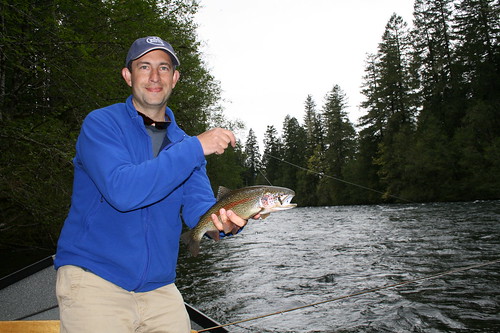
The lower Mckenzie River near Eugene, specifically the drift from Hayden Bridge to Armitage Park fish fished surprisingly well yesterday. The water was high, around 6600cfs but softer inside turns and the few defined bars that were available did produce good action. Most of the fish were native Cutthroats from 6-12 inches, with a few rainbows mixed in. We did find one fish rising, dropped the anchor near him, cast a Hackle Stacker Flag dun Adams #14 on him and he ate it. That was it for the dry fly fishing. All of the other action was on a 2 fly rig cast down and across (traditional swung method) with a Possie Bugger #10 and a Royal Coachman Wet #12.