NOAA Fisheries Releases Latest Snake River Biop

On May 5 NOAA fisheries released its latest court ordered Biological Opinion  intended to guide the operation of the Snake and lower Columbia hydrosystem in a manner safe for the 13 threatened Snake/ Columbia River anadramous fish stocks.  This was the agency’s third attempt, the previous two biological opinions didn’t meet the requirements of the Endangered Species Act to recover listed species. 

In the previous Biop, NOAA contended that it was not required to consider the effects of dams on the fish populations in the basin because the dams were an immutable part of the environment.  NOAA was roundly defeated in the courtroom and sent scurrying back to the drawing board to come up with a plan that wasn’t an embarassment. 

Snake River fish stocks have plummeted since the four lower Snake River dams were built.  Federal District Court judge James Redden who has been presiding over the matter has warned of harsh consequences if the newest plan isn’t sufficient.  It is against this backdrop that the newest plan was released. 

Not surprisingly the NOAA concluded that the hydrosystem, with what it sees as improvements including removeable spillways, increased barging, predator control, habitat improvement and changes in spill practices will be sufficient to ensure recovery.  Recently almost all of the affected tribes dropped their opposition to the newest plan in exchange for securing 900 million dollars of habitat and other fisheries improvments on tribal lands.

The State of Oregon, the Nez Perce Tribe and many conservation groups including the Save Our Wild Salmon Coalition longstanding plaintiffs appear unimpressed by the Feds most  recent plan.  In fact, these groups are concerned that the newest Biop does even less than the previous plans to protect salmon.  Governor Kulongoski recently outlined Oregon’s opposition stating that the new plan reduces flow and spill and fails to make meaningful changes to the dams instead relying on hatcheries and habitat improvments that the Governor feels are insufficient to recover native salmon.

We’ve all seen this dance before–the feds claiming that their plan will recover salmon, conservation groups and Oregon asserting the plan is a roadmap for extinction. 

It looks like this plan won’t be leaving the courtroom anytime soon.
Posted in Oregon Conservation News | Leave a comment

Fly tying video: Stimulator pattern

The yellow stimulator is one of the most popular flies in the West and it’s a great imitator for a Golden Stonefly. It’s got excellent floatation and you can hang a good sized nymph off of this fly. We tie the stimulator for speed and durability. This is a heavily dressed pattern and it fishes all summer long on the Deschutes, McKenzie and Willamette rivers.

Yellow Stimulator Pattern:
Hook: TMC 200R size 6-16
Thread: Yellow or hot orange 8/0
Rib: Yellow thread
Body: Yellow or gold fine and dry dubbing
Hackle: Brown dry fly
Wing: Yearling elk
Thorax: Yellow dubbing, grizzly dry fly hackle

Posted in Fly Tying | 1 Comment

Free Rocky Mountain Fishing guide book available in the shop

If you’re planning a trip to the Rocky Mountains to fly fish this summer, come by the shop and pick up a copy of Greg Thomas’ Tight Lines 2008. This publication offers forecasts for the major fisheries in Montana, Idaho, Wyoming, Colorado and Utah. The annual guide includes maps, photos of hog brown trout, and a lot of info on where to book a trip this year.

Posted in Fly Fishing Travel | 1 Comment

Improved formula for estimating steelhead weight

Tom Keelin, an engineering guru and fly fisherman, recently published a new, more accurate way to estimate the weight of fish. The article ran in the May 2008 issue of Fly Fisherman. The conventional formula: weight = length x girth (squared)/800 underestimates the true weight of steelhead, according to Keelin. The more accurate equation, based on collected data from 87 steelhead weighed on an IGFA certified scale, is: weight = lenthg x girth (squared)/690.  Keelin says using a denominator of 690 correctly estimates a steelhead’s weight within one pound, 80% of the time.

Keelin’s Website, FlyFishingResearch.net, features an article explaining how to calculate fish weight, as well as an online fish weight calculator.

Posted in Oregon Fly Fishing Tips | 2 Comments

Low and slow scores from Deerhorn to Hendricks

Yesterday we floated from Deerhorn to Hendricks on the McKenzie River. We were on the water from 10:30am to 5:30pm and didn’t see a single fish rise. There were some large mayflies and large caddis coming off, but not enough to make a big difference in the surface action. Todd Mullen, VP of Trout Unlimited Chapter 678 was scoring with a weighted wooly bugger, fished deep, forcing Karl to put one on as well. Two split shot and 100 feet of fly line out in the current later, Karl started picking up fish. A bead-head prince, size 12 out-fished my possie bugger 2-0 on a tandem rig off an indicator, picking a few fish up behind boulders in the slower water.

Black bugger trout

Catch and release

Posted in McKenzie River | Leave a comment

Gear review: Trying to break a Winston BII mx boron fly rod

Don’t try this at home folks. Last week, Winston Rods rep Jon Covich came by the shop to demo the flexibility of the Winston BII mx fly rod. These rods are super light, with extra backbone in the butt section. But does the nine-weight have what it takes to pull up a 6lb weight off the ground at full bend? Sure. What about a 10lb boat anchor? Watch the video and find out.

Pick up a Winston BIImx fly rod at CaddisFlyShop.com.

Posted in Fly Fishing Gear Review | Leave a comment

Water beginning to warm on the McKenzie River

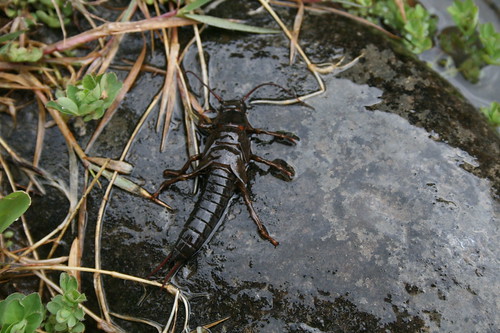
Water temperatures on the Mckenzie are edging up. I fished Friday and Saturday and had a thermometer in the water start to finish. Around 9am water temps were 45 degrees and by 5pm we had 49.6 in some areas.  Lower in the river near Armitage temps were over 50 degrees. In close to shore temperatures were higher and bug life was abundant. Numerous cased caddis were crawling around many of them close to full maturity.  Willow bushes had good numbers (in spots) of Salmon flies and some Golden Stone fly exoskeletons indicating they had recently crawled out and emerged. I found this giant under a near shore stone.

IMG_2291

Although we have had nice weather and warming water hatches have been sporatic at best. The past couple of days we had few shots at consistently rising fish. When they were rising, they were catchable with CDC Green Mckenzie Caddis #10, Barretts Emerging Peacock Caddis #16 and Hackle Stacker flag duns #14-16. When they were not rising, which was the majority of the last two days for me, they did eat March Brown Emergers #12-14, Possie Buggers #10-14, and other traditional wets fished swung down and across.

Things to look for in the coming week are, increased numbers of big green caddis, more stonefly activity both little yellow stones and larger golden stones, as well as smaller lighter mayflies including Pale Morning Duns.

Posted in McKenzie River | Leave a comment

Mikey Wier tackles Oregon wilderness steelhead

Mikey Wier of SoulFish fame is working hard to catch some wild Oregon winter steelhead. In this blog post from The Cleanest Line, Wier tells the tale of hiking into the Kalmiopsis Wilderness to fish the headwaters of either the Chetco or Illinois River. From Wier’s post:

After post holing through the snow, climbing over trees and descending 2,000 feet with four days worth of supplies on our backs, we finally reached the trailhead and the edge of the wilderness boundary. It’s only a mile from there to where we first hit the river. Once on the trail, the hiking conditions were even tougher. The downed trees were hefty obstacles with such heavy packs on our backs… Every time we came to a downed tree, we had to balance beam along the trunk, climb over branches, or duck under a high spot. There were no stretches longer than 100 yards at a time with no trees down… Still we pressed on in the name of steelhead.

It’s a good read, and sounds a lot like the wilderness steelhead trips Karl and I got into this spring.

Posted in Coastal Steelhead Fishing | Leave a comment

How to tie the CDC Green McKenzie Caddis

The Green McKenzie Caddis should be hatching in the next week or so. This large green caddis adult tends to flop around on the surface and the CDC hackle on this imitation kicks off a lot of action and the fish love it. You want to get the CDC fibers splaying off the stem — the more CDC the better. You gotta see how this looks underwater — this post on McKenzie Green Caddis on WestFly has a great shot.

CDC Green McKenzie Caddis pattern:
Hook: TMC 100 or Gamakatsu F10 size 8-12
Thread: Uni 6/0 olive or green
Body: 2mm thin foam, green
Rib: Thread or Mono
Hackle: CDC fibers, dun
Wing: Natural Deer or Yearling Elk

Posted in Fly Tying | Leave a comment

Willamette Falls passage blows up!

Steelhead had been passing Willamette Falls at a steady clip the last few weeks but the past few days have seen warmer temps on the lower Willamette that triggered the stampede.  The last three days of April saw 622 sea-run bows blow past the window bringing the summer steelhead to count to 1,968.  They are already here and more are coming every day.  The 29th was the first relatively “big” day for chinook passage with 354 crossing the window. 

Consider giving the springers a break and see about getting into some summer steel.  The run is looking really good!

Posted in Summer Steelhead | Leave a comment

Sharkskin fly line giveaway winner announced

Many thanks to all those who participated in the Sharkskin fly line giveaway. We appreciate all of your comments on the Sharkskin reviews  as well as other posts. And now for the winner:

Don Dexter can pick up his line at the shop anytime he would like.

In addition I would like to answer a few questions posed with regard to the Sharkskin Fly line.

Longevity: In recent tests the Sharkskin line has been shown to last 2-3 times as long as other lines. These  tests considered cracking, floatation and general wear. Now this line is new, and we don’t have all the testing apparatus that 3m/Scientific Anglers has but so far the line has resisted cracking, collected less dirt, and remained the same color (not darkened in heavily worn spots) like other lines have done under heavy use.

Cleaning: Best to clean the lines with Scientific Anglers fly line cleaner and pad. These lines contain AST which is distributed throughout the line rather than just on the surface. As you wear down the surface you get a new re-conditioned sliker, cleaner surface. Sci-Anglers rough cleaning pad actually roughs the line up to get more AST out.

Dirt Collection: While the micro-replicated surface would appear to collect more dirt in the “valleys” of the surface, it really hasn’t done so. Rather it seems that dirt has a hard time sticking to it. We have had our demo lines out in the parking lot and compared to others, the Sharkskin is much cleaner. And the parking lot is brutal on fly lines.

Trying out the line: Please come by and give the line a run. We have a line on a reel and encourage anglers to take it fishing.

Thanks to all for the positive response to the blog. Special thanks to Matt Stansberry and Karl Mueller for educating me on the ways of the blog. Much more to come.

Chris

Posted in Fly Fishing Gear Review | Leave a comment

Wet and cold again, will it ever end?

Fished the Middle Fork of the Willamette  this past Tuesday on another brutal day of weather. The river was high and out of shape until we got to the North Fork confluence, then it was just high and cold. The fishing was tough most of the day with occasional fish being taken on Mega Prince #8,  and black stonefly nymphs in #6. Around 2pm things warmed a bit and we caught a few more fish on swung wets. Overall fishing was a bit disappointing. 

Even when fishing is tough a good day can be had with lots of laughs. Manufactures representative Kevin Thompson (Umpua Feather Merchants, Cloudveil, Nautilus) and Kristen Mustad owner of Nautilus Fly Reels had a blast heckling each other, tangling lines and talking tackle business. Check out Kristen’s “Violet” Nautilus FW 3 fly reel.

IMG_2277

IMG_2286

Posted in Middle Fork Willamette River fishing | Leave a comment

High water, decent fishing: Green McKenzie Caddis spotted

Caddis Fly guide Ethan Nickel had guests out on the Mckenzie this Wednesday. While things started a bit slow the afternoon yeilded some decent fish. The river is still high and cold but appears to be dropping once again. If we could just get some sustained warmth things could really get rolling on the Mckenzie.

A few green Mckenzie Caddis have been spotted on what I am now calling “warmer afternoons”. When we do  get a couple of days in a row of decent weather look for the big greens to get bouncing around on the surface and fishing to get much more active.

Fishing swung wets on the lower Mckenzie remains the best overall method. Best patterns are: Possie Bugger #10, Mega Prince #10, Royal Coachman Wet #12, Karnopps Riffle Diver #10, Flash Soft Hackle #12,  and Beadhead March Brown Emergers in #12,14.

Posted in McKenzie River | Leave a comment

Catching up with Jim Teeny

This week we talked to Jim Teeny, Oregon fly fishing legend about his new projects and product lines. This is an excerpt of that conversation:

What is the most exciting fishing you’re getting into these days in Oregon?
Jim Teeny: Spring Chinook — they start entering the rivers in June. You can always get this info on what rivers have Springers from ODFW. To hook a spring Chinook on a fly is darn near the ultimate fresh water adventure. They’re strong, fast, fat coming in from the ocean. They are going to be in all summer. The springers are explosive.

We’ve had some days on springers where some of us are hooking over 50. You might land one out of three or five and boy is it a workout. We stay with 10 weight rods, a springer can be 12-30 lbs. But as far as powerhouses they’re the best. A lot of guys think you can’t catch them on flies, but they really are wrong.

We use a relatively new line I developed three years ago called our Chuck and Duck — the worlds fastest sinking tips, they’ll almost beat a rock to the bottom. There is tungsten in the coating. It’s not a beautiful casting line. But when you’re in the right water and need to get down, it’s very deadly.

We here you have a new fishing show in the works, can you tell us about it?
Jim Teeny: The show is called Alaska Outdoors and it’s airing in Alaska and British Columbia. It starts September 20th, Saturdays at 5pm. It’s going to run through the rest of the year, and in 2009 we plan to change the name of the program — after my book Fly Fishing Great Waters. We’re focusing on involving kids and groups like Casting for Recovery and Project Healing Waters.

We need to have some meat — big fish — but also have the show be extremely educational. We’d like to talk about tackle selection, and why we’re doing that. My goal would be take the viewer right with me on the trip, and end the program by showing how to tie the patterns we’re using.

What’s new from the Teeny product line?
Teeny: We’re planning to introduce new products this in September at the fly tackle dealer show.

We are working on our popular Mini Tip line. It’s 90 or 100 feet in length and we’re going to introduce a 60-foot entry level line. The reason for the 60-foot line is we are able to greatly reduce the cost of the line to the consumer — it knocks almost $20 off the retail price. If you’re not casting much over 50 feet, then these are a great value.

We’re also working on the Mark Bachmann integrated Spey line. Mark guides on the Deschutes River and owns The Fly Shop in Welches, OR. The one piece Spey line is really going to simplify spey fishing for people who don’t’ like using multiple tips that are looped and hinge lines.

We’re also working on a clear floating tip line with Bruce Chard, very well known guide from Big Pine Key in the Florida Keys for tarpon, permit and bonefish. Our new HPC coating is just the best coating we’ve ever had and if you’re a good caster, you can pick 60-70 feet off the water. Not only can you get the distance — which can be very important in saltwater — but you can get the fly and leader to turn over really well.

Posted in Fly Fishing Profiles | Leave a comment

Opening Day of trout season on the Deschutes

This reader report is from Caddisfly Customer Brian Bell. He was accompanied by Roger Saydack and Tim Herrmann from Eugene.

What is the magic about the Opening Day of Trout Season, especially if you have already been fishing through the winter and into early spring, trying to lure trout to March Browns?

For the Deschutes, it is a time of reawakening, luring trout who have not seen a fly since Halloween, the short-lived bright green canyon vegetation that will all too quickly change to its normal desert hues, while perhaps most of all it is a special time and a place to share with special people who care about clear rivers and wild trout as much as you do.

Opening Day Deschutes

Yes, it is also about new gear, flies and techniques; a chance to put to practice the last six months of reading, asking questions, thinking about your evolution as a fisher and a steward. It is about the change in the aquatic cycle of the trout you are after, or are you really after something else?

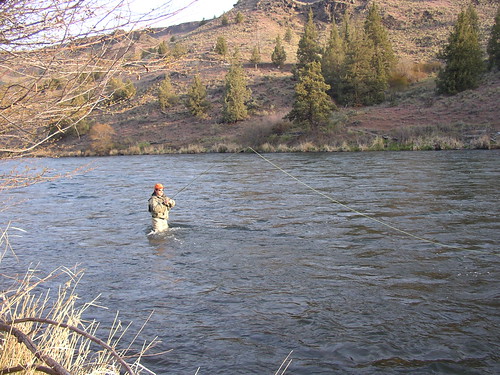
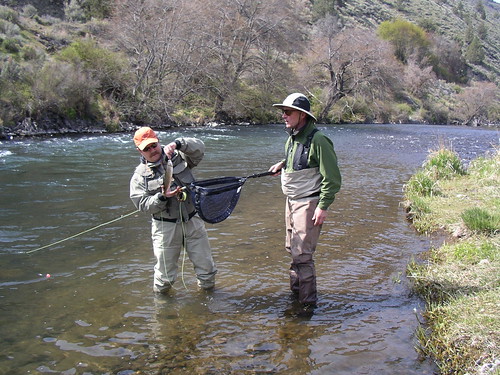
On the river before the sun spilled into the canyon we placed the first flies downstream, dead-drifted runs and swung stone flies over the cobbled bottom before any other fisher this year. We saw how fat the Osprey have grown since last fall. We passed the many campers at Mecca who were struggling to trade warm coffee cups for cold fly lines, offering us first dibs on water that would all too customarily been theirs. We only hit one spot,allowing the three of us to each fish totally different water with a range of patterns from small to large, before the campers had walked down the trail. From that point on, all of the walk-in water was left to the walk-in anglers.

It was the harmony of moving the boat with the river, feeling the wonderful tug of the oars, the joy of coming to a stop to wade that is akin to parallel parking your car while the road underneath you is moving, and so the fish don’t look up and think you are a gapper.

Opening Day Deschutes

What is it about building a sandwhich out of the cooler, the first taste of a cold beer, the mischevious joy of a normally forbidden Oreo’s cookie?

Opening Day also is about the increasing joy of working new pieces of water, no matter how many times you might have cast your fly through this drift before; last year or years before that. Discovery. You have changed and the river has.

With the boat on the trailer, the gear stowed and the slow and painful, bumpy drive up out of Trout Creek underway, perhaps it was the silence of satisfaction amongst three better friends whose thoughts were already zooming ahead to how much fun Opening Day on the Deschutes will be in April 2009!

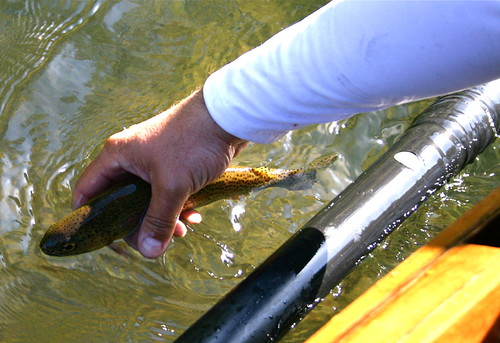
Despite the absence of anglers since November 1 on this top section the fishing was slow, even with big stone flies and a various assortment of droppers fished by each of the three of us. Catching picked up in the late morning so we had steady action through the rest of the day with rainbows in the 10-12 inch range. We saw one large redside go airborne three times for one happy angler who had been working a back eddy, but otherwise the hookups for others seemed to mirror our fortunes.

Posted in Central Oregon Fishing Report | 1 Comment