A Free Fly Fishing Class for Ages 11 and up with an Adult

Free, fun, interactive class will explore fly rod casting, knot-tying and how to use flies. The instructors will also teach fish identification, fishing regulations, and where to catch the big ones. On Saturday, May 9, the class will go fishing at a pond stocked full of fish!

Instructors will be there to help you catch, clean and cook the fish.

Where: Roosevelt Middle School 680 E 24th Ave.
When: Wednesdays, 6:30-8:30 p.m., April 22, 29 & May 6, and on Saturday, May 9, at 9:00 a.m., a special fishing trip for all participants.
Cost: FREE!

To register: Call 682-3255 or email hampson@4j.lane.edu
Additional information: call Penny Hampson 687-3255

Posted in Oregon Fly Fishing Clubs and Events | Leave a comment

An intro to fly fishing in New Zealand

Clifton Molatore, one of the big winners at the McKenzie Two-Fly Tournament, just got back from a fly fishing trip to New Zealand and sent us this report:

I was invited by a friend to go to New Zealand this February to fish. He said that we could stay at his parents’ house in Mataura, Southland and that his dad, Sean, who has fished the Southland for five months each year for the last 15 years, would show us the ropes. With an offer of free housing, a free guide and cheap airfare, it didn’t take long for me to say yes. The only issue was that I could only get nine days off work and with two full days of travel, that only left seven days for fishing.

Sean told me that it wasn’t worth going to New Zealand unless you had two weeks to stay. I thought Sean was saying that because the flight is long and it doesn’t make sense to travel all that way unless you can stay awhile. Well, I only had nine days and it was either go for a week or not go at all. I decided I was tough (I am easily fooled, even by myself) and I would just have to make the most of my time.

After arriving in New Zealand after 24 hours of travel, I was beginning to see why going for only a week was a little crazy. However, when Sean told me that it had been raining in Mataura for most of the last week, all of the rivers were blown out (and still rising) and he was concerned that the rivers would not get in shape before I left, I realized that there was an even more important reason to have at least two weeks when traveling to New Zealand: the weather is unpredictable and you can get rained out for a week, even in the middle of summer.

Undeterred, I asked where we could fish the next day. He told me that the only things that would be in shape were the spring creeks. In the area there were two choices: a very difficult spring creek and an impossibly difficult spring creek. We chose the very difficult option.

Upon arriving at the creek I received my first bit of good luck. The owner of the property told us that no one had fished the creek in about a month. With a spring in my step, I rigged up and headed out. After fishing for about two hours without seeing a fish (not sitting in the creek, rising or fleeing after we spooked it) I was starting to think I had figured out why no one had fished here in a month and that my New Zealand fishing experience was going to be a disaster. Sean could see the concern on my face told me not to worry and that things in New Zealand can change in five minutes.

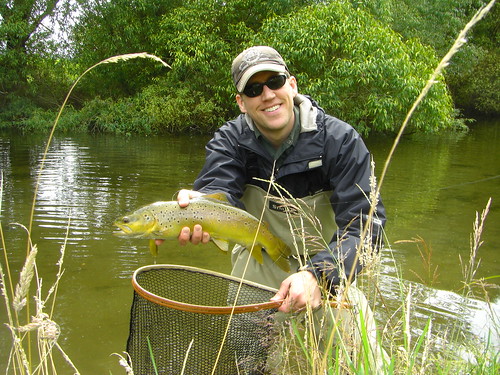
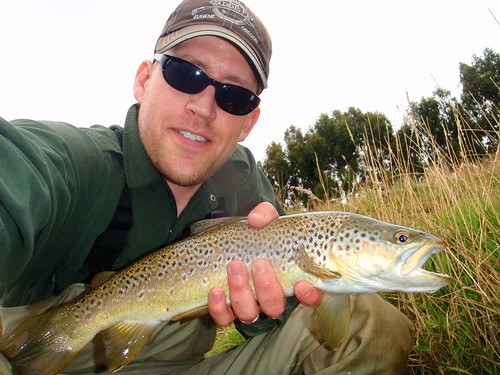
About four minutes later we came upon a bend in the creek that looked very un-fishy to me. Sean stopped quickly and said there was a “small” fish in the creek. I snuck up to the edge of the bank, cast into the middle of the creek and hooked and landed the two to three pound brown trout pictured below. While Sean thought the fish was barely worth throwing a fly over, I was pleased to have landed my first New Zealand brown trout and was very happy with the size.

nzpicture1

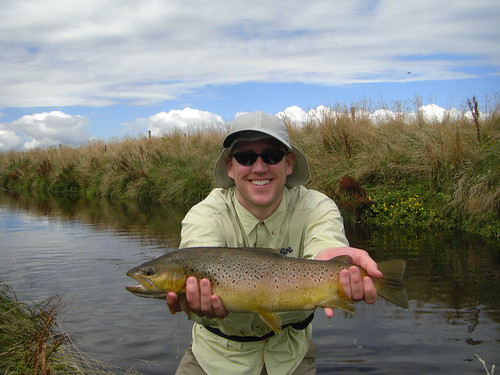
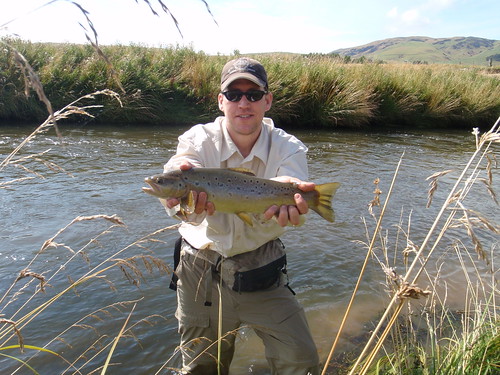
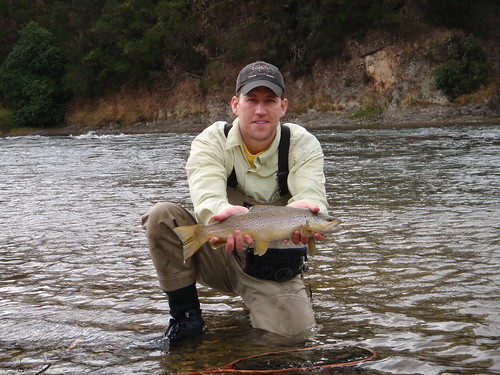
The next day we went to the famous Oreti River to try and catch a “big” fish. We didn’t get the water we were hoping to get, and despite reports of two 12 pound fish in an area I fished, we struck out. The next day most of the smaller streams around Mataura were fishable and during the next few days I caught a nice five pound brown trout on one stream, a beautiful six pound brown trout on a possie bugger on another stream, and several other fish three to four pounds. Life was good.

nzpicture2

nzpicture3

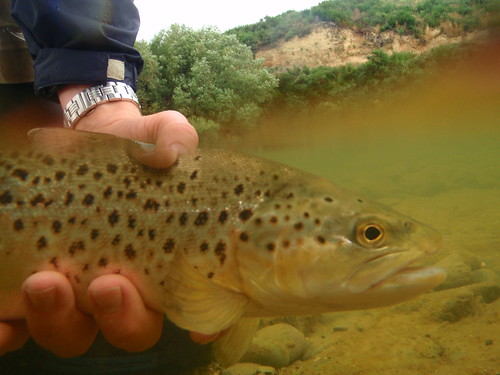
On my second to last full day of fishing, the Mataura was finally fishable and we spent the day on the famous Mataura near town. We were hoping to catch a good hatch and experience some of the famous Mataura dry fly fishing, but it wasn’t in the cards. I decided to try a parachute adams from the Caddis Fly and a copper john that I picked up to fish the Deschutes. Both flies worked perfectly (especially the copper john) and I caught at least 13 fish, 10 of which were between three and five pounds. The fishing was incredible. We met up with several fisherman from the U.S. who winter in New Zealand later that day and they couldn’t believe I had caught that many fish (I guess I don’t inspire confidence from my appearance) and really couldn’t believe I had caught all those fish on two flies from Oregon. The next day and a half were more of the same, with the adams and copper john combination being the ticket, although I never did experience a famous Mataura River hatch.

nzpicture6

nzpicture5

nzpicture7

I spent seven full days fishing in New Zealand and could have spent another seven doing nothing but the same. If you ever have the opportunity to fish in New Zealand (even if it is only for one week), I highly recommend doing it.

Even though my trip of a week was great, I certainly recommend staying for at least two weeks. After I left, the dry fly fishing on the Mataura took off and the fishing was fantastic. Oh well, I guess there is always next year.

Send us your fly fishing stories and pics!

Posted in Fishing Porn, Fly Fishing Travel | 5 Comments

Video: How to organize your fly boxes

If your fly boxes are a disaster, you should probably watch this next video. We tear apart 12 months worth of disorganization, throwing out rusty hooks and mangled flies. Then we organize my hodge podge of fly boxes into six small, workable systems, each designed for its own trip. Also, Chris put the Rio C&F Fly boxes from this video on-sale, over 30% off.

Posted in Oregon Fly Fishing Tips, Shop Sales and Specials | 3 Comments

New international shipping policy on caddisflyshop.com

European orders under 4 pounds will now be $12.95. European orders over 4 pounds will pay actual freight and each customer will be contacted before we charge or ship your order.–CD

Posted in Shop Sales and Specials | Leave a comment

Custom dubbing blending workshop with Jackson and Jay Nicholas

Fresh from an enthusiastic reception at the FFF Expo in Albany, Jackson and Jay Nicholas will be at the Caddis Fly on Saturday, April 4 from 10am to 3pm, to demonstrate the art and science of blending custom dubbing colors and textures. Request a custom blend – we’ll mix you up a free sample!

Jackson and Lisa dubbing at FFF Expo

Dubbing, dubbing, dubbing!
Yeah, you know, those cute little packets of fuzzy stuff that we harass around our threads to wind on our fly hooks – dubbing! You can it in find hundreds of colors and a wide range of textures, stuffed into little plastic bags and hung on pegs in fly shops. Of course, the Caddis Fly carries a great selection. Dull and bright hues, fine to coarse textures, fluorescents, sparkly, shaggy, oh-my-gosh – all these terms could be used to describe some of the dubbings you will find at the fly shop.

Jackson Nicholas' Dubbing Blends

Why on earth would anyone want to blend their own dubbing when so many ready-made materials are available already?

Reason one, it’s fun.

Reason two, it might allow you to match the hatch by creating a color or texture that no one has thought about.

Reason three, it will allow you to create custom dubbing colors that form the basis of a “signature fly” – the fly that is so effective, so different, and so appealing that it will be copied by others, and maybe even make you famous. If you become engaged in this art, you just might wake up dreaming about creating a series of colors and textures that you won’t find on the racks — blends that haven’t found their way into mass production.

Fly tyers are often tinkerers. They like to mess around with tools, hooks, fly vises, and threads. They are never quite satisfied with simply copying fly patterns in the shops, so they create their own. Blending your own custom dubbing materials is right in line with the creative side of the fly tyer’s brain.

Most of the custom blends we Nicholases create tend to be on the fuzzy side and are especially suited to tying steelhead and salmon flies. We also create dubbing for dry stoneflies, caddis nymphs, and soft hackles. Our custom dubbings make awesome leeches too, and Hareline Dubbin provides a nice selection of pre-blended leech and scud dubbings.

Jackson with Dubbing that Produces

What you’ll need to blend your own
Not much; just a simple coffee grinder (available for about $10) and an assortment of dubbing materials that you want to combine. Here’s a thought – you ought to consider dedicating a grinder to your dubbing adventures; that wad of chartreuse and pink hair won’t look so good floating around in your morning coffee.

Our raw materials
Hareline Dubbin provides all of our raw materials. The Caddis Fly carries virtually all of the materials that we blend together, plus a few we haven’t had time to try yet.

A few pointers
Most of the coarse dubbing materials blend very nicely. Hareline Trilobal, Angora Goat, and a range of rabbit fiber dubbings blend very easily. Many of the Ice Dub materials also blend well, but some blend better than others.

You just might be amazed at the result when you start with a base of Black and Purple Trilobal, add a trace of Chartreuse Rabbit, and finish off with a pinch of Gold Ice Dub. Zowie. This stuff will make your eyes water with anticipation. Now go back and substitute a little Steelie Blue Ice Dub somewhere in the mix. Gimme that coffee grinder! Throw a little Minnow Belly Ice Dub in with some Adams Gray or some Dark Hare’s Ear to add just a hint of sparkle to your trout flies.

A few materials, however, are difficult to blend and you may find yourself with a knotted, lumpy mess in your grinder. Through trial and error, you’ll figure out which materials work well. We have not been successful blending some of the Super Fine materials intended to tie small dry flies with very smooth bodies. You may have success where we have not, though, so don’t be timid about experimenting.

Hope to see you at the Caddis Fly on April 4 10am-3pm! The Nicholas family will be there to show you how we blend our favorite mixtures. Let us create your special requests.

JN & JN

Posted in Fly Tying | 2 Comments

Derek Fergus, creator of the MOAL leech talks shop

In this video, Derek Fergus, creator of the MOAL leech talks about how he created this favorite strung-out leech pattern, and some tips for tying it.

Fergus also talks about how he came up with some of his other strung-out versions of staple patterns.

Posted in Fly Fishing Profiles, Fly Tying | 1 Comment

Gamakatsu fly hooks second to none

Gamakatsu has been making premium quality hooks since 1955. Made of high quality, High Carbon Steel Gamakatsu hooks are super sharp and consistently perfect out of the box. They are made in thier own facility, which is one of the most technologicaly advanced in the world.  Gamakatsu measures hooks by the sharpness, hardness, and viscosity of the point. Using low quality materials results in points that are weak and not truly sharp. In order to use High Carbon Steel , Gamakatsu developed a unique electronic tempering process which enables hooks to be tempered in a stable condition. As a result, Gamakatsu is able to manufacture consistently high quality, extremely sharp hooks in large quantities.

Gamakatsu’s numbering system.

Going way back to old bronze Mustad and Partridge Hooks we’ve used a numbering system. We learned the numbers because that is just what you did. I am sure they had some sort of system in mind when the 3399a and 94840 were created but I never figured it out, I just memorized the numbers and equated numbers to hook type and style.  Over the years we learned to equate old Mustad numbers with new TMC numbers, 94840 became 100 and 9672 became 5262. Again not really sure what the numbers signified. Gamakatsu explains their numbering system in thier catalog and it really makes sense.

For example S11s-4L2H breaks down like this:

First letter=style of bend (S) is sproat, P=perfect C=curved  B=Bend L=Limerick T=Tapered R=Retainer

Second is the Model Number 11 is Gamakatsu’s model number for the given hook

Third Letter refers to the Eye Style, S=straight, U=up, V=vertical

Fourth in the code is the length of the hook L=Long, S=Short in the examples case we have a 4x long hook shank 

Fifth and finally possible code is the hooks strength H=hard/strong, F=fine, for our example we have 2x strong.

Not all Gamakatsu hooks use the entire code, they have used simpler terms for hooks with few variables and make some assumtions on more standard hooks. For example the C14S, our most popular glo bug hook, C=Curved 14=Model number and S=Straight eye, for the S10a fantastic dry fly hook S=Sproat or Standard bend 10=model number and everything else is assumed, down eye,  standard wire, standard length.

Below is a discussion of many Gamakatsu fly hooks. Each hook was developed with specific applications in mind.  These are amazing hooks and anglers will not be dissapointed with their performance.

S10 Standard Down Eye, multi use dries and wets. We have been using the S10 as our standard dry fly hook, it’s slightly longer than most standard length hooks, light, strong and micro-barbed for easy crimping.

s10

C15BV Vertical Eye, Emerger/Klinkhammer Barbless Hook. Super light wire designed to have the curved shank sit  sub surface. When tying sparse emerger types this is a nice choice. Near the eye there is a flat spot for a parachute post or wing.

klinkhammer hook


C14S Glo Bug hook. Short Shank, ridiculously strong and sharp, we love this hook for glo bugs, tube fly trailer hooks, and carp corn flies.

c14s

L11S-3H Salmon Steelhead 3x strong. We love this one for Chinook flies. Comets and Clousers are excellent on the L11S-3H.

ls11

B10S Stinger Hook, 1x strong  Stinger.  Awesome bass fly and streamer fly hook with a massive gap, sharp point and straight eye. Barrett likes this one for his Bassmaster Cascade Killer.

b10s

T10-6H Salmon Steelhead Tapered Loop Up-Eye.  A good all around standard wire Steelhead fly hook.  Elongated razor sharp point makes the T10-6H sticky.

t10

SP11-3L3H Perfect bend Saltwater long shank. Great for poppers, longer streamer patterns and billfish in the larger sizes. Tin plated, sharpenable and friendly when you leave it in a fish.

sp11


SC15 Saltwater wide gap, tin plated. Excellent for shrimp patterns, saltwater tube flies, and small tarpon flies. Lighter wire than the SC17 makes this hook a bit more versatile in saltwater arena.

sc15


SC17 Tarpon specific. This hook is an absolute killer. Once this one sticks it’s the best hook on the market to help you land the fish. Extra strong and sharp this hook is flat out burly. Tarpon Toads and Bunny Baitfish patterns are must on this hook.

sc17


SL45 Saltwater Bonefish Hook. I really like this hook for lighter bonefish flies. When you are tying your tailing patterns, no eyes or mono eyes the SL45 is great. My hook up rates are better with the SL45 than the Mustad 3407.

sl45

For consistently high quality, sharp hooks with great design give Gamakatsu a try, you will not be disappointed.–CD

Posted in Fly Tying | 2 Comments

Fly tying video: Klinkhammer March Brown Emerger

This March Brown pattern sits half in half out. It does a great job of imitating the may fly struggling to break the surface meniscus. The Klinkhammer will fool the pickiest of trout with it’s slim, sparse profile. Best results come by fishing the Klinkhammer dead drift down stream to rising fish during a March Brown hatch.

March Brown Klinkhammer

Klinkhammer Style March Brown
Hook: TMC 2488 size 12
Thread: 6/0 Uni Thread
Tail: Lemon Wood Duck
Rib: Fine copper wire
Dubbing: Australian Possum
Hackle: Brown
Post: Neon colored Antron

Posted in Fly Tying | 4 Comments

Fly Fishing for Surf Perch on the Oregon Coast

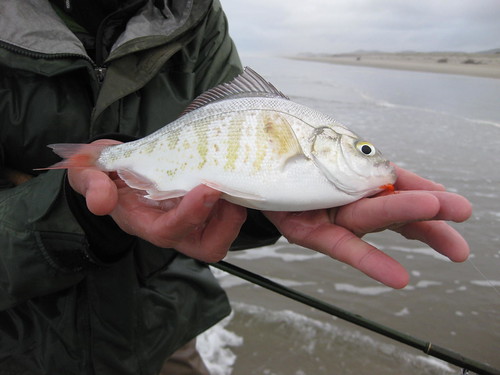
The open beach is always difficult terrain to fish. There is just so much area to cover and conditions generally do not favor the fly fishing enthusiast. With spring right around the corner and calmer weather (hopefully) on it’s way the surf should mellow and opportunities for surf perch will present themselves. Should you want to try your luck with these colorful critters use smaller crab patterns (Size 4-6), shooting heads (type 3-6), and I would recommend a rod size that you feel comfortable casting in the wind. 

Surf Perch

These are very cool fish and nothing beats a day at the beach!

Surf Perch

Posted in Oregon Saltwater Fishing | 18 Comments

Lower McKenzie April Guided Trip Special $250

UPDATE: LINKS FIXED, THANKS FOR THE FEEDBACK.

Here is the background on this one time offering: The Caddis Fly Shop needs to test our new on line reservation system.  We would like to make sure that we have no issues and the only way to test it, use it!

So here is what the shop is offering:
1.   The cost of this special preseason trip is $250 for one or two people.
2.   This offer is good for any Monday, Tuesday, Wednesday, or Thursday during  the month of APRIL.
3.   The trip will last from 10am until 3:00pm.
4.   All equipment (yep, flies too!) will be provided by the guide. NO LUNCH will be provided.
5.   The guide chooses the drift on the lower Mckenzie.
6.   All reservations and payment must be made ON LINE.   No phone calls will be used to take a reservation.   You may call the shop for questions, but you must make your reservation and payment,  ON LINE.
7.   You will receive a email letter confirming your trip.
8.   The shop will call  and tell you where and when to meet your assigned guide on the river within 48 hours of your scheduled trip.

Remember, this is for April only! Any Monday, Tuesday, Wednesday, or Thursday.   We hope that you will take advantage of our special and help us out by testing our new reservation system.

Posted in Shop Sales and Specials | 3 Comments

Winter steelhead season winding down, lessons learned

Just when my winter steelhead season starts to get into a groove, it’s almost over. The water levels are reasonably stable, the wild fish are up in the rivers, and the bait-chucker armies have returned to their lairs to prep for springer season.

When I go out in March, I actually feel like I have a reasonable chance of catching a fish. The days are longer, warmer. It’s such a far cry from those dismal days in December on the Alsea, racing to get to the boat ramp before dark, hoping the road over Mary’s Peak isn’t covered in snow.

The March Browns hatch in the rivers, the sun shines in the Oregon Coast Range, and steelhead lurk behind every boulder.

These are the days that I carry in my mind the rest of the year, this bogus image of “winter steelheading” that drives me to be on the rivers in darkest days of the year.

Every year I try to learn something new, to make some kind of meaning of a winter on the water. Hard earned wisdom. And this year, the prevailing theme was “You don’t have to drive several hours to get skunked.”

There are just too many beautiful and productive rivers to get skunked on close to home.

I could drive six hours to the Olympic Peninsula or to the Steelhead Train in Minam, and have the same or worse odds of catching fish as I would 40 miles from Eugene.

In fact, you might argue that if I’d spent more time on a handful of home waters, I’d catch a lot more fish in the long run. But the lure of the road, the untrammeled wilds and freedom of the road-trip are hard to resist.

With some fishy friends and a gazetteer you can build a local steelhead circuit within just a couple hours of town, gorgeous uncrowded waters that fish well at various water levels.

My steelhead circuit is still forming, but I have a baseline to work from. So next year I won’t be buzzing around the Northwest, hoping to stumble onto the bonanza, but instead staying close to home, learning a few river sections like the back of my hand.
-MS

Posted in Oregon Winter Steelhead Fishing | 5 Comments

Getting sucked into the switch rod craze: Redington gear review

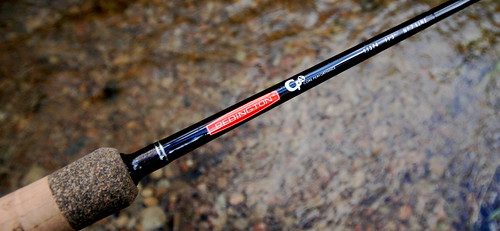
I’ve fallen prey to the switch rod craze. Full disclosure: Redington Fly Fishing sent me a 7-weight 11’3″ CPX Switch Rod to review. So of course, it’s the best switch rod I’ve ever cast. Ok, it’s the only switch rod I’ve ever cast.

But it’s a great rod. I can fish the surf with it, chuck heavy nymphs with beach ball-sized indicators like nothing’s even there. I think it actually casts better with a few split shot on the leader. I can joust bears with this rod.

And therein lies my only complaint. This thing is heavier than He-man’s sword. One day of winter steelheading and it felt like Karl had spend the whole day punching me in the shoulder. 11’3″ is a lot of rod to handle single-handed, especially for a short and spastic guy like me.

Redington CPX Switch Rod

Despite that, I could put two weighted flies and a thingamabobber anywhere I wanted on a mid-sized steelhead river. I got better, longer drifts, mending easier and keeping my rig in the feeding zone longer. As for fighting fish, the one steelhead I had on decided to dive under the boat and break off immediately, so there’s not much to go on.

I paired this rod up with a Bauer Rogue Five (because it’s made in Oregon and is a great looking reel), and a 290-grain Sage Indicator Taper line. And I think it’s the perfect set-up for a big indicator rig.

As soon as I come up with the cash, I’m going to get a Bauer spool and string this rod up for spey casting. In these economic times, it’s nice to have a rod that can pull double duty. I’ll be loading it up with a Scandi Compact 390 grain head, and a Skagit compact 420-grain and testing the Redington CPX Switch Rod’s spey casting abilities soon.

For more Switch Rods, check out the CaddisFlyShop.com: Winston, Sage, Echo and Redington.

-MS

Posted in Fly Fishing Gear Review | 5 Comments

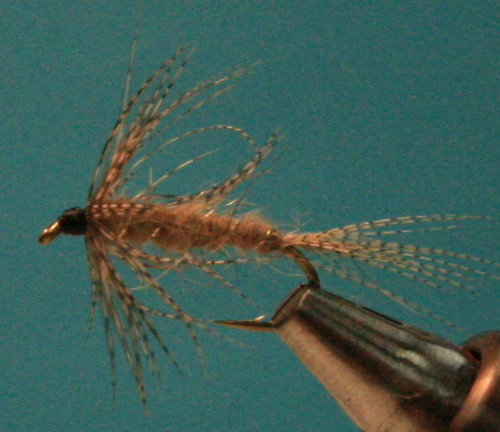
Fly tying instruction: The Hare’s Ear soft hackle

A great march brown imitation for the lower McKenzie River, the Hare’s Ear March Brown is a must-have pattern. This buggy wet fly is great in any number of situations, but should fish really well these next few weeks. It’s definitely worth having some of these easy-to-tie patterns in your spring fly box.

Hare's Ear soft hackle

Hare’s Ear soft hackle
Hook: 3761 TMC Size 10
Thread: 6/0 black uni
Tail: Lemon wood duck
Rib: Lagartun Gold Tinsel
Body: Hare’s ear dubbing
Hackle: Partridge

Posted in Fly Tying | Leave a comment

McKenzie near Eugene continues to fish well subsurface

It’s always great to fish dries, but phenomenol hatches and good fish up on top don’t happen everyday. This past Saturday I had two skilled anglers up front and we nymphed and swung wets all day. Fishing was great and our average size of fish was anything but average. Nymphing rigs varied throughout the day, golden stones, Mega Princes, Pheasant tails and March Brown Nymphs all worked. The key was having the fly down near the bottom dead drift. After things warmed up a bit we swung March Brown Bead head emergers.–CD

odfw # 918

IMG_4232

IMG_4256

IMG_4258

Posted in McKenzie River | 4 Comments

Middle Fork Willamette Picking up

Most of the fishing has been focused on the Lower McKenzie, but the Middle Fork of the Willamette has been heating up as well. Great mid-day hatches of both BWOs and March Browns have put the larger natives on the feed. March Brown wet and nymph patterns have been the go to.

Trout Middle Fork Willamette

The amount of bugs in the air has been insane!

Trout Middle Fork Willamette

Posted in Middle Fork Willamette River fishing | Leave a comment