Winter Steelhead Technique — Dead Drift fishing primer

I have this friend, see, who’s on the verge of committing to year-long, exclusive use of a fly rod. He loves to fly fish for trout. You should see his eyes sparkle when he talks about fly fishing for sea-run cutthroat: Daybreak mist on the water, silvery streaks exploding on his fly.

But when winter steelhead season rolls around, he looses confidence in the fly rod. Out come the eggs and spinners. He wants to catch fish, he says, as if that was sufficient to conclude the discussion.

Jay Nicholas steelhead technique

But now he’s teetering on the edge, seriously exploring the option of fishing flies for winter steelhead. He asked for my advice. Here’s what I said, abbreviated.

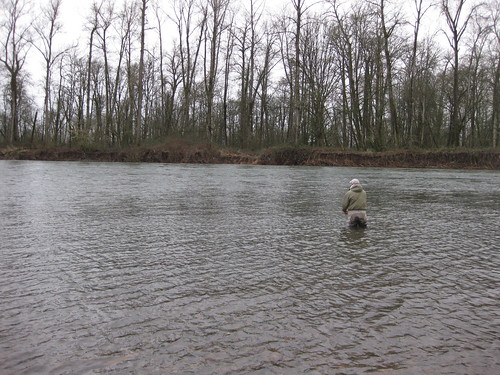
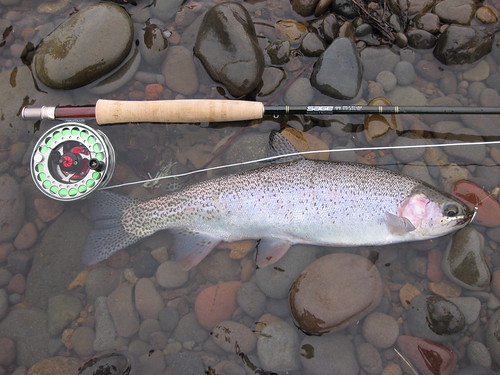
Dead-drifting usually involves using some sort of nymph or egg pattern, fished under a strike indicator, trying to achieve a drift-speed about the same as the river current. Whether you believe that winter steelhead feed actively or not, they do take stuff into their mouths, and sometimes they even swallow. Curiosity? Aggression? Hunger? Who knows? That discussion is topic for future story-telling and conjecture.

Nymph and egg patterns totally rock wherever steelhead are concentrated in sweet spots because you can put your fly right on Mr. Steelhead’s nose. Side-drifting flies under a Thingmabobber is effective when prospecting long river reaches from a driftboat, because you can let your fly drift alongside the boat, guiding your fly into areas where you think steelhead are most likely to lay. This is how a lot of guides fish eggs, and it’s also a most excellent technique for fly fishing.

Jay Nicholas steelhead technique

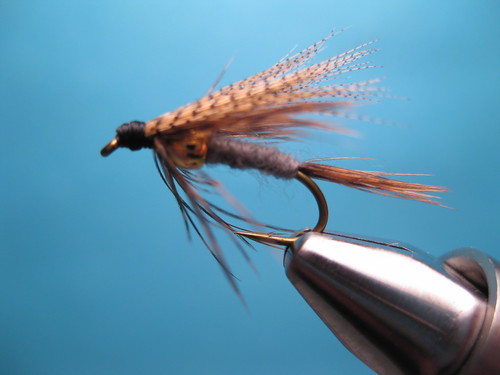
Winter steelhead will, on occasion, eat every type and size of nymph they encounter. Big stoneflies; little mayflies; cased or swimming caddis – they eat ‘em. So your flies can be the same nymphs you fish for trout, or you can draw attention to them with a fluorescent bead.

Egg-style flies are also effective and there are a zillion different egg patterns out there. Some of these flies are little, some are big; some are designed to look like an egg, some are simply a bright colored blob of some sort. I tend to fish larger egg patterns flies in murky water and smaller eggs in clear water. Fish a nymph and an egg on the same leader (if it’s legal).

Jay Nicholas steelhead technique

My favorites include the glo bug, lowly glowly, trilogy egg, and the Strung Out Fat Albert. The Thingmabobber is an effective, easy to use strike indicator and fishes well.

Jay Nicholas

Posted in Oregon Fly Fishing Tips, Oregon Winter Steelhead Fishing | 3 Comments

Do wild rainbow trout exist in the McKenzie after decades of stocking hatchery trout?

Jay Nicholas posted his response to this question recently on his Blog, Fishingwithjay.wordpress.com. You can view it if your curiosity is piqued, if you have an opinion one way or the other, or if you just want to see some of salmon art.

http://fishingwithjay.wordpress.com/category/salmon-conservation-issues/

CD

Jay Nicholas Salmon Art

Posted in McKenzie River, Oregon Conservation News | 1 Comment

Fly tying materials primer: Selecting feathers from a package

A little while back we got a reader comment asking how to select the best feathers from the packs of strung saddle hackle, schlappen and marabou. In this new video, Jay Nicholas shows you how to make the most of your fly tying feathers. How to grade feathers in a package, how to sort them, and which parts of the feather make the best flies.

Fly tying materials discussed:
Strung Saddle Hackle
Strung Marabou Blood Quills
Schlappen

Posted in Fly Tying | 1 Comment

Fly tying materials demo: How to fold a hackle feather for collars

If you want to make great looking collars for steelhead flies, you need to fold your hackle. Tying the feathers in from the tip, and wrapping them forward, Jay shows you the best way to create great looking patterns.

Folding Hackles

Jay Nicholas
has been demonstrating his fly tying tips and fly tying materials selection for us down at the shop, so look for lots of new videos with Jay.

Posted in Fly Tying | 4 Comments

Smoking Fish 101: Barrett’s Smoked Salmonids Recipe

Looking for something to do with those hatchery steelhead? Here is Barrett’s smoked fish recipe:

Brine:
1/3 cup salt
1/3 cup brown sugar
6 cloves peeled garlic crushed
3 tbsp. ginger fresh grated
Juice of one fair sized lime
3 tbsp. high quality soy sauce or tamari
1/4 tsp. cayenne (optional)
1 qt. water

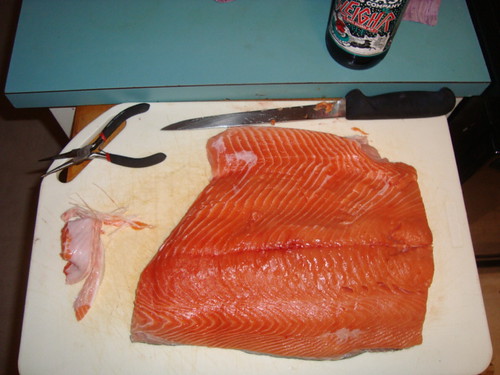
I remove all the bones (both pin and rib bones)with a needle nose pliers.

beautiful salmonid slab

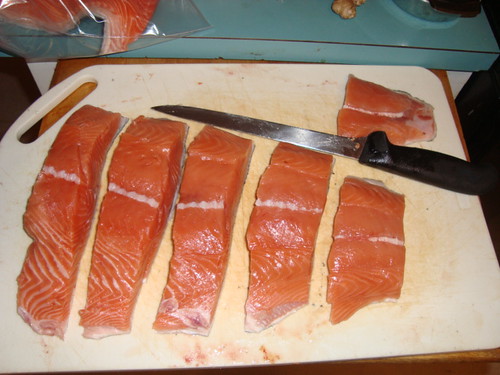
Slice the fillets into the size pieces your family uses (about 2 in. for my crew). Don’t forget local libations.

sliced fillets

I use a gallon Ziploc bag to soak as many fillets as will fit (usually half of a salmon/steelhead or 10 hatchery trout)for 24 hours in the fridge.

loaded zippy

barrett's salmonid smoking

I then set the fillets on the racks of my electric smoker to air dry for about a half hour. When the fillets look tacky I put the rack in the smoker, I use apple or cherry wood to smoke my fish but there are a lot of options, almost all are good. 4-6 hrs later I remove the racks of fish and allow a hour to cool to room temp.

salmonids on the rack

Then you can vacuum seal for long term or Ziploc for short term storage. Enjoy freshly smoked or freeze to enjoy later in a myriad of recipes!–BC

Posted in Oregon Fly Fishing Tips | 5 Comments

The Drake Fly Fishing Film Tour comes to Eugene Feb 16th

Most of you have probably heard of The Drake’s Fly Fishing Film Tour. They’re coming to Eugene next month and offering a special rate for the shop. Ticket prices for this years event are $14 online at the film tour site, $15 at the door, and $12 at the shop — on sale now.

FFFT

The show is scheduled for:

Tuesday February 16th
The Shed, 868 High Street
Doors @ 6:30 PM, Show @ 7:00PM

The show will run aprox 2.5 hours which includes a 20 minute intermission.

Be sure to check out s trailer for one of the new films they’re showing:

Posted in Oregon Fly Fishing Clubs and Events | 1 Comment

A day with Dave Hughes: Trout fishing seminar Feb 27th

Dave Hughes, co-author of Western Hatches, author of Trout Flies, and 20 other titles will be at The Caddis Fly on Feb 27th.

Dave Hughes Fishing

Dave will be putting on a workshop on the Elements of Fly Fishing For Trout from 9am-3pm for $50/person, 20 person maximum. From 4pm-5pm Dave will be doing a book signing and tying demo, free and open to the public following.

Elements of Fly Fishing for Trout (a 4- to 5-hour workshop).
Includes the following three slide shows and a casting demonstration if space and weather permit.

Reading Trout Water: Learn to read water and find trout in creeks, streams, rivers, plus lakes and ponds. The initial skill in trout fishing is learning to focus your fishing in water where trout hang out, and to eliminate time wasted fishing water where they do not. Based on Dave’s books Reading Trout Water.

Selecting Trout Flies: Learn how to select the right type of fly—dry, emerger, nymph, wet fly, or streamer—for the situation you’re in: the type of water you’re fishing, and the naturals, or lack of them, that trout might be taking. Based on Dave’s books Handbook of Hatches, Trout Flies and Essential Trout Flies.

Tactics for Trout: Learn the most effective rigs, casts, and methods to present dry flies, nymphs, wet flies, and streamers to trout on waters moving and still. Based on Dave’s books Dry Fly Fishing, Nymph Fishing, and Trout Rigs and methods.

Casting Demonstration (weather permitting): Covers appropriate tackle selection for all types of trout fishing. Demonstrates the parts of the basic casting stroke, variations on the basic cast, and casts to apply the methods covered in the workshop. This is not a distance casting demonstration, rather a presentation of practical fishing casts that actually catch trout.

Dave Hughes: Dave is author of more than 20 books about fly fishing. They include the classic Western Hatches with Rick Hafele, American Fly Tying Manual, Handbook of Hatches, Reading Trout Water, Dry Fly Fishing, Nymph Fishing, and the massive reference Trout Flies. His latest book, published in 2009, is Nymphs for Streams and Stillwaters.

Call the shop to reserve your spot ASAP: 541-342-7005.

Posted in Oregon Fly Fishing Clubs and Events | 1 Comment

January Trout fishing on the McKenzie

Winter indicator fishing

Although I did not have a thermometer yesterday afternoon the water temperature was “fish friendly” enough.

Winter Trout on the McKenzie

We spotted one March Brown, a couple of Winter Stones and a few Beatis. The only sipping on the surface was in very slow water.

The few fish we caught were  on the Mega Prince, fished under a Thingamabobber about 6 feet.

The McKenzie did rise yesterday evening and had a steel gray green color to it. Look for it to drop during the next couple of days and for warm afternoons to be very productive. All indications are we are going to have a fine early trout season on the McKenzie and Willamette.–CD

Posted in Fishing Reports, McKenzie River | 7 Comments

Salmon Fisher’s Journal Field Observations: Stray hatchery fish

Salmon “home” right? They find their way back home to the river, tributary and maybe even the gravel bar where they were spawned. In the case of hatchery fish, they home to their release location, right?

Jay Nicholas Strays 1

Well, yes and no. Homing by Pacific Salmon is crucial to the ability of these fish to develop genetic characteristics that have survival benefits, characteristics that improve their fitness, productivity, and ability to survive in different river basins. This is true.

It is also true, I think, that a certain amount of straying is essential to the survival of Pacific Salmon. If these fish did not – ever – stray from their home stream, there wouldn’t be anadromous fish in rivers that have been frozen under ice sheets, cooked by volcanoes, baked in drought, blocked by fire and landslides, and so on.

Pacific salmon are pioneers. But there is a balancing act between the benefits (to a locally adapted stock) of returning to a home stream versus the benefits (to the species) of venturing forth to some other river to spawn. This is not a conscious choice, I remind my friends who tend to anthropomorphize salmon and intuit their desires.

Some stocks of Pacific salmon do home very precisely to very local spawning areas. Sockeye salmon of an inlet race would survive very poorly if they spawned in an outlet river. I believe that some pink salmon stocks home to very spatially distinct reaches where they spawn near springs and braided channels. Cutthroat trout in Alaska, I understand, also home very precisely.

But we know that there is indeed a degree of straying in our lower 48 Pacific salmon stocks. Not enough that they all blend into one mass of indistinguishable genetic goo – but enough that it is a matter of interest and curiosity.

It is easier to track coded-wire-tagged hatchery fish than wild fish. Rogue Chinook wind up in the Klamath. Klamath coho wind up in the Rogue. Rogue half-pounders show up in The Elk. Chetco steelhead return to Elk River Hatchery. When they were in operation, private hatchery coho and Chinook roamed into many of the nearby watersheds instead of all returning to their home hatchery. I remember a year when several-thousand hatchery coho returned to Elk River instead of the Floras-New River system where they were stocked as smolts.

Jay Nicholas Strays 2

Keep your eyes open when you fish rivers where hatchery fish are not stocked. Make mental note when you catch a hatchery fish there. The Chinook pictured above is a hatchery buck that was not in its home river.

Pacific salmon and their home rivers are full of grace and wonder. I encourage you to observe the fish and think about how these ecosystems once functioned. Think about how hatchery and wild fish interact and how hatchery and wild fish factor into our fishing experience. Share your observations. Learn.

Jay Nicholas

Posted in Oregon Conservation News, Oregon Salmon fly fishing | 4 Comments

Changes in Trout Unlimited National Leadership: CEO Gauvin steps down

From Trout Unlimited Oregon State Council Chair Tom Wolf:

Charles Gauvin is stepping down as CEO of Trout Unlimited and Chris Wood will be replacing him. Also , Whit Fosberg will be the new president of Trout Unlimited while the new Chairman of the Board of Trustees will be John Christiansen.

Charles is leaving after almost 20 years as CEO of Trout Unlimited. He has done a great job of building the organization and making it a leader in cold water conservation. When he came on board in the early 90’s, TU was a very small organization , with a small budget, small staff and in debt. He built it into a large organization of 150,000 members, 120+ staff, a budget of over 20 million dollars and the largest cold water conservation group in the country, an effective voice for native trout and salmon. He deserves a thanks and praise.

Chris Wood, who will be taking over the CEO job, and many of you have met when he was out here 2 years ago for our state council meeting, is an outstanding choice to be Charle’s successor. He has been ,throughout his career , a passionate voice for protecting trout and salmon. His leadership since he has been with Trout Unlimited has really been amazing, leading TU in new areas we haven’t been involved in before such as roadless and wilderness. He will be a great CEO and continue to help TU grow in it’s role as an advocate for wild trout and salmon.

So we will be saying good bye to a person who has lead TU faithfully and with great ability for almost 20 years-a very long time in the non-profit arena. But we will also be getting a leader who will continue the great work done by his predecessor. I look forward to working with Chris as we continue the outstanding work that TU does.

-Tom Wolf

Posted in Oregon Conservation News | 1 Comment

Protect Tillamook and Clatsop State Forests, and salmon

If you care about salmon and steelhead on Oregon’s North Coast, now is the time to get involved with the ecological nightmare about to unfold on the Tillamook.

From Jeff Hickman: Back in June 2009, the Oregon Board of Forestry voted to increase clear cutting from 50% to 70% of the Tillamook and Clatsop state forests. The Board’s decision authorizes increased clear cutting of thousands of acres of diverse, native forests, which are rare in the North Coast range, including up to 70% of some key salmon “anchor” watersheds.

The Tillamook and Clatsop state forests that are affected by this decision are the largest publicly owned coastal rainforest south of the Olympics and home to some of the healthiest remaining runs of wild fish in the lower 48 states. These forests and the health of their watersheds face an uncertain future if the Board’s recommendations are allowed to proceed unchallenged.

Bob Van Dyk of the Wild Salmon Center said the Oregon Board of Forestry is seeking public comments before they finalize their June 3 decision to weaken environmental protections on your state forests.

You can send your comment through a website created by the Sierra Club. The website has a good preset comment, but it can be changed, so add something personal, too.

Or you can send your own comments via email to Jeff Foreman and the Oregon Department of Forestry. Jeff.Foreman@state.or.us Put “State Forest Rule Making” in the subject line.

KEY POINTS:

1) Do not lower the goal for growing and protecting older, complex forests.
2) Do not increase the amount of forest that is allowed to be recently clear cut.
3) Work cooperatively with the federal fish and wildlife agencies to design a strong habitat conservation plan.

COME TO A PUBLIC HEARING IF YOU CAN:

Salem Oregon on Tuesday the 26th from 5:30 to 9 PM at the Department of Forestry Headquarters.
Seaside Oregon on Thursday the 28th from 5:30 to 9 PM at Seaside City Hall.

Details on hearings and proposed changes in ODF press release HERE.

COMMENT PERIOD CLOSES FRIDAY JANUARY 29

Posted in Oregon Conservation News | 1 Comment

2010 Northwest Fly Tyer and Fly Fishing Expo is set for March 12-13

The 2010 Northwest Fly Tyer and Fly Fishing Expo is set for March 12-13, 2010 at the Linn County Fairground and Expo Center in Albany Oregon.

Albany Fly Tyer's Expo

The NW Fly Tyer and Fishing Expo brings together the social network of fly fisherman throughout the Northwest, Northern California, and Idaho. Over 2,000 people attended last year’s Expo. The NW Expo has been heralded as the “largest fly tying event west of the Mississippi”, with over 80 classes. Class choices include: fly tying techniques, fly casting (single and two handed), and fly fishing techniques. The NW Fly Tyer Expo is sponsored by the non- profit organization, Oregon Council of Federation of Fly Fishers (FFF). All proceeds are dedicated to education and conservation efforts within the state.

Nearly 200 tyers will be demonstrating in shifts all day, both days (March 12 & 13, 2010), plus 59 different vendors of products peculiarly of interest to fly fishers, “where & how to” programs, raffles, and silent and oral auctions of quality merchandise. Federation of Fly Fishers (FFF) members get free admission, non-members pay only $5.00. If you attend and are not yet an FFF member, you can join, and then get in free, basically a $5.00 discount for your membership!

Also, there is no charge for parking at the Linn County Fairgrounds facilities. Good food is available within the Exposition area. Tying classes are conveniently just down the hall from the main hall, and casting classes are in an adjacent building.

On Saturday evening, after the close of the show, there will be an opportunity to meet and mingle with fly tyers and instructors with a no-host bar, followed by the annual banquet and oral auction to conclude the festivities. It is not necessary to buy a dinner ticket to attend the auction. You may learn more about the Expo and sign up for classes or purchase banquet tickets here.

Posted in Oregon Fly Fishing Clubs and Events | Leave a comment

Dark Cahill Wet with Hidden Bead: Spring trout searching pattern for McKenzie, Willamette

The Dark Cahill wet fly with hidden bead is an excellent searching pattern on the McKenzie and Willamette rivers in the spring time. The body of this fly is made of Uni-yarn, an interesting alternative for folks who have a hard time making nice tapered bodies with traditional dubbing.

Hidden Bead Cahil

Dark Cahill wet with hidden bead
Hook: TMC 3761 #8-16
Bead: 1/8 Tungsten Gold Bead
Thread: 8/0 Black
Tail: India Hen Back Natural
Body: Uni yarn, gray
Rib: Copper Wire
Hackle: India Hen Back Natural
Wing: Lemon Wood Duck

Posted in Fly Tying, Proven Spring Fly Patterns | 6 Comments

Winter steelehad patterns: fly tying video for Gorman’s Caballero Egg

The barrage of egg-pattern variations continues! This is the Gorman’s Caballero Egg, a dead drift winter steelhead pattern that is very effective on local rivers. Check out our Steelhead Pattern Index for more fly tying instructions.

Cabiero egg

Gorman’s Caballero Egg
Hook: Gamakatsu C14S #4-10
Thread: U140 Ultra Thread Pink or Orange
Bead: 5/32 copper bead
Tag: Uni floss Neon Chartreuse
Body: Speckle Crystal Chenille Pearl/fl. Orange
Veil: Egg Veil

Posted in Fly Tying, Oregon Winter Steelhead Fishing | Leave a comment

Fish and Wildlife Service Does Right by Bull Trout

The US Fish and Wildlife Service recently announced its intention to revisit its 2005 critical habitat designation for bull trout, a species listed under the Endangered Spcies Act since 1999.

The new proposal would increase by 19,000 stream miles the amount of habitat listed as critical for the bull trout. The Forest Service revisted its previous decision after the Inspector General found that former Deputy Assistant Secretary for Fish, Wildlife and PArks, Julie Macdonald (a name which shall live in infamy) interfered with the designation of critical habitat for bull trout. She instructed agency biologists to abandon the best available science, to exclude all federal lands and exclude all lands that had any “plan” governing land use whether that plan was adequate or specific to bull trout.

From the Inspector General’s report: “We determined that MacDonald was heavily involved with excluding large amounts of areas from the bull trout CHD; she accomplished this goal by making several policy decisions. Many FWS staff whom we interviewed believed MacDonald’s ad hoc policy decisions resulted in a final CHD rule that was not based upon the best available science and was harmful to the recovery of the species.”

The newest propsal identifies 32 habitat units in five western states including 3100 miles of habitat in Oregon. The agency will be accepting public comment on the draft proposal until March 15. You can see Fish and Wildlife’s bull trout homepage here for more information. A Critical Habitat map can be found here.–KM

Posted in Oregon Conservation News | Leave a comment