Feather inventories across the country are returning to more normal levels. This is great news for the fly tier. If you been holding out for a really cool Barred Ginger or Natural Dun this is the time to come to The Caddis Fly and have a look at our large selection.
We welcome you to stop by the shop and have a look at our inventory of feathers or visit the online store Caddisflyshop.com. For Rooster Saddles in specific check out: our Rooster Feathers Page and for many of our great sale feathers check out our Soft hackle Feathers page.
As always, we have Ninkasi on tap in the shop and free shipping and no sales tax for online orders over $25.
Fifth Annual Eugene Spring Fly Fishing Festival
Saturday April 21st 2012 9:00 a.m. to 4:00 p.m.
Campbell Community Center, 155 High Street (by the river at Skinners Butte)
Bring the whole family down to the river and enjoy a FREE day of fly fishing, fly tying, and fly casting designed to introduce people of all ages to the sport of fly fishing. Again this year the McKenzie Flyfishers, the Cascade Family Flyfishers, the Oregon Department of Fish and Wildlife (ODFW) and the City of Eugene are offering this special day to learn about fly fishing, casting and tying with hands-on activities and informative presentations.. Including a catch and release pond in which you can try out your fly fishing skills on live rainbow trout. Continue reading →
Native Fish Society’s 16th Annual Benefit Banquet and Auction was held last night at Montgomery Park up in Portland. While your friendly neighborhood river stewards were busy entertaining Captain Nate while he’s in town, I managed to escape certain doom in the streets of Eugene and drove north to hobnob with some of the most dedicated conservationists in the Pacific Northwest. The food was good, the auction items were incredible, and a boatload of money was raised to support wild, native fish.
The big news at this year’s benefit was the announcement of Native Fish Society’s new Executive Director, Michael Moody, who previously served as the President of the Molalla River Alliance. It’s an exciting time for NFS and we’ll be enthusiastically watching their progress with Mike at the helm. Other highlights included silent bidders going bonkers over Rob Russell’s Kingtruders, Jeff Hickman’s insane donation of EIGHT guided trips during the live auction, and a well-deserved standing ovation for NFS founder Bill Bakke. It was great seeing so many familiar faces in the same room and encouraging to know there’s so many passionate people involved with the good fight. Consider making a contribution to NFS and know that your donation will support their efforts to protect and restore native, wild fish and their habitats.
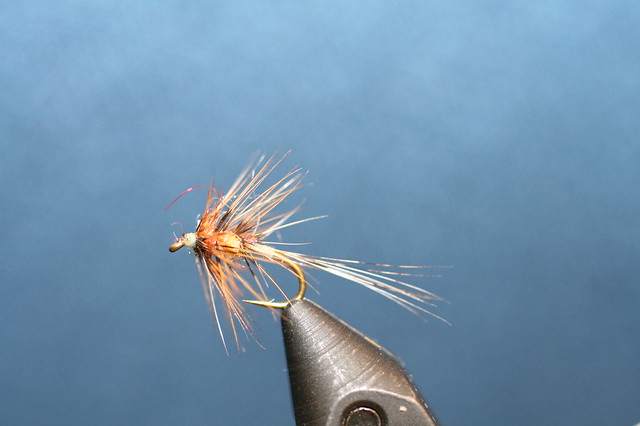
This pattern was killer this year in the Bahamas. The lead eyed version was great for fish cruising in knee high and deeper water. The fly was really durable and matched up well to a variety of smaller crabs inhabiting grass and sand flats.
We here at the Caddis Fly Shop are big fans of biscuits and gravy. Some might even call us biscuit connoisseurs. When leaving town for an early fishing trip, not much compares in terms of calories per dollar or stick-to-your ribs value. A good plate of B&G keeps the stomach gurgles at bay and allows the angler to focus on catching fish.
Given our love for a cheap, hearty, and satisfying breakfast, you can imagine our gastronomic excitement when a new food cart opened its doors across the street from our shop a few months ago. Streets Food Cart, at West Sixth Avenue and Lincoln Street, serves up some of the best biscuits and gravy that our widely traveled palettes have come across. For six bucks, you get a heaping pile of buttery homemade biscuits and your choice of sausage or spicy cheesy gravy. Definitely enough food to feed two hungry fishermen. The next time you’re heading out of town or swinging by the shop for some supplies, stop by and get yourself set up with some grub. Tell the manager, Justin, that the guys from the Caddis Fly sent you.
The water coming out of Hills Creek is still a bit off color but a fine level for fishing. Clarity improves as tributaries merge and mix on down the river. Although a decent March Brown Hatch developed around 2pm fishing double nymphs proved to be most productive. Our two best flies were the Mega Prince and the Double Bead Peacock Epoxy Backed Nymph. Mega Prince in size 6 and 8 and the Double Bead Peacock Nymph in size 4 and 6. Learn to tie the Mega Prince here.
Barrett’s Bunny Baitfish has taken a wide variety of fish from Snook to Wahoo. The version in this video is aimed at Largemouth Bass. Using new Clear Cure Goo resin and eyes the pattern is easily finished with a durable hard head.
Great fly fishing on the McKenzie River yesterday, despite blizzard grannom caddis hatches. Be on the look out the next few days for ridiculous numbers of tan, charcoal, and black caddisflies sizes #14-18 in huge swarms. This hatch can be frustrating. The fish aren’t hungry and you’re eating bugs all day too. But it tapers off in the next few weeks.
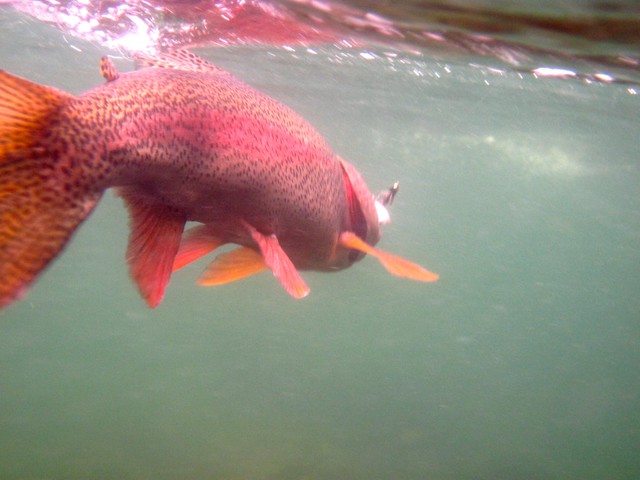
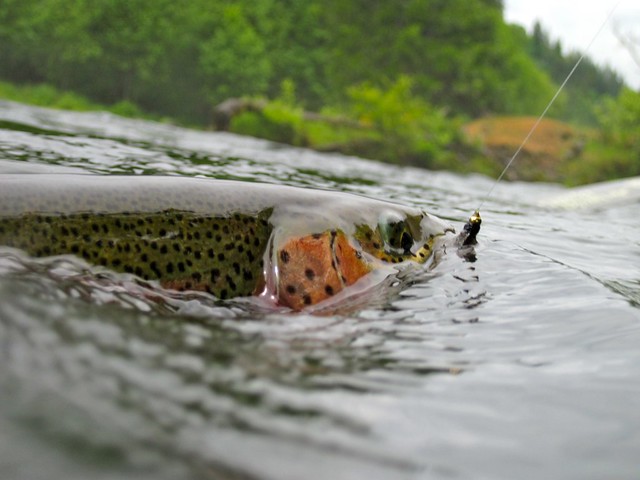
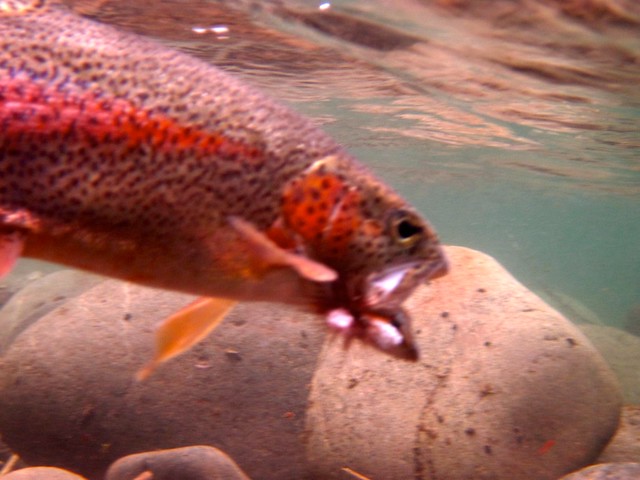
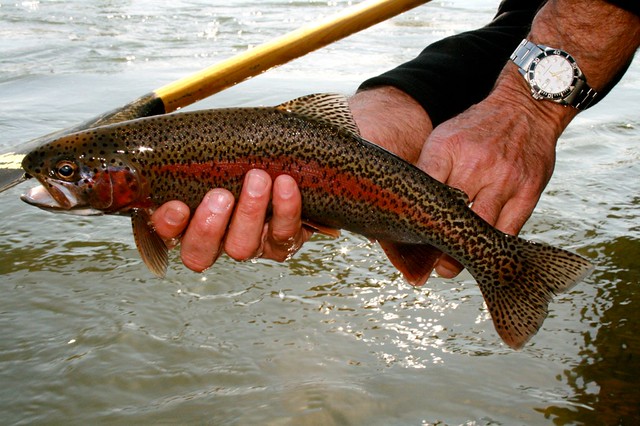
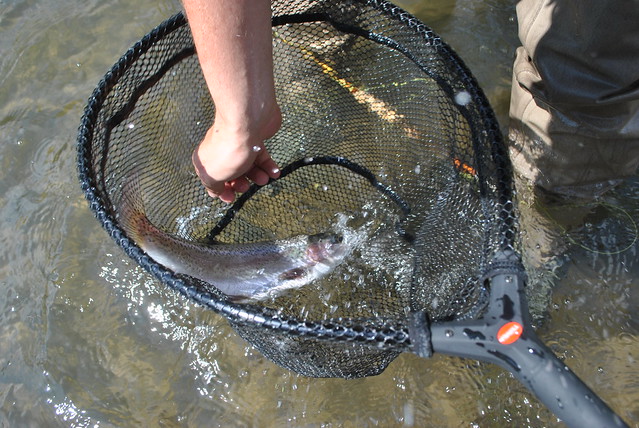
We convinced some native rainbow trout with big meals — golden stonefly and megaprince nymph imitations ruled the day.
FYI: For a great Mothers Day Caddis Grannom imitation, check out Barrett’s P90X Caddis.
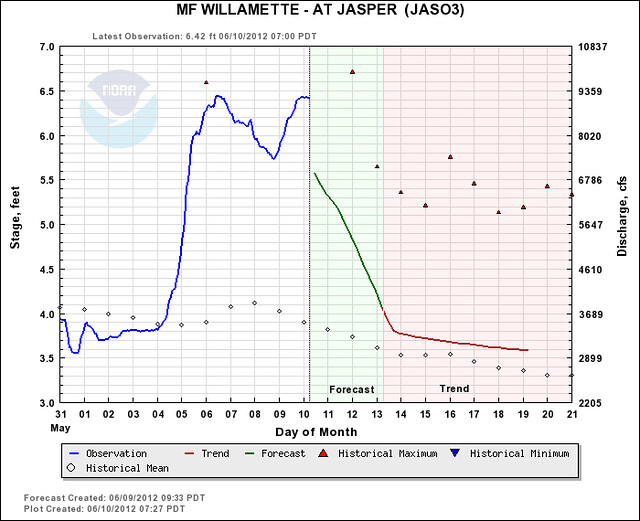
Our local rivers are still swollen, but they are clear and in shape to fish. The lower McKenzie and Willamette Rivers are seriously rested folks, and despite the current outgoing “smolt-fest”, and blizzard Grannom Caddis emergence, there is some good fishing to be had.
Here are some of the best flies to have when you venture out on the lower McKenzie, lower Willamette or Middle Fork of the Willamette Rivers this Spring.
The Double Bead Poxy Backed Peacock Nymph in sizes #4-8 . A great nymph to use when fishing a two fly rig. Tie a smaller nymph off the eye or bend of the Double Bead Peacock and you will get down in a hurry. We run between 4-8 feet of tippet off of a Thingamabobber when fishing the double nymph set up during high Spring flows. Continue reading →
It has been a few years, maybe more than a few, since I have really focused on fishing the McKenzie. The old memory banks are full to the brim, however, with wonderful days spent fishing the Mack from Bellinger clear down into the Willamette. Never fished the full distance on one day, mind you. We took shorter daily floats to focus on different hatch conditions and fish different river levels. Some days were magic and the wild cutts and/or rainbow cooperated, even in what I considered “muddy” water downstream from the Mohawk. Some days were crazy making, with bugs popping out and trout going crazy with no love whatsoever for our best flies of the time.
Speaking of the Mohawk, ODFW has run downstream-migrant fish traps there for several years. Turns out that the Mohawk is birthing place and nursery for many, perhaps tens of thousands of wild cutthroat. The importance of the Mohawk to the wild cutthroat in the lower McKenzie and Willamette can not be overstated. As far as we know, or suspect, or guess from ODFW’s observations, McKenzie rainbow tend strongly to be mainstem spawners, but the Cutthroat seem strongly dependent on tributary spawning and early life rearing, before an almost smolt-like migration to the larger waters of the McKenzie and Willamette.
This time of year, fishing the McKenzie below the Mohawk, I remember catching wild cutts in the 9″ size range, fish that were fat and silvery. I also remember catching cutts of that size and larger, fish that were very heavily spotted and very slim. The former fish were first-time downstream migrants, probably, and sexually immature. The slim cutts were post-spawning fish, moving down from the Mohawk where they probably over-wintered, to the mainstem grocery store to bulk up during spring and summer.
McKenzie Rainbow caught at this time of the year include fat shiny immature males and females; fat (really bulging fat) females that are ripe with eggs and almost ready to spawn; females that are partially spawned; and sexually mature males that are brick red and all hook jawed. When the water is clear enough, one can see the small redds of the rainbow around gravel bars, especially around any of the few remaining river braids and islands in the lower river.
As important as the Mohawk is to the wild cutthroat, these channel braids and islands are crucially important to the health of the wild Rainbow. No braids, no islands, and the wild rainbow population will be seriously compromised. Adding rip-rap and channelizing the McKenzie is like poison to these wild rainbow.
The Renegade was one of my favorite flies to fish during the times when trout were hungry and not particularly selective. Fished upstream on a dead drift, fished down and across on the swing, or fished straight blow the boat, with a twitch now and then, were all effective at different times throughout the day. People laughed at me for my stash of renegades, but they laughed at me for more reasons than I could count, so …….
Anyway, Chris asked me to dig out some of my old favorites in the March Brown type of fly to shoot videos. We are always looking for opportunities to keep people excited about fly tying, and along the way, tell a few fishing stories and demonstrate fundamental fly tying methods. This fly is dressed up with the addition of the trailing shuck which I never was innovative enough to use back in the days. Unlike the fore-and-aft hackled Renegade, this version is one that I used because it was simpler for me to tie by palmering the peacock body like I would have with an EHC (Elk Hair Caddis). Frankly, there were days when a store-bought renegade, slightly more sparsely hackled, was better received than my fly, so I carried some of them too.
This fly, sans nymphal case, was a great dry fly fished in the Metolius above Wizard Falls in June (size 12) and in September (sparse size 18). The Metolius rainbow demanded a perfect dead drift, and only RARELY accepted a down and across swing with this fly.
Laugh all you will, but the Renegade or/and this version of the fly, remain among the traditional patterns that merit consideration next time you are poking around your fly vest for something to tie on the end of your leader.
Monday night is party night around here. Tuesday through Friday can get pretty silly, too. And party nights in Eugene often involve feverish fly tying. We drink too much, we smoke & chew too much, we re-tell our favorite fish stories, and we argue like teenage geeks over various subtleties of our so-called sport. Somehow it rolls along amicably. And somehow we manage to be productive. Makes no sense, but it works out that way. Call it “collective inspiration.”
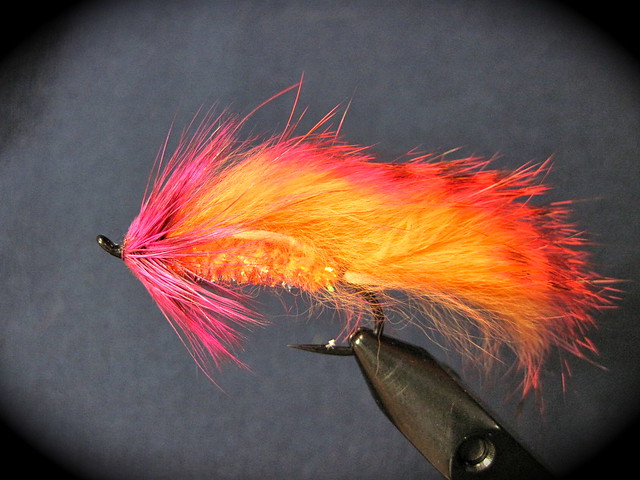
One recent evening brought some extra-special inspiration, a sudden flash of clarity, the result of an experiment fueled by necessity. I had run out of saddle hackle and was scrounging through everyone else’s materials. The only saddle on the table was chartreuse–well outside my preferred color scheme. But, left with no choice, I went with the bright green saddle, palmering a feather over a base of fluorescent orange Lagartun braided tinsel. Not bad! Then I tied in a clump of bright orange deer hair, followed by a dubbing loop of fluorescent red arctic fox.
“It’s the Fire Tiger!” I said. I might have yelled a little. It looked amazing!
A royal blue Ostrich hackle and a sexy pair of cerise hen hackles for the shell-back completed the spectrum, and pulled the whole thing together. The geek-o-meter was pegged out, and I was losing my mind over the sweet new combo.
So where, you might ask, is all this hogwash headed? Well, in honor of the most excellent Native Fish Society, I spent the next several days creating a series of six Fire Tiger Kingtruders. And this outrageous, one-of-a-kind, never to be duplicated set of chinook flies will be on display, and up for bid, at this year’s benefit banquet. So get your ticket now, and help support grassroots activism on behalf of wild fish, and wild rivers. Home waters require vigilance, and you can help!
Chinook image courtesy of Wildfish Studios, Miguel Morejohn, photographer.
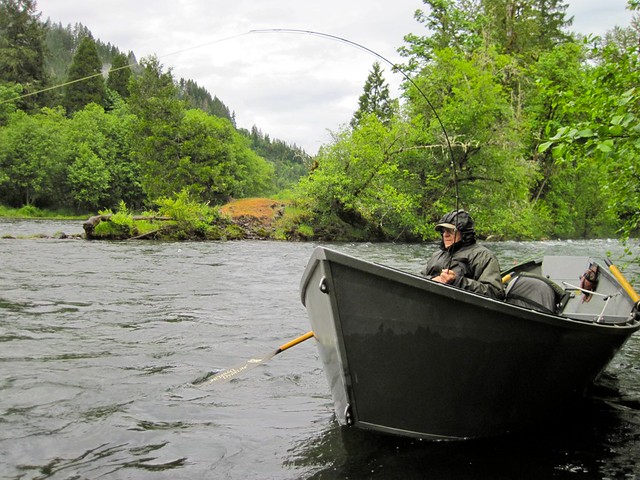
Oregon is reeling from a big weather event — rain rain rain, and low lying snow. Most coastal steelhead fishing is shut down. So what’s an angler to do? Go tackle the McKenzie in high water. Ethan, Clay and I headed out yesterday on the biggest McKenzie River I’ve ever fished. We brought a few nice trout to the boat with big leggy nymphs, saw a lot of march brown duns between hail storms, and busted out Ethan’s propane heater to keep our hands from getting stiff.
The Super Skunk fly was born from the simple fact that I could not find a bright red Arctic Fox Tail to suit my discerning eye. I wanted a tail that would “pop” on a chartreuse tipped winter steelhead fly.
This is a wet fly that shows itself off nicely and will draw fish from some distance, if they are in the mood to leave their holding place. Hot Orange, Chartreuse, and black are winning colors in any steelhead fly, and this a nice blend to show the fish and tempt them to eat on the swing.
This is a fly that I would fish under moderately dirty winter flows, say, when the color is trending to the clearing side of a solid steelhead green.
Jay Nicholas
February 2012
Spey Iron Winter Steelhead Fly Series – Super Skunk
Okay, you sickos, don’t get all excited. I’m talking about steelhead flies here. Specifically, I’m talking about a class of modern steelhead fly called Tandem Tubes, the inventions of two esteemed tyers, Brian Silvey and Bob Quigley. Like most of today’s most innovative commercial fly designers, Brian and Bob are continually solving problems, coming up with ingenious ways to help us increase our hook-to-landing ratio. The Tandem Tube and it’s offspring, Silvey’s Tail light, and Quigley’s Jig-a-Lo, are the product of an ongoing evolution in the search for the perfect bunny leech.
The idea of securing the rear end of a long bunny strip using a tiny tube is slick as snot, and the flies have proven themselves throughout steelhead country. But for me, a loyal fan of the classic Samurai design, the pinned-down bunny strip leaves me somewhat uninspired. I know what that bunny wants to do in the water, and confining it to the clunky, lifeless motion of the stinger hook seems like a blasphemous waste of fishy goodness!
So there I was, swinging Quigley’s Jig-a-Lo through an especially sweet little boulder patch, when my destructive nature got the best of me. I pulled out a pair of scissors, whacked the bunny strip right above the little rear tube, and BAM! I had a whole new fly that I knew would drive steelhead wild. A couple of days later, back at the Caddis Fly beer garden, I saw Silvey’s Tail Light in the bins, and knew that my little cosmetic surgery technique would improve the hell out of that fly, too.
So, in the spirit of our beloved industry, where every little tweak of an existing fly deserves a name and trademark, I’ve decided to call my new, completely unproven invention, the Russell’s Chopped-to-Shit-Tandem-Tube-a-Lo! I’m gonna be rich, and you lovely folks are gonna be bangin’ steelies like the Holloway boys. You are welcome!