Willamette Fisheries Science Review next week

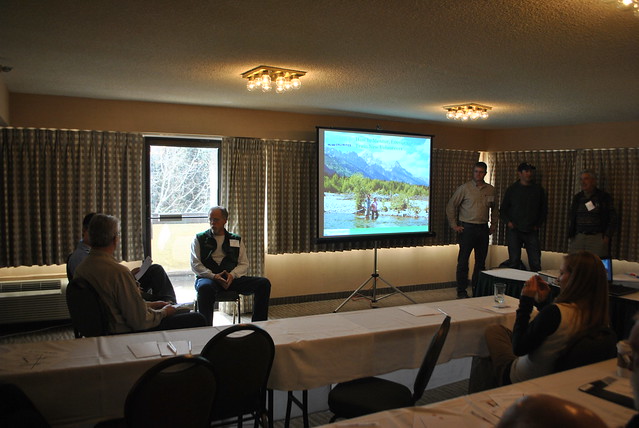
For all you fish geeks, Oregon State University is hosting the Willamette Fisheries Science Review next week, featuring presentations from ODFW, Army Corps of Engineers, NOAA, OSU, and others on topics like:

-Review Of Fish Return Data Collected At Fall Creek Fish Faciltiy In The Willamette Valley,
-2012 Hatchery Research Monitoring And Evaluation By ODFW In The Upper Willamette River
-Spawning Success Of Spring Chinook Salmon In Fall Creek And The North Fork Middle Fork Willamette

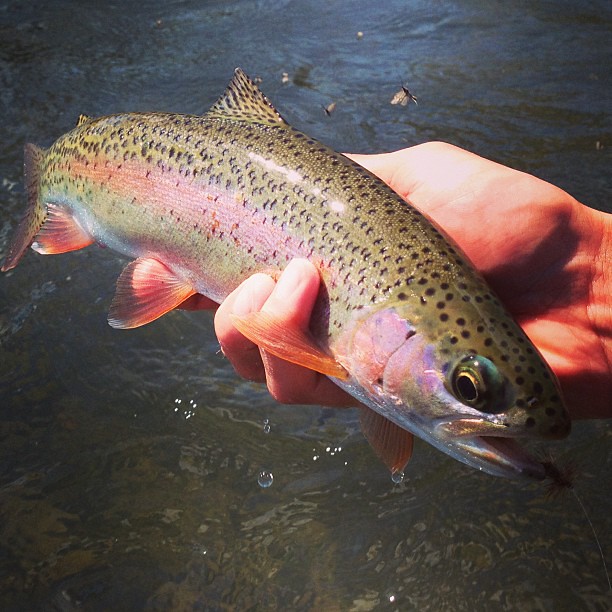
McKenzie River Wild Trout

And that’s just the first few sessions. Full agenda here. All pretty important stuff. It’s free to attend, but you have to register HERE. Stay informed, stay active… on behalf of native fish!

Posted in Oregon Conservation News | Leave a comment

2013 NW Fly Tyer and Fly Fishing Expo

NW-Expo-2013--Medium-Vertical-a

The 2013 Northwest Fly Tyer and Fly Fishing Expo is scheduled for March 8th and 9th at the Linn County Expo Center in Albany, Oregon. A vision conceived by the Oregon Council of Federation of Fly Fishers (OCFFF) 25 years ago has now become one of the largest fly fishing expositions on the west coast. (nwexpo.com)

Flys

The mission of the OCFFF is to improve fly fishing in Oregon by providing information to fly fishers to improve their skills, by preserving and expanding fly fishing opportunities, and by improving fish habitats. This vision encompasses the total fly fisher and is visible throughout every aspect of the Northwest Fly Tyer and Fly Fishing Expo.

Volunteers are the mainstay of the Expo, engaging over 400 volunteers from 23 chartered and affiliated FFF clubs throughout the Pacific Northwest to make this event the success that it is. In 1987, volunteers not only organized that first event but they offered their time as tyers. Today, the fly tyers you’ll see on March 8th and 9th are by invitation only, the best of the best.

Expo 09 055

Through the support of the OCFFF, Skip Hosfield and Keith Burkhart initiated the first Expo in 1987. Together, they hatched a plan to bring fly tyers together at the expo center in Eugene. Many members of the Mckenzie Flyfishers Club played critical roles in the first expos, establishing the auctions of flies and equipment as highlights of the Expo programming. A few key contributors were Cliff Adams, Bob Guard, Greg Pitts, Tom Porterfield and Stan Walthers.

The Expo has grown from 40 volunteer tyers to well over 200 of the best. Dwight Klemin and Jim Fisher played key roles in moving the Expo to larger quarters in Albany. The larger facility created opportunities to add classes on tying and angling, demonstrations and instruction on casting, including single-handed and Spey casting, and added space for vendors to display the latest equipment in fly fishing and tying technology. These attractions and the expansion of the Expo to a full two-day event have resulted in one of the best fly fishing shows anywhere.

In 1987, the OCFFF developed the Expo with two primary goals: to create a solid and replicable fundraising event, and to provide an educational platform to promote fly tying and fly fishing. You will see when you join us in Albany on March 8th and 9th that the Northwest Fly Tying and Fly Fishing Expo has far exceeded these expectations. Thousands of attendees have been awed by the diversity of all aspects of fly fishing at this event. This year, ORCFFF honors the Coast Cutthroat Trout and the Spruce Fly, a fly developed especially for this trout by Milo and Bert Godfrey between 1918 and 1919. The Spruce Fly is at its best during the sea run of the Coast Cutthroat.

Through your participation at the Expo, the OCFFF has funded two scholarships to promote studies in fisheries management. Yet the most universally favorite aspect of the Expo is reconnecting with friends and meeting new friends who share the love of fly fishing. See you at the Expo! www.nwexpo.com

Posted in Classes and Instruction, Fly Tying, Oregon Fly Fishing Clubs and Events, Oregon fly fishing links | 1 Comment

Spey Iron Winter Steelhead Fly Series – Flame Boss

We have no shortage of choices when it comes time to knot something onto the end of our leader at the side of a steelhead stream. We have literally hundreds of nymphs, leeches, MOALS, eggs, jigs, intruders other unspeakably deadly and hilarious flies at our disposal.

Sometimes, it is really nice to tie on an un-weighted fly and swing it through steelhead water. The Alec Jackson series of Steelhead Irons are classic hooks, with sharp points and low barbs. They look good in a fly box, they swim well in the water and they attract steelhead too.

Here is one of my favorite Spey Iron flies that I like to swim in the winter. This fly is an adaptation of the Flame Boss – perhaps a stretch, but heck, that’s what I call it.

Since Chris is bound to ask, yes, the flies in this Spey Iron Winter Steelhead fly series also fish well in summer too. However, I tend to fish smaller flies in summer; so I reserve these larger critters for summer days when flows are up (if you fish the Deschutes you know the days when White River pukes and visibility drops) or as a change-up fly for fish that have refused a more sensible #8 fly offering.

I would reach for this Flame Boss Spey Iron pattern when the water is really dirty, or should I say “gritty”? This fly will show up in very poor light conditions and I have caught steelhead in downright muddy water with this fly.

Jay Nicholas
February 2013

flame boss steelhead fly


Spey Iron Winter Steelhead Fly Series – Flame Boss

Hook: Alec Jackson Heavy Spey Irons #3 Gold
Thread: Lagartun 95D Black
Tinsel Rib: Lagartun Oval gold, small
Tail: Eumer Arctic Fox, black, edged with Hot Orange Krystal Flash
Rear-body: Silver Lagartun Mini Flat Braid
Fore-body: Hareline Medium Carded Chenille, Fl. Flame
Hackle: Whiting Coq De Leon Saddle feather
Wing; Eumer Arctic Fox Tail – Hot Orange, topped with pearl Krystal Flash

Posted in Fly Tying, Fly Tying Materials and Supplies, Oregon Winter Steelhead Fishing | Leave a comment

Fly Tyers Saturday, Jan. 26th Recap

download-3

If you missed The Caddis Fly’s fly tying demonstrations this weekend we missed you, and you missed out on some tips and techniques from a couple of veteran fly tiers. Our featured tiers were Jay Nicholas and the outstanding “hand-tier”, Adrian Cortes. We had a great showing and people seemed to enjoy the chance to get some questions answered about methods and techniques. Don’t worry, there will be more opportunities to drop by this winter as the Caddis Fly will have many more tying days with a variety of tiers to answer your questions and maybe inspire you to try something new.

download-5

download-4

download-6

download-1

download-2

Posted in Fly Tying, Oregon Fly Fishing Clubs and Events, Oregon Fly Fishing Tips | Leave a comment

There Snow Trout Like Winter Trout

P1010183

Hard to believe we are only about a month away from the beginning of March Brown season. But, don’t wait for dry fly fishing to come back before you head out to the streams for trout again. The trout are there now, they are hungry and very willing to take flies. The Middle Fork of the Willamette has been producing some wonderful catches these past few weeks.

P1010130

P1010180

The best flies have been: Mega Prince, golden stone nymphs, bright orange bead head flies (I tie up a white gus bugger fly, and an orange bead on a possie bugger has worked) , and small egg patterns (I hear it is whitefish spawning season).

P1010179

P1010164

If the wonderful fishing isn’t enough, it is great to get out of the valley fog and see some of natures beauty in the “off season”. And hey, a little hypothermia is good for the soul.

Rick Bocko

Posted in Fishing Reports, Middle Fork Willamette River fishing | 1 Comment

Tri-Color Steelhead Tube Fly Tying Video

Ethan Nickel demonstrates how to tie a straight forward but highly effective Steelhead tube fly. Excellent movement, slim design, and good color combo makes this pattern a winner for Summer and Winter Steelhead.

Tri color steelhead tube

Tri-Color Steelhead Tube

Tube: HMH Small 3/32 OD
Thread: U140 Black
Body: Lagartun Mini Flat Braid
Profile Bump: UV Black Ice Dub
Hackle: Blood Quill Marabou, Kingfisher Blue, Black, and purple
Collar Hackle: Black Pheasant Rump
Flash: Black and Pearl Flashabou
Hook: Gamakatsu Octopus

Posted in Fly Tying, Fly Tying Materials and Supplies | Leave a comment

Spey Iron Winter Steelhead Fly Series – Cold Blue Hammer

This Spey Iron steelhead fly offers the blue/black hues that steelhead just seem to be incapable of ignoring. This is a silly statement, of course, because I have fished this fly over enough of chrome winter fish to know that they are capable of ignoring any and all flies on a given day/hour/moment.

That said, some great steelhead flies do incorporate blues and blacks and this is a bold profile un-weighted fly that is built to cast small, swim large, and draw fish that are willing enough to give it a go.

This is a fly that I would fish in water anywhere from a nice steelhead green to crystal clear.

Jay Nicholas
February 2013

cold blue hammer steelhead fly

Spey Iron Winter Steelhead Fly Series – Cold Blue Hammer

Hook: Alec Jackson Heavy Spey Irons #3 Nickel or bronze
Thread: Lagartun 95D Black
Tinsel Rib: Lagartun Oval gold, small
Pro Sportfisher Marble Fox Black edged with Pearl Krystal Flash
Body: Lagartun silver Mini Flat Braid
Body hackle: American Saddle Clump, blue dyed grizzly – narrow
Coq De Leon Feather
Wing: Ostrich, Black, and Blue Angel Hair

Posted in Fly Tying, Fly Tying Materials and Supplies, Oregon Winter Steelhead Fishing | 2 Comments

Pro Tube Popsicle Tube Fly tying video

Bruce Berry ties a “Popsicle” style tube fly aimed at Winter Steelhead. Using Finn Raccoon instead of Marabou the fly is more durable, active in the water and versatile in terms of added weight, cone, bead etc.. Swing this pattern for Winter Steelhead arriving to a river near you soon.

Check out the new selection of Marble Fox, American Opossum, and Finn Raccoon from Pro Sportfisher. All of these materials can be adapted to the above pattern and so many more.

Procicle

Popsicle Pro Tube

Tube: Pro Tube Micro Tube Clear
Hook Guide: Large Pink
Weight: Flexiweight 15mm
“Intruder bump”: Pro Soft Sonic Disc
Thread: Lagartan 95D Black
Wing: Finn Raccoon Guard Hairs
Body Dubbing Loops: Finn Raccoon Underbody Fur
Flash: Lateral Scale Pearl
Hackle: Black and Purple Schlappen
Eyes: Pro Tube imitation Jungle Cock

Posted in Fly Tying, Fly Tying Materials and Supplies | 1 Comment

Saturday Fly Tying X 2. Clinic with Jay Nicholas plus Adrian Cortes

Jay Nicholas will set up his vise at the Caddis Fly this Saturday, January 26th, from 9 AM until Noon, and will be offering technical tips and mentoring to anyone who drops by the Shop.

Jay will be working at honing his own slightly rusty skills and plans to cover some widely different tying styles including dry trout flies, traditional-iron winter steelhead flies, and winter steelhead tube flies.

Bring your questions, grab a chair and a cup of coffee, and give the man a little encouragement as he dusts off old patterns and creates new flies to warm up the crowd for the Headline Performer (Adrian Cortes) who will tie from 1-3 PM. Adrian will tie married wing Salmon and Steelhead flies without a vise. Yep pretty amazing

adrian cortes fly

adrian cortes flies tied without a vise

Hope you can make it, but if not, this is the first of many such Saturday fly tying clinics Jay will offer at no charge at The Caddis Fly Shop throughout the year.

CD

Posted in Classes and Instruction, Fly Tying | 1 Comment

2013 McKenzie River Two-Fly Tournament dates set

Mark your calendars for the sixth annual McKenzie River Two-Fly Tournament October 5th 2013, brought to you by the Caddis Fly Angling Shop and your local native-fish supporting guides. Since it’s inception, the tournament has raised $25,000 for habitat restoration on the McKenzie River.

This is your chance to fish with some of the best guides on the river at the best time of the year to catch big wild trout. And all funds go to help protect and restore our resource.

McKenzie River Two Fly Tournament

The event starts on a Friday night October 4th, with a group of anglers, conservationists, and family gathering around your favorite fly shop, buzzing with fishing chatter and local Ninkasi beer on tap. Mazzi’s portable woodfire pizza oven in the parking lot, kids piling ripe local vegetables, sausage and cheese on fresh tossed dough.

A representative from McKenzie River Trust will talk about the work that organization was doing. Good work, taking care of the land around our river and putting it back into the floodplain, repairing broken, nearly invisible systems that are integral to the river’s survival into the coming decades.

The rules are simple: Anglers fish in teams of two. Each picks two flies. Take photos of them, don’t lose them. Fish 9am to 5pm. Guides are judges, tape your biggest fish and take a digital snapshot. Your three biggest fish might add up to a win. Prizes TBD this year, but past winners have walked away with gorgeous fly rod and reel outfits, resort accommodations, and other fly fishing gear.

Special thanks to the guides who sacrifice a day’s pay in the best part of the year to give back to the resource.

Cost is $750 per boat, or $375 per angler. Contact the shop for details on how to register 541-342-7005. Space is limited, so sign up now.

Posted in Fly Fishing Contests, McKenzie River, Oregon Conservation News | Leave a comment

North Umpqua River Fishing and Accommadation Report

winter steelheading on the umpqua river

The North Umpqua River is one of the premier places to swing flies in Oregon for Winter and Summer Steelhead. With countless named and unnamed pools sometimes it’s hard to choose where to fish. For myself, Lou, and brother Ty the choice was quite simple. We were fortunate enough to stay at the North Umpqua River Retreat which has enough steelhead fly water right out the front door to keep any fly angler busy for hours. The North Umpqua River Retreat’s home pools were very enjoyable to fish. A classic tail-out that spills into a a perfect step through run, it was hard to fish anywhere else, especially with the option to walk back up to the house and warm up. The mornings were freezing so we would sometimes just sip coffee and ponder the donning of waders while overlooking the water from the living room windows.

north umpqua retreat

The central location of the North Umpqua River Retreat makes it a perfect jump off point for numerous Fly-fishing opportunities. During our stay we fished a new section of water everyday; the fly water is a mile to the East, the first boat ramp is a mile to the West, and the main Umpqua is less than an hour away. My suggestion would be to stay at the North Umpqua River Retreat for several days to sample a true taste of the Umpqua.

north umpqua retreat.com

All that stayed at the North Umpqua River Retreat were very impressed with the outstanding accommodations, and the incredible view of the river. Take a look for yourself and Give Rich a call (541-496-4869) as Summer time slots are filling fast and winter is becoming increasingly busy as the North Umpqua River Retreat gains recognition.

nothumpquaretreat.com

Many thanks to Rich for his hospitality.

CH,TH,LV

NUR website: http://northumpquaretreat.com/

Posted in North Umpqua River Fishing Reports, Oregon Fly Fishing Tips, Oregon Winter Steelhead Fishing | 5 Comments

Sink Tips for Spey Fishing Part 3: Airflo Review

Sink tips for Spey fishing Part 3: Airflo Products

Here’s a quick review of Airflo Polyleaders and the range of Airflo sink tips that are most popular and effective with Two-Hand Spey and Switch anglers fishing for anadromous and lake-run salmonids around the world.

Airflo PolyLeaders, Sea Trout Steelhead : 8 ft long and offered in six sink rate options from 0.5 ips to 6.1 ips. This is an 8 ft tapered leader with a welded loop on one end and a surgeon’s loop in the monofilament core at the other end. Loop on your tippet of 3 to 6 ft or tie it in with a blood knot. Polyleaders are constructed over a mono core that tapers to 24 Lb, so choose a tippet that is in tune with the core – we usually fish these with tippets in the #8 Lb to 16 Lb range. For those anglers who want a Polyleader longer than 5 ft and shorter then 10 ft, this is the Polyleader of choice.

Airflo PolyLeaders – Salmon Steelhead Polyleader: These are available in 5 ft, 10 ft, and 14 ft options, all with a 24 Lb maximum core strength. These Tapered Pplyleaders are offered in 7 sink rates from full floating to extra fast sink (6.1 ips) rates. All Polyleaders have welded loops at one end and a Surgeons Loop in the core monofilament at the other. We add tippet of bout #16 Lb or less by looping or blood knotting to the mono core tip.

Airflo PolyLeaders – Salmon Steelhead Polyleader, 40 Lb option: This is your go-to Polyleader when you want to fish #20 or #25 Lb Maxima Ultragreen as your tippet. The standard #24 Lb Polyleaders can’t match this stuff but the #40 Lb can. This would be a great Albacore leader too.

Airflo Custom Cut Tips (CCT) With both a 10 ft and an18 ft option to choose from, this Airflo product is quite similar to the Rio Level T material, except it is provided in a specified length, is built over a braided core, and has a welded loop at one end. The 10 ft option can be used as is, with the addition of a leader tippet. The 18 ft option can be used as is or may be cut to make up a 10 ft plus a 8 ft tip, for example. In this case only one of the two pieces will have the welded loop, so you will need to make your own loop on one tip. T-7, T-10, T-14, and T-18 sink options.

Remember, T means that the tip coating incorporates Tungsten as a hi-density sinkant and the numeric rating indicates the tip material’s wt in grains per foot. Thusly, a ten-foot length of T-14 weighs in at 140 gr. The higher the number, the heavier the tip will be for a given length, and the faster its sink rate will be. T material is level, and is not tapered like PolyLeaders are.

Airflo Custom Cut Tips (CCT) 20 ft option: This Level T-material has a sink rate of either T-10 (8 ips sink rate) or T-17 (10 ips sink rate). The nice feature of the 20 ft CCT (custom cut tip) product is is that it has welded loops on both ends. This makes it easy to make, for example, a 12 ft and an 8 ft tip, and both will have welded loops on both ends. As with the shorter CCTs, you need to attach a tippet with an Albright knot or by making a nail-knot loop on one end of the tip. Suggestion: use the lighter version of CCT with Switch rods and light Spey rods. Use the heavier CCT with Spey rods.

Airflo 10ft & 5 ft Salmon – Saltwater PolyLeader Set: These are complete sets of PolyLeaders in sink rates including clear floating, clear hover, clear intermediate, slow sink, fast sink, super fast sink, and extra super fast sink rate. This set includes all 7 PolyLeaders in an Airflo Tip Wallet. These make great leaders for use with tippets of about #16 Lb or less when fishing rivers, estuaries, beaches, and offshore. If you want the convenience of a full range of Polyleaders, this delivers the goods and saves you money.

Airflo Spare 15 ft Sink Tips: This Airflo Product is analogous to the Rio Replacement 15 ft sink tips. Rio offers their 15 ft tips to fish with line classes #4 (at a 64 gr tip) to #12 (a 190 gr tip). Airflo, just to be different, offers their spare 15 ft sink tips to fish with line wts #6/7, #7/8, 8/9, and 10/11.

So concludes Part 3 (the final installment) of this Spey Sink Tip Review
Jay Nicholas, December 2012

Posted in Fly Fishing Gear Review | Leave a comment

Painting my way back to the Pacific Northwest

I started painting again after the photo editor at my favorite magazine, the FlyFish Journal reached out to ask if they could use one of my drawings in an upcoming issue. Of course, I said yes. And hopefully they can use it. But now I’m painting every day, wondering why the hell I moved away in the first place.

Sturgeon: Bottom of the River

Nate hates float tubes

Elk River Salmon Fly Fishing

seabass hero shot

Chum Salmon Kilchis

Bull Trout, McKenzie River

Deschutes, spring redside rainbow trout... Broken Rod?

Estuary fly fishing for chinook salmon

Cabezon -- Strait of Juan de Fuca

Kelp Greenling

If you too are wasting away somewhere less than awesome, or waiting for better water conditions… go ahead and pick up a set of acrylic paints and a case of liquor and paint your regrets away.

We’ll post whatever crazy art you send us.
-MS

Posted in Fishing Porn | 8 Comments

“Fundamental Nymph Fishing” Free Clinic with Skip Morris this Saturday 10am

skip morris tying class4

Fundamental Nymph Fishing Clinic to be held at the shop 10am this Saturday the 19th of January.

An instructional presentation on how to fish artificial nymphs in rivers and creeks–the standard, versatile, deadly indicator method. Explains the techniques, the rigs (including the dropper system, the suspended nymph, lead on the
leader…), reading nymph-water, tackle–the whole ball game, made clear and understandable.

Stop in for this 1 hour free presentation. Learn the basics, ask questions, get dialed in on Winter/Spring nymphing tactics.

Skip still has a few spots for his Friday Night fly tying class, check out the details HERE

Posted in Classes and Instruction | Leave a comment

Echo PRIME One-Piece Fly Rods: Interview with Tim Rajeff


Among the fine new fly rods introduced in 2012, our friend Tim Rajeff has created an intriguing new Echo rod, the ECHO PRIME. The Echo Prime is a one-piece rod designed for use in a saltwater. I fished Prime 8 wt and 12 wt fly rods this Autumn for Silvers, Rockfish, Kings and Albacore. I fished little Clousers and Comets, 10 inch Buck-tails, 6 inch baitfish, and Poppers. I cast short and long with full floating lines, shooting heads, integrated intermediates, and 400-500 gr fast sinking saltwater lines. These rods are noticeably lighter, faster, and easier to cast than the Echo 3 series of already great fly rods. I fished Echo ION, Hatch Finatic , and Sage 8000 Pro fly reels on Prime rods. I am honestly impressed with these rods. They are fun to cast, fun to fish, fish and fun to fight on, when you actually connect with one of the pesky beasties.

Sadly, I must now return these PRIME Demo rods to Tim so that he can share the love with some other less deserving guy or gal, but I am on the first-to-ship list when they are available at the end of 2012.

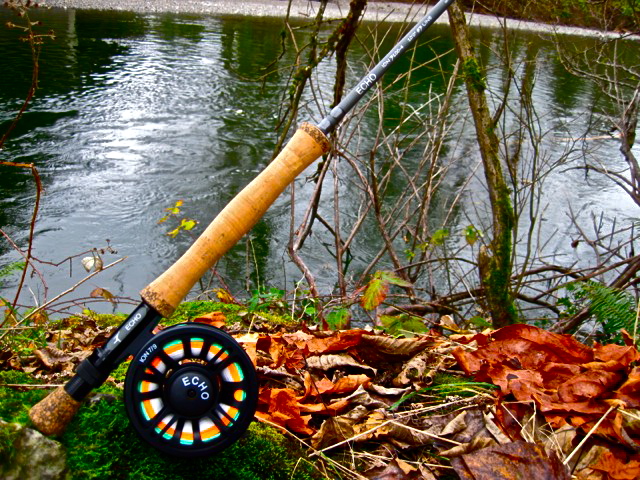
Other New Echo Fly Rods for 2013 include the Echo Classic Spey Rod ($269.99 offered in three line classes – 12 ft 6 in #6; 12 ft 9 in #7; and 13 ft #8 to cover the key Spey fly fishing bases.

A Cosmetic upgrade to the Echo SR Switch rod series: the blank color has been changed to a now attractive slate gloss from the original pale olive that no one liked but Tim.  Good move.  The updated SR series includes hard chrome snakes and tips, plus an anodized black aluminum reel seat – a deal at $329.99.

The Echo Carbon is also being image and weight upgraded for 2013.  The cork composite sections of the handle have been reduced to lighten the overall rod weight by simply retaining right-sized composite tip and butt of cork elements.  At $169.99, this Carbon is an extremely thrifty and popular Echo performance fly rod option.

Echo Ion fly rods have been lightened up by trimming handle and reel seats without the teensiest bit of structural diminishment.  The Ion Rod Shafts are now a slate gloss instead of the original most unattractive (sorry Tim, but it’s true) olive. The ION remains at $189.99 and is still practically indestructible in the hands of sincere fly anglers.

Echo Solo Complete Fly Fishing Outfit: a new deal on fly rod, reel, line, leader, and padded case in 4 wt, 5 wt, 6 wt, and 8 wt packages for a mere $169.99.  Amazing

Echo Ion Fly Reels: We now have two new sizes in the Echo Ion 2/3 and 7/9 for 2013.  We are most excited about the 7/9 for steelhead and salmon fishing, and the 2/3 will rock the mountain streams.

PRIME Interview note: I decided to pose a series of questions to Tim, with the purpose of helping fly anglers better understand these new Echo rods. Forgive me, Tim; any errors of substance or omission are your fault, not mine.

JN: Why should we consider fishing fish with the Prime, a one-piece rod, after years of learning to love the convenience of 4-piece rods?

TR: Prime rods are lighter by nearly 20%, lighter, they are faster, They are so strong it will amaze you, and they cast easier than any comparable 4-pc fly rods. It’s just that simple.

JN: I know that can transport these rods around my home waters here in Oregon, but what can I do if – for example – I want to fish Tarpon this fall in Mexico?

TR: Prime rods, in their tube, can be shipped to most destinations via UPS, and be there when you arrive. You can also carry these as checked luggage on any airline. And you already know, because that’s how we shipped your demos, that two PRIME’s will fit in one tube for shipping.

(JN Note:  Chris Daughters has shipped one piece rods to Florida for roughly $35 so that should cover the east coast and Texas and Southern Cal destinations as well.  We are not experienced yet at shipping to Mexico or Cuba, but with the right carrier, the trip of a lifetime should be do-able with a one-piece fly rod.  Need advice?  Call Chris at the Caddis Fly.)

JN: Any downsides to the Prime?

TR: If you are willing to put up with the inconvenience of owning a one-piece rod, you can benefit from the weight savings, line speeds, and improved strength of fishing a rod with no ferrules.

JN; What is your base material in the Prime?

TR: We are using what I would call a very high modulus, high end graphite.  (JN note: near as I can tell this material is “virtually” GLX graphite).

JN: is it more difficult to manufacture a one-piece rod than a 4-piece rod?

TR: Yes. And no.

JN: How so?

TR: Lets start with the complexities of building a 4-piece rod. Each section of a 4-piece rod has to be engineered to compensate for its mate. Take the butt section, for example. The butt actually has to taper from larger to smaller diameter, creating the male ferrule. To compensate for the smaller diameter of the male ferrule, we have to increase the wall thickness in the male ferrule. Then think about the female ferrule that fits over the male section. Our overall engineering of both male and female ferrule wall thicknesses has to be balanced to reduce flat spots or knuckling in the rod when it is under tension. Sorry if this sounds complicated, but it is. We have to mess around with adjusting wall thickness of both male and female ferrule thicknesses to achieve an overall smoothing effect when the sections are mated.

JN: OK, now tell me bout the issues of building a one-piece rod.

TR: Building a one-piece rod is difficult, but in different ways. We no longer have the challenges of messing around with increasing and decreasing wall thickness and ferrule diameters. We have the advantage of designing a taper that smoothly transitions from butt to tip. This may sound like all the challenges are removed, but it turns out that it requires more skill to roll graphite onto an 8’ 10” mandrel than it does to roll graphite onto a 3’ section of mandrel. That is one part, simply rolling the material onto the steel rod. The long mandrels are also a challenge, because they must be handled very carefully to avoid accidental damage in the rod factory. Then there is the fact that the graphite sometimes tries to un-roll on that long mandrel, and we have to keep it snug before we can apply the cellophane spiral wrap to secure the material before we put the raw shaft in the oven. Finally, and this is something almost no one wants to talk about, is rod spine. Building four separate rod sections will result in 4 different spines but none of them will be particularly noticeable,  and and partly because the extra material rolled on each short mandrel to create and compensate for stiffness of the ferrules tends to make it difficult to even notice a spine on any individual section.

Rolling graphite on a mandrel to create an 8’ 10” rod must be done to perfection, in terms of the quality consistency of the material, how precisely the material is cut, and how smoothly the material is rolled onto the mandrel. We have very strict quality control inspections, and we have been able to craft absolutely perfect straight shafts for our PRIME fly rods.

JN: Why the 8 ft. 10 inch length? Why not 8’ 6” or 8’, or even a one-piece 9’ rod?

TR: 9 ft rods dominate the psyche of fishermen, the Fly Fishing Tackle Reps,  and the shelves of fly shops. We can’t easily ship a package that is over 9’0” so we had to shorten the rod by two inches to be able to ship the rods to our customers. By making the rods as little as 2” shorter we’re able to lighten it up, helping the rod recover quicker and to lessen the effort a caster needs to throw heavier saltwater lines and flies.

JN: If I hold an Echo PRIME side by side with an Echo 3 Saltwater rod, will the average angler be able to detect the differences?

TR: I think so. The Prime will be about 18% lighter than the ECHO3 family of rods. They are not necessarily slimmer but you will definitely notice how stupid light the rods are. (For those readers not up to date with modern fly fishing lingo, the term “stupid” in this context is a good thing: JN)

JN: Materials: are Echo PRIME fly rods built with the same high modulus material as you use in your Echo 3 saltwater rods?

TR: Yes. ECHO PRIME fly rods are made from high modulus main fibers and a carbon fiber scrim just like all of our ECHO3 rods. Our material is virtually GLX-class.

JN: Do Echo PRIME fly rods really throw tighter loops than your Echo 3 Saltwater rods?

TR: With a slightly faster action and less tip deflection because of their lighter weight, PRIME rods will help people throw tighter loops.

JN: Do you expect to see other rod makers follow echo in the one-piece rod production line?

TR: There are already a couple of other people doing it. We took our time to make sure that when we did it we rocked. Will others jump on the bandwagon? Maybe.

JN: Do you expect to see one-piece rods break less-frequently than your 4-pc rods?

TR: The one-piece rods are slightly stronger than our 4 piece rods. The most common break-point on a fly rod is in the tip section – caused by the fly hitting the rod or from the rod tip getting injured in the car or on the boat. In that respect we don’t expect the ECHO PRIME to be any different from a four-piece rod. If you smack your Prime with a lead-head fly or jam the tip into the dashboard, you might break it.

JN: Does the warranty for Echo PRIME differ from your standard warranty?

TR: Yes. We would have to replace the entire rod if it is broken. Contrast this to a multi piece rod where we can replace an individual broken section. The difference is significant, making the warranty cost of a one-piece rod higher. We charge $150 to replace a broken ECHO PRIME rod – still a heck of a deal. These rods are not fragile, so they don’t requiring “babying.” That said, it makes sense to take normal care in casting and carrying your Prime, and all of your rods to and from the water.

JN: Echo’s catalog mentions Permit and Tarpon as species the Prime is built. What about Salmon, Stripers, Blues, Shark, Tuna. and Billfish?

TR: PRIME are perfect rods tor anything that swims. Our catalog has space limits, and we just chose a few species to mention.

JN: What fly line recommendations would you make for the PRIME rods?

TR: Use the same lines for a PRIME that you would have used on any other rod of the same line rating.

JN: Will the PRIME rods throw traditional shooting heads that we old-school salmon anglers prefer?

TR: You betcha.

JN: Are Prime rods going to be hot sellers for steelhead and salmon anglers fishing in rivers?

TR: Probably not. While they will work for steelhead in a river environment their 8’10” length might not be optimal for many folks, especially for those that are accustomed to fishing 10 foot rods to optimize line mending. Guys like you who fish estuaries and tidewater will probably love the Prime.

JN: Is lifting power of the PRIME any different than your Echo 3 saltwater rods?

TR: PRIME rods have similar butt power and therefore similar lifting power. Shorter rods offer an advantage when fighting a fish so I guess you could say that the PRIME rods are a little stronger due to their shorter length and lack of ferrules.

TR: on the subject of lifting power, check out this youtube video at: Echo PRIME Break Test

JN: Why not offer a seven wt PRIME?

TR: Not enough demand for seven weights at this time. We want to see how these rods are received and then consider designing lighter Prime rods.

JN: When are we likely to be able to purchase Prime rods?

TR: January 2013 is our expected delivery date.

End of interview September 2012. Thanks Tim.

Who’s going to fish the Prime? I asked a friend who reps in the fly fishing industry, how popular do you think these one piece rods will be? His answer was blunt.  No one is going to buy these rods.  They’re a dead end.  The only people who will buy one-piece rods are a handful of freaky guides who live in a grass hut on the beach and fish 300 days a year.

That’s a pretty bleak outlook, if true. Personally, after fishing two Primes, casting a bunch of lines, fighting fish, and transporting the rods in my 4-Runner and boat, I can’t wait to get two more. These one piece rods are something I think must be experienced to fully appreciate. Will they be inviting to everyone? No. Would anglers who have the pleasure of fishing a rod like the Sage ONE trade-out for an Echo Prime? I just don’t know. My guess is that any such hypothetical angler (I’m one) will want to keep and fish both the the Sage ONE and the Echo PRIME. I think that anyone who fishes from boats or windy beaches will love PRIME rods: they cast traditional shooting heads, integrated shooting heads, and the entire series of coldwater and tropical lines by Rio, Airflo, and SA. If this sounds like you, I firmly believe that you will enjoy the PRIME.

Technical Details

Price: $449.95.

Length: 8 ft 10 in.
PRIME Rod Options: 8 wt, 9 wt 10 wt, 11 wt, and 12 wt.
Titanium coated snakes, tip top, and SIC Stripper guides
High density Cork Handles with HI-D rubber end cap
Triangular rod tube with zipper end and foam in both ends
Rod Sock (two Primes fit into one Tube for shipping
Silver-tips on Midnight Black thread guide wraps.
NO FERRULES
Up-Locking Metal Reel seat is saltwater-safe
Two dots on reel seat and locking ring make foot-alignment easy

Jay Nicholas, overworked field tackle tester: November 2012

Post Script: Echo makes great fly rods that perform significantly above their price range.  The performance aspect is directly attributable to Tim Rajeff’s technical expertise in casting and rod design, fly fishing passion, work ethic, and freaky intuition where graphite cloth, resins, mandrels, ovens, and human hands intersect to create a great fly rod.  Tim Rajeff’s mind, heart, and hands are responsible for the performance vs. price combination that benefit fly anglers at all experience levels.


Posted in Fly Fishing Gear Review | 3 Comments