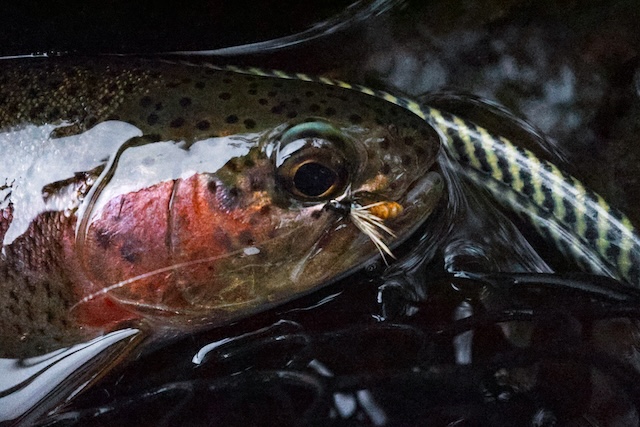
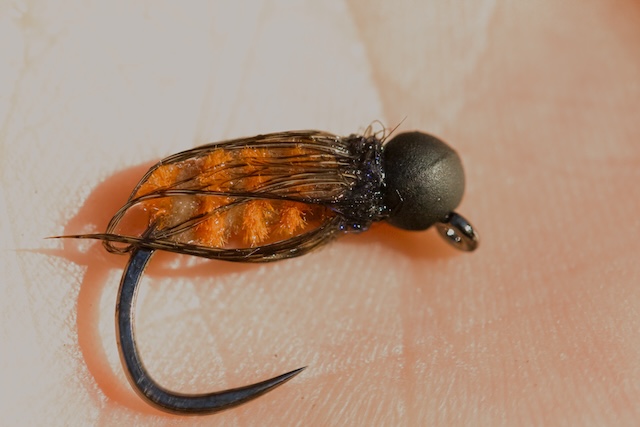
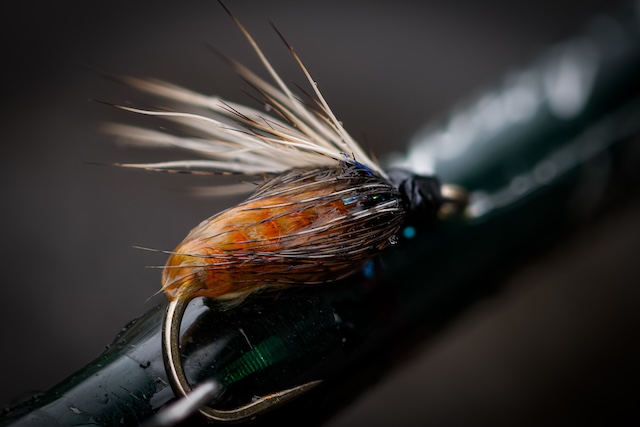
In this video, Simon ties an extremely simple, but effective October Caddis pupa. The fly uses a variety of fantastic materials from Fulling Mill. Chenille body caddis pupa are a great way to pump out a large quantity of flies in a short window. The Super Suede Chenille from Fulling Mill makes tying juicy caddis patterns a breeze. Fall is a time where fish get really keyed in on large nymphs, most notably October Caddis pupa. By now, they have been heavily feeding on them and will move from their lie to catch one adrift in their field of vision. For this reason, searching in the Fall with an October Caddis pupa is a great way to prove promising water. This fly can be sized down for smaller caddis pupa as well. There is another pattern herethat we did and it makes a great summer dropper. Again, colors and sizes can and should be changed depending on conditions and location!
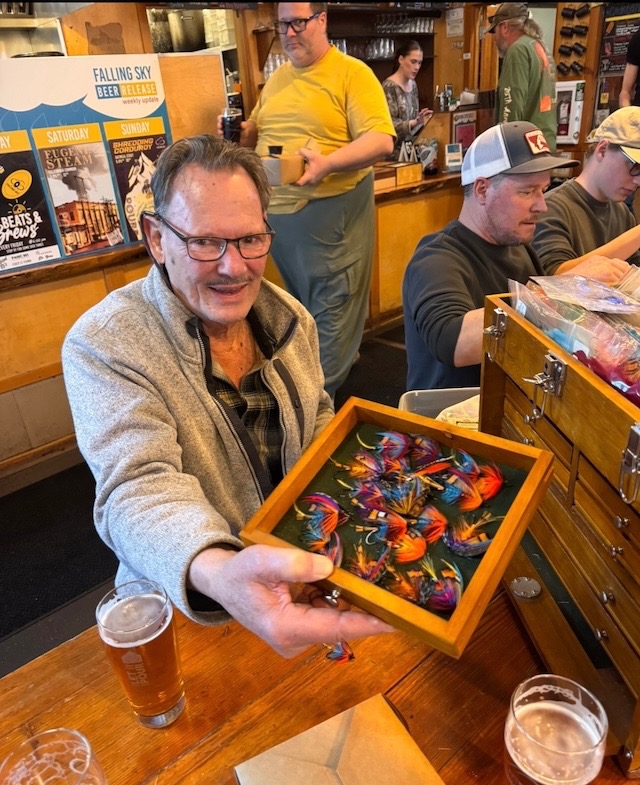
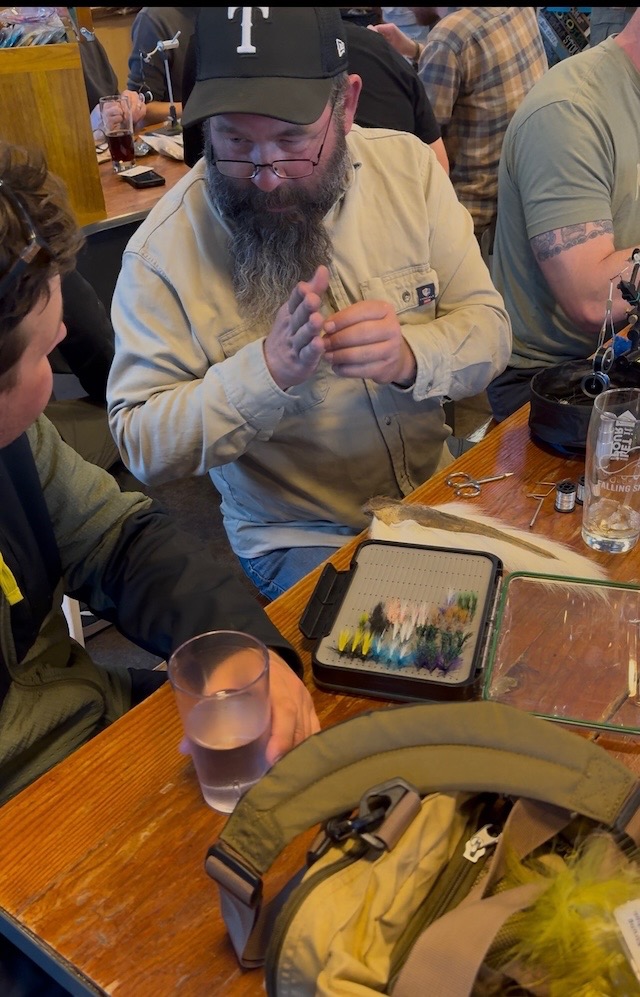
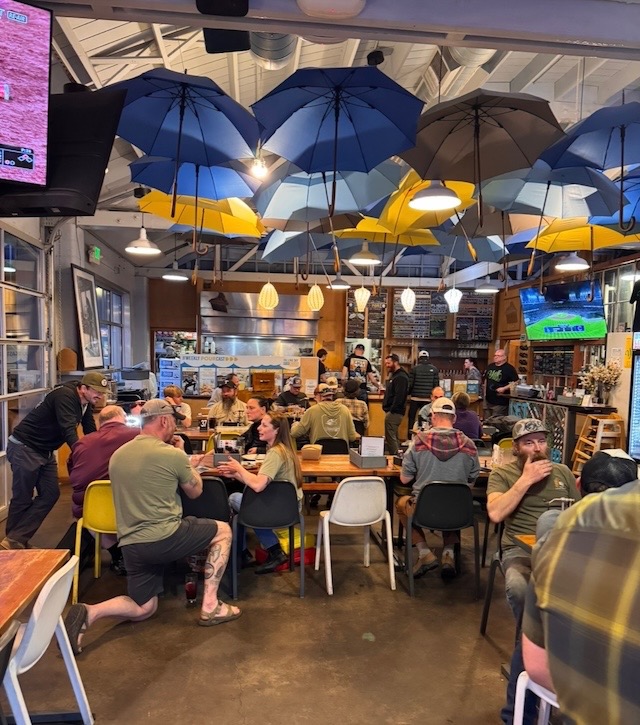
Join us this Tuesday at Falling Sky Brewing for a community night which begins at 6:30. Initially this monthly event began as a tying night, but we figured opening it up to everyone was better! We’ve found we get a more diverse group of anglers if the event isn’t just limited to tiers. We’ve also found people are a lot more social if they aren’t looking at the tabletop tying flies all night. Fly tiers, you are still welcome and encouraged to bring your tying stuff.
Next week’s time & place
When: Tuesday, November 18th at 6:30
Where: Falling Sky Brewing on 13th
We’ve got a great group of regulars who show up monthly, and each event brings more new faces into the community. This is a great opportunity to meet people to get outside with, observe tying if you’re interested in starting, and connect with the local fly fishing community.
Please help spread the word! Everyone is welcome, and the event is free to attend. Share this article, and invite all your friends.
Falling Sky has graciously hosted us monthly for coming up on a year at their location off of 13th. They have fantastic beer and talented chefs in back that make great food. There is nothing better to pair with great conversation than a cold drink and great food.
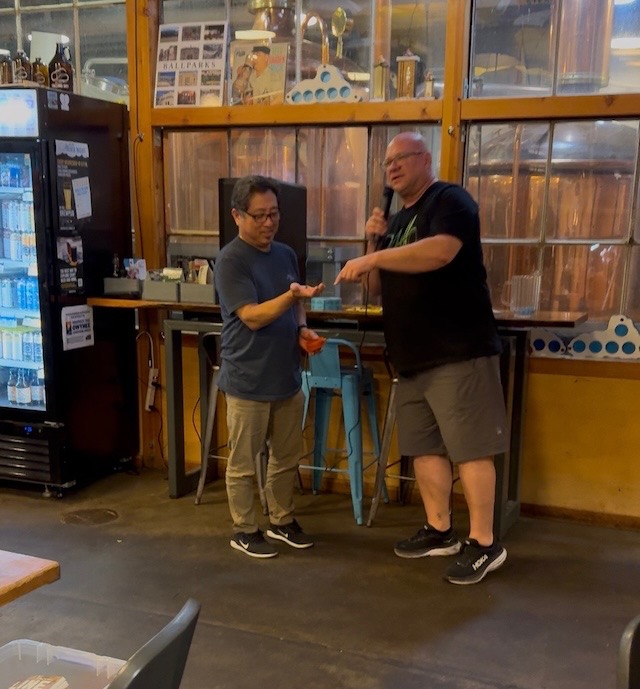
Generally, for the tiers, we do a fly swap where we all contribute a fly into a pot. You will receive a ticket, and as the tickets are called you are able to come pick a fly out of the pot. This is generally where we do a giveaway too with items from many of your favorite brands.
If the turnout is significant we will be raffling off a Fishpond Tailwater Tying Kit. This is a fantastic storage solution for your tying materials. It is how I carry my tying things to and from the shop for videos, and how I carry my tying things into this community night.
December’s community night will take place on December 16th at Falling Sky, starting at 6:30. We are still working out dates for next year.
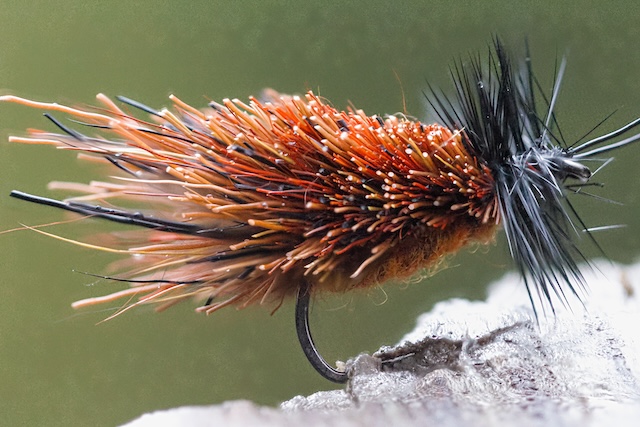
In this video, Simon puts a modern spin on a timeless classic. The Goddard Caddis was at one time one of the most buoyant flies available. Before the widespread use of foams to achieve buoyancy, tiers spun and packed hair tightly to create watertight bodies. Generally, Goddard Caddis are not tied this large, but we are blessed with an especially large Fall caddisfly that allows for some experimentation at the tying bench. Simon has had great success mottling his smaller Goddard Caddis patterns and several years ago began experimenting mottling the beloved McKenzie Green Caddis and larger October. This resulted in a more realistic looking pattern. The corded up chenille is suggestive of a caddisfly abdomen touching the water making the fly that much more irresistible. This general framework is one Simon sizes up and down depending on his needs and certainly changes color when necessary. Spin some up and see for yourself what it’s all about!
Many of us wait with great anticipation for fall weather. The fall colors, a break from the heat and smoke, salmon, mushrooms, bird season, cooler weather, but most importantly the October Caddis. This is an especially difficult time of year because opportunities are abundant for a day off, but as we all know, time is limited. This fall I urge you to make time to fish the October Caddis hatch and enjoy the Fall colors from the water. If you have fished it before, I know you don’t need any convincing to make time for a day on the water fishing the last big bug hatch of the year.
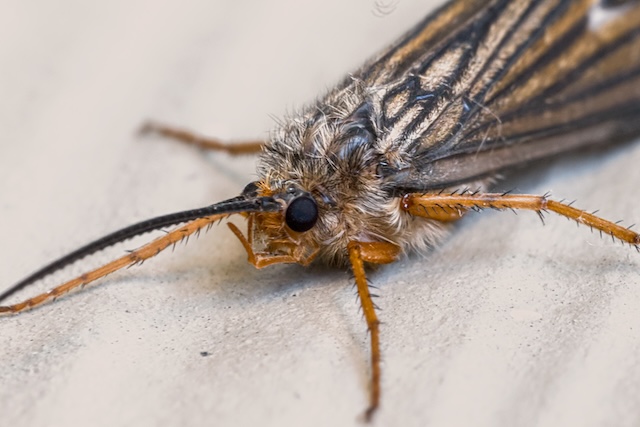
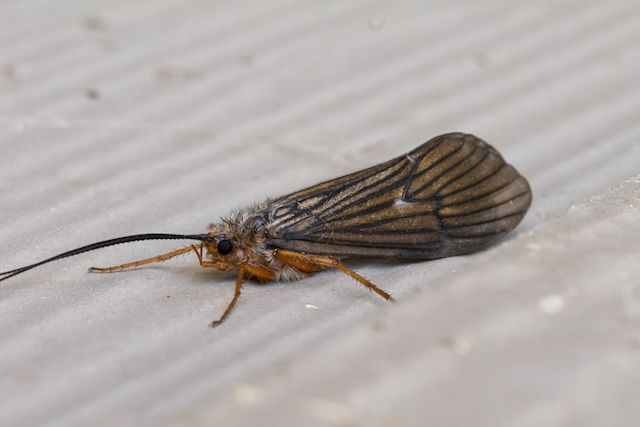
Few caddisfly species rival the size of the massive October Caddis. Also known as the Great Autumn Brown Sedge, this extra large caddisfly is hard to miss. These insects are large, pushing 1.5 inches. This is massive compared to the much smaller caddisflies we are used to. They sport light brown striated wings and a large gold/orange abdomen. They are easily seen fluttering around, when I first saw one, I thought it was a hummingbird or tiny bat. With their wings open and fluttering they look massive. Another telltale sign that the hatch has begun is the presence of pupal shucks on stream side rocks.
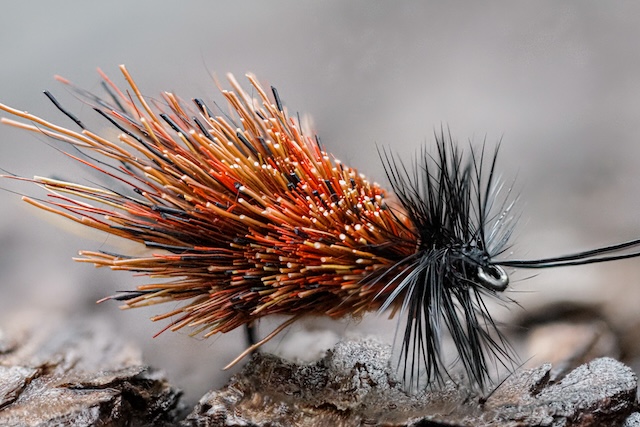
Stay tuned for the tutorial for this October Goddard Caddis.
October Caddis are most often seen in the evenings when they become most active. You can readily find them in the evenings fluttering around or see the females ovipositing in slower more calm water. Caddisflies are easily distinguished from other insects by their unique flight pattern. They flutter erratically and look like they’ve had too much to drink. This “drunken” flight characteristic is exclusive to caddisflies. Females oviposit, or deposit eggs, in slower water by diving to the water’s surface and dropping eggs each time she dips her abdomen in the water. During the day, these insects hold tight in stream side vegetation only to emerge in lower light conditions. You can have increased daytime activity on especially overcast days, these will often be accompanied by BWO’s on days like this.
Tutorial for this jigged pupa is below.
October caddisfly are in the case building family of caddisflies. This means the larvae make large rock cases that they live in carry around on the bottom of the river. As fall approaches, they move their case to a suitable location and anchor it to a rock on the river’s bottom. They then close themselves in their case and pupate. Their emergence as a pupa happens in the evenings, so often you do not see actively emerging insects as we do more often with other caddis species and mayflies. What you will see, once things get going, is stream side rocks littered with pupal shucks. Fish gorge on ascending pupa, so swinging wet flies mimicking these large pupa is extremely effective.
Tactics
Tactics for approaching the October Caddis hatch can be broken into two separate categories for simplicity: things happening above the water and below. Generally searching subsurface is more fruitful for this hatch, but surface eats for Octobers are especially memorable.
Tutorial for this October wet is below.
Pupa
Pupa are especially helpless compared to their more developed counterpart: winged adults. Fish know this and expounding energy chasing pupa is generally rewarded with a meal more often than adults on the surface. Trout are especially aware of their energy expounded vs calories consumed, so thinking like a trout helps you catch more of them. There are two different ways to present pupa to trout.
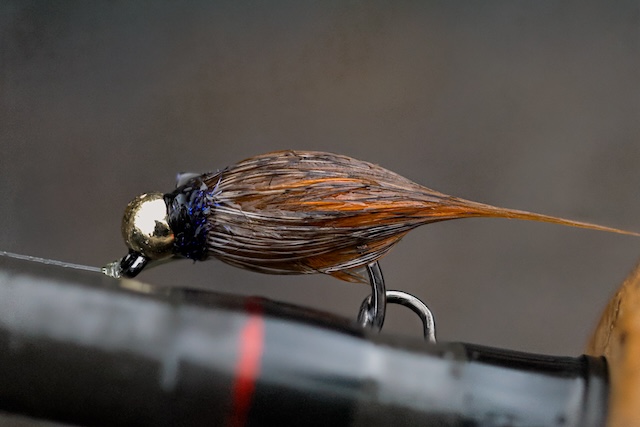
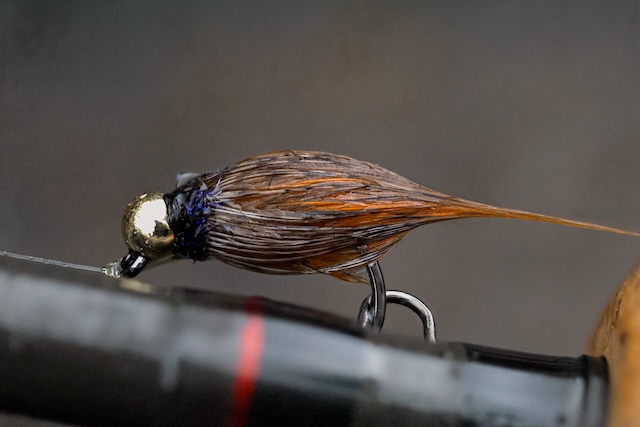
Stay tuned for the tutorial for this jigged chenille October Caddis.
Dead drifting pupa is easiest to start with as it is no different than running nymphs under an indicator or on a Euro stick. Running flies along a seam, dead drifted often yields eats. Fly selection is intuitive for this hatch. October Caddis pupa are big and orange, and your nymphs should be too.
Swinging wet flies is an alternative approach to fishing subsurface that is much more animated than the traditional dead drift. When done correctly, it mimics an insect ascending from the river bottom to the surface. Casting upstream coupled with several upstream mends gives your flies time to sink. Once they pass you, pinch your line to your cork and hold tight. The tension on your fly line will pull tight and begin to “swing” your flies across the current towards your bank. As things pull tight this lifts flies from the river bottom, effectively mimicking an ascending insect. Classic wet flies with a soft hackle work fantastic for this. I like to pair a heavy nymph with a lighter soft hackle off the back; this aids in getting your flies down quick. When fishing with an indicator setup, you can lets your flies “swing” back towards you at the end of the drift.
It is rare that these bugs stay still long enough for a good photo!
Winged Adults
October Caddis dry fly eats are really what everyone is after. Throwing one of these large dry flies can cause explosive eats by large fish. Every Fall I have at least one memorable eat from a massive fish at dusk on an October Caddis dry. Females ovipositing in the evening are a big proponent in fish seeing these adults. Finding slack water near riffles are both where large fish wait, and where female caddis oviposit their eggs. Skating caddis can be effective as well for this hatch. It is essentially swinging a dry fly as you would with a wet fly. Sometimes casting a dry and animating it with tiny strips can entice big fish to surface as well. The first list of flies below are general dry flies that should be fished solo, or with an additional trailing small dry like a BWO or smaller #16 caddis. The second list is for running a fall dry-dropper setup. Note: the first list of flies are ones you can skate and skitter, not flies from the more buoyant second list.
Stay tuned for the tutorial for this October Goddard Caddis.
For all of you fly tiers out there, here is a list of several October caddis patterns we have done. Note: we will be releasing an October Caddis dry and jigged chenille pupa any day now, so stay tuned. A sneak peak of these bugs can be seen in the article above.
If you have any additional questions regarding this hatch swing by the shop. We are happy to answer any questions, and get you geared up for an awesome time on the water.
In this video, Simon ties an extremely versatile October Caddis pattern. This wet fly can be tagged behind a dry, swung, or dead drifted in tandem with a heavier nymph. The material selection of ostrich, chenille, and wire creates an extremely realistic body when wet. Simon’s preferred method of fishing this fly is tagging it behind a larger October Caddis dry as a cripple/emerger. This offers fish the choice between a flying adult and a vulnerable pupa. Generally, they always take the tagged wet fly. Finding where fish are holding in softer water is key to fishing this fly; running it along seams bordering soft water will reward you with a heavy net. Quartering casts downstream can yield explosive eats, especially in low light conditions. Tagging this in a tandem with a heavy tungsten nymph is a great way to present a heavy and light duo beneath an indicator.
Upriver Coho Salmon fishing has been decent! Stripping flies for Coho is one of my favorite fisheries in Oregon. It can be Type II fishing when a whole bunch them are splashing around you and no one is biting. But when its good…its good! I have not had any amazing days this season but I have not been skunked either. For salmon fishing on the fly that is pretty good! We have a week and half to a month or so, depending on the fishery, left of Coho Salmon fishing on the Oregon Coast. I would expect fishing to improve after this week’s big rains. If you see fish rolling that is a fine spot to fish. I target the frog water, pools and tailouts casting and retrieving flies. I will experiment with different strips throughout the day. Usually you will have the frog water and pools to yourself. Salmon are moody. The ones around you may not initially be in a biting mood. They could turn on at any moment. I tend to stick it out 30 minutes to an hour in a spot that has been productive in the past. When things are grim and morale gets low: remember salmon hit flies in Oregon, not just Alaska.
They do hit flies
When fishing for Coho salmon I use single hand rods with Intermediate or Sinking Lines. While you could get away with using a 8wt, I would recommend a 9wt or 10wt if fishing around wood (everywhere) or in heavy current. The Boost Blue is a quality option that I fish in a 9wt. I also use a pair of old Cam Siglers in 10wts that I bought from Chris, on consignment, years ago when I was a customer. You should fight Coho like you do bass. Do not let them run too much or they will go for wood. When they roll… do not pull. When they stop spinning… reef on em’. The SA Full Intermediate Line gets put to work early season or on our Coastal Lakes. The line I use the most is the SA Sonar Titan I/3/5 . It works for deep pools, mid depth frog water and tailouts. This line gets your fly in the zone and the intermediate running line helps it stay there. Outbound Shorts in various sinking configurations are another option from RIO. I fish Clouser Minnows and bunny leech flies that I tie in various colors. Chartreuse-White, Chartreuse-Pink and Red-Black are the colors I fish the most. Plain pink, purple or blue all work too. It really helps to tie your own flies so you can have various colors, weights and quality hooks. Boss or Comet style flies can excel in low water.
Getting Bent
On the steelhead front I have put in a few half hearted half days and been rewarded with what I put in. Not much! Steelhead fishing locally should be productive for another week or two. We have heard a few positive reports from the Willamette and McKenzie. This can be a great time to head out to the John Day, Deschutes or other Eastern Columbia Tributaries.
We have been loving all of the Backcountry Skinz products. This short video illuminates the BC Skinz ethos, in the field. If you haven’t checked out the awesome non-wader, wading products from Backcountry Skinz, take a look at the links below the video.
Work on the Rewilding of the McKenzie River Basin:
Planned restoration projects for 2025 seem to have been productive. The Gate Creek Flood Plane Enhancement was largely completed, expanding on the work previously done at Finn Rock Reach on the McKenzie River. However, several key staff at the USFS either left or were fired as that agency adjusted to the priorities of the new administration. As most of the Upper McKenzie Basin is part of the Willamette National Forest, it is now unclear to what extent there will be needed federal participation in projects going forward. However, for 2026, there are plans to expand the flood plane restoration on the Lower South Fork towards Cougar Dam. At this point, it appears that funding will be available for this work. However, beyond 2026, the program will need to find new sources of funding to maintain the goals and expectations of the various partners in this basin-wide program.
I am currently working with the McKenzie Watershed Council and the McKenzie River Trust to identify promising sources of supplemental funding to provide ongoing support. The working premise is that there will be about a six-year period of unreliable federal support that will need to be “patched” with new sources of funding. The good news is that, in preliminary contacts with foundations that traditionally support conservation programs, they are well aware of this situation and intend to step up their participation as needed.
On a more positive note, the McKenzie River Trust continues to expand their holdings as landowners transfer basin properties to them. Of course, this process sets up an assessment of work that is needed to return the land to the services that meet the organization’s charter. This in turn stimulates project planning, including budgeting. Accordingly, the funding needs for basin programs increase and putting more pressure to resolve the funding issue described above.
The Status of Spring Chinook:
At this point in the year, the returns of ESA listed Spring Run Chinook Salmon at Willamette Falls were very close to their 5-year average. Data for salmon entering the McKenzie River at Leaburg Dam have not been released. However, it is expected that, given the efficiency of the Leaburg Dam sorting operation, only a small percent of hatchery origin salmon (HOR) will achieve the upper river to spawn. Last year the reported PHOS for the upper river was less than 5%.
However, the salmon spawning grounds below Leaburg Dam are extensive with a very high PHOS (>40%). For reasons that are not understood, HOR salmon moving up to Leaburg Dam seem to avoid the sorting operation and spawn below the dam. It is notable that if all spawning data are aggregated for both above and below the Leaburg Dam, the overall PHOS for Spring Chinook in the McKenzie River Basin is about 25%. This number is substantially above the recommended all-river PHOS (<5%) called for in the NMFS BiOp for this subbasin. In discussing this point with ODFW’s regional fishery biologist, Jeff Ziller, he opined that because the lower river (i.e., below Leaburg Dam) has warmer water, he did not expect that redds in that segment to be as productive as those above the dam. However, he offered no data to support that claim. NOAA’s 2024 5-year review (2024) of the status of listed salmon and steelhead in the Willamette Basin concluded that no progress has been made in the recovery of these listed species. ODFW seems to agree with this finding, but no party has committed to a serious process or program that might accomplish the purpose of the ESA listing.
Looking Forward:
The fate of the Leaburg Dam and bridge seems to be settled, in that the owner, EWEB has committed to decommissioning the Leaburg Power Station, it’s diversion canal and removing Leaburg Dam and the associated bridge. This system was put in place during the nineteen twenties and has provided electricity to the Eugene-Springfield area. The current move to remove the power station was spurred by a discovery of substantial instability in the canal used to divert water to the power station. This led to the decision to remove the entire system and the recognition that FERC would require dam removal as part of the decommissioning. Initial estimates of this project have been in the range of 20-30 million dollars. At present water previously diverted to the canal has ceased and is not expected to be reopened, even on a temporary basis. However, EWEB has recently notified their members that they expect to need about 5 years to assemble the relevant documents to submit to FERC as a petition to remove the project and that they expect to begin the physical removal process in 2032, with no estimate for completion.
Associated with these actions, the ACOE owned and operated McKenzie Hatchery is dewatered so that its only use is limited to recovering eggs from captured salmon and to caring for them until they hatch. Independently, the only other hatchery on the McKenzie River, the Leaburg Hatchery has suffered from increasing temperatures in its rearing ponds so that it now fails to meet the Oregon temperature standards for releasing water into rivers. Accordingly, fish are no longer reared and released from that hatchery. To further complicate these issues, ACOE seems to have taken the position that regardless of any commitments it may have made in prior mitigation agreements, now that they are being pressed to directly address issues of fish passage at their dams, the prior financial commitments are moot.
Fish Passage at Trail-Bridge Dam:
In the nineteen sixties EWEB developed a system of reservoirs and dams in the Upper McKenzie River Basin which they refer to as the Carmen-Smith Hydropower Project. The system provided several power stations and associated reservoirs, the lower segment ending at Trail-Bridge Dam and reservoir. The position of this dam acts as a barrier to listed Spring Chinook Salmon reaching spawning grounds above that dam. Also, a serious concern is the threat to the remaining isolates of endangered Bull Trout in the Western Cascades. By the time this species was recognized as highly endangered, its range was limited to small (>200 spawning fish) isolates above either Trail-Bridge or Cougar Dam in the McKenzie Sub-basin. As neither dam provided effective fish passage, efforts were made to reintroduce Bull Trout below Trail-Bridge Dam and above Hills Creek Dam on the Willamette River Middle Fork. At the time, it was assumed that fish passage improvements at the dams would support inter-connection of these populations and thus produce a more robust and sustainable population.
Downstream fish passage at Cougar Dam is a work in progress and an occasional Bull Trout passes down to the mainstem McKenzie River. However, their chances of moving back up to their natal spawning grounds are highly unlikely. In the case of the Carmen-Smith Project, when the FERC relicensing process was initiated in 2006, several conservation groups and ODFW pressed for the inclusion of fish passage to support Bull Trout and salmon spawning. After much back and forth, the license was renewed in 2016 with the specific inclusion that effective fish passage would be implemented at Trail-Bridge Dam, but exempting two dams higher up in the system.
Since then, and despite substantial prodding from the conservation community, EWEB has only implemented a pipe apparatus, large enough to hold a single fish attempting to move above the dam. By periodically checking this apparatus, the fish can, in principle, be captured and trucked above the dam and released in the above-dam reservoir. EWEB has provided no data on how many fish and of what species have been moved by this manner, but Jeff Ziller tells me that ODFW has assisted EWEB in moving “a couple of fish” above the dam. In 2024, a Bull Trout eDNA survey carried out by the McKenzie Flyfishers, and supported by the USFS and ODFW documented the current failure to expand the Western Cascade Range of these highly threatened fish.
How EWEB will respond to their obligation to provide effective fish passage is unclear. As noted earlier, they face substantial costs with the decommissioning of their Leaburg Power Station and associated dam. In response to the recent Federal Courts dismissal of the lawsuit regarding Trail-Bridge Dam fish passage, EWEB has simply announced the “We Won” with no explanation of the issues or the question of jurisdiction. In July they announced a new power contract for purchasing electricity from the Bonneville Power Administration (BPA) from 2028 when their existing contract ends and extending it for another 20 years. The ultimate cost of this contract extension is expected to be from 2.5 to 3.0 billion dollars; all of which will be passed on to rate-payers. This is not a fixed rate contract, but only specifies the number of kilowatts that are being purchased, so the cost of electricity could rise substantially in the future. It is interesting to note that BPA is providing at least 80% of the power needed by EWEB. Hence, the in-house capacity of EWEB to produce electricity at the Carmen-Smith Project is limited to backups in times of high demands or as should BPA power not be available. Currently, EWEB has not released a time-line or cost estimate for Trail-Bridge fish passage, but their board of directors were advised that the costs would likely be above 20-30 million dollars. Given the current commitments to Leaburg and the BPA, we can expect that EWEB will be motivated to delay the project as long as possible. Whether there will still be Bull Trout in the Upper McKenzie Basin by then is at best an open question.
Perhaps independent of all these issues, on September 18th, the EWEB CEO and General Manager, Frank Lawson, announced that he is retiring next year. The utility has initiated a search for a replacement.
In this video, Simon ties a fantastic Mahogany Dun nymph. These insects are often overshadowed by their more popular fall counterparts: Blue Winged Olives and the mighty October Caddis. These small mayflies can offer fantastic dry fly fishing if you catch their emergence. If you happen to miss the initial hatch, there generally is a phenomenal evening spinner fall much like the summer PMD/Sulphur hatch. By this time of year, trout are keyed in on feeding on their nymphs. This pattern effectively imitates Mahogany Dun nymphs. Its sheen below the vinyl rib is suggestive of a gas filled emerging nymph. This is exactly what experienced trout are searching for. This fly is a great fall searching nymph; tie some up and enjoy your next day on the water.
In partnership with McKenzie River Trust, Our local Trout Unlimited Chapter, Redsides will be volunteering at the special Green Island property on Saturday, Nov. 15th. Following the work, the property will remain open until 4 pm for exclusive fishing access to the Willamette River and the property’s pond. Please join us!
Join us for a day of willow harvest at Green Island, just outside of Coburg, Oregon, to support replanting efforts in the newly restored Quartz Creek! Quartz Creek, located near Blue River, Oregon, is a key tributary of the McKenzie River, benefiting native species like salmon, trout, lamprey, beavers, and more.
We will work in the morning and welcome people to stay to fish in the afternoon along the Willamette River or the island’s restored gravel pond to help remove non-native species such as largemouth bass and bluegill.
Work will take place from 9:00 am — 12:00 pm, with gates remaining open to fish until 4:00 pm. This event is geared towards the fishing community – please help spread the word and invite friends to join you! Registration is required to help us prepare tools and materials – Register HERE.
Willow has a strong root system that helps filter water, stabilize banks, and control erosion while providing shade and thicket to support nesting habitat and shelter for fish and wildlife. It is also an important food source for native pollinators, hummingbirds, and beavers.
The willow processed at this work party will go upriver for a community Willow Planting Party at Quartz Creek the following day. Willow will root right out of the stem when put into the ground. One long branch can be cut into several pieces, and each piece will sprout, so long as it is planted right side up. We hope to have at least 1,500 stems to plant, and we could use many hands to help make this possible!
You don’t need any experience; tools, gloves, and chairs will be provided. This activity can be done standing or seated. Some project pieces include bending, lifting, and walking on uneven ground.
Additional project details will be shared ahead of the event. Porta-potties and drinking water are available on site. Snacks and beverages will be provided! Please bring a lunch that meets your dietary needs if you plan to stay and fish.
Directions: Green Island is located at the confluence of the McKenzie and the Willamette Rivers and the property is reached via Green Island Road in Coburg, OR.
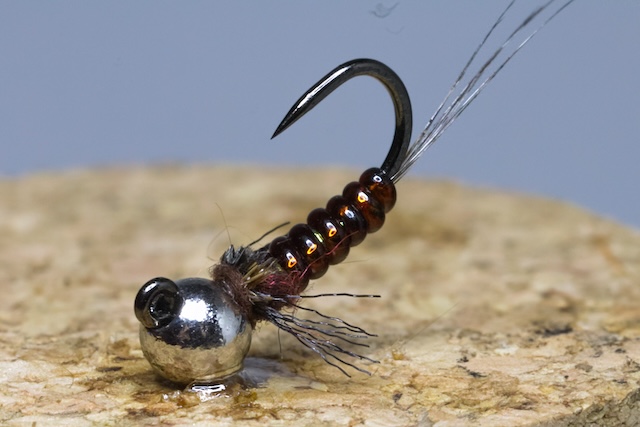
In this video, Simon ties a fantastic fall searching nymph pattern. October Caddis are a large species of caddisfly that hatches in many places out west. This is a hatch that both anglers and trout alike are excited for. The pupa emerge in lower light conditions and offer trout a large, vulnerable meal. Fish key in on their presence and there are several weeks each year where trout feed on October Caddis Pupa with reckless abandon. The rabbit making up the body compresses beautifully into an irresistible pupa. This fly works best dead drifted or swung mimicking a pupa adrift or ascending to hatch. Feel free to size this up or down. The bead size of this fly can also be adjusted for water conditions or depth. We like to carry these in a variety of bead sizes to accommodate different conditions.
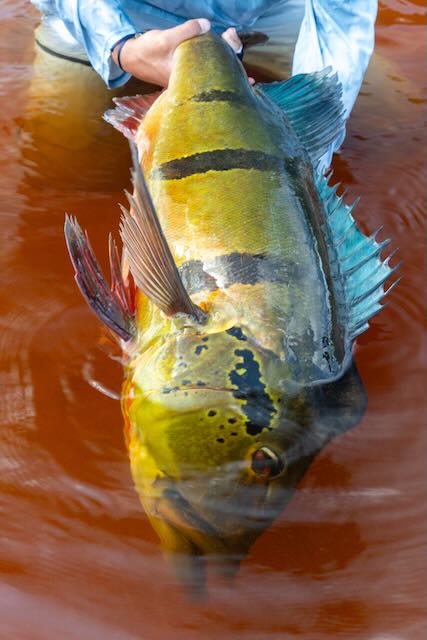
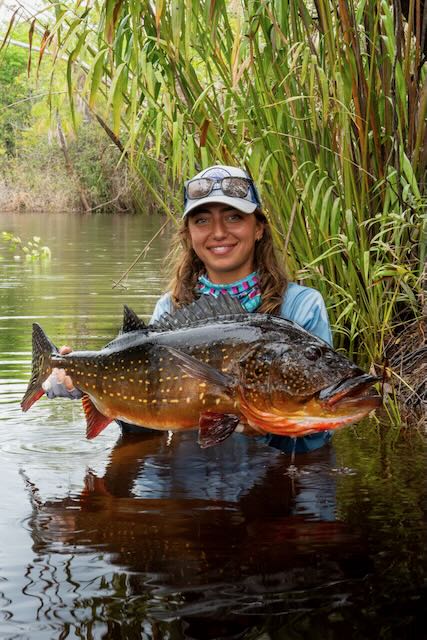
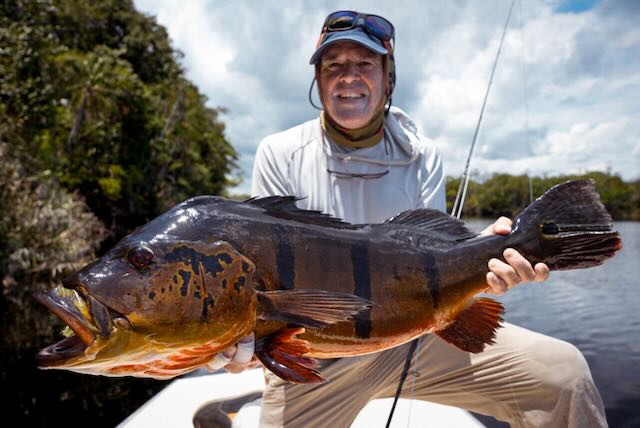
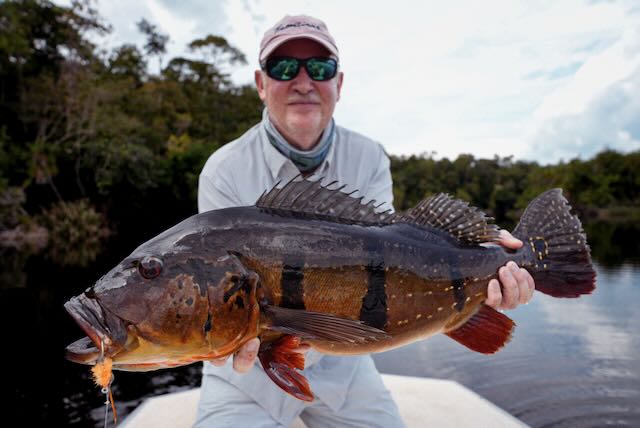
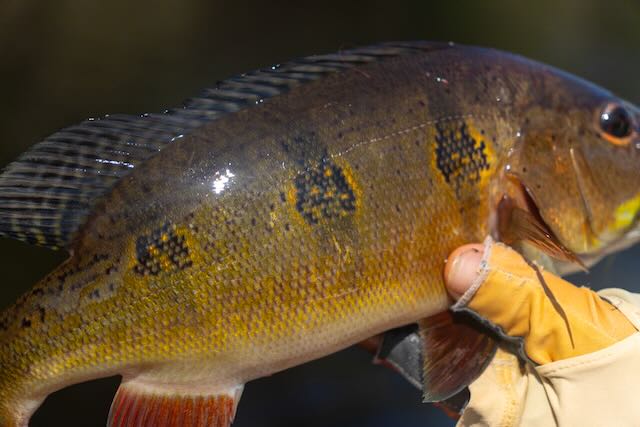
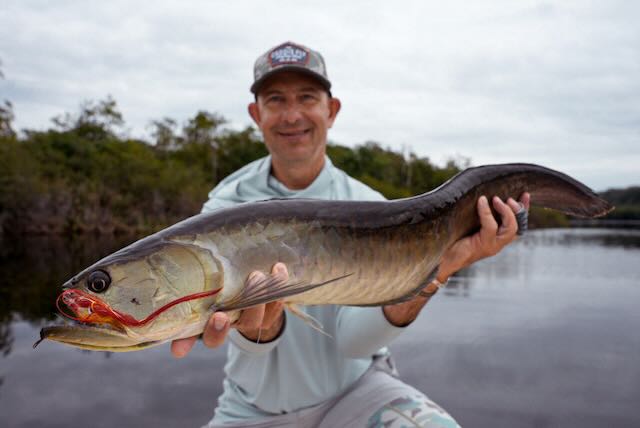
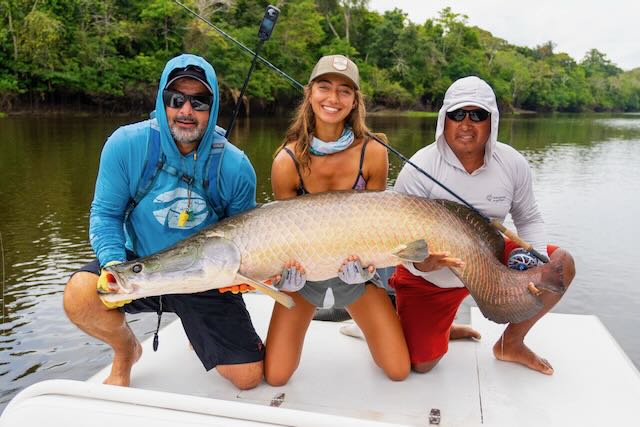
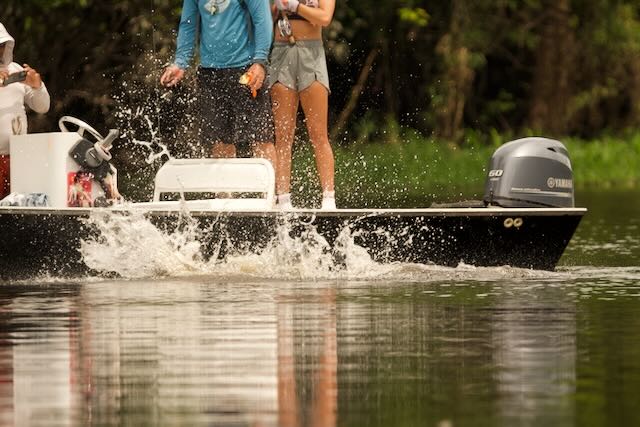
Our group of 8 anglers flew to Manaus Brazil late August for a combination trip targeting Peacock Bass and Arapaima. The first seven days were spent on the Rio Marie fishing for Peacocks. The next four days/five nights would be spent in the Mamiraua Reserve at Pirarucu Lodge seeking 100+ pound Arapaima.
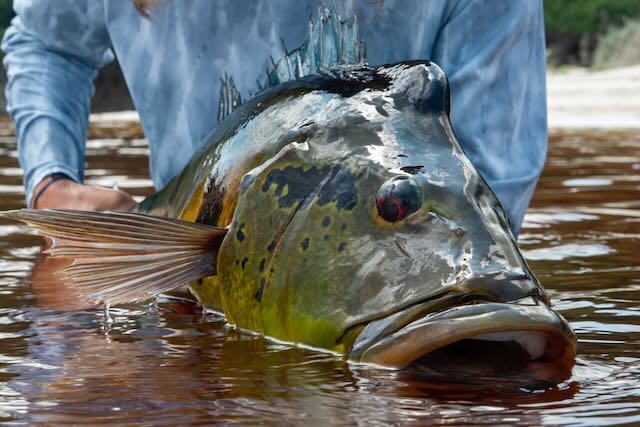
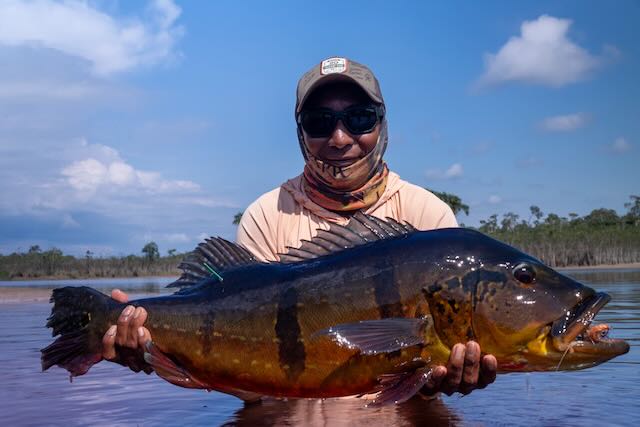
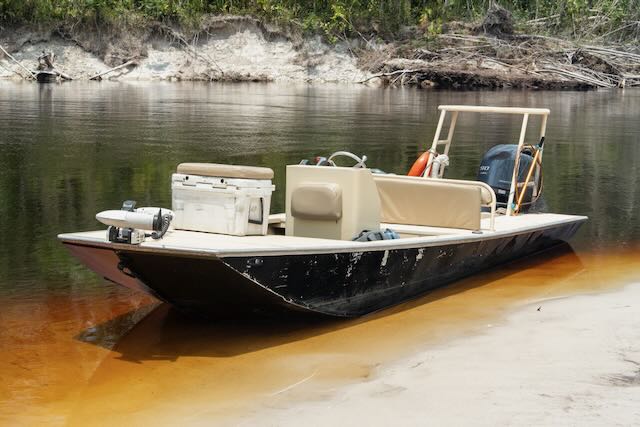
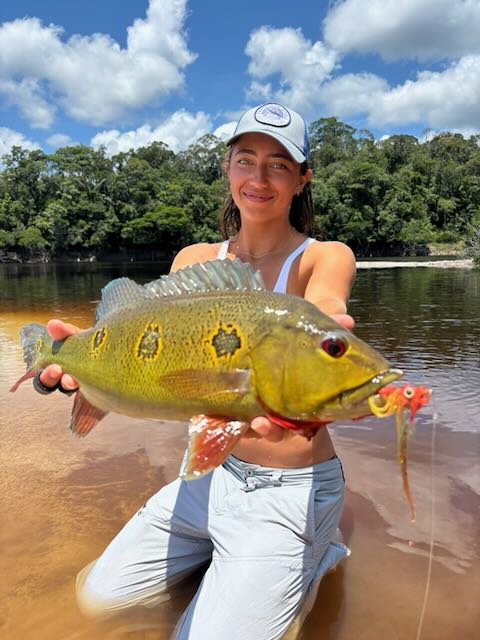
The Rio Marie River is home to some of the largest Peacock Bass in the world, and once again, it did not disappoint. Using 9wt rods with jungle clear tip lines we fished the dropping river’s lagoons and creek mouths with 3-8″ long streamers. The daily program is pretty simple, guides were given daily beats to insure you were fishing unmolested water. Anglers make accurate casts from stable aluminum skiffs all day long. The more times your fly is in stripped through cover and ambush zones the Peacock Bass inhabited, the more success you had.
Some exceptional fish were taken on our week. Fish over 20lbs are considered trophies and our group was lucky enough to find several.
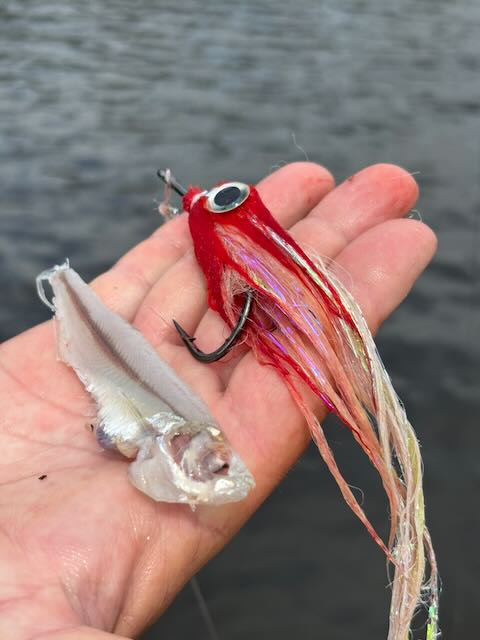
Fly styles varied but 2/0 to 4/0 black and orange, and white and red flies that pushed water were consistent performers. Poppers in red and white were also effective. This trip is not just about big fish. Butterfly Peacock Bass are super plentiful and can be caught in numbers. Willing “Butterflies” are around 2-6lbs and are super hard fighting. No need to change flies for the smaller fish, they readily gobble up big and small flies.
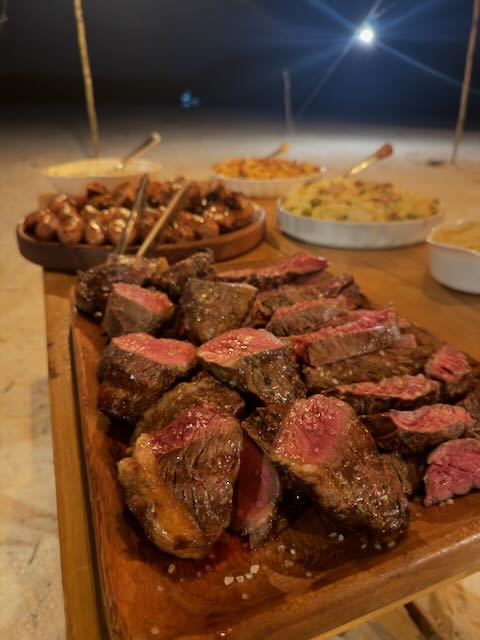
On the last night of our stay we had a fantastic beach BBQ hosted by chef Leandro who has been with Untamed Angling for more than 10 years and his food was fantastic all week.
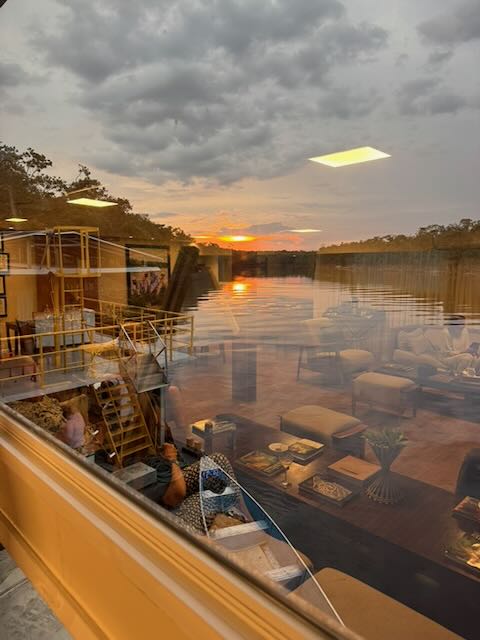
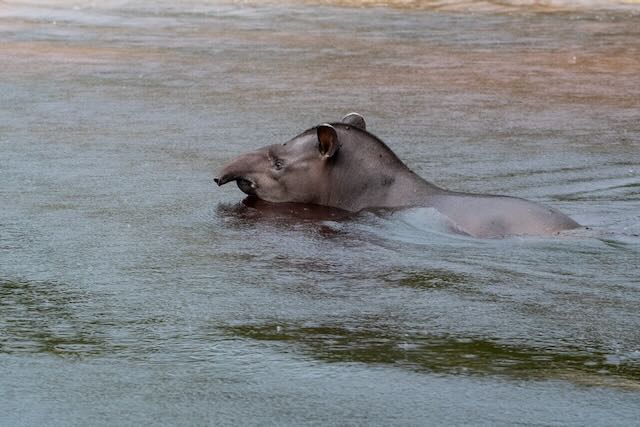
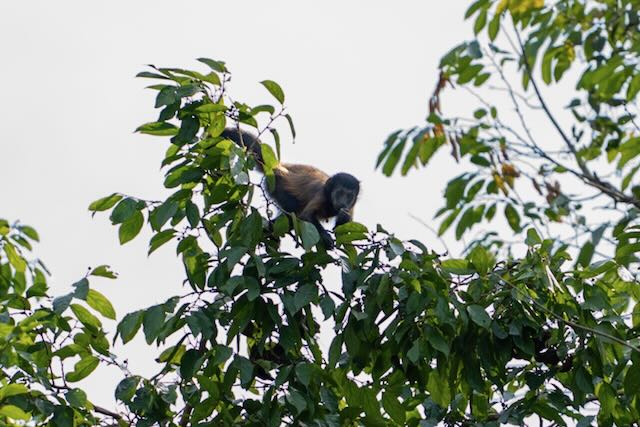
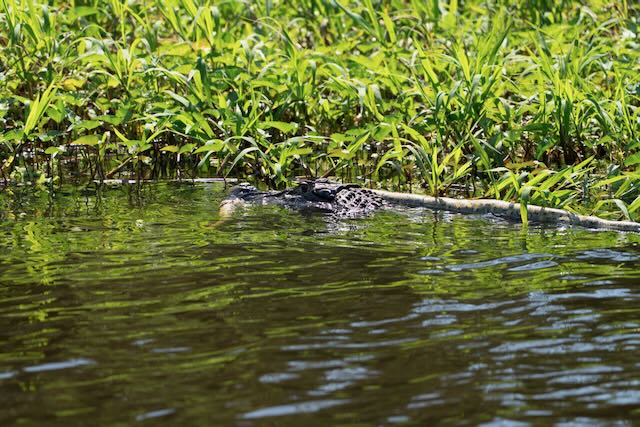
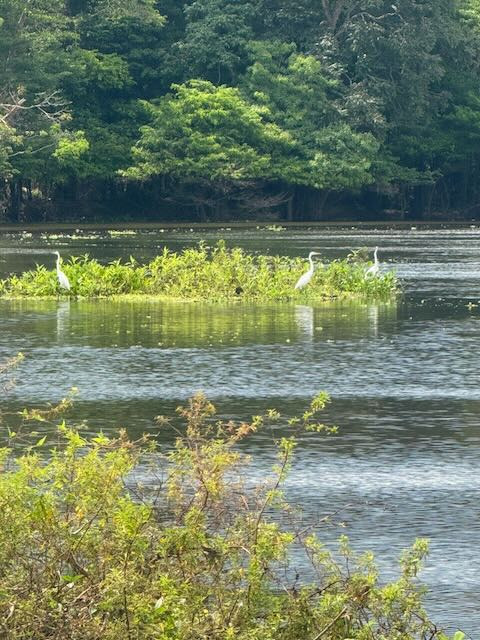
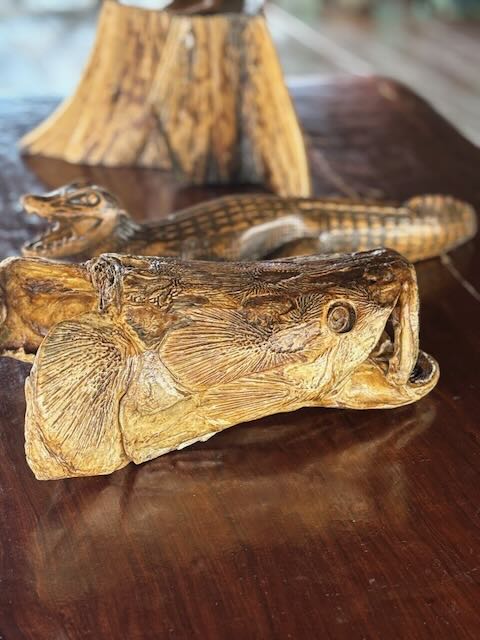
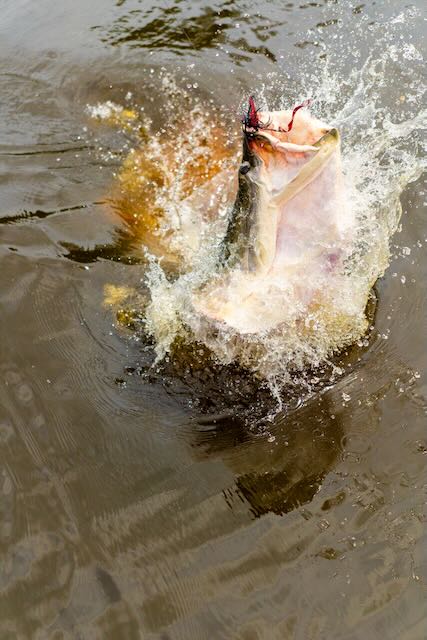
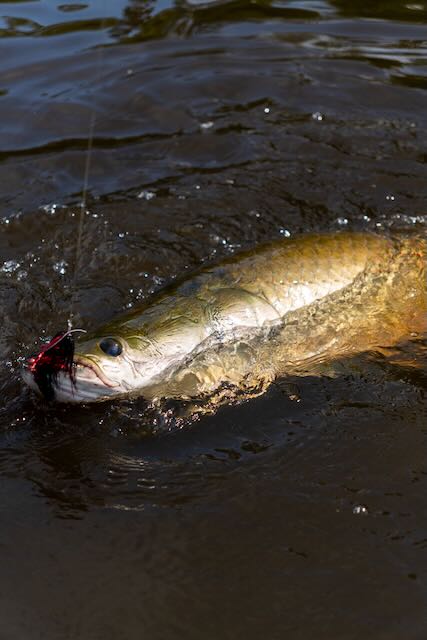
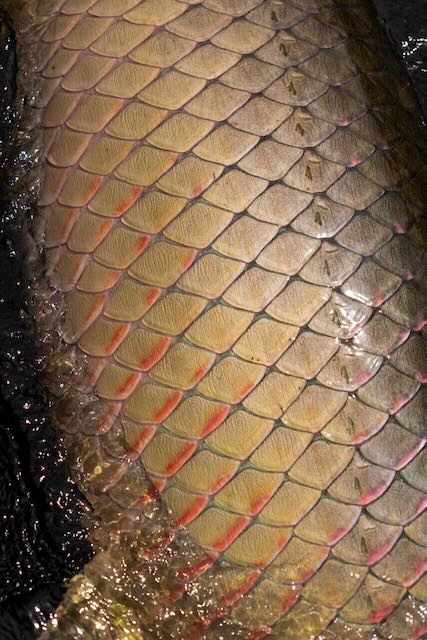
After a float plane ride from our floating accommodation on Rio Marie to Tefe, Brazil we took a fast boat approximately one hour to the Mamiraua Reserve and Pirarucu Lodge. Pirarucu means Arapaima in Portuguese. The Mamirauá Reserve is more than 1 million hectares, and was created to preserve Arapaima and their habitat. The area is renowned for its fantastic wildlife, with 427 species of mammals, 1,300 bird species, 378 species of reptiles, and more than 400 species of amphibians. Our cabins sat on floating logs in a wide spot in the river. Caymans and Arapaima rolled, swam and splashed 24 hours a day. Monkeys could be heard in the distance most of the time and innumerable bird species flew and called all day and most of the night. The place buzzed with life!
The water was extremely high for September, our guides were in week three of about a 14 week season. They had never seen the water this high! Pirarucu’s season starts in late August and finishes in November. This timeframe is chosen for low water! Which was not the case for our stay. Huge masses of grass floated down the river, trees were submerged 5-6ft underwater and there was no visible river bank. Fishing was tough but rewarding. With the high water fish were not concentrated and were able to feed literally inside the jungle. You could see and hear these monsters rolling 50 yards back in the jungle. Other species that are normally available to anglers such as Arawana and Tambaqui were also deep in the cover and we had no shot at those until the last day when the water had finally dropped enough in a few spots that the fish decided to come out to some degree.
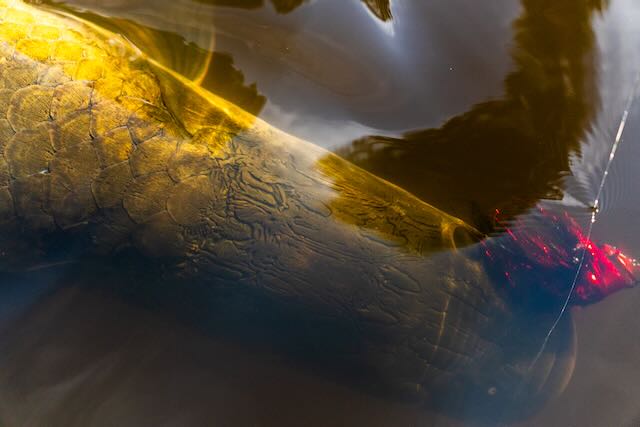
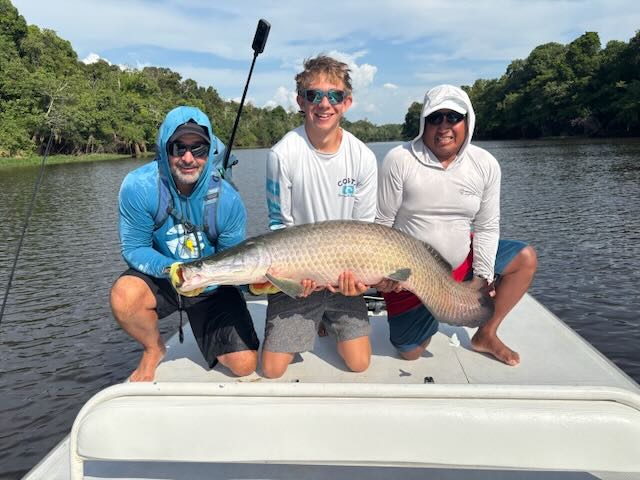
Arapaima fishing is done with 10-12wt rods and sinking lines, on our week really fast sinking lines. Tippets range from 60-120lbs, the best lines were Sci Anglers Custom Cut Jungle sinking line and Sci Anglers clear Full Intermediate sinking line. Flies were massive 8/0 streamers in variety of colors, I don’t think pattern was vital, but hook quality definitely was. The fishing reminded me of tarpon fishing in many respects. Hooks sets, hook set success… strength of fish and how hard you need to pull to land the fish. On our week, we had extra challenges associated with the high water. Once hooked, nearly all the fish would race for the trees, controlling them early was key. Since there was no river bank available, we had to hoist fish into the boat to unhook, photograph and release them. No one was injured but I can definitely see how a tail slap could be a problem with these super strong fish.
Fly fishing in the Amazon Basin is absolutely incredible. Not only are the fish super exciting to catch but the place itself is really something to behold. If you are interested in booking this trip or need advice on what to bring and what to expect please feel free to contact travel@caddisflyshop.com.
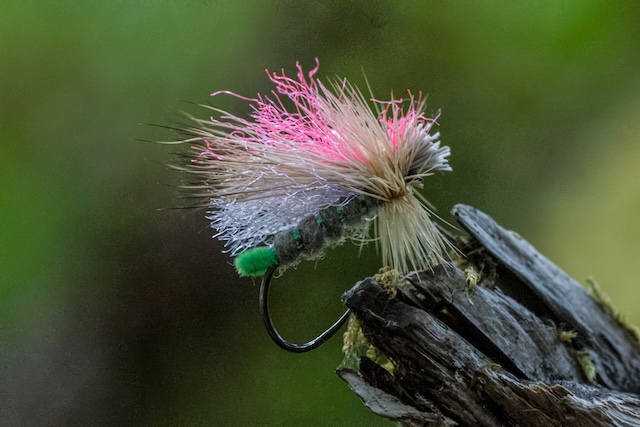
Late in the summer and early fall is when several caddisfly species make their emergence out West. As the weeks tick on by, we find more species of caddisflies in our stream side vegetation. In this video, Simon ties up a great caddis searching pattern that will work as a great choice among the several hatching species of caddis. This pattern is fished well in the afternoon into the evening when the insects are most active. It also makes a fantastic searching pattern on smaller streams. It is buoyant, and visible making it a great choice as trout put on the feed bag before dark. The Fulling Mill Ultra Dry Yarn for the underwing aids in buoyancy, and the tuft in pink makes the fly especially visible when light is low. The chenille on the rear serves as a target point, helping this fly mimic ovipositing female caddisflies. These were deliberate choices in the fly’s design to create a caddis pattern that delivers for their evening activity. Typically, October Caddis steal the show in the fall, but you mustn’t overlook the several types of smaller caddis species that make their emergence during late summer/ early fall. This is a pattern that effectively imitates several of these species, and is responsible for bringing eager trout to the surface. Feel free to size this up or down, or tweak colors depending on your fisheries needs.
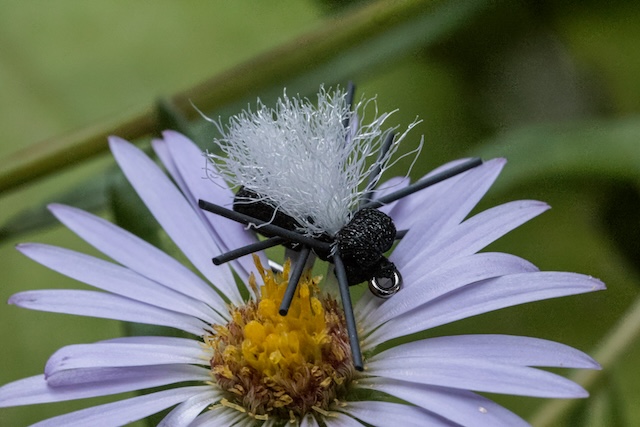
In this video, Simon ties a simple, but effective ant pattern. As summer progresses into fall, ants become more and more of a staple in trout’s diets. This is especially pertinent on small streams, spring creeks, and high alpine lakes. On small streams, terrestrial insects make up over 50% of a trouts diet in the summer. This means ants are on the menu, the brusher the banks and the more narrow the stream, the more important land based insects are to sustaining these trouts. On alpine lakes, ants are notoriously on the menu for trout. This is especially true for lakes with significant amounts of dead and downed logs on the banks. These are hot spots for terrestrials, and often trout hold near this structure and pick off ants that end up in the water. This ant is simple, buoyant, and uses few materials. It casts a realistic profile in the water featuring three body segments. It is small so feel free to add some Fulling Mill Ultra Dry Yarn in Pink or Orange or Montana Fly Co Widows Web in bright color for visibility. If you want to add a hi-vis spot after the fact, the Scientific Anglers Indicator Markers work great for on-the-go visibility. Feel free to size this up or down, tying it up in brown for a cinnamon ant would be great too!