Fly Fishing for Spring Chinook, King of Kings

The Spring Chinook, King of Kings
springer1

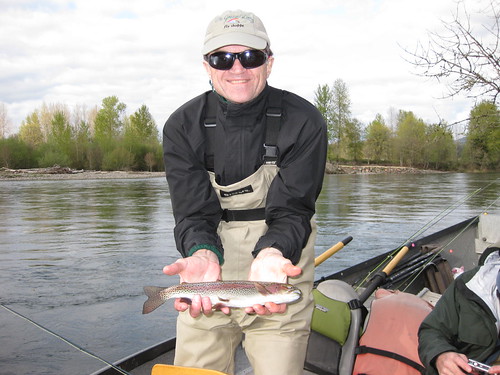
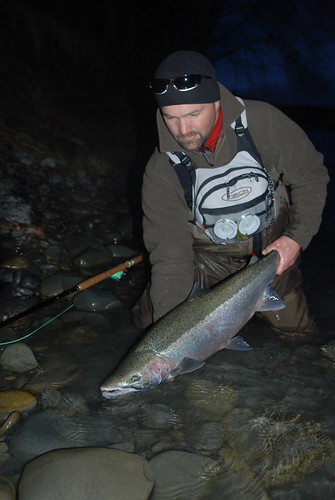
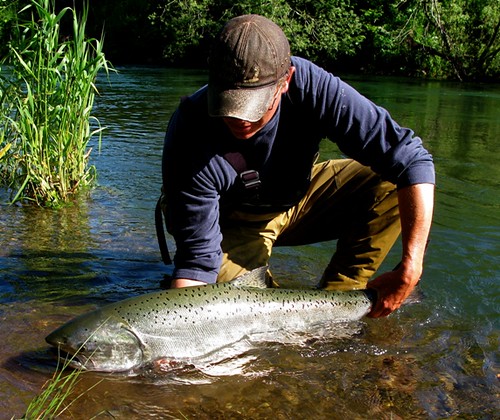
Caption: A particularly fine spring chinook, the kind that swim in and out of my dreams. Courtesy of Jay Nicholas.

Spring chinook light a fire in me like no other fish in freshwater. When I think about the reasons, I can’t pin it down to one attribute. It’s the whole package–strength, speed, cunning, beauty, girth, stamina. It’s also the time of year, when days are suddenly long, rain is warm, rivers smell sweet, swallows skim the water, ospreys dive, and eagles ambush. Nature’s palate of green becomes impossibly vivid and varied, and the once skeletal river banks are hidden under the shade of alder and cottonwood.

Fly fishing for spring chinook is a singular challenge. While these brutes are the occasional by catch of steelheaders, springers are extremely difficult to target and hook with consistency. I have still never landed a springer on a swung fly, and the two I am certain of hooking tore me to shreds and left me with a stubby leader. Only one of my clients ever landed a spring chinook on a swung fly in ten years of guiding. He actually landed two in one morning, a twenty-pounder and a ten-pounder (the late Don Wysham, a gentleman and a great angler). I still devote time to the chase every season, and I know that one day lightning will strike.

Stripping flies has been much more productive in my experience. But that’s not saying much. Last year I didn’t hook a single springer on the fly, devoting several days to the effort. But there was one season when everything came together. I lost count of the fish we brought to hand. That season was highlighted by several days that I will never forget. One such day Frank Amato and I stood in the bow of my drift boat watching fresh salmon circling in a pool. We hooked several fish, bringing three or four to the boat, but lost every one before we could bring them to hand. We watched them chase and grab our flies, but every fish beat us, either by wrapping around an underwater tree limb, diving into a log jam, wrapping around the anchor rope, or wearing a hole in their lip and slipping away. The last fish of the day was a monster, probably 25 or more pounds, super chrome. It put up an astonishing fight. Near the end of the battle, the fish went to the bottom of the river, clearly visible to us, and started smacking its jaw against the bottom of the river. The motion resembled that of a spawning female, but instead of the tail flapping against the gravel, this fish used its head. It was a brilliant tactic, and a few moments later as the net was lowered for the scoop, my hook straightened and came free.
springer2

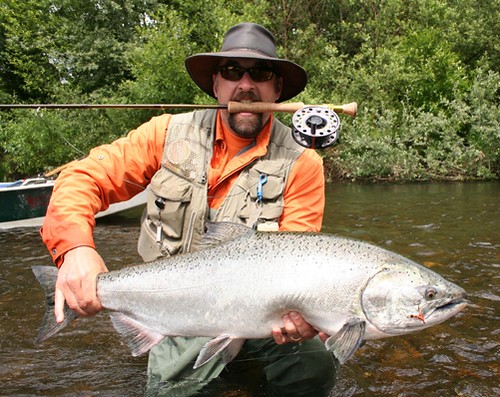
Caption: Scott Plemmons was rewarded for his persistence with this beast, just a couple of miles from reach of tide.

Portland was quite a hub for springer fishing. I had the lower Willamette, the Clackamas and Sandy, all just minutes away. In the upper Willamette Valley, opportunities for chasing spring chinook are still quite good. The Willamette and McKenzie both offer reasonable opportunities, and I look forward to checking them out. But my quest for ocean-fresh fish is pulling me toward the Umpqua. What a river! I have never seen a river with such grandeur, variety and character. A little surfing on the world-wide-web quickly revealed that the Umpqua is famous for jumbo-sized springers. A gear popped loose in my brain when I read about the FIFTY-POUNDERS! That’s more than my little pea brain can handle, and I can already imagine the conversations with my new boss about how I can’t take a sick day every time it rains.

The Umpqua has seen fairly modest runs of spring chinook for the past few years, but in big years it is capable of producing over 30,000 fish. The 2008 run is expected to be relatively small, and as a result, angling pressure will be lighter than average. Most anglers fish on anchor from a boat, or plunk close to the bank. Less boat traffic should mean that fish are more relaxed, and more likely to suspend off the bottom. It should also mean that they are more susceptible to a swung fly.
springer3
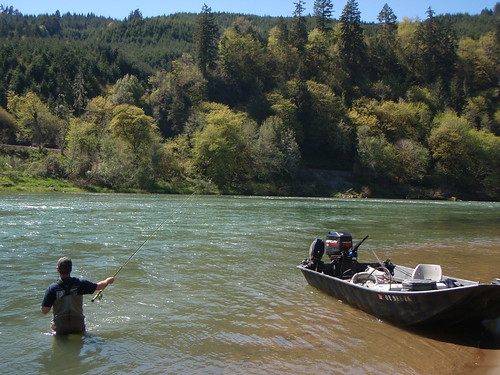
Caption: Mishler scoping out a sexy-grab-a-licious corner on the big Umpqua.

So, last weekend my friend and fellow chinook junkie Jeff Mishler decided to try our luck. We plied the river from Elkton to Scottsburg, looking for the best places to swing a fly to moving chinook. The hot, sunny weather didn’t seem to work in our favor, and the other anglers we spoke to had similarly poor luck. But we did find a few spots that had all the right qualities–inside bend, relatively shallow, slow swinging, sexy-grab-a-licious! We also found out that, despite her demure appearance, the Umpqua has some big ass rapids. The hairiest ones have big logs sticking up in the middle of them, as if to say “over here, little human, over here!”

After two full days on the water, I hooked two bright kings on the fly, one about four inches, and the other pushing six inches. They were strong for their size, though somewhat out-matched by my thirteen-foot Burkheimer spey rod. I thought about swallowing the small one whole, but as the thought came to me, the fish slipped away. They are SO smart! Or maybe I’m just that…duh, never mind.

Reality Check

Sadly, our best fish is also our most imperiled. In most watersheds in the lower forty-eight, spring chinook are barely holding on. They are the most susceptible to human-caused changes, both as juveniles and adults. One prominent biologist recently told me he is afraid that conditions in many coastal rivers no longer allow for the survival of wild spring chinook. Water is sucked out of these rivers during the dry summer months, at their headwaters for municipal supplies, and out of the flood plains by irrigators. Riparian zones have been severely altered, particularly in the flood plain, leading to hazardous warming of what water is left. And then there’s pollution. It’s not a pretty picture.

Historically the Columbia River hosted the largest mass of spring chinook anywhere on the planet. Among the Columbia’s tributaries, the Willamette was the jewel. But today only two Willamette tributaries have viable wild runs, and the numbers are paltry. In the early 1800s the Willamette springer run was estimated at between 200,000 and 400,000 fish. Today the wild runs on the Clackamas and McKenzie are fewer than 10,000. Fisheries agencies still manage all of the Willamette’s tribs for spring chinook, directed by the Endangered Species Act to “prevent their extinction.” But aside from the Clack and McKenzie, the remnant populations in Willamette tribs are supported purely by hatchery programs.

On Oregon’s northern coast, my favorite place to chase springers, most fish are of hatchery origin. Ironically, they are reared and released by the very hatcheries I have always railed against. I admit my own ridiculous hypocrisy spending so many hours, days, weeks on a fishery maintained by hatcheries I oppose. I’m an addict. My biologist friend consoles me by saying that our coastal rivers may no longer be capable of sustaining wild fish. So are hatchery springers better than no springers? I guess so. But it may be a bit early to write off wild spring chinook. Every year I see a few wild ones, and they are often the best and brightest fish of the season. Locals “complain” about catching “damn” natives. So our rivers are at least capable of sustaining a few fish, if not the great runs of the past.

Eugene’s local chapter of Trout Unlimited is directly engaged in efforts to restore habitat wild salmonids, including endangered spring chinook, in the upper Willamette basin. If you would like to be a part of the solution, come to a meeting and see what’s going on. Visit the chapter blog for more info.

The Wild Salmon Center is proving to be the strongest voice for wild salmonids in the Pacific Northwest. To learn more and to contribute, visit their website.

-Rob Russell

Posted in Oregon Salmon fly fishing | 3 Comments

Fourth Annual Mckenzie River Wooden Boat Festival to be Held Saturday, April 25.

Coinciding with the opening day of trout season, the fourth annual Mckenzie River Boat Show will be held this Saturday, April 25th at Eagle Rock Lodge in Vida, Oregon. The event is free and features historic wooden Mckenzie River drift boats as well as newer wooden boats by modern builders. This is a great opportunity to see side by side the past, present and future of these nimble, stable and beloved boats!

CRW_5425

This year, there is also going to be a wooden boat parade. If you have a wooden boat and want to participate contact Greg Hatten.

The parade is a modest revival of a tradition that began on the Mckenzie in 1938 when a handful of guides launched at Belknap and took out at Leaburg Lake, scouting the river just prior to the opening of trout season. From that first small scouting party the event grew and by 1962 the parade had over 300 participants.

The parade became huge. Dignitaries and tv personalities were invited and crowds of up to 30,000 people lined the river banks to watch the spectacle. The archival footage below is from a 1958 Universal Studio’s news reel, note the boat flipping shortly into the clip:

Unfortunately, the tradition became unsustainable. Alcohol, unsafe craft and the Mckenzie’s icy waters were a potentially lethal combination. The crowds left large amounts of litter and the last parade was held in 1970 after a participant was killed. Even today there are those who rue the idea of the parade making a comeback and to keep the number of participants down, the parade is limited to wooden boats.

The boat show is always well attended and is a lot of fun. Even if you are just floating by, pull your boat up on the lawn and celebrate our region’s biggest contribution to fly fishing!–KM

Posted in McKenzie River, Oregon Fly Fishing Clubs and Events, Uncategorized | 2 Comments

Suckers evolving or… They found out it’s cool to fly fish for them on the blogs

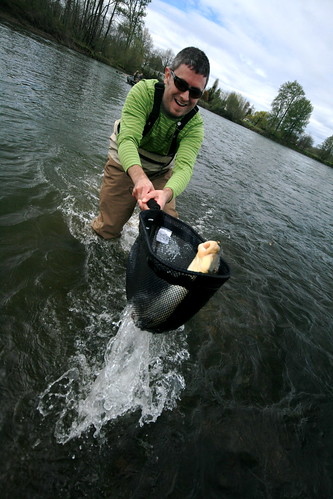
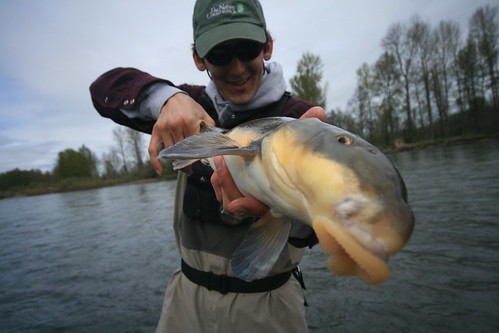
Chris thinks suckers are evolving to take flies (explaining why he’s caught more of them this year than any other in the past 25). I think the suckers are just reacting to all the good press they’re getting these days in the Wall Street Journal and the blogs.

Let’s hear it for the net man!

Lower McKenzie Trip

Lower McKenzie Trip

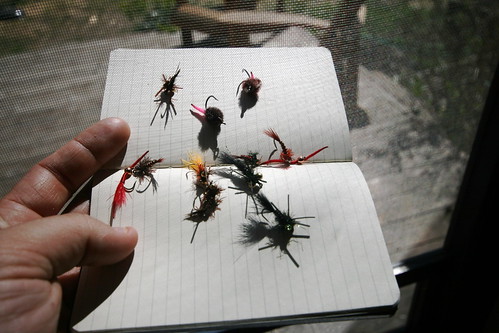
Lucky for me, I just got my end of the fly swap from Jean-Paul Lipton at The Roughfisher. Looks like I’ll be hitting our local carp waters this weekend instead of fishing the pellet-head opener. I’m sending Lipton some megaprinces and tungsten possie buggers, so we’ll see if some West Coast magic works on his home waters.

Roughfisher Flies

-MS

Posted in Fishing Porn | Leave a comment

Giant hatchery slob detained for questioning near Oakridge

trout

Posted in Fishing Porn | 7 Comments

Stillwater report: Triangle Lake

From our bud, Christian Howarth, a detailed report on Triangle Lake — a nearby panfish and bass destination.

-Clarity 5.5 ft.
-pH 6.5
-Temp (surface) 59.8*f
-Thermocline @ 19 ft @ 46*f
-Hydrilla to 18 feet down from the bank
-Bass suspended at 9-12 feet, not biting
-Yellow Perch beginning spawn, males full of sperm
-Salmonoid activity is good with kokanee hitting bass plugs on the subsurface along drop offs and weed lines. Massive schools (shoals) of fry to be seen in the flats and shallows

Kept two, eight inch yellow perch for dinner.

Posted in Fishing Reports | Leave a comment

Recommended: Saving Homewaters, The Story of Montana’s Streams and Rivers

A little while back, Jim Van Loan at the Steamboat Inn recommended I read Gordon Sullivan’s new book, Saving Homewaters: The Story of Montana’s Streams and Rivers — and it is a must-read for Oregon anglers looking for ideas for saving our own watersheds.

One of the great aspects of Montana’s fisheries management is the early emphasis of science based decisions for optimizing trout populations. For example, a 1954 study of the Gallatin showed that removal of streamside brush by property owners reduced trout weight by 40%. A study like that in Oregon could shape policy — keep cattle from stomping and shitting in our streams, keep riverside homeowners from mowing down riparian zones for better views from their BBQ decks.

The other aspect that Montana has right is assigning an economic recreational value on wild fisheries. Montana’s “Blue Ribbon” designation is much like the values placed on tarpon and sailfish in the tropics to convince governments to keep economically important gamefish from being harvested for fertilizer.

Montana fisheries managers also realized early on that put-and-take trout planting hurts native fish: Every river has a limited amount of energy it can produce in the form of food for aquatic life. Pollution, siltation, increased water temperature, and dewatering by irrigation or drought all play significant roles as trout species compete with one another for available food. In lay terms, the equation is: More competition requires more expenditure of physical energy, leading to less growth. Older larger trout, especially wild rainbows, browns and cutthroats, simply cannot compete as effectively with younger, more aggressive feeders like stocked trout.

The simple fact revealed by the multiyear research project was that increasing the trout population with planted fish meant increased competition. It was particularly clear that increasing the population during summer, the peak feeding season, achieved nothing more than to divide an already limited food source among too many mouths.

Does that sound like anywhere familiar?

Sullivan makes another point that we in Oregon need to take to heart: Historically, amateur warriors have carried the torch when it comes to protecting the environment, and generally their strongest enemy has not been the vampires of industry but the federal and state agencies we have entrusted to protect our rights.

-MS

Posted in Fly Fishing Books, Oregon Conservation News | 3 Comments

Lower McKenzie experiencing massive caddis hatch

Air temperatures are fore-casted to be near 80 degrees the next couple of days.  McKenzie  fish have focused more on the adult caddisflies and less on March Browns of late. Water levels have dropped considerably and anglers have been having a great time with rising fish. The surface feeding seems to be best after about 1pm. Best patterns to fish on the surface include: X-Caddis, Peacock Caddis, Outrigger Caddis, Black Elk Hair Caddis  and Caddis Sparkle Pupae.  Swinging wets has also been productive. Traditional patterns like Royal Coachman Wets, Soft Hackle Hares Ears, and Caddis Poopah in Tan. March Browns are still hatching but the hatch seems to be on the down slope. Golden Stones and Salmon flies are also emerging on these warm days. You may want to have a couple of large stonefly patterns in the box. Even just to use as an indicator fly, dropping a Possie Bugger or Prince Nymph off of the big dry. Try Half Down Golden Stone, Blooms Bearly Kicking Golden Stone, and Parachute Madam X as your high floating dry and drop the nymph below. Fishing should be great on our local streams, ideal weather and water conditions. Be on the look out for big Green McKenzie Caddis, we haven’t had any reports on the big greens yet but any day now.–CD


,

Posted in Middle Fork Willamette River fishing | 2 Comments

Buying Locally: Frank’s Custom Oars

Update: I made my first run with these oars this past weekend and was pleased with the balance and performance . . . and yes, I am able to lift them with one finger.

I finally had enough. The pain in my shoulder, neck and spine from my functional but poorly balanced oars became unbearable and I had to upgrade as soon as possible. I looked around and priced out drift boat oars from a few well known manufacturers and also placed a call to Frank of Frank’s Custom Oars located on Cloverdale Road just off Highway 58. I’ve heard owners of Frank’s Oars rave about them so I couldn’t believe my ears when he quoted me a price. “Two eighty for the set.” he said.

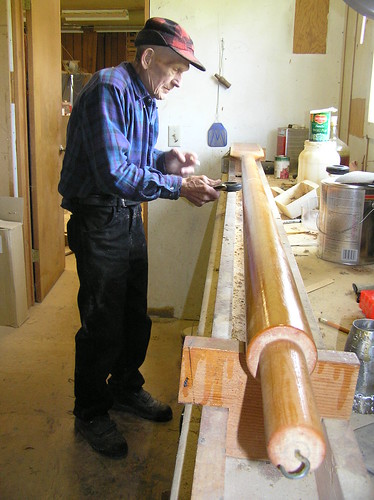
Frank was working on the greenhouse when I arrived. A throwback to the pioneers of drift boating and really to the earlier days of our region, Frank has done it all and on his own terms. If he needs something, he builds it, fells it, whatever it takes to get the job done. In his seventy seven years he has fished with the legends of the Mckenzie, trapped, guided, built and repaired boats, felled trees for his handcrafted oars and just about everything else you could think of. It seemed right to buy my oars from him . . . .

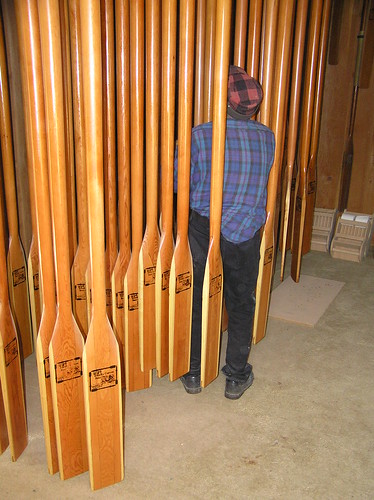
Custom Oar Inventory

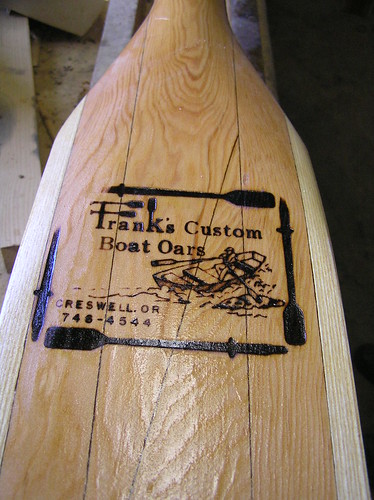
As for the oars, each shaft is generally lathed from a single air dried Douglas fir log. “Kiln drying makes the wood brittle”, he explained to me, “and I want ’em to last.” That makes two of us. The shafts are a little beefier than production oars but don’t feel heavy, they are nicely balanced. After lathing, for lack of a better term, Frank laminates the blades and then hand shapes them.  The blades have a wooden wedge to prevent splitting and the outer edge of the blade is made from Madrone or from Ashe that Frank fells from the grove behind his homestead. The blade and the shaft are single piece construction, “keeps em from rotting.”

I was sold and sold my backbreakers yesterday and headed back  to select my oars and custom place my oar stop.  We measured the distance between my oar locks and subtracted six inches, three on each oar to keep the oars at the proper distance from each other. Here Frank marks the oar for placement of the stopper:

Marking the Oars for Wrapping

Like I mentioned, Frank’s drift boat oars are a little chunkier than production models, some talcum powder and elbow grease and the stop was in place:

Sliding on the Oar Stop

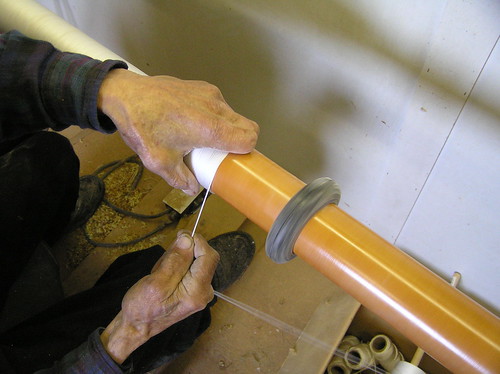
The next step was to wrap the oar. Frank definitely has the hands of a lifelong woodworker:

Wrapping the Oars

After wrapping, he coated the wraps with Urethane and we headed out into the sunshine as we waited to turn the oars a couple times, making sure they dried evenly.

It isn’t everyday I sit down with someone like Frank and we had a far ranging conversation. He “grew up on the Mohawk” he explained to me and the “only time [he] left the state was to fight the communists in Korea.” There used to be pretty good fishing on the Mohawk for cutthroat and some rainbows. As a boy, he says he saw steelhead up there too, though just a few. He fished the smaller creeks, Mcgowan and Parsons and in the fifties and early sixties guiding before Dexter and Lookout Point, Cougar and Blue River dams, the spring salmon were thick and the catching was easy . . or so it was remembered.

On Woody Hindman: “He was a nice guy, real nice guy. Not the world’s greatest carpenter but a hell of an engineer. Engineered one of the best boats in the United States.”

Frank’s an opinionated guy and much of our conversation was off the record. But, if you are in the market for good oars at a great price, you might consider asking him yourself. It beat the hell out of a department store or marina experience that’s for sure!–KM

Oar Blade

Posted in Fly Fishing Profiles | 28 Comments

Warm weather bring on the Caddis

The shallow edges of both the McKenzie and Willamette rivers are currently inandated with small cased caddis. These case makers and other caddis species are sporadically emerging throughout the spring but really pop when we get air temps to about 70 degrees in April and May. Look for Caddis patterns to be really effective before and after the 1-3pm March Brown hatch. Also look for evening fishing with caddis imitations to really pick up this weekend with the great weather.  Good caddis imitations include: Peacock Caddis, CDC  Elk hair Caddis CinnamonElk Hair Caddis Black, Outrigger Caddis and Stroups CDC Caddis.

Yesterday I floated from Deerhorn Bridge to Belinger. The March Brown hatch did come off between 2 and 3pm. There were tons of bugs and   fish were on them in certain areas.  Riffles dumping into slow pools seemed to best for us but the water was dropping all day yesterday and fish should push into faster water in the coming day. The swung fly had success all day. Using a Possie Bugger and a March Brown Bead Head Emerger in tandem was a deadly combo. Later in the afternoon when the sun finally won out over the grey, caddis flies swarmed the rivers edge. A solid day of warmth will have fish tight to the banks feeding on the adult caddis.-CD

Darryl Miller lower mckenzie

Craig Miller  Lower Mckenzie

Posted in McKenzie River | Leave a comment

11th Hour Winter Steelhead the Olympic Peninsula

Rob Russell Olympic Peninsula trip

Continuing with my “ten years behind the curve” theme (see Intruder Alert), I finally took a steelheading trip to the Olympic Peninsula last week. That’s after 12 years of procrastination and preoccupation with Oregon’s coastal rivers. I’ve never felt the need to leave Oregon for winter steelheading, so it took some pressure from my friend Monte to get me out of the state. He convinced me to set aside an entire week. He also convinced me to leave my jig rod at home and dedicate the week to swinging flies.

We headed north on a sunny Sunday, arriving at the Hoh Oxbow campground that afternoon. A quick stop at the Hoh River Resort allowed us to organize our shuttles for the week, get the latest intel, and enjoy some friendly banter with the new owners, the Ross family. They recently relocated from California’s Owens Valley to the Hoh rainforest. That’s a major shift in rainfall, but they maintained that they “love the rain.” They reported that the lower Hoh was producing for the gear guys, but the upper river was slow. Based on that, and the fact that I like to be as close to saltwater as possible, we agreed to spend our first day floating from our camp at Oxbow down to a gravel bar known as G&L.

We awoke to a cold clear sky, scarfed up a meager breakfast and launched the boat. The lower river was big and burly, rising slowly throughout the day as the hot sun melted mountain snow. We were impressed by some choice fly water and the occasional boulder field, but spent a lot of time rowing through water that was better suited for gear. As we pulled into G&L that afternoon, a slough of gear boats were loading up, cracking beers and stowing their bags of giant pink worms and assorted baits. A lone plunker situated just above the take out yanked a small steelhead up on the gravel, unhooked it, and booted it back in the river. All in all, it was a lovely and depressing scene for a couple of fly guys. We returned to camp, sipped some fine beers and grilled a couple of steaks for dinner.

Rob Russell Olympic Peninsula trip

Day two was another bluebird day. This time we hit the upper Hoh, taking out at the gravel bar below Minnie Peterson campground. Words cannot adequately describe the beauty of the upper river. Just thinking about it, I’m still spellbound. For me it was love at first sight. But to her I was just another goofy chump vying for affection. Monte and I swung every gorgeous, classic run we came to, but for whatever reason, we found no players. As the day came to a close a strong wind pushed thin cirrus clouds over the sky. The weather was changing.

Day three brought morning clouds. We headed south for the Queets for a change of pace. It has always been my favorite Olympic river, mainly because it is the wildest. The Park Service manages it as such, refusing to build a bridge from the campground at road’s end to the trailhead. Hikers have to ford the river, and I can tell you from experience it is no small feat. Anyway, this winter the river blew out the road above Hartzell Creek, so we had a choice of running the short float from Hartzell to the Clearwater, or coughing up $50 for a shuttle and traveling an extra hour by car to run the upper section. We took the easy and less expensive route and enjoyed another fishless day. Again we fished some classic runs, but were aced out of three of the very best spots by guides with clients. The river ran slate gray, matching the sky above us. As we pulled out at the Clearwater Bridge, we marveled at the high-tech monofilament gill nets scattered through the river below. For this Oregon boy, that was a disturbing sight. We drove up to Forks for a late lunch and scoped out a few spots on the Solduc and Bogachiel. Both were running crystal clear, and gear boats were scattered throughout.

Back at camp that night we hashed over what we had learned. The lower Hoh had fish, but it also had lots of gear boats. The Queets was falling off our radar, and the Solduc and Bogie were just too damn clear to get me excited. All signs pointed to the upper Hoh, and I couldn’t think of anywhere I would rather be skunked. Fish or no fish, we would be in heaven up there. I pushed to launch somewhere in the park, even though there were no ramps.

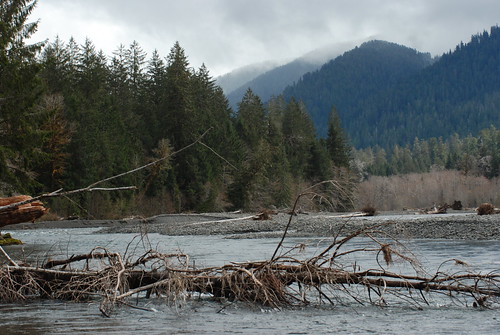
Day four started with a cool drizzle. Everything felt right. We launched off the road, just inside the park. The river ran clear, contrary to claims that the Hoh’s color comes from her glaciers. The milky color of the Hoh in summer certainly is influenced by glaciers, but we soon learned that the winter color comes from three main deposits of clay that lie below the confluence of the South Fork. Just below our launch we spied a couple of fly anglers targeting a pair of spawning fish. Thankfully we didn’t have to say a word. Once they saw us coming their guilt forced them elsewhere.

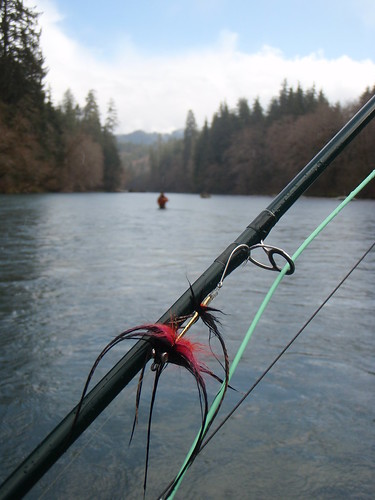
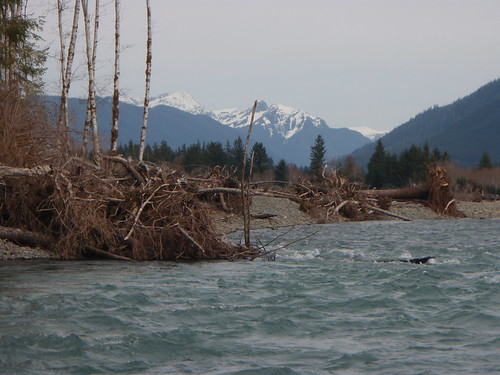
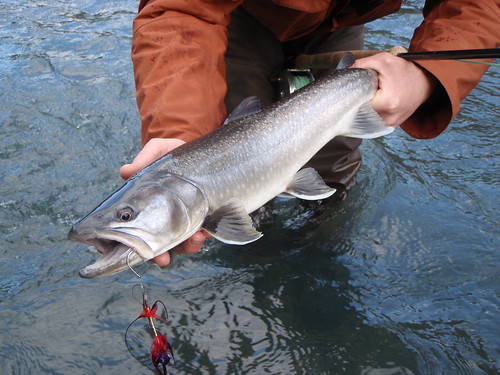
We had some close calls in the uppermost reach, guessing which channel would allow us passage. Twice it looked like we might have been cooked by massive log jams, but both times there were escape routes. Unscathed, we approached the classic runs below Spruce Creek, passing through the massive boulder field that serves as the gateway to Shangri-la. This time we knew what tips to fish, where to walk, where to spend our time. We anchored above my favorite piece of water. It was Monte’s turn for first water. He unhooked his fly, flopped it in the water and prepared to cast. As he lifted the line to cast, a swirl surrounded his fly but nothing connected. He cast again and slowly drew the fly through the same spot. “There he is!” he yelled, and the rod finally bent over. But within seconds we both knew this was not the fish we had traveled to the Peninsula to find. A silvery char came quickly to hand, barely tethered to Monte’s giant Intruder.

Rob Russell Olympic Peninsula trip

He was a great consolation prize, and the only fish of the day. Monte did have another grab that afternoon and proceeded to break his leader on the hook set. Poor bastard. I saw the grab, but I was so desensitized by the end of day four, I wasn’t sure if it was a rock or a fish. Monte was certain it was a fish and spent the rest of the evening beating himself up for the rookie move. We agreed to spend our final day on the upper Hoh, focusing on the very best water.

Day five was another perfect gray day. No wind, a light drizzle with breaks. We fished hard. We tried new angles on old pools. Desperation got the better of me, and I converted a wine cork into a strike indicator trying my hand at dead drifting flies through the obvious slots. By lunchtime we had fished all but a couple of runs, and the writing was on the wall. I no longer cared whether I saw a fish. I was already writing the headlines in my head: “Olympic Smackdown” or maybe “What’s that Smell? It’s Olympic Steelheading!”

Monte wolfed down his sandwich and jumped in the river. I putzed and sulked around like a spoiled kid who just got told he wasn’t getting any Christmas presents. A few minutes into it, Monte let out a loud “Woohoo!” Jeez, man. What? Another rock? I looked up to see his rod bent, but only for a second. Whatever it was came free. I really thought he was losing it. But he took a deep breath, kept his faith and proceeded through the run. I stepped in behind him and started working out line. The water was so perfect, that despite my lack of faith, I got caught up in the sweetness of the water and started fishing with intention. And when I reached the exact spot where Monte had let out his wail, it was fish on. For real!

Line tore into the river, the fish rolled on the surface, and the world came alive. Monte grabbed the camera from the boat and I worked the fish to shore. It was a perfect buck, colored, but still fresh, about ten pounds. Monte turned on the camera, raised the lens, and the fish came free, shooting back into the sapphire water. Classic! But nothing mattered anymore. The trip was a success. I was a success. Life was good.

We smiled, laughed, breathed. Monte went through the run again. Halfway through he had another grab, but no stick. Again I followed through and stuck a nice little seven pound buck. This one stayed on for the full photo shoot. Then another, and another. We hooked seven fish in a couple of hours, all in the same gorgeous run, but Monte still hadn’t brought one to hand. I was getting pretty cocky.

Rob Russell Olympic Peninsula trip

Our final piece of water for the day, for the trip, was a beauty. It was the same place where Monte had crackered his “fish” the day before, and he was dead set on hooking up. But he worked through it without a grab. I started in behind him, letting my fly swing right at his boots, praying for one more humiliating grab. That’s just the kind of guy I am. The evening was upon us, the sky was getting dark, and I had the sense that the trip was over.

Monte’s last cast of the trip, fired from an impossible location under an overhanging tree, met with a monster grab. “There he is!” And this time there was no doubt. The rod pulsed under the weight of a heavy fish. I ran for the camera as Monte reefed that fish to shore. He didn’t hold back. He literally wrestled the fish to shore, bending the nine-weight Vision rod to extremes. I clicked off shots as fast as I could, and managed to get a couple of decent pics before he released the fish, a perfect, hump-backed buck of about fourteen pounds. By far the best fish of the trip, and a fitting end to a perfect week.

That night we went into Forks for a burger and some beers. The next morning the rain fell in sheets, and as we drove south, the Hoh rose several feet. The fish gods do have mercy, but they dish it out sparingly…

Rob Russell Olympic Peninsula trip

-Rob Russell

Posted in Fishing Porn, Fishing Reports, Fly Fishing Travel | 5 Comments

Midwest Great Lakes Steelhead trip

This past week I have been fortunate enough to catch the tail end of the Great Lakes Steelhead run. This is an interesting fishery and the fish were in low clear “frog water” milling around and very cautious (for good reason when you see the amount of treble hooks in the tree limbs). This is also a semi-urban setting at times by comparison (please note the concrete bridge), but out of the way spots still exist amongst the crowds. The Sage 7wt. 11ft Z-Axis switch rod was a huge hit and helped to deliver large nymphs with no indicators or spilt shot on a floating line to relatively spooky fish. Like I said nothing about this would draw comparison to fishing on the West Coast, but with nice fish in unexpected places what is not to love?

DSCN1189_edited

DSCN1185

-NS

Posted in Fishing Porn, Fly Fishing Travel | 4 Comments

Are suckers evolving as a species?

You know you’ve been staring at the Thingamabobber to long when you start pondering such things as sucker evolution but hey it’s been a long Winter. Wait it’s April 14th and I just fished all day in sideways snow on the Middle Fork. All things considered it wasn’t really a bad day. We caught fish on March Browns, Possie Buggers and Mega Princes. It was colder than hell and I had to turn the boat around (backs to the sleet) to gobble lunch down in 2 minutes before it “sogged” in my hand.

Craig Miller Middle fork rainbow

Back to the Suckers, I hate to admit this but 5 have been landed in my boat this spring. Believe it or not they have been hooked in the mouth, if that is what you’d call it. Scary!

Tj's sucker

Any insights on why I have caught more suckers this spring than the previous 25 are welcomed. I know that “rough” fishing and “Brownlining” are the new thing but come on.

Other fishing reports around the state include

Bright Spring Steelhead have been caught at Dexter Dam and Leaburg Dam. Amazing since there are only about 600 fish over Willamette falls but believable because in high water they make a serious be line for home.

I heard a rumor that the Crooked River was fishing well. Great news as the past few years have been dismal.

Lower Deschutes near Maupin continues to fish well. Blue Winged Olive hatches have been good. Fishing tiny Blue Wings in back eddies out of the wind has been the best bet. March Browns have been spotted and will be emerging with more regularity as the days warm.

Great weather is on the way for the weekend. State wide water conditions will be very good. –CD

Posted in Fishing Reports | 5 Comments

Zowie Dub: Custom dubbing blends by Jackson and Jay Nicholas

An enticing selection of custom dubbing color blends were showcased on Saturday, April 4th at the Caddis Fly by Jackson Nicholas with a little help from his parents, Jay and Lisa.

Zowie Dub is a series of a dubbing blends created by the Nicholas family with support from Hareline Dubbin. Zowie Dub’s roots go back to when Jackson, then age 6, stuffed Jay’s coffee grinder with multi-colored chunks of Anton yarn, blending piles of weird-colored fluff, covering the kitchen counter and pretty much everything within a 30 foot radius of ground zero. Fluff was fun to make, but it was better suited to padding bird nests than to tying flies.

Eventually, dad offered access to his inventory of commercially packaged dubbing. The creative imagination of a 7 year old combined with the experience of the seasoned tyer elevated the product from bird-nest material to a real advantage at the fly vise.

The first public unveiling of Zowie Dub occurred at the FFF Expo at Albany in 2007. Starting with a half-dozen colors of dad’s dubbing in fresh-from-the-rack-packets, Jackson began creating wild color combinations and handing out free samples to curious onlookers. Jay sat at the next table, tying Clouser Minnows. More people were attracted to Jackson’s table than dad’s.

The artistry and utility of Jackson’s custom blends has grown over the past 3 years, to the point where Jackson has a dedicated following of EXPO tyers who have been back three-years-running, telling fish stories, asking for more of last year’s blend, and requesting new color combinations.

Straight-off-the-peg dubbings are perfectly functional, and a great selection is available. But some fly tyers want more. More what? More variety. Different color shades. Dubbing that incorporates complex color highlights. More sparkle. Greater allure.

We want to say thanks to Hareline Dubbin and Marcos Vargara. First, Hareline provided the raw materials that we experimented with the last two years. One day, I was talking with Marcos about people’s reactions to the blends Jackson was creating, how great the color/texture combinations were, and, for lack of a better word, I just paused and said: Zowie! Days later, Marcos suggested that we name a dozen of our most enticing blends and name it Zowie Dub. Wow, Marcos, what a great idea. So here we go. Jackson’s Zowie Dub – The Lucky Thirteen blends. Note: We hope this Key Ingredients list will help jump-start your creative grinding. Enjoy!

JN & JN

Zowie Dub ingredient list:

Regal Roe No. 1 Fresh Roe
A translucent orange cast; creates the impression of fresh eggs.
• Hot Orange Trilobal
• Fl. Cerise Trilobal
• Red Trilobal
• Fl. Pink Trilobal
• Red-cast Pearl Ice Dub
• Chartreuse Trilobal

Regal Roe No. 2 Dead Egg
Choose creamy pink blend when the water is cold, clear, or when everyone else is fishing bright colors.
• Hot Pink Trilobal
• Cream Trilobal
• Hot Pink Hareline
• Fl. Yellow Hareline
• UV Minnow Bally Ice Dub

Ultimate Egg-Head
A dazzling palate of fluorescents; a perfect complement to any egg-sucking Leech. By the way, this blend makes a great Sea-run cutthroat fly too.
• Fl. Pink Trilobal
• Cream Trilobal
• Fl Shell Pink Trilobal
• Fl Red Hareline
• Fl. Yellow Hareline
• Red-cast Pearl Ice Dub

King Salmon Green
Fishing big Kings or Chum salmon? Your big Intruders deserve to be dressed with this is the mother of all greens.
• Chartreuse Trilobal
• Kelly Green Trilobal
• Chartreuse Ice Dub
• Kingfisher Blue Trilobal
• Fl. Orange Hareline
• Red-cast Pearl Ice Dub

Lisa’s Voluptuous Violet
Summer steelhead love this shimmery violet blend. Swim it, skate it, the fish will eat it. Believe in it. You will be rewarded.
• Purple Trilobal
• Cream Trilobal
• Kingfisher Blue Trilobal
• Fl. Yellow Hareline
• UV Minnow Belly
• Steelie Blue Ice Dub

Hypnotic Blue
Blue is the new purple. Steelhead, kings, silvers, half pounders, and Atlantic salmon all go for blue flies. This custom blend isn’t just blue, it’s the living, breathing blue these fish can’t resist.
• Blue Trilobal
• Black Trilobal
• Red Trilobal
• Purple Trilobal
• UV Minnow Belly Ice Dub
• Steelie-Blue Ice Dub

Ultimate Steelhead
If you must choose one blend for tying dark steelhead, salmon, and trout flies, this is it. Not quite black, purple, blue, or claret – or is it? Tie it, fish it, hang on.
• Black Trilobal
• Purple Trilobal
• Kingfisher Blue Trilobal
• Fl. Flame Trilobal
• Stonefly Brown Trilobal
• Steele-blue Ice Dub

New Millennium Skunk
This blend elevates black to a new level of excitement for fly tyers. Your traditional salmon and steelhead flies will look better and fish more effectively than ever before. A hint of fluorescence and a sparkle of silver add to the magic.
• Black Trilobal
• Purple Trilobal
• Kingfisher Blue Trilobal
• Silver Ice Dub
• UV Minnow belly Ice Dub

Perilously Purple
Not your father’s Purple, this enticing blend is a dark purplish that shimmers like it is alive. Egads!
• Purple Trilobal
• Black Trilobal
• Gold Ice Dub
• Red-cast Pearl Ice Dub

Gathering Storm
Can’t decide whether to stick with tried-and-true black or experiment with a claret fly at dusk? Here ya go. This subtle blend isn’t quite black or claret, and looky here, is that a hint of copper too?
• Black Trilobal
• Claret Trilobal
• Stonefly Brown Trilobal
• Copper Ice Dub
• UV Minnow Belly Ice Dub

Posted in Fly Tying | Leave a comment

More reader photos: Big bows and N. Umpqua Steel

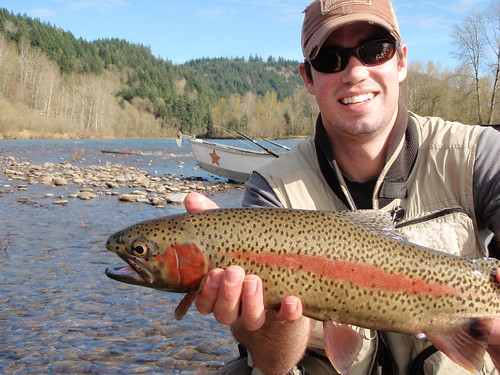
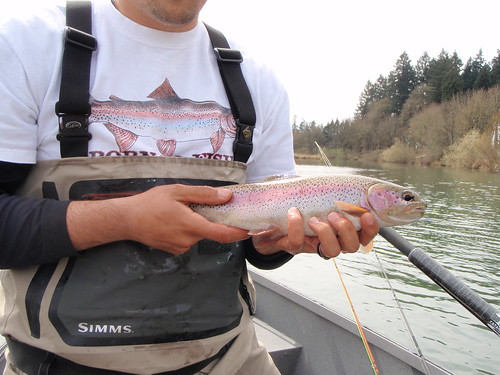
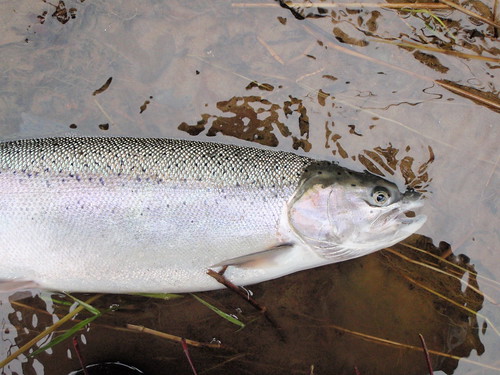
Oregon Fly Fishing Blog reader Evan had a has had a great April so far, with some nice Lower McKenzie Trout and a North Umpqua Steelhead.

Reader Photos

Reader Photos

Reader Photos

Send us your pics and reports.

Posted in Fishing Porn | Leave a comment

Red Gold in Portland this week

Red Gold in Portland

RED GOLD, a 1 hour documentary film showing at the Baghdad Theater on THURSDAY, APRIL 16th. Doors open at 5:30, film starts at 6:30. Admission is $3. Hosted by guest speakers Lisa Sedlar, President of New Seasons Markets, Guido Rahr, president of Wild Salmon Center and MacGregor Walker commercial fishermen and president of West Coast Wild Salmon , a Q&A will follow the film. FREE BRISTOL BAY SALMON will be served!

Posted in Oregon Fly Fishing Clubs and Events | 1 Comment