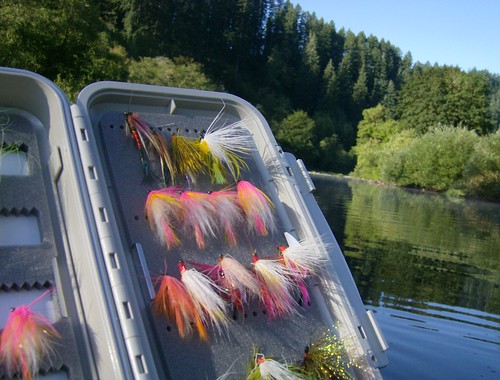
North Umpqua Fall Fly Tying Fesitval
Glide Community Center-Glide, OR
Sept. 19th 2009 9am-4:30pm
There will be 25-30 tyers, misc. displays, Frank Moore and Dean Finnerty are featured guest speakers, John Matthews will be painting flies on vehicles. Presented by the Umpqua Valley Fly Fishers Of Roseburg.
This weekend, the Deschutes Chapter of Trout Unlimited with Orvis Store in Bend are pleased to announce the First Ever North American Fly Casting Tournament at the Bend Orvis store and Casting Course. You can follow along on Facebook as well.
This will be 3 days worth of events and programs including Amateur and Team Events on Friday, a Professional Men’s Tournament on Saturday, and a Professional Women’s Tournament on Sunday.
Overview
The 2009 Orvis National Casting Competition at the Old Mill in Bend, Oregon will be held on the first-of-its-kind 18-hole fly casting course completed last year and located adjacent to the Orvis Bend retail store. The course was designed to test and improve fly casting skills in a variety of settings much like those you’d find in actual fishing conditions. The 2009 National Casting Competition will use selected holes on the course but each competition hole will be modified from its current format challenge for this competition.
Dates
The 2009 National Casting Competition dates are September 18-20, 2009.
• September 18 Men’s and Women’s Amateur Casting Division
• September 19 Men’s Advanced Casting Division
• September 20 Women’s Advanced Ladies Casting Division
Entrance Fee – Maximum Number of Competitors
A $25 entrance fee is required for all entrants. Entrants are also required to fill out the required entry form. Entry forms can be sent via email to mylert@orvis.com or included with your check and sent to this address.
76 competitors are allowed per division and are entered on a first-come, first-served basis until all slots are filled.
Prizes
Amateur Fly Casting Event
1st Place Prize – 12’ Pearl Native Ultimate 12’ Kayak ($969 value)
Advanced Fly Casting Event
1st Place Prize – $3000 Cash Prize
2nd Place Prize – $1000 Cash Prize
3rd Place Prize – 12’ Gold Native Ultimate Kayak ($969 value)
4th Place Prize – $500 Cash Prize
5th Place Prize – $250 Cash Prize
6th Place Prize – $100 Cash Prize
Ladies Fly Casting Event
1st Place Prize – $4,200 trip for one to the Zancudo Lodge – an Orvis Endorsed Lodge in Costa Rica.
Prize includes 3 days and 3 nights stay at the lodge and includes 3 days of inshore or offshore fishing (your choice), all ground transfers, food and alcoholic beverages at the lodge, and hotel and flight from San Jose, CA to the lodge.
2nd Place Prize – $500 Cash Prize
Cooking and Casting for Conservation
Orvis donates 5% of pre-tax profits annually toward conservation efforts throughout the U.S. As part of the Orvis conservations mission, part of the proceeds from the 2009 National Casting Competition and other donations from Orvis will go to the local Bend Trout Unlimited Chapter to aid in local conservation projects. In addition, the evening of September 18 the Bend Trout Unlimited Chapter will be hosting a dinner and auction to help kick off the casting competition event and raise additional funds for local conservation work.
For more information on the casting course, visit www.orvis.com/bend for a full course description.
If you have more questions regarding the event please contact Gabe Parr at deschutestu@gmail.com.
Next week begins the first day of Fall 09. The fall is one of the best times of the year for Oregon fly anglers. The Deschutes is hot with steelhead, the Cascade lakes are producing as water and air temps cool. October Caddis are beginning to fly around streams. The Mckenzie native Redsides begin to increase in numbers as the water temps cool and the river level begins to rise slightly.
Meanwhile, on the coastal streams, Alsea, Siletz, and Siuslaw; the sea run cuts are entering the tidewater areas. Sea runs fall prey to the Borden Special and Spruce patterns. The sea run angler awaits the passage of summer days for those foggy and wet early days of fall. “Tis the Fall Season”. Get out there!
LV
Two weeks remain to get your October Caddis pattern entered. Hareline Dubbin is sponsoring the contest and we have had some excellent bugs mailed in and dropped off.
The October Caddis emergence is occurring on our local waters. Currently there seem to be more bugs on the upper McKenzie than anywhere else. As the weather cools and September moves on, the October Caddis adults will be present in nearly all of Oregon’s rivers. Check out some of the entries so far.–CD
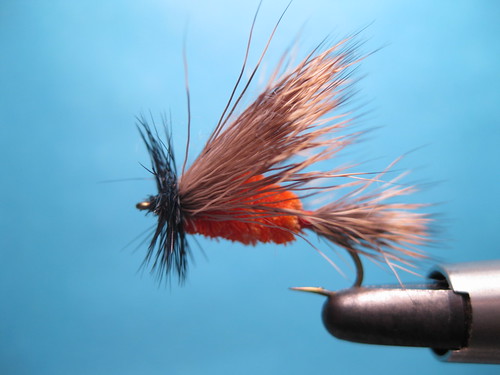
October Caribou Caddis
Hook: TMC 2312 # 10
Thread: Orange 6/0
Body: STS Trilobal Golden Stone mixed with Caribou
Under wing: CDC Super Select Mahogany Brown
Wing: Brown Swiss Straw Clipped to shape
Head: Body Mix with a few less Caribou fibers
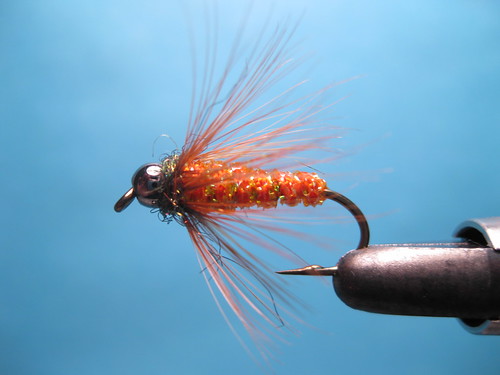
V.O. Caddis (Voltaic October Caddis)
Hook: Alec Jackson # 7
Thread: Ultra GSP
Under body: Flymaster A (for building up body shape), white
Under rib: Ultra Holographic Mylar, Copper
Rib: Medium Ultra Vinyl Rib Orange
Thorax: Ice Dubbing Peacock Wing Pads: Medallion Sheeting Gray
Legs: (4) Golden Pheasant Tail fibers over CDC fibers, Black
Head: Spun CDC black
We’ve all been there before. The hope that a fresh face will bring needed changes and make our lives better. So it was in the Columbia-Snake basin. Hopes ran high as the Obama administration declared that it would place science before politics.
Not so. Instead, they decided to go forward with the Bush era plan for Snake River recovery, really a laughable exercise in cynicism rather than anything that has even a remote chance of recovering four endangered Snake River stocks. Perhaps most disapointing is the intentional repackaging of the most odious part of the Bush plan, the “trending toward recovery” standard while retaining the substantive content which could mean that if so much as one additional fish makes it to its natal waters the plan adequate.
We could have seen the administration move towards a solution that protects vested interests in the Snake basin, develops a clean energy economy, delivers and protects jobs and recovers endangered salmon and steelhead.
Instead we get this. It is a sad day for those of us who hoped for better-and more importantly, for the endangered fish of the Columbia basin.–KM
This is a breaking story-the Obama administration announced its intentions today. Read more here.
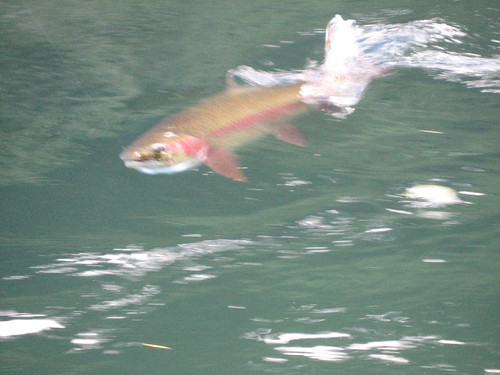
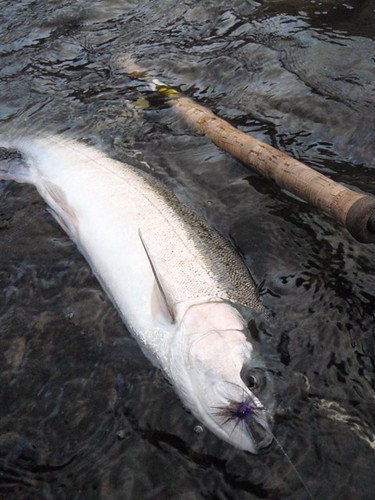
Steelhead are tough to catch on a swung fly. We who live for this soulful pursuit are fighting big odds. So why would we want to make it even harder on ourselves by skating dry flies? Because seeing a big, sea-run rainbow chase down a dry fly is freakin’ cool, that’s why!
So when I had a chance to guide my friend Les Martin on his third consecutive day of fishing the lower Deschutes with Larimer Outfitters, I asked him if he had any interest in trying a dry.
“Well….” he said, sounding reluctant, “I’ve heard about that. It sounds neat, but I like to hook up!” Then he added, with some trepidation,”Whatever you think, Jeff. You’re my guide.” I told him there was only one way to get ‘em on a dry and that is to try.
“Lets try it then!” he said, finally sounding enthusiastic. I tied on a Claret Shade Chaser, one of my favorite skaters, and we walked down to a sweet little break where I’ve gotten fish up on dries many times before. The spot is a shallow wade, only ankle deep on a large flat basalt ledge, and a very short cast. I instructed him carefully how to present the fly. Often times the fish are so close, and they take the fly so quickly, it startles people and they pull the fly completely out of the water.
“Don’t set the hook until you feel the weight of the fish,” I instructed.
We moved to just the right spot and Les pulled few feet of line from his reel. He flipped the fly into the choppy seam. I told him it was very important to guide the fly all the way over onto the shallow bedrock ledge before re-casting, as the fish sometimes will eat the fly just as it comes up over the ledge. Almost instantly there was a chrome explosion right in front of us! Both of our hearts stopped, waiting for the pull, but the fly was unscathed by the burst, still skating across the surface. Then, just as the fly came up onto the ledge, the fish shot out of the water and engulfed the fly with half of its chrome body high-and-dry on the rock! With the fly in its mouth, it turned and wriggled back into the water, taking off with the fly. I couldn’t contain my excitement and let out uncontrollable screams. “Oh my…SET THE HOOK!!!” To say that Les was caught off guard would be a gross understatement. He arched the rod back so that the tip went straight up into the air. But tension was lost as the fish did a 180 and came screaming straight back towards us. In a flash, it thrashed one more time on the surface and threw the hook.
I tried to regain my breath but just broke into laughter as what we had just witnessed set in. A kamikaze steelhead! I patted Les on the back and brushed off the fact that the fish was gone.
“Throw it back out there!” I urged. Les flipped the fly out and worked it through the narrow seam again. We both calmed down as the fly made several swings without reaction. Then four steps down from our starting point, “BOOM!” Another explosion on the fly, but no connection. Then again, “BOOM!” in the same spot. Then another cast, followed by another explosion. Again and again. I was laughing hysterically! The fish came to the surface five times, but kept missing the fly. Maybe it was just trying to throw the fly from the water with its tail, or maybe it was just near-sighted. But after five attempts, the fish quit coming up.
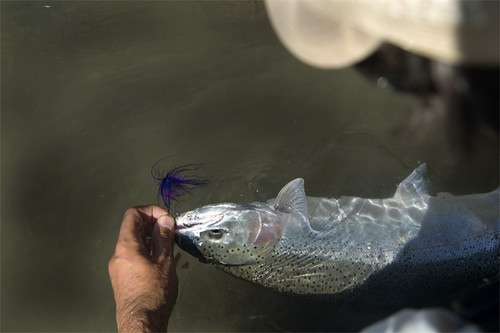
We switched flies, tying on a smaller purple Silvey Steelhead Caddis. The first cast in the same spot brought another violent slash from the steelhead. And this time the fish got the fly and Les hooked up! We both screamed for joy as the line came tight. The rod bent hard and the fish took off into the rapids.
Later, back at the boat, Les and I recalled the action over coffee. He admitted that his expectations had been low.”But seeing is believing!” he said with a big smile.
We caught plenty of fish that day, switching to wet flies as the sun beat down on the canyon. All the fish were great, but none could top our dry-fly kamikaze steelhead.
This Monday through Thursday only, bring in our plastic fly cups and get 10% off any fly purchase of any size. Online orders for ship or in store pick up will receive the 10% off automatically.
We also have great deals online on remaining summer clothing, bags, rods, reels and many other items, including a $15 table that has Mountain Khaki Cords (normally $75) on it.
Don’t get me wrong, I’m eager for October Caddis hatches, coastal salmon in our rivers, and football on TV. But it’s great to get a last blast of summer.
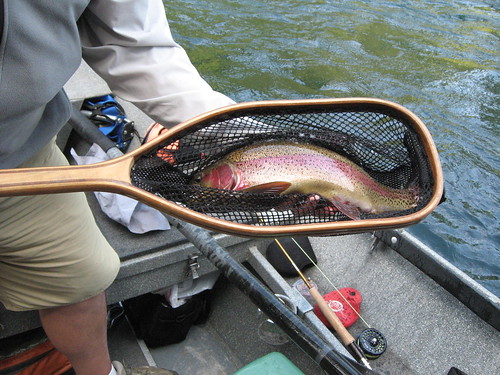
Nate and I hiked a few miles of an Upper Willamette Tributary yesterday, fishing plunge pools and riffles for wild redsides. The fish were small but plentiful, with a few in the 12-inch range.
I caught the majority of my fish on a size 10 yellow stimulator, in an attempt to match the current “termite hatch” going off in the area now. Termites are trout candy, according to a Westfly article by Hafele and Hughes:
Once a year each colony produces thousands of winged reproductive adults that mate and search for new nesting sites. This is the most important time to fly fishers, since these swarms of flying ants and termites often end up in the surface of lakes or streams.
Trout seem to have a high preference for these hapless creatures, and the fishing can be fast during an ant or termite “fall.” The exact time swarms take to the air depends on local species and conditions. Several falls of ants or termites may occur in an area during a season, and you should be on the lookout for them anytime from May through September.
I didn’t see any termites on the wing yesterday, but have seen a lot around town.
The fishing on these small streams will get much better over the next several weeks, but the school-hating kid in me is still sad to see summer go. Not many weekends left when you’ll be able to vent finicky trout frustrations by cannon-balling the pool.
Bob Hunter, founding board member of WaterWatch and the Oregon Water Trust, recently came to Eugene to speak with our local Trout Unlimited Chapter about removal of Rogue River Dams.
In an effort spanning more than 20 years, Hunter and WaterWatch have fought entrenched state and local bureaucracies to save one of the largest salmon and steelhead runs in our state. And now we’re on the cusp of reaping the rewards of WaterWatch’s hard work.
Savage Rapids Dam is the first man made obstacle on the Rogue River between the Ocean and Grants Pass. The dam is 39-foot high, 500-foot long and spans the mainstem of the Rogue River at river mile 107.
According to Hunter, there are over 500 miles of salmon and steelhead spawning habitat upstream of Savage Rapids Dam, including 50 miles on the mainstem of the Rogue River. All spring chinook salmon spawn upstream of the dam, and the dam impedes passage of significant portions of the four other runs of salmon and steelhead in the Rogue
The dam has long been considered the biggest fish killer on the Rogue. The dam harms and delays returning adult fish, but the pump turbine system has never been properly screened and it kills a lot of fry heading downstream. The 3.5 miles of reservoir flood prime fall chinook spawning habitat.
From WaterWatch:
The dam is strictly an irrigation diversion dam and is being replaced by pumps. It does not provide any flood control, storage, navigation, or hydropower function. The structure has been a considerable problem for salmon because the facility’s fish ladders and screens do not meet current legal standards. There is also increased predation of juvenile salmon in the seasonal reservoir pool created by the dam and after juveniles pass through the dam’s bypass systems. Additionally, the reservoir pool covers over 3.5 miles of fall chinook salmon spawning habitat. This habitat could be reclaimed when the dam is removed.
According to a 1995 Bureau of Reclamation Planning Report and Environmental Statement (PRES), removal of the dam would increase fish escapement at the site by 22%. This translates into approximately 114,000 more salmon and steelhead each year (87,900 that would be available for sport and commercial harvest and 26,700 that would escape to spawn) valued at approximately $5,000,000 annually. Reclamation’s PRES also found removing the dam and replacing it with pumps to be more cost effective than trying to fix the ladders and screens.
History: The dam was built by the Grants Pass Irrigation District in the 1920s. By 1988, the GPID had 100 miles of open leaky canals and was asking for more water. The district attempted to secure additional water rights to the Rogue in 1988, and that’s when WaterWatch, The Rogue Fly Fishers raised the issue of fish passage.
The U.S. Bureau of Reclamation had determined that dam removal and irrigation pump replacements would be cheaper than fixing the dam, and the GPID was onboard. But state politics got in the way and the GPID reneged on the dam removal deal.
Through the Endangered Species Act listing of Oregon Coho, WaterWatch, EarthJustice and Trout Unlimited locked down an agreement through litigation, and finally got to work on how to remove the dam. OWEB stepped up and pledged $3 million – the most they’ve ever spent toward dam removal, and that made the project real. In October 2006, the first dam removal equipment arrived on site.
This is going to be the last year of a fish trying to pass Savage Rapids Dam. You can see the gallery of Savage Rapids dam removal images. The removal project is expected to be completed by late 2009.
While Savage Rapids is the biggest fish killer, WaterWatch has coordinated with other groups to facilitate the removal of Gold Hill Dam, Gold Ray Dam and Elk Creek Dam.
Gold Hill Dam, which was identified as the 2nd greatest hindrance to fish passage in the Rogue Basin, after Savage Rapids Dam, was removed in Summer 2008.
The dam, which was built in the early 1900’s, once served as a diversion to a power generation facility, and was the source of the City’s municipal drinking water. The power facility is no longer in use, and the City removes water through a new water supply intake built in 2006.
Gold Ray Dam is a 38-foot high, 360-foot long defunct hydropower dam located in Jackson County, Oregon on the mainstem of the Rogue River at river mile 125.7. Its removal represents one of the largest dam removals ever undertaken in the United States.
Upon removal in late 2010, Gold Ray Dam will represent the fourth significant dam removed or notched in the Rogue Basin in three years, and mark the end of the largest number of significant dam removals ever to occur within a single river basin in so short a time span.
With Gold Ray Dam removed, there will be 157 unhindered river miles from Lost Creek to the ocean.
According to WaterWatch, Elk Creek Dam has been sitting partially constructed and serving no useful purpose for decades. The dam blocked Elk Creek and its inadequate fish passage facilities caused major problems for salmon and steelhead. Historically, an estimated 30% of the Rogue Basin’s coho salmon spawned in Elk Creek.
They blew a notch in the dam with dynamite in July 2008.
Despite petty political grandstanding and bureaucratic stonewalling, after twenty years we’re laying TNT and backhoes into these dams and that’s got to be one of the most satisfying outcomes I can imagine.
Fall is definitely is the air. Even when high temperatures reach towards 90 degrees this week, it’s only for a hour out of what is perfect early fall weather. The only problem is it doesn’t last for 6 months!
The McKenzie has been fishing very well of late. The Corps of Engineers have started their annual draw down on both the McKenzie and Willamette Rivers. This push/flush of cold water freshens our local waters, and they will fish well in their entire lengths through the fall.
This flush also moves steelhead around, expect fishing below Leaburg Dam on the McKenzie and Dexter Dam on the Middle Fork to be very good. Spring Chinook Salmon will be on their reds over the next couple of weeks and this never hurts fishing for large trout and steelhead looking for an easy meal of Salmon Eggs.
Low light conditions and the higher water will improve the lower McKenzie. Anglers will find shaded water throughout the day. The upper McKenzie is going to be tougher to wade below Blue River and the South Fork confluence because of the water release, but above on the McKenzie River trail fishing can be awesome mid day.
Science Pub Eugene is hosting a discussion on restoring the Willamette River floodplain tonight at Cosmic Pizza, 7-9pm.
The Science of Restoring Rivers: Floodplain Restoration on the Willamette
Rivers and their floodplains provide homes for salmon and other aquatic critters, as well as drinking water, recreation, and rejuvenation for humans. Floodplains also produce “ecosystem services,” such absorbing our pollution, providing water for irrigation, detaining and storing floodwater, and providing favored places to build. Yet, with climate change, a growing population and crashing salmon runs, how can “science” help? At this Science Pub, Chris Orsinger will speak about how to apply knowledge from the sciences of hydrology, the geology and shape of rivers, climate predictions, and native plants to restore healthy rivers.
Chris Orsinger has been executive director of Friends of Buford Park & Mt. Pisgah since 1995. He has led floodplain restoration projects on the Coast Fork of the Willamette, restoring flow to “abandoned” side channels, controlling invasive weeds, and restoring native habitat and floodplain functions on over 250 acres. Chris participates in inter-agency Willamette Basin floodplain restoration planning. As the leader of Friends of Buford Park, he oversees a native plant nursery growing over 85 species, prairie and oak savanna restoration, and trail enhancements. The organization involves over 600 volunteers annually. Chris is also leading the organization’s initiative to add 1200 acres with six miles of river front to Buford Park.
The text message came at 1:59 p.m. on Sunday afternoon… “Give er another go this eve?” After a little “convincing”, we agreed on a short float down a familiar stretch (Rick and I had gone out the night before and all we got was a couple of bumps).
We launched at about 6 and rowed right through good water to get to some great water for summer steelhead. It is a “go-to” spot — particularly productive early in the day or at last light.
Rick was on the oars and we had two flies out in front of the boat. We worked the tail-out methodically, swinging both flies in slow graceful arcs right in front of these huge flat slabs of rock that more often than not hold a Steelhead in September.
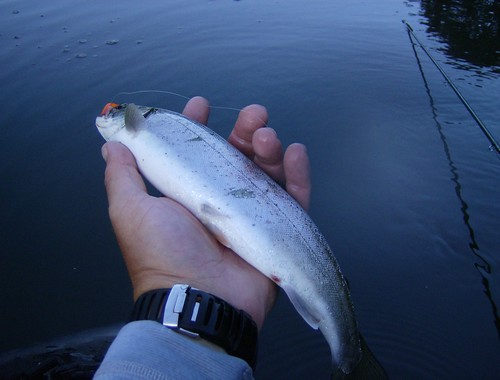
On about the second pass through the tail-out a Steelhead came from beside the boulder in the center of the tail-out and hit Rick’s black and blue leech like he hadn’t had a meal in months. Rick’s 8 wt. almost left the boat, but he grabbed it just in time and dropped the anchor to fight the fish. I checked my watch – 6:15 p.m… awesome.
After a rum toast we took a few more passes and then pushed through the break. Fishing below the tail-out is usually even more productive in this stretch and we weren’t disappointed. Minutes after boating the first Steelhead of the night, Rick’s rod tip hit the water when another Steelhead hit the blue and black leach. No “hook-up” on that one but “close” very very close.
We reeled up and pushed through fishable water to get to a favorite place to end the day. I considered switching from purple to black and blue but didn’t, instead – I took the oars, figuring it must be the “hot seat”.
Anytime Rick offers to let me row, I take it – his boat is easy to row and his Sawyer oars are light as a feather. We made a pass through water that looked magical – light was fading fast and it put such a nice touch of “darkness” to the reflection on the water, we just knew we were going to hook up. We didn’t. It was 7:45 and we had time for only one more pass through this “fishy looking” stretch before total darkness.
On the second time through, my rod jumped from where it was laying peacefully by my side and I grabbed the reel as it went sailing by. It was a feisty Steelhead that hit my purple leach and using the current to it’s advantage, gave us a great fight and a wonderful show.
When we landed the second fish it was dark and we were late. We both scrambled for cell phones to let “significant others” know we were out of the water and had fish to clean… plural.
We had another toast of rum and cleaned our fish… man I love this time of year!! If Rick sends you a text – jump on it… but only if he let’s you row his boat – that was one “hot” seat last night.
Jeff Hickman and other anglers are attending the Board of Forestry meeting in Silverton today — 8am to 12pm. The Board is trying redefine “Greatest Permanent Value” of our state forests as maximum timber, mudslides and decimated rivers.
Hickman is taking it to these river-raping bureaucrats though. From the Oregonian’s Matthew Preusch:
Jeff Hickman, an angler and advocate with the Sierra Club, challenged Marvin Brown, the state forester, on a statement he made in June that recreation in the Tillamook and Clatsop state forests generated about $800,000 in revenue.
Hickman cited a study funded by Travel Oregon that found fishing, hunting and other activities in the forests proved tens of millions of dollars in economic benefit for Tillamook and Clatsop counties.
Brown responded by saying that he had erred back in June.
“I do stand corrected on the recreation figure,” Brown said. “I sometimes get things wrong; I got that wrong.”
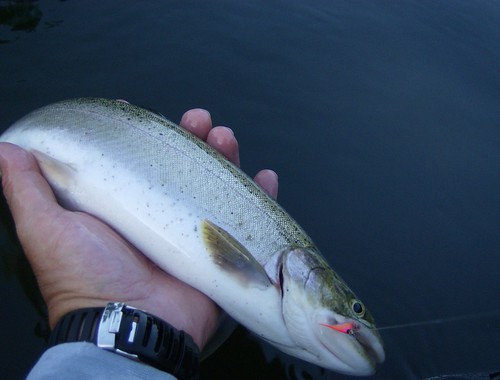
Last week I had the pleasure of taking some of the awesome Idylwilde Fly team out for a day on the Lower Deschutes. It was going to be Matt, Patrick, Zach and me. All three of them are very experienced anglers. Matt however had yet to spend anytime swinging a fly in search of chrome. We had a clear mission that day: get Matt (the trout slayer) into his first steelhead on a fly. He was excited to say the least, I don’t think he slept for at least two nights leading up to the trip.
I didn’t know what to expect with the day, as just two nights before, the clarity of the river went to chalk. Something had happened up on the White River Glacier and the White began spitting glacial till into the Deschutes just upstream of Sherars Falls. With cooler evening temps, I made the call to go forward with the trip despite the lack of clarity. I dumped the boat in that morning 20 minutes before first light and the water didn’t look good. Chalk with no more than a foot and a half vis. I did my best to remain confident but it was fading quickly. We jetted up river as the first hints of dawn revealed the path. We started with dry lines and some very proven classic style flies, an Idyl’s Postman and Silvey’s Pool Cleaner. After working through several of the known buckets in the first piece the score was low. Nothing but one subtle bump without return.
We made our way up to the next piece and made the call to switch to larger profile flies on sink tips. Matt with 12ft of T-11 and a Purple Fish Taco for the head of the run, and Patrick with a short 7ft section of T-14 and a weighted Black Party Boy Leech for working the boulder strewn tailout.
I walked Matt up to the top and coached him as he worked slowly down to the sweet spot. When he started to get in the real good section I had him slow down even more. When the first swing came in behind the magic boulder I could almost countdown to when the line would stop and come tight. 3… 2… 1… One bump… drop… Second bump… drop… and here comes the, CRAP! Premature hookset!!!!
I kept Matt calm and we continued to work the fish. I told him sometimes they will drop back 15ft or so from that spot to the next hold, and I walked down to the tailout. Just as I came to the edge of the tall grass at the tail I watched Patrick’s line mid-swing get crushed. Fish on! It jumps, cartwheels, runs, jumps, cartwheels, runs more. All in all it jumped 7 times as it went to deep into the throat of the fast water and eventually popped off. Awesome fish, a perfect, hot chrome, wild, hen and perfectly executed LDR.
It took a few minutes for Patrick to catch his breath and allow his heart to return to a safe beat. But before he could relax, we heard a scream of joy and terror all at the same time come from up stream. At the same instant a chrome explosion broke the surface directly in front of us. The distinct sound of knuckles on reel handle followed by various shouts and mutterings of $#&% @ &$#% @%#. Matt’s hooked up!!!
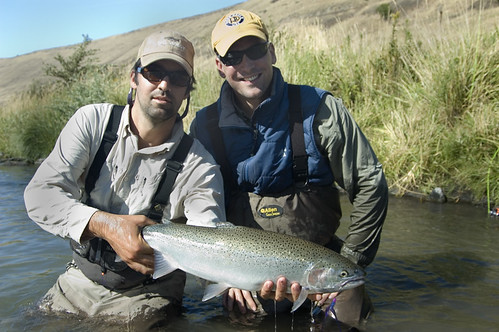
I ran up there to coach him through the epic butt kicking he was receiving. I think mostly I just offered moral support as the fish flew through the air, ran down stream, back upstream, across stream and amazingly stayed pinned through it all. We walked it down into the softer water and brought it in to be tailed. He did it!!!! He brought his first chrome native buck to hand on a swung fly!
It was truly an awesome event to witness and be a part of. Nice work Matt!!! May it be the first of many awesome fish you bring to hand throughout your new career as a steelheader. The day continued strong with everyone bringing a fish to hand and many other opportunities. And the best part was we had most of the river to ourselves. Seems the glacial color kept most other folks off the water. This was one day that will go down in the memory book for me of special days on the river.
-Jeff Hickman,
Sierra Club Hunter/Angler Organizer
Steelhead Guide
Native Fish Society River Steward Guide Service Blog
Trout Unlimited Meeting Wednesday, Sept 9th, 7pm at the Eagles Aerie, 1375 Irving Rd, Eugene, OR
Featuring guest speaker Bob Hunter: Free the Rogue River!
The Rogue River in Southwestern Oregon is one of the nation’s most outstanding rivers. Because of its scenic beauty, world-class whitewater, and internationally renowned salmon and steelhead fishery, it was one of the original group of rivers designated as “wild and scenic” with the passage of the Wild and Scenic Rivers Act in 1968.
The Rogue’s salmon and steelhead have long suffered from a series of dams that are now coming down at an unprecedented rate. Removal of Savage Rapids Dam, known as the biggest fish killer on the Rogue, is nearing completion. Last year, the Gold Hill Diversion Dam was removed and Elk Creek Dam was notched. Gold Ray Dam may be removed as early as next year.
Bob Hunter, a staff attorney for WaterWatch of Oregon, will discuss these dam removals and WaterWatch’s “Free the Rogue Campaign”. WaterWatch is a statewide river conservation organization devoted to restoring and protecting natural flows in Oregon’s rivers and has played a leading role in these dam removal projects for the past twenty years. The goal of the campaign is to have a free flowing Rogue River for 157 miles from Lost Creek Dam to the ocean. The goal is now within reach.
Bob Hunter is a past president and honorary life-member of the Rogue Flyfishers, and founding board member of WaterWatch and the Oregon Water Trust. He is also an avid flyfisher.
Even if you’re not a TU member, this is guaranteed to be an outstanding presentation. Please come on by. -MS