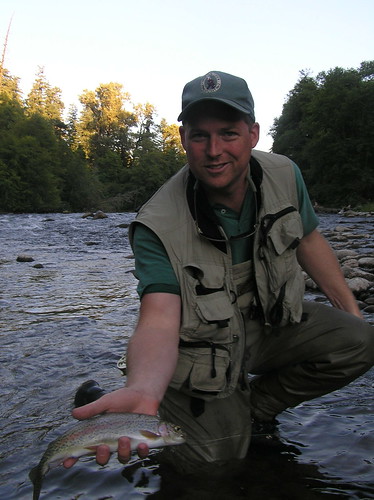
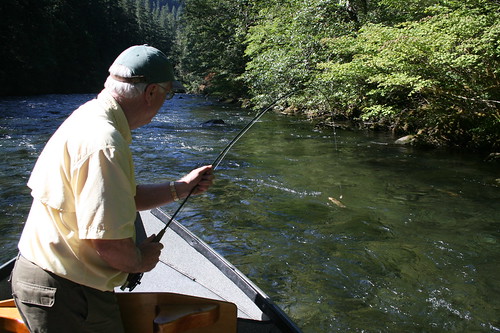
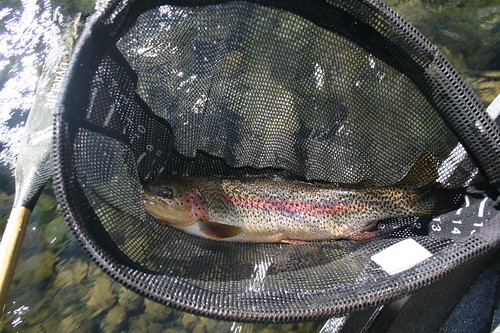
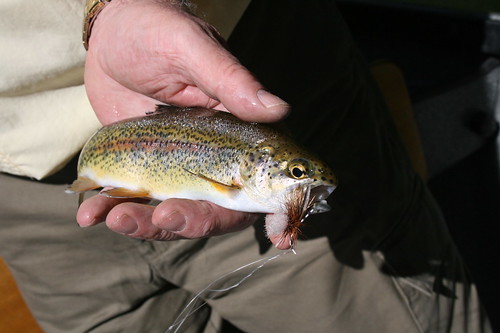
On Friday evening I met up with Matt and Mark for a quick post work float from Deerhorn to Hendricks Bridge. Granted, I’d prefer to fish higher in the watershed but short on time we stayed low and caught a mix of natives and planters–the first fish was a pretty 12″ native. Fish ate #12 Possie Buggers on the dead drift and the swing as well as a #10 Prince Nymph and a halfback golden stone. When the hatch came off, there were a lot of little yellow stones, some yellow caddis and a few bigger golden stones. In addition to the trout, Mark also caught a “nice” whitefish:
You have to love that face at least a little!
This was Mark’s first trip on the Mckenzie and hopefully I got him warmed up for the nice float he is taking with Chris from Paradise to Silver Creek today.–KM
The Editor by Mike Brooks is an Atlantic Salmon fly, but it is also a good summer steelhead fly pattern in low, clear water. It literally glows. Tie this fly sparse.
The Editor
Hook: Size 6 Tiemco up-eye salmon hook
Thread: 6/0 BlueTail: Golden pheasant breast feather
Body: Fluorescent white floss
Rib: Pearl mylar tinsel and fluorescent green mono
Wing: Fluorescent green and black arctic fox, crystal flash
Hackle: Black hen neck
Overwing: Gray Fox
Jerry Lorang of the Tualatin Valley chapter of Trout Unlimited is spearheading Project Healing Waters in Oregon. Project Healing Waters Fly Fishing, Inc. is dedicated to the physical and emotional rehabilitation of disabled active duty military personnel and veterans through fly fishing and fly tying education and outings. In this video, Lorang outlines some of the projects the organization has going on in Oregon.
For more info or to get involved with Project Healing Waters in Oregon, contact Jerry.
Caddis fly employee Ty Holloway spent yesterday at Crane. Despite recent shoulder surgery his hunt for big fish could not be disuaded.
He used Ice Cream Cone chironomids black with red rib size #10 under a small Thingamabobber indicator. Ty’s rig was a 9ft 3x full flourocarbon tapered leader plus 3ft of 3x flouro tippet to his first fly. Another 3ft of tippet off the bend of that fly to another chironomid of another color or size.
Fish were caught in the channels. Channel depth maxed out at 16ft, with channel edges being around 11 feet. Water temps in the deeper portions of the channels made the difference. Position yourself to fish the deeper sections.-CD
Summer is my favorite time of year. Wet wading, light till 9pm, dry flies and tons of trout. And the Upper Willamette River is my favorite place to be on a summer evening. The flows are finally down enough for very successful wade angling. During the early evening, the planters were taking a half-down golden stone dry with a size 14 possie bugger dropper. The fishing lagged between 6pm-7pm, and then a monster hatch of large tan caddis and golden stones erupted. Larger native rainbow trout came out to smack the big bugs off the surface, far out into the middle in heavy current. I switched to a yellow stimulator after refusals on the parachute golden stone and landed a few of the nicer fish in the run, missing quite a few more. Almost makes me want to move to Oakridge. -MS
Mike Brooks, friend of the Caddis Fly and expert Atlantic Salmon fly tier demonstrates a classic Atlantic Salmon fly in this video. Brooks uses this pattern for steelhead in the Pacific Northwest, but learned to fish the Ally’s Shrimp in Sweden.
Ally’s Shrimp:
Hook: Size 6 double Atlantic Salmon Hook
Thread: 6/0 Fire Orange
Tail: Fire orange buck tail, crystal flash
Body: Fire orange Antron yarn, black floss
Rib: Silver tinsel
Wing: Arctic fox natural
Beard: Arctic fox natural
Hackle: Webby orange hackle
Overwing: Golden pheasant crest
As many of you already know I am sick, sick with a disease that can only be cured with a 12 wt. rod and a couple dozen 60lb shock leadered toad flies. This affliction takes me to some of the most striking warm weather locales. Rife with blazingly hot sun, mosquitoes, and 100 plus pound tarpon, the Florida keys serve as the ultimate backdrop for my demise (economic, mental).
This was my 12th year going to the northern keys of Florida to fish for megalops atlanticus. These are the ultimate test of angling prowess, no other animal is capable of intense runs and jumps like the tarpon. Not to sound like a walking Chasing Silver commercial but it is the best bite in the business, period.
Long casts, 80-100ft, are mandatory, as is precise accuracy. Then the world erupts with molten silver and you lose control of everything for at least a few minutes. The ocean has huge wholes blown in it and your knees finally stop knocking from your adrenaline super enriched blood, time to pull, time to pull like you have never pulled before on anything with fins.
If you are lucky the giant fish has been up all night chasing shrimp or bait and gives up after only twenty minutes. Then there is the worst case scenario, a true giant that is hell bent on keeping up with the rest of the school that you just plucked it from.
These fish usually make you work a lot harder, minutes feel like hours and the sweat burns your eyes. Finally, the fish is boat side and the Kodak moment becomes a reality. A quick thank you and a safe healthy release. Another day in paradise! If you are interested in a trip to fish for these prehistoric gladiators please don’t hesitate to come into the Caddisfly for a full rundown on tackle, casting and guides. It is one of my life’s great passions and with a little preparation it could be one of yours, too.Great light and tides-BC
Last week we published an article on KATU about fly fishing on the Lower McKenzie River. From the article:
As summer continues, early and late parts of the day become the best options for fishing the lower river. Anglers should try fishing faster water during the midday. Evening dry fly fishing can be excellent – anglers just need to scale down the size of their offering (size 16 and18 pale morning duns, pale morning dun spinners, little yellow stones(sally’s) and small caddis) are best.
Also, Caddis Fly guide Lou Verdugo hooked up with the Oregon Duck at the Track and Field trials media day to teach folks how to cast. Photos below.
My favorite time of year on the Deschutes is upon us. All day blizzard caddis hatches can create a scum of insects on the water that will make you want to clean your waders. Streamside vegetation can hold so many caddis during evening hours your lantern can be darkened with swarms of caddis. You begin to not care about whether you are eating caddis with your dinner or not, a little protein never hurt anyone. Eddies and edges hold great numbers of hot Deschutes Rainbows slurping the never ending supply of caddis flies.
Tie on a #18, Elk hair Caddis, Royal Wulff, X-Caddis, E/C Caddis or Sedge Hammer Caddis imitation, position yourself on a good looking edge, work a short amount of line out and make short casts upstream continuously moving your feet upstream. Hopefully you will be able to sight cast to rising fish. Time your casts to match the rythmic feeding of the trout. Active fish and active fishing with small dries doesn’t get better. The float from Trout Creek to Maupin is ideal, good walk in access can be had at Mecca Flats, Trout Creek and South Junction all below Pelton Dam.-CD
Both the Mckenzie and the Willamette Rivers, and tributaries dropped huge amounts this past week. If you are used to walking in on the Middle Fork or the Mckenzie access is as good as it has been all year. In addition Salt Creek, Salmon Creek, and the North Fork of the Middle Fork are all in fine shape. Insects present on all previously mentioned waters include, Green Drakes (especially on the upper Mckenzie), Golden Stones, Little Yellow Stones, Pale Morning Duns and Brown Caddis.
As waters have dropped clarity has improved. It’s time to start thinking about lighter tippets, moving from 4x to 5x or on the really small waters even using 6x. We are headed for another hot period of weather and fishing will be best in morning and evening on the lower Mckenzie and main Willamette. The upper Mckenzie and upper Willamette offer more broken, fast water that will hold feeding fish through out the day. When surface activity is limited go subsurface with Prince Nymphs, Possie Buggers and Copper Johns in sizes #10-16.
Our local waters are now much closer to normal flows. They are far easier to read in terms of drop offs and submerged structure and the wading is much safer. Summer seems to have finally arrived.-CD
As many of you know, EWEB’s Carmen-Smith Hydroelectric Project on the Upper McKenzie River is up for relicensing. EWEB is in the process of submitting a new long-term license application to the Federal Energy Regulatory Commission (FERC) for approval.
The relicensing process is an opportunity to get more flow and fish passage for ESA-listed bull trout and chinook salmon in the watershed.
Trout Unlimited (specifically the Oregon Council) has been involved in the relicensing process, and at a recent meeting we interviewed Kate Miller (TU’s legal representation on the issue) about the project:
Last week we attended the Oregon Trout Unlimited State Council meeting at Belknap Hot Springs. Council Chair Tom Wolf was on hand to discuss the organization’s conservation and legislative priorities for the upcoming year. The video below outlines that agenda:
Wolf says key legislators and Governor Kulongoski’s office have promised to make the 2009 session one where water quantity, pro-fish and habitat bills will be passed. Here are some of the issues to watch:
1. Non-native aquatic invasives bill: This will include legislation that will deal with illegal stocking of non-native fish and ballast dumped from ocean freighters. Within the budget process TU will be seeking money to implement boat check stations at borders to check for aquatic invasives (such as zebra mussels), and funds to educate people about the dangers of non-native invasives.
2. Water Storage management bill: Governor Kulongoski is planning legislation that would divert peak winter flows and store them in either offsite storage, tributary reservoirs and in the aquifer. Waterwatch and TU will be working to make sure that this will not have a negative impact on wild native salmonids.
3. Woody debris bill: There is currently no law in Oregon that prevents people from removing woody debris from streams. TU will be working on a bill to prevent this, except for emergency reasons.
4. ODFW budget: Currently, as many of you know, ODFW is proposing an 18-25% license fee increase for 2009 session to meet their current budget needs. The Oregon Council plans to work to make sure that some of the money goes to protecting and restoring wild native fish and habitat.
5. River Navigability and access bill: TU’s goal is to produce a bill that will better define Oregon’s Public Trust doctrine and allow anglers access to navigable rivers.
6. Other Natural Resource agency budgets- Oregon DEQ, Oregon Department of Forestry, and the Oregon Department of Water Resources.
7. Global Warming/Climate bill: TU will be supporting climate change legislation to mitigate global warming impacts on coldwater fisheries.
Other areas TU may be involved with include: Marine Reserves, pesticides control bill, the LNG bill, land and use bills.
Despite the climbing temperature, the Middle Fork Willamette remained stable on Saturday as I floated from the Guard rail launch in Oakridge to Black canyon. The river level has since risen sharply and has probably adversely affected the fishing and definitely has made floating les enjoyable. Levels are still very high for productive bank fishing in the Oakridge area.
The day started with a few ten inch natives eating both #8 Possie Buggers and #10 Prince nymphs nothing spectacular. The heat of the day ground the bite to a halt. Finally in a promising looking spot I hooked three decent fish on the Possie Bugger. Since nothing had eaten the Prince, I fully committed. One rod saw two Possie Buggers fished under a Thingamabobber. The other was rigged with two Possie Buggers and a couple of split shot so I could swing the Buggers deeply.
I hooked one large trout that I proceeded to lose just beneath me. In my experience, the most dangerous point in a fight with a fish is just when you are getting it under control and it moves directly below you in the current. It is easy to fall into the trap of pulling the fish directly towards you through the current or to stalemate for a moment in that position. A trout is often able to cause momentary slack in the line by thrashing and that slack is sometimes all the fish needs for the hook to pull free. To keep this dreaded and all too common long distance release from happening it is best to apply side pressure—this helps the hook hold. Anyway, I caught a few more decent trout in that hole but the big boys were done playing.
For the rest of the float, the Possie set-ups hooked fish consistently but nothing oversized. Finally, near the take-out this nice trout slammed one of the flies and I was able to bring it too hand:
I got hammered by another nice trout on a swung Possie but it didn’t hold. How that happens is a mystery. I finished up with a few smaller trout. A respectable day of fishing.–KM
Last weekend we drifted from Olallie to McKenzie Bridge on the Upper McKenzie River. The water was high, running around 1600 cfs and water temperatures were still under 50 degrees by midday. Chris and guide George Recker ran the class IV rapid Fish Ladder twice to scout it out for 2008. The high water made these drift boat runs less technical than usual, but much faster.
Lots of bug activity on the upper river, including golden stones and the first green drakes of the year (monsters!!! Size 8). Possie Buggers fished below an indicator with split shot worked really well, but a golden stone dry fly or large parachute Adams pulled several fish as well.
The fish in the Upper McKenzie were super fat and healthy. We pulled several fish in the 16-18 inch range.
Friend of the shop, Mike Brooks, ties some of the most elegant flies we’ve ever seen. This pattern, originated by Syd Glasso, is an excellent traditional steelhead fly. Mike’s flies are on display in the Smithsonian.
Quillayute
Hook: Size 4-6 Tiemco up-eye steelhead hook
Thread: 6/0 hot orange
Tag: Flat silver tinsel
Tail: Golden pheasant breast feather
Body: Fluorescent fire orange floss
Dubbing: Hot orange seal fur
Hackle: Black, blue-eared pheasant feather
Wing: Golden pheasant breast feathers
Hackle: Teal
Check out this tribute to Syd Glasso flies by our pal Stud Farnham.