Hareline Dubbin Fly Tying contest — Summer Steelhead patterns due 8/1/09

Bust those vises out of summer retirement — it’s time to get tying again! Hareline Dubbing in Monroe, OR is sponsoring a quarterly fly tying contest for Oregon Fly Fishing Blog readers. For the first round of the contest, we would like to see your best summer steelhead pattern, either an original or your own spin on a classic pattern.

Drop off two finished flies at The Caddis Fly Shop, along with paperwork that includes the fly pattern name, material list, your name and address, and either email or phone number for contact. You will not get the flies back — one will go to Hareline and one will go to the shop. Bob Borden and the folks from Hareline Dubbin will be the judge of the fly patterns, along with the crew from Oregon Fly Fishing Blog.

If you are not local, please send your flies in the mail to the shop.

The prize for this contest is the full spectrum of Crystal Flash — Yup. One of every single color Hareline makes.

Hareline Dubbin tour

Your patterns are due August 1st, so get tying!
-MS

Posted in Fly Fishing Contests, Fly Tying, Summer Steelhead | Leave a comment

"Hi and Dri" fly patterns great for hopper dropper set up

A flies “floatability” has always been a priority when fishing larger western rivers. Fishing two flies has now become quite common. In order to have a dry fly hold up a bead headed nymph it must be tied with “floatability” in mind. “Floatability” can be an excessive amount of hair, hackle, foam, yarn, or even a Thingamabobber. Yes that’s right the thingamabobber has been integrated with flies. Check out some of our hi and dri patterns pictured below.

IMG_1658

Hi and Dri Parachute Hares Ear is a great searching pattern. I’ve used it during Green Drake Hatches as well as for March Browns. It can hold up your #14-16 bead heads when it’s a size #12

IMG_1657

Hi and Dri Green Drake in a size #10-12 is an outstanding floater and will hold up size #12-16 nymphs in fast water. This fly is heavily dressed and may not trick your flat water feeders, but in big water you will see it and it will float.

IMG_1654

Chubby Chernobyl floats like a toy sailboat. It is a Golden Stone imitator and will hold up standard and tungsten bead heads up to size #8. This fly has been performing really well this year on the upper McKenzie and should work in size #8 on all of our small tributaries.

IMG_1655

Jimmy Z is a great floater but a low floater. His muddler head keeps him up but also let’s him dive like and egg laying caddis. Killer attractor pattern.

IMG_1653

Thingamastone, just ridiculous I fished this fly all day yesterday with a size #10 Possie Bugger under it. Not ever having to dress a dry fly is a little weird, but very nice. This fly is durable, high floating and you can see it from another zip code. $4.00 a fly and limited quantities at this point.

IMG_1652

Thingamahopper, similar result to his cousin the stonefly. This is only the beginning in terms of Thingamabobbers integrated into flies. Wait till next year.

VIDEO: How to rig hopper-dropper

It is a great time to head to the upper tributaries of our rivers and fish a hopper dropper system. Keep is simple, take some Possie Buggers and Prince nymphs sizes #10-14 and a hand full of high floating dries, your boots and shorts, and go do some rock hopping. Try the upper McKenzie on the McKenzie River Trail, the South Fork of the McKenzie above Cougar Reservoir, Salt Creek, Salmon Creek, the North Fork of the Middle Fork of the Willamette, and the Middle Fork above Hills Creek reservoir. All of these streams are perfect for a two fly system, and with the hot weather they are a great spot to escape the heat.–CD

Posted in Oregon Fly Fishing Tips | 7 Comments

Local . . . (Fill in the Blank) Resident (?) Causes Big Drop in Willamette River

I thought about using harsher words in the title but I have been known to habitually destroy garage doors with my pick-up so I’ll stick with the facts and you can fill in the blanks.

A local resident managed to submerge his pick-up in about ten feet of water in the Willamette River–coincidentally right on top of an EWEB water line. The Register Guard has the full story here. That’s going to cost him.

A quick call to the Corps of Engineers and I found out they are going to drop the river a down to a couple thousand CFS not a couple feet as reported in the Register Guard article. They have already reduced the flows out of Dexter and will be doing the same thing at Dorena. Once the truck is removed the Corps is going to bump the flows back up.

This will not affect the navigability of the river though it may not help the fishing.–KM

Posted in Lower Willamette, Uncategorized | Leave a comment

Oregon Restoration Projects Receive Federal Funding

Today Commerce Secretary Gary Locke announced fifty habitat projects that would receive a total of 167 million in federal funding under the American Recovery and Reinvestment Act (the stimulus package). Included in the projects receiving funding was Eugene’s own Delta Ponds restoration. Trout Unlimited National staff asked its local membership to identify worthy projects. Mckenzie Upper Willamette Chapter VP Todd Mullen brought the Delta Ponds project to the National Staff who lobbyied for it and other Oregon projects to NOAA. Nice work Todd!

The Delta Ponds project will restore and enhance twenty one acres and two river miles of riparian habitat by removing invasive species and connecting seven ponds that provide refuge and rearing habitat for juvenile spring chinook. Removal of the last meaningful impediment to salmon and steelhead on Oregon’s Rogue River, Gold Ray dam, will also receive funding and following the removal of Gold Hill dam in 2008 and Savage Rapids dam which is currently being breached, the lower 153 miles of the Rogue River will flow freely.

There are may other worthwhile projects that will be funded through this initiative including the removal of Great Works dam on the Penbscot River in Maine which is the last “stronghold” for Atlantic salmon in the United States.

No matter your political leanings, I think most people reading this site would agree–improving fish habitat is a wonderful thing.–KM

Posted in Oregon Conservation News | 1 Comment

Spey crazy, be afraid — by Jay Nicholas

Rob Russell’s recent post on Spey Rods is over the top. Plain and simple, it rang so many bells that I couldn’t help myself. I should be mowing the lawn, or tying salmon flies, or sorting my threads. Hummm. Should I tidy spools in alphabetical or spectrographic order?

Anyway, here I am at my keyboard, hammering away in response to Rob’s post. Am I sick or what?

Please forgive me Rob. Think of it as a conversation we are having over beer and pulled-pork sandwiches at Papas. Only problem with that scenario is that I’m here at home and you, you fishin’ fool, are probably on the river, swinging a Silvey’s Spey on your 7133.

Here are some of the thoughts racing around in my head as I read and re-read your most excellent Spey Rod article.

1. Commit yourself – to the mental ward. Yes. If you fish for salmon or steelhead, get thee on the Spey Path, and get thee on quickly. I had several Spey rods leaning in the corner of my den for years. I bought them because I’m a gear junkie. I thought Spey fishing was a fad, a silly snobbish, unnecessary complication. I thought I was just fine, thank-you-very-much, fishing single-handers. Boy was I wrong. The first day I took a two-hander to the river I was smitten. Hopelessly in love. My casting sucked, but I saw the promise of what Spey casting could do to improve my fishing.

This is what to expect when you start Spey Fishing — pure crazy.

Jay's Spey Crazy

Understand what you’re getting into. One of the most telling characteristics of Spey Fishing addicts is regular participation in 12-Step programs. Hi, my name is (fill in the blank). It has been twelve days since I spent (grocery, mortgage, school loan, car loan, orthodontist, etc) money on (a Spey Rod, a Spey line, a big-ass reel, sink tips, ostrich plumes, or whatever).

2. Let go of your fear of big rods. Ditto to what Rob says. I love switch rods. (OK, I love all fly rods, DUH!) but a switch rod seems closer to a versatile single-hander than a Spey rod. Let go your fear? Hah! Like Yoda said to young Luke Skywalker, “You should be afraid.”

3. Purchasing two lines is the “gateway” to Spey. But let me ask you this – how many Spey fishers do you know who have only two fly lines? I bet the answer is – none. Zero. First you buy the Spey rod. And two lines plus tips. From that point on it’s a done-deal. More rods. More lines. More tips. It is, figuratively, the endless summer of fly fishing.

4. Do take a class. Not taking a class was my biggest mistake. My Spey casting sucked for two full years because I was so stubborn about learning to cast all by my lonesome. After receiving some good instruction, my casting still sucks, but less so, and more of my casts have the ring of truth because of the coaching I got. BTW, even though my casting was horrible, my line mending, amount of water fished effectively, and catch rates soared. (I caught three fish that season instead of one, so that’s like, three times more productive, right?)

Simon Gamesworth prepares to slap a Spey Casting student in a desperate effort to correct serious casting deficiencies.

Jay's Spey Crazy

5. Devote one morning or afternoon a week to casting. Rob’s right again. Weeks and months between Spey casting exercises don’t make the journey smoother. Try to cast often and master a small number of casts. I think the Snap T and Double Spey are a great way to start.


6. Debarb your flies and wear eye protection.
Yes, yes, yes! Listen to the man. He is telling the truth. I’ve had close brushes with serious injury. I buried the eye of a fly deep-into-cork. I’ve wrapped flies completely around my head on several occasions. I’ve had flies whistle within a hair’s breadth of my ears. Glasses and a hat are must-haves. Learn to watch your anchor point and don’t be afraid to abort a cast if your life is in danger.

Nice head wrap, but the barbless hook didn’t manage to even break the skin.

Jay's Spey Crazy

7. Big rods. Ooohh. Now you’ve got me going. Beg pardon. Rob’s got it right again. Know also that the largest flies and windy conditions call for comparatively heavier line-weights to achieve decisive lift and penetration.

Final disclosure: Rob is a great friend and, like, dude, a great Spey Fisher. I am a Spey novice. That said, I hope this babbling will give the average guy more confidence: Rob is spot-on – give Spey fishing a chance – you’ll be changed forever.

Hoss disembarks with a rare summer steelhead. Hat not for sale.

Jay's Spey Crazy

JN

Posted in Fly Fishing Gear Review, Oregon Fly Fishing Tips | 7 Comments

Oregon Fly Fishing Film Festival call for entries

Oregon Fly Fishing Blog is excited to announce the Oregon Fly Fishing Film festival, open to submissions as of today, June 28, 2009. Over the next six months, we will be collecting entries for the contest. So fire up those digital camcorders and get out there.

This festival is geared toward amateur film makers, and features celebrity judges, a grand prize valued over $3000, and proceeds benefit Trout Unlimited’s conservation efforts right here in Oregon.

Submission Guidelines:
-Videos should be 5-10 minutes in length. Fifteen minutes maximum.
-The films must be about fly fishing, but can cover any aspect of the sport, from conservation, to big fish, humor, history, etc.
-The submission must be new for the contest – never before aired publically. That means nothing that’s on YouTube or other online video site.
-It’s best to submit video in AVI file format for quality, but we can accept MP4, .MOV or .MPG format as well.
-Send CDs or DVDs to The Caddis Fly Angling Shop, 168 West 6th Ave, Eugene, OR 97401.
-There is a $20 entrance fee, which goes to Trout Unlimited in the McKenzie River watershed. Make check or money orders out to Trout Unlimited Chapter 678 and include them with your submission. All entrants will receive a DVD of the finalists and winning film.
-Movies using copyright material without permission will be disqualified.
-By submitting your movie to the Oregon Fly Fishing Film Festival, you are giving rights to Oregon Fly Fishing Blog to show your film or excerpts of it during the festival, and to include the film or excerpts for a compilation DVD.

Judging:
-Deadline for submissions is Dec. 20, 2009.
-Videos will be judged by our panel, including Brian O’Keefe, fly fishing photographer and co-founder of Catch Magazine, and Justin Coupe, director of the fly fishing film, Rivers of a Lost Coast.

Prizes:
Grand prize for the winning submission is a handmade bamboo fly rod by Oregon’s own Geniune Bellinger Bamboo Fly Rods. Also, the grand prize winner will receive a five-day guided tour of Oregon’s best fly fishing destinations, guides and lodging paid, in the fall of 2010 – including our world-class trout, steelhead, salmon, saltwater fisheries – specifics TBD by regulations, conditions and interests of the winner.

Runners up will be featured in the film festival showings and compilation DVD.

Film Festival Dates:
The premiere of the Oregon Fly Fishing Film Festival takes place on Saturday, January 9, 2010 at the David Minor Theater in Eugene. We will show the winning film, plus excerpts from the finalists at two showings that night, plus one matinee showing Sunday January 10th in the afternoon. Trout Unlimited Chapters across Oregon will coordinate other showings around the state in the following weeks.

So fire up those cameras guys — and remember, it’s for a good cause — raising funds for our home waters. Leave questions in the comments section.

-MS

Posted in Fly Fishing Contests, Oregon Fly Fishing Clubs and Events | 2 Comments

Little yellow stones: Yellow sally hatch goes off on the Lower McKenzie River at 9pm

The Lower McKenzie River is fishing well in the evenings for cutthroat, coinciding with massive yellow sally hatches. We’ve been fishing from Hayden Bridge to Armitage, with most of the action below Harvest Lane boat ramp. The bugs are all over the place, but the best dry fly fishing in the flat, slow runs. We had a lot of success on light colored soft hackles about 30 mins before the hatch started. This is a late evening game, so it pays to run your shuttle beforehand if possible. Not many big fish around (not any in our case), but this prolific hatch is worth seeing in its own right.

Yellow Sally McKenzie River

Yellow Sally McKenzie River

Yellow Sally McKenzie River

Here are a couple variations of the yellow sally: Traditional Little Yellow Stone, CDC Yellow Sally.

And a couple yellow sally patterns from the shop: Mini-stimi style and a low-rider version.

Posted in Fishing Reports, McKenzie River | 2 Comments

Considering a spey rod? Big water, big fish, big rods

Considering a spey rod? by Rob Russell
Spey_casting

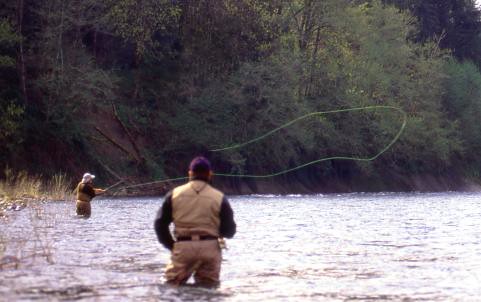
The “Spey” or two-handed fly rod has become the tool of choice for steelhead and salmon anglers looking to swing flies on big rivers. Two-handed rods take the drudgery out of swinging flies by minimizing casting effort, maximizing swing time, and allowing for incredible mending and line control. Two additional benefits: 1) they can chuck BIG flies and sink tips; 2) they can chuck LONG casts. Best of all, Spey rods are fun. But with all the rod and line options on the market today, it’s hard to know where to begin. So here are some pointers for getting started with two-handed fly-fishing:

1. Commit to it. If you are considering a Spey rod, you need one. If you think you might need one, you probably need three or four. If you are destined to become a Spey junkie, you will probably end up with as many two-handers as you have single-handers. It’s time to get on the wagon. If money is tight, there are some excellent options out there. If you can budget $500 for your first outfit, you’re home free. If that’s too high, you can still find a way.

2. Start with a full-sized rod, not a “switch” rod. Budding Spey fishers often fall for the dainty switch rod. The shorter, lighter rods seem like a good transitional step between the old single hander and those really long ones. And switch rods are exceptional nymphing sticks, but they are not the best way to learn Spey casting, nor are they the right tool for most winter or spring fishing. Let go of your fear. The long rod is the way to go.

3. Buy two lines for each rod. You will need a Compact Skagit head with a suite of tips (intermediate, type 3, type 6 and type 8), AND you will need a Compact Scandi head for dry flies. Follow the rod manufacturers’ line recommendations to make sure you have the right grain weight to match your new rod. You might even get a couple of opinions on line size or weight before you buy. Experts often disagree as to the perfect grain weight for a rod. If two experts are quibbling over 10 or 20 grains, go with the lighter of the two, then ask the guy who made the lighter recommendation for a lesson. If you have two opinions and they’re off by 50 or 100 grains, get a third opinion.

4. Take a class and/or hire a guide. Spey fishing is not something to “dabble” in. Like golf, you will always suck at it until you get serious. You gotta hire a pro to teach you (some will work for beer and food), you gotta practice, and you gotta love it. Otherwise, walk away. Trust me.

5. Devote one morning or afternoon a week to casting. Hopefully it will grow to a couple days a week. But you need to fish at least once a week to make progress, both as a caster, and as an angler.

6. Debarb your flies and wear eye protection.
Until you become intimate with Spey casting, barbed hooks are not safe. I have personally escorted two people to the hospital, thereby cutting fishing days short, killing any hopes of a tip for the day, and flirting with tremendous liability. One guy got six stitches in his forehead–literally scarred for life. Advanced Spey casters are not safe either.

Even Mishler, one of the finest casters on the planet, stuck a fly in his eye socket. Thankfully the hook was debarbed and it missed his eye ball. My personal worst was a 3/0 Alec Jackson sunk to the hilt in my forearm. I will always marvel at the strength of human skin after that tug-o-war. Most Spey anglers have a grizzly story or two.

Big Water, Big Fish, Big Rods
Spey_handle
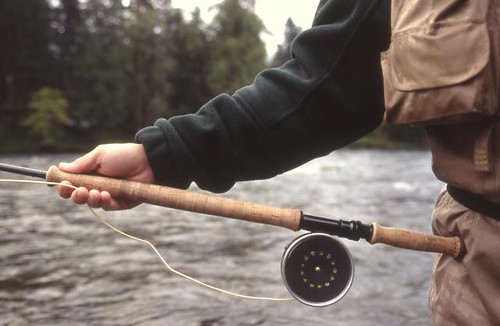
Caption: Long Rods are the best tools for swinging flies on big water. Photo courtesy of Jon Jensen.

The bigger the water, the more helpful a Spey rod becomes. Big rivers call for a “long rod” in the 13- to 15-foot range. Long rods can be as light as a 6-weight and as heavy as a 10- or 11-weight. Smaller rivers or low-water conditions can call for shorter and/or lighter rods.

The bigger the fish, the heavier the rod. Summer steelhead call for 6- and 7-weights, winter steelhead call for 7- to 9-weights, and kings call for 8- to 10-weights. If you’re swinging streamers for trout, there’s a whole class of lighter two-handers just for you.

You want one rod that will do everything. But there is no such thing. There are a couple that come really close. My rod of choice most of the year is a 13’3″ 7-weight (7133). It’s a little heavy for small steelhead, a little long for small rivers, and a little light for big sink tips. But it has proven to be heavy enough to handle big fish, including kings, yet light enough to cast all day.

Every manufacturer offers rods in the 13-foot range for a 7-weight line. That’s the zone for your first rod. If you can spend $1,000 on the outfit, you’ll have a lot of fine choices (Burkheimer, Sage, Winston, Zspey). If you are strapped for cash, go with an Echo rod. Plenty of pros swear by them. If you can afford the Dec Hogan series, do it, but Echo’s traditional Spey rods are also excellent, especially for the money.
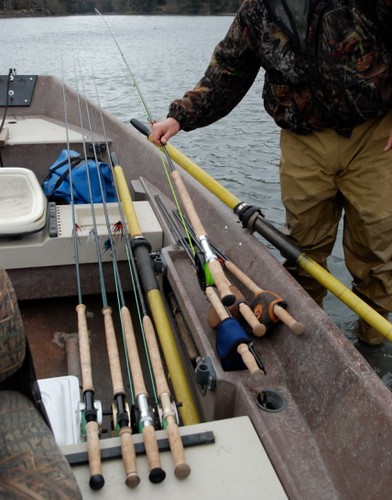
Spey_rods
Caption: “A fool goes salmon fishing with one rod.” Hugh Falkus. Photo courtesy of Monte Ward.

It might be irritating to hear, especially if you are struggling to come up with the cash for your first Spey rod. But old Hugh Falkus was right. Always have a back-up rod. Rods are delicate, salmon and steelhead are big and feisty, and the fish gods can be cruel. Your new Spey rod will need a partner, either a single-hander of similar weight or another Spey rod.

Helpful spey casting videos:

RIO’s Modern Speycasting with Simon Gawesworth

modernspey

Simon Gawesworth is a perfect caster, a perfect instructor, and an all-around gem of a human being. The other cats on this set aren’t bad either. This DVD set will help you for years to come–answers every question you’ll ever come up with. Kinda pricey at $49.95, but a worthwhile investment.

Modern Speycasting and More with Dec Hogan
Modern Spey-lg

My personal favorite for those looking for an introduction to steelheading with a Spey rod. Dec is the master of simplifying Spey fishing and getting casters to relax, slow down, and “let the rod do the work.”

-RR

Posted in Fly Fishing Gear Review, Oregon Fly Fishing Tips | 7 Comments

Oregon Fly Fishing Blog Survey — Enter to win Sharkskin Line!

We’re looking to improve Oregon Fly Fishing Blog over the next few months and we’ve launched a survey to get your feedback. Everyone who takes the survey will receive one of our new Oregon Fly Fishing Blog stickers, and one random survey taker will win a Scientific Angler Sharkskin line of their choice. Click here to take the survey: Click Here to take survey

Thanks
-MS

Posted in Uncategorized | Leave a comment

Curing the fishing hangover

It happens every year after the Canadian pike trip – the fishing hang over.

You spend seven days catching a fish on every cast, buzzing around anywhere you want to go on a huge playground of a lake, quaffing mass quantities of Canadian beer and eating your weight in deep fried walleye fillets every day. You play poker till the generators kick off, eat beans from a can, and smoke cigars till your teeth turn brown.

And then you get back to the real world. You fart loudly at a restaurant with your wife. You crave booze and tobacco in the morning. You’re a bloated, wind-burned, bug-bitten mess and you just don’t know what to do with yourself.

Normally you’d turn to fishing to find solace, direction. But it’s hard to get motivated. You’re not in the mood to work for fish. And you’re sure as hell not interested in fishing for an hour or two, some small chunk of time stolen from work or family – it’s not worth it.

Nope. Better to stay home and rearrange furniture or water the garden.

Eventually you’d come back around. You’re not reading this unless you’re some kind of addict. You’d come back. But if you want a cure… you have to forget about the fish.

I found the cure the other night on the Lower McKenzie. We put in at 5:30 at Hayden Bridge on a float down to Armitage. Nobody expected to catch a fish till 8pm at least, so we took it slow and easy with a full cooler and turkey sandwiches. On a summer night, eating dinner, floating down a gorgeous river, it’s hard to feel the fishing hangover.

Yellow Sally Trip

And then it starts to happen, bugs. More bugs than you’ve ever seen in your life. Mayfly spinners, a mix of caddis, and a blizzard of little yellow stoneflies dive bombing the surface of the water. It’s hard to breathe without eating bugs.

The flat spots in this wide, lower river start to pop with tiny native cutthroat trout, some bigger fish mixed in somewhere. It’s nearly dark, and you can’t really see your fly. But you can hear trout splashing all around you.

And all of the sudden your hangover is cured.

-MS

Posted in McKenzie River | 3 Comments

South Santiam Unvarnished

South Santiam, Again and … – Jay Nicholas

Thirty-one years on this piece of water. Jeepers. I wonder if I may have worn it out, but I keep going back when June comes around. Every June.

Skamania summer steelhead – we stacked ‘em in the fish box like cordwood back in the seventies. All big, bright, clean, sleek, fat fish. Sure they were. Lately, though, these fish don’t seem quite as grand. Lately, I notice scuffed-up gill covers, stubbed-off tails, mossy re-cycle tags, rounded noses, and chaotic scale patterns. Digital cameras are cuttingly accurate. Memories, on the other hand – – –

I miss fishing the Willows and Upper Last Chance. Gone now, forever, victims of the damn dams. But it’s still only 45 minutes to the River, still June, and I still feel that anticipation when clouds gather and it smells like rain. Got that new Spey rod lined and strung, waders laid-out, my biggest-baddest leech tied on, and I’m ready to go. Check the flow. Pack a hundred-dozen flies, just in case.

reel in motion jay

June 18th. I meet Ed at the Lebanon Walmart. We goin’ fishin’? Ha ha! We’re geared up for thirteen-hours on the water, but the bagels and Powerbars don’t make it into the boat. Oh well, we’ve got water and sunscreen. Boat traffic is heavy, so we fish between the gear-guys. They think we’re freaks and we are – fly fishing freaks. We find grabby fish: six leaping, blurred handle, into-the-backing-twice fish. Three meet their hatchery-ordained destiny in the fish box. Ed boats two and I kill one for Andy. He’ll savor the whole fish, every scrap and flake of protein, working the carcass down to a pile of boiled bones. Andy remembers the Great Depression.

chromerjay

June 19th. Can’t go back. Too much to do. But-but-but. Make plans. Cancel plans. Can’t go. Work, work, work. Oops! I’m in the truck heading back to the river. Thirty driftboats on the river yesterday all had babies last night; trailers crowd the parking lot today, wailing, waiting to be fed.

It’s 4 PM and there’s still time to swing a fly through a few favorite places. A thirteen-year-old boy beaches his third fish of the day at Wiley Creek. Dad calls him a “dumb-ass”. Swallows swoop over riffles as I push downriver against the afternoon wind. Pretty soon, I’m over the side at the Island hole on river-left, ready to wade-fish. A boat with three teenage boys pulls in, twenty feet away. “Would you mind if we fish through” – the young oarsman asks, politely. Go right ahead; thanks for asking” I answer, standing there, fly rod in hand. They run the hole and drift on. My turn now. Cast, mend, swing, breathe, anticipate, step, repeat – no grabs. Not today.

jayssantiamboats

OK, the Chair hole is empty. I anchor and pick up my rod. Two slow-but-sly guys drift behind me, plop-down their bobbers, and snake-out a fish where I was about to cast, never making eye contact. Hummm. A few more bobber plops and they slip off downriver. I sit down; photograph fly box; photograph fly line on water; fiddle with camera settings, breathe deep and banish bad thoughts.

jays fly box

Nearly everyplace has a boat in it – nearly. The Tire hole is open, for the moment, so the anchor goes down even though this place hasn’t produced a pull in ten years. I jam a short cast to river-left, feed 30 feet of line, mend, swing. Gentle-firm tug. Wow! Reload. Recast. Hold breath. Try ten more times. Fish smaller fly. No deal. Nobody’s fallin’ for it tonight.

I head for the takeout, trying to beat the tin-can-crush. 4x4s are parked all over the hillside. Ah-ha, the familiar stench of rotting ghost shrimp in the bushes. One guy cleans a fish at the mouth of Ames Creek, the in Sweethome Sewage outfall. He knows. Guess he doesn’t mind a little poop-rinse; it probably makes a great marinade.

jaysgoinghome

June 21st. Fathers Day. God-am-I-blessed. Andy has a fish. I have plenty to smile about this morning. I browse the Internet. JH and buds are in AK harassing big-ass King salmon. Damn! Imagine that. A great honest river, good friends, and sleek wild salmon. Someday. Maybe.

Next week, I’ll dump all my South Santiam memories in a big strainer. I’ll filter out the disappointments of filled-in holes, scarred-up hatchery fish, crowds, the occasional drunk, bad language, and mean-spirited people. I’ll cherish the rest – and keep on telling and re-telling stories about friends, cloudy afternoons, and the best grabs from thirty-one years on the river.

Think I’ll be back on the South in a week or two? Ha ha!

JN

Posted in Summer Steelhead | 10 Comments

Oregon coastal summer steelhead on the move

By Rob Russell

Entering the coast range Friday evening, I left the sun behind and drove into an impressive mass of clouds. Rain came down in sheets for the next two hours. Later, as I pulled into the little coastal fishing village, Mishler was cruising the boat ramps looking for rolling fish. We met on the outskirts of town at the lowest landing. The bay was choppy and a strong incoming tide was bringing in mats of debris. Not ideal for flyfishing. We decided to get a burger and beer at the Sportsman’s Bar and Grill.

The little pub was packed, but we found a corner table. I went to the bar to order. When I returned we had a visitor. A spry codger named Noel had sat down next to Mish, talking to the folks at the next table. Soon we were all talking, and Noel held court. He was a retired teacher and commercial salmon fisherman. Most everyone in that bar was somehow related to Noel. The bar owner had Noel to thank for getting him into his first salmon, for getting him to move to the Oregon coast, and for getting him to open the bar. The locals at the next table were Noel’s kids, fun people, full of smiles and laughs. Then Noel’s grand-daughters showed up, along with a bunch of their girlfriends. We were surrounded by some fine young ladies, all of whom were getting their drink on.

Jack Harrell and his son John walked in, and I waved them over. Jack is one of the North Coast’s flyfishing gurus, so we were grateful to hear his report and share what little we knew. The word, according to Jack, was that the fish had migrated. “They left Monday or Tuesday,” Jack said. “The bay went dead.” His story was easy to believe, especially given all the rain that had fallen over the prior 24 hours. But it was not what I wanted to hear. I could easily focus my efforts in the river instead of the bay. But I knew the rain would bring out a lot of drift boats, so competition in the river could be intense. I also doubted Jack’s assertion, not because I thought he was lying, but because time has taught me to trust my intuition. And my intuition told me the bay was full of fish.

We camped under a calm night sky, sipping micro brews until midnight, telling old fishing stories and irritating the poor tourists in the next camp. Sorry, campers! We were having too much fun to retire early.

The next morning we launched into the bay at first light. The bay and the sky overhead were serene. Fog rose from the hills and puffy clouds hung low over the valley. As soon as we were situated we noticed salmon entering the pool. They pushed big wakes as they shot through shallow sand flats. Most wakes disappeared as the fish entered deeper water. A few stayed suspended just under the surface and waked all the way through the pool and into the next shallow flat. It was a fly fisher’s dream, and the stage was set. Three of us worked the water, stripping our flies at varied depths and speeds. The fish kept coming, and they kept going by. After a couple of hours, I finally hooked up. I set the hook, felt the fish pumping, and struggled to strip more line in. The fish came at me and I was too slow to strip tight to him. A few seconds later he was gone. Strike one!

The tide set ended without any further action, so we pulled out and headed up river for a float. The river looked great, with just a hint of color. It was still extremely low, and there were several boats ahead of us, so our chances of hooking salmon were not great. Thankfully, a prime spot had been neglected by the other boats, and we hooked a perfect chinook. I pulled away from the nasty snags at the head of the pool, and the fish followed obediently. It came to the boat easily in spite of its size and freshness. Then the shiny beast made a quick roll and threw the hook. Strike two!

We fished diligently all the way down river without a bite. Finally, we anchored at reach of tide. High tide had just passed, so there was a good chance there was a salmon in the pool ahead. Mish stripped flies for a while, but the fly wasn’t getting down into the zone. I backed a little plug down and whammo! Fish on–a heavy one. Shake, shake, shake, gone. I checked the hook and it was still sticky sharp. Strike three, outta there! Just one of those days.

Sunday I was joined by my buddy Tim and his son Mitch. We ran the same routine: bay in the morning, river in the mid-day, back to the bay for the evening. This time only two wakes came up the bay. There was a light breeze and good cloud cover. No grabs, and very few fish showing themselves. We bailed early for the river.

As we launched, a bank angler walked away with a steelhead. Just down river Tim got a small steelhead, covered in sea lice. Below there we saw a pod of three fresh steelhead moving through a tailout. Then a few more. There were a lot of steelies on the move. As we approached reach of tide, we saw two more groups of fish coming up. I kept hoping we would intercept one of those pods in a good spot, and as I was thinking that, Mitch hooked up. The little rod flattened out and Mitch set the hook. There was a moment of silence, then a big steelhead flew into the air just a few feet fom the boat. “Oooooh!” we all yelled in unison. The fish was HOT! Up the river, down the river, jump, jump, back up river. It just wouldn’t quit, and it was a couple of pounds over the average size.

Rob Russell megachrome steelhead

Finally Mitch pulled the mint-bright fish to the beach and pounced on it. His father, Tim, looked on with pride. Not a bad way to celebrate Father’s Day. And a great kick-off to coastal summer steelhead season! Time to tie up a dozen muddlers and dust off the summer gear…

Posted in Coastal Steelhead Fishing, Summer Steelhead | 4 Comments

Summer season begins on the McKenzie

It has been a fantastic Spring on the McKenzie this year. We started with high water and tough conditions, but ended with unbelievable fishing and perfect water and weather.

IMG_0025_1

IMG_0023_1

IMG_0016_1

Soon hot days will mean better hatches during the later hours of the day. Pale Morning Duns, Little Yellow Stones, smaller Caddis, Green Drakes, and Golden Stones will be important bugs to have in your box. Fishing a Possie Bugger off of a bigger dry will work in fast water now. Fish will look to take refuge in the highly oxygenated fast water on drop offs and behind boulders. Our great water conditions will continue all summer as reservoirs are full and snow pack a plenty.–CD

Posted in McKenzie River | 1 Comment

Middle Fork Willamette Report: Fish Gods Dispense Mercy

Father’s Day, 2009

Fresh off my skunking on the Metolius  I decided to wipe that day off the books by floating the Middle Fork Willamette from Oakridge to Black Canyon.  Expectations already running high were stoked even higher when I missed a good bite right away.  A couple minutes later I hooked a heavy fish that ended up fighting like a boot.  You know what that means:

MIddle Fork Willamette Whitefish

Oh well.  I caught a hatchery fish that must have migrated down from Salt Creek and broke a Green Caddis dry off in the snout of a nice fish.  Ugh.  The fishing slowed.  In desperation, I put on a stonefly nymph which was eaten right away by a decent trout:

Middle Fork Willamette Rainbow Trout

Then the fishing really slooowed.  The intermittant cloud cover became a blanket and the temperature had dropped by about ten degrees.  Bug activity nearly ceased and along with it the fish activity.

After a fishless hour or two my mind was wandering.  Just as I had given up and allowed myself to ruefully wonder at the capriciousness of the Fish Gods . . .

‘you know it is Father’s Day and I’ve worked hard at parenting this year . . . plus I’ve done a lot for Trout Unlimited . . . you’d think the Fish Gods would have mercy . . .’

… My rod slammed down and this nice trout had eaten a #16 light wet Cahill:

Middle Fork Willamette Rainbow Trout

Bug activity picked back up.  There were PEDs on the water and I caught several more trout none more notable than this fish that viciously attacked my Cahill like a Great White destroying a seal:

Middle Fork Willamette Rainbow Trout

It was awesome and left me trembling.  Trout ate the green caddis, lashed out at some tan elk hair caddis and grabbed the Possie bugger but the fly of the day was definitely the light cahill.  PMDs and PEDs are only going to get more important as the summer comes on strong.

Every time the sun was on the water there were tons of bugs:  big green caddis, tan caddis, pale duns and I got the feeling I was sitting on a bomb.  I suspect the next consistently nice day we get, the river is really going to fish.–KM

Posted in Middle Fork Willamette River fishing, Uncategorized | Leave a comment

Metolius Basin protected from mega-resort development!

This just in from Central Oregon Landwatch: This is a historic moment, as the Metolius Protection Act of 2009 just passed the Oregon House 31-28! House Bill 3298 recently passed the Oregon Senate as well and now heads to the Governor’s desk to get signed into law.

We’ll be back in touch with more details soon, but we wanted to take a second and spread this amazing news. Thank you, everyone who helped make this happen. Thank you for making this possible and helping turn this legislation into law. We’ve just helped protect over 300,000 acres of land in and around the Metolius River Basin. This is truly a remarkable and historic achievement, one for the history books indeed.

Posted in Oregon Conservation News | 6 Comments