Mike Maxwell: Lessons from the First Speyfisher

High water has its benefits, not the least of which is the shocking productivity it can bring back to a steelheader’s home life. Last weekend was a whirlwind of yard work, house cleaning and resumed projects, which inevitably led me to my dusty, neglected laptop computer. Browsing in the luxury of a lazy, spring-like afternoon, I clicked into an old, faintly familiar file entitled “Speyfishing.” I was surprised to find notes from a forgotten 2003 interview I conducted with Mike Maxwell–steelheading’s first Speyfisher. Mike passed away in 2004, but not before producing two important books and a series of instructional videos on his craft. As I read the interview, I knew it had to be shared. Mike’s irreverent, vital personality was refreshing in his day, and it was just a refreshing as I read it in the present. It occurred to me that modern Spey-fanatics could use a reminder that Speyfishing has roots that are wider and more inclusive than the strict down-and-across style that some folks cling to like an old-world religion. Some of the choicest bits had to be omitted, for fear of upsetting a few of today’s luminaries. But the essence of Mike’s message is as follows:

Spey_handle

Mike answered the phone. I told him I was working on an article about Speyfishing, and that I wanted to get his thoughts on the subject. He let out a little burst of laughter, and jumped straight into the interview like he had something to get off his chest…

“You know I’m 79 years old,” Mike said, “and I’ve been Spey casting for 60 years!”

Before I could say “Wow,” he continued, practically beaming through the phone.

“I learned in England as a young man, then came to Canada in the late ’50s. When I got here, everyone was using these puny little rods. Like seven feet long or something. I just thought it was ridiculous!”

He explained how he brought a handful of his “Salmon rods” from the UK, and started using them on British Columbia’s famed steelhead rivers.

“People couldn’t believe it,” he said. “They just looked at that thing and they couldn’t believe it! ‘What the hell are you gonna do with that?’ they would ask me. Then I would make a cast, and their jaws would drop!”

Mike’s energy was intense, and I found myself smiling as he held court.

“One time, about thirty years ago, a great friend of mine who organized fishing shows in the States asked me to bring one of my rods to demonstrate at his show. Well, when I showed up with my Spey rods, people went nuts. They couldn’t believe it. Of course, the organizers gave me a little casting pond about eight feet wide by a hundred feet long. What the hell was I gonna do with that? Well, I had to cast like they did. I remember I grabbed this old woman who didn’t know how to fish, and I gave her the rod. I told her to make a simple overhand cast, and she threw it over 70 feet. Oh, you should have seen everybody go on and on! And from that moment on, rod manufacturers have all been about distance. Everything has to do with the distance a rod can cast.”

I didn’t need to ask any more questions for a while. Mike was on a roll…

“You know, when most Spey casters go fishing, they wade up to their ass in the river and cast all the way to the other side. I tell them, ‘Why the hell don’t you just go over there and fish, for God’s sake?’ It’s just ridiculous. You know, we have these brilliant float fishermen here in Canada. They are very effective–too effective! Believe it or not, most of these guys give it up because it’s too easy. Anyway, one of these chaps walks up to the river after some Spey casters have been standing waist-deep, casting to the opposite bank. He flips his float out about four feet from shore, lets it drift as far as he wants–these guys can drift a float over 100 feet–and in three casts has three fish! It’s just amazing.

“But the reason I bring that up is that the fish were there the whole time. They were just waiting for the Spey fishermen to move. Then they got back to their business. You see, a steelhead has two eyes, both of which can see up to thirty feet in either direction. One eye can be focused on something twenty feet away, and the other can be focused a foot or two away. But the fish can’t see a fly until it’s right over his head. So, you see, what we’ve learned from float fishermen is that steelhead like a downstream-drift presentation.

“Most people who Spey cast never learn how to fish. We–Denise and I–we teach people how to fish with a Spey rod. We start with the customer–that is the fish–and work up from there. You see, most people just flop out a roll cast at a 45-degree angle from the bank and let it swing. But if a fish sees a fly swinging quickly by, it will rarely bite. If, however, the fly is drifted right over his head, the fish is much more likely to grab it. We Spey fish for steelhead like float fishermen fish. We cast across and upstream, let the fly drift down to the end, and then swing across. Then we do it a little farther each time. We fish the water.”

I asked Mike about the title of his book, The Art & Science of Speyfishing. I explained that I had been warned by a few people to avoid the term “Spey” and to always use the term “Two-handed.” Mike chuckled knowingly, then began another story…

“Well, you know, in the UK they’re known as ‘Salmon rods.’ When I first came over and started making these rods–of my own design–I didn’t know what to call them. I couldn’t call them ‘Steelhead rods,’ because here in Canada a steelhead rod is a huge bait rod. Of course, I didn’t want to call them Salmon rods because I don’t fish for salmon.

“Then I wrote an article for the Atlantic Salmon Journal where I first called my rods ‘Spey’ rods, and I introduced the concept of ‘Speyfishing.’ Oh, the Brits went ballistic! ‘You can’t call them Spey rods, blah, blah, blah!”

Mike paused momentarily and took a few breaths. It seemed to me he was reliving an old scene, and I wished I could see into his minds eye. I asked him which of his lessons he would most like to impart to budding Speyfishers.

“Fish the water, and stick to your effective range,” he said. “An angler only really has control over his or her presentation within two to five rod lengths.”

I countered, “But Mike, I was instructed that your rods and lines were meant to throw lines of six to seven times the rod length.”

“That’s bullshit. Absolute bullshit! Whoever told you that was an idiot.”

I love this guy!

For more information on Mike’s books and videos, or to book a trip to his beloved Bulkley River in British Columbia, contact Denise Maxwell via email: info@maxwellsteelheadguides.net
-RR

Posted in Fly Fishing Books, Fly Fishing Profiles, Oregon Fly Fishing Tips | 5 Comments

Kelly Galloup inspired articulated streamers

These past few weeks I’ve been tying a collection of articulated streamers for my dad’s birthday, inspired by Kelly Galloup’s style and specifically by the videos posted at Fly Fishing The Ozarks.

Dad's Fly Box

To be honest, I debated whether or not to post this because of how amazing this guy’s fly tying videos are. We hope to take some pointers from this in the future.

I think these flies are going to lay waste to some warm-water midwest brutes this spring/summer.
-MS

Posted in Fly Tying | 7 Comments

Montana?

“Many go fishing all their lives without knowing it is not fish they are after.”
– H.D. Thoreau

yellowstone brown 2

madison26

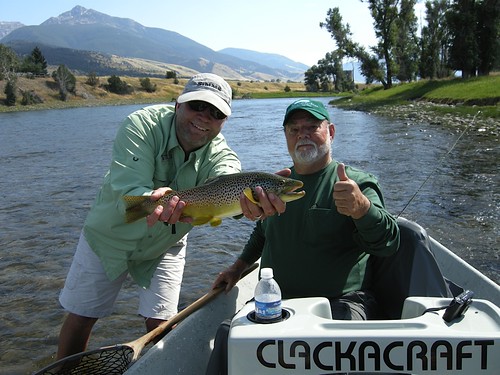
ellen's big brown

Here’s your chance to experience some of the finest fly fishing in the Lower 48 on two of Montana’s most famous, blue ribbon trout streams. The Madison and Yellowstone rivers are populated by 1200 – 1500 wild trout per mile; ‘Bows, Browns, and ‘Cutts.

“Lou” from the Caddis Shop, is heading up a group of anglers from September 24-27 to Bozeman Montana. We will hook up with our friend Ed Lawrence of Ed Lawrence’s Fishing Outfit. The trip is geared for both the inexperienced and experienced fly anglers who will be in the company of licensed, experienced guides who have been plying these waters for decades.

This four day all inclusive package has been created especially for the Caddis Shop, and will allow us to fully experience Montana fly fishing at its best.

What’s included?
4 Days of guided fly fishing, 5 nights lodging, most meals
It is affordably priced at only $1587* per person.
Why did we choose Ed Lawrence’s fishing outfit?

In one word: competence. He and his guides know the territory.
As Ed says, “We’re not crotchety old-timers, but we’ve been successfully guiding clients for decades, and we’re proud that a high percentage of our clients are returnees.”

HERE ARE THE details: We will have 4 days of guided fishing in drift boats, and will not fish the same place twice. We will stay at The Wyndham Wingate, the finest hotel in Bozeman. Cooked breakfast will be provided at the motel, lunch will be provided on the river, and we will have dinner at our choice of restaurants in the evening.

QUESTIONS? Call the shop (541-342-7005) to sign up or ask questions.

*Includes lodging, meals, transportation to the rivers and the services of a full-time, professional fishing guide. Rate does not include gratuities or travel to Montana. Package is based on two anglers per boat; lodging is based on double occupancy; Single occupancy rates.

This trip is going to be a lot of fun!
Space is limited!
Call today!

Posted in Fly Fishing Travel, Uncategorized | Leave a comment

South Island Trip Wrap Photos

We’ve had a great time in New Zealand this year. New friendships, new rivers and many fun adventures experienced. Here are a few photos from our last week.

view of lake wanaka

View of Lake Wanaka where we made our home base for two weeks. Wanaka is a really cool town near all kinds of fishing, and within striking distance of innumerable activities from Bungy Jumping to Wine Tasting.

a+p show wanaka

Wanaka A+P Show Jack Russell Race. Letting the Jack Russell’s get a sniff of a dead Rabbit.

a+p show wanaka

Over 70 Jack Russell’s line up to chase the Rabbit. Absolute chaos ensued.

clutha brown

clutha brown

Clutha River Brown Trout

south island browny

South Island Brown. Thanks for the loan of the Hatch Reel Bruce, it worked well!

chasing a 6lbs rainbow

Chasing a Rainbow Down

south island backwater Brown

Back Water Brown

feeding lamchop

Farm-Stay Fun

feeding lamchop

LambChop gets her bottle.

looking up the wilkin river valley

Classic New Zealand River Valley

chasing thar in the makarora valley

Chasing Thar in the Makarora River Valley

Posted in Fishing Porn, Fly Fishing Travel | 3 Comments

Brad’s Brat – Winter Steelhead Tie – Fly Tying Video

A search of the blogosphere and various fly tying books indicates that this fly, the Brad’s Brat, was a creation of Mr. Enos Bradner and fished extensively on the Stillaguamish River in Washington in 1937. I bet those old boys could teach us a thing or two or twenty over a cup of coffee these days.

The original Brad’s Brat steelhead fly pattern used orange and white for both tail and wing, typically orange over white. The body was orange in the rear and red for the fore-body, and wool was the material of choice. Hackle was typically brown saddle or neck hackle tied as a beard of sorts. Wing materials varied, and in those days the fancy flies could sport Polar Bear, but most of these flies were probably tied with bucktail. Over the years, Polar bear became less and less available, and reserved for special occasions, and thus was viewed as a magical and superior winging material, while in fact (in my opinion at least) the translucent bear was no more or less effective than the plain old Bucktail as far as the steelhead catching properties.

Now-a-days, Bucktail is still effective, calf or kip tail is good too, but it is difficult to find kip tails with long hair, but we now have Arctic Fox Tail materials for winging, and this is a great material in terms of ease of use, durability, and fish catching qualities.

This Winter Steelhead Tie version of the Brad’s Brat uses a largish gold hook and a solid profile to enhance its visibility in the dark cold flows of winter.

Fish this fly with confidence; it remains a winner after all these years.

Jay Nicholas
February 2012

Brad's Brad Winter Steelhead Tie

Hook: Alec Jackson’s Spey Fly Hooks #3 heavy wire Gold
Thread: Lagartun 150 D – Black
Rib: Lagartun Oval Gold Tinsel – Small or Medium
Tail: Short Tuft of Red Kip Tail
Rear Body: Orange Hareline STS blend with Fl. Shrimp pink Ice Dub
Fore Body: Red Hareline STS blend with gold Ice Dub
Under Wing: White Eumer Arctic Fox tail or Eumer Zonker strip
Over Wing: Orange Eumer Arctic Fox or Eumer Zonker Strip
Topping: Hot Orange Krystal Flash
Hackle: Hot Orange Saddle hackle soft and webby

Posted in Fly Tying, Fly Tying Materials and Supplies, Oregon Winter Steelhead Fishing | 2 Comments

Clear Cure Goo Blood Worm Chironomid Fly Tying Video

The second video of three demonstrating how to tie killer looking Chironomid patterns using Clear Cure Goo as the coating. The Blood Worm is a top producing Chironomid fly pattern in lakes all over the Pacific Northwest.

clear cure goo blood worm

Clear Cure Goo Blood Worm Chironomid

Hook: TMC 101 # 10
Thread: Red Lagartun 150
Bead: Small Red Glass Bead
Tail: Red Krystal Flash
Body: Thread
Rib: Krystal Flash 1 strand each black and red
Goo/Coating: Clear Cure Goo Thin and Hydro

Posted in Fly Tying, Fly Tying Materials and Supplies, Oregon High Lakes | Leave a comment

Huge rivers and mythical beasts

If the fool were to persist in his folly he would become wise. –William Blake, Proverbs from Hell

Standing in the bottom of a huge valley, Rob, Jeff and I watch the weather roll in from a couple miles out. A squall on the horizon, hanging on the trees like an old wet blanket. The rain is just a few minutes away.

Casting over a giant riffle, I guess it looks like the Columbia, before the dams.

IMG_5772

There’s something mysterious about this place, spooky even. Its sheer size makes you feel small and insignificant. This huge river has carved the whole damn state in half, from the Cascades to the Pacific. But it’s more than that. It seems out of time. It’s so big, it’s going in every direction at once. Nonlinear.

The landscape sparks a conversation about the afterlife. If I drown right now, would my ghost haunt these waters? Would I spend the rest of eternity in these stinking waders? Would my ghost be a conscious extension of my current motivations and terrible casting habits? I doubted it.

But what if I die and there’s nothing? Annihilation? There has to be some cycle.

Can we derive meaning by wading in these gray-green rivers, pushing out feathery handmade squid imitations into the current, waiting for some connection to the natural world?

IMG_5783

We had a long debate the night before, about whether catch and release angling for wild fish is ethical, given the challenges facing wild steelhead. Every time you put your hook in the water you’re putting a fish’s life at risk. (In my case that risk is pretty low, but stay with me here…)

Is it more justified to fish for giant spring chinook and to kill one and feed all of your friends, than to go catch a dozen wild winter steelhead and let them all go, potentially to die from hooking mortality?

I argued, help me go catch a dozen wild winter steelhead in a day and then I can offer you some kind of insight, since I’m eking out a handful of fish each season. My pleas unheeded, we’d decided to chase chinook.

The river is lined with huge myrtlewood trees, plunking shacks. It’s populated with serious men in custom jet sleds with secret handshakes. The sprawling seams and boulder fields are epic.

Epic: heroic; majestic; impressively great; of unusually great size or extent; noting or pertaining to a long poetic composition, usually centered upon a hero, in which a series of great achievements or events is narrated in elevated style.

I consider man’s role in society: For millennia our job has been to enter the realm of mythical beasts and to return with bounty or stories. Standing on a gravel bar near a deep pool at tidewater, I feel that tension of lurking danger.

What if one of this river’s 10-foot sturgeon decided to find out what I had for lunch? Just pinned me down on the bottom and sucked on my face with its barbels? Or worse, decided I looked like a curvy female sturgeon in my too-tight gray waders, playing hard to get, and the prehistoric bastard decided to spawn with me in one of those sturgeon ball orgies?

It could have happened. Anything could have happened.
-MS

Posted in Fishing Reports | 6 Comments

March Madness is here: Time for trout fishing

Ok, I confess, I have been not out on the Lower Mckenzie or the Middle Fork. I have succumbed to a severe case of “winter steelhead fever”, and shop time. My fever has subsided, I have regained consciousness, and ready to pursue our beloved Redsides!

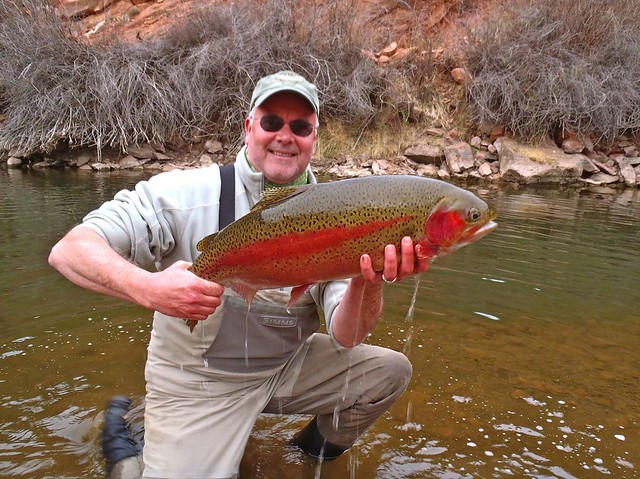
McKenzie River Wild Trout

McKenzie River Rainbows

Customers and our Caddis Shop guides are reporting seeing “a few” March Brown’s on our local waters. I have been on the mighty Willamette and did see “a few” March Browns for a very brief time around 2:00pm. With the forecast for showers, sun breaks, and cooler weather anglers should begin to see stronger hatches.

Last year, Chris and Ethan took a trip and Ethan shared some of his tactics and strategies regarding nymphing and swing fly’s during March Brown time. It never hurts to get a reminder about tactics or hatches.

Why swing two flies? Sometimes you get doubles. Sometimes on the upper fly I’ll put a bead head on to keep the flies from skating on top in the faster water. But honestly, two flies give you two chances. Even though the upper fly is on a much heavier tippet, the fish don’t seem to mind much.
A team of flies is always better. The other thing is you can experiment with different patterns. Sometimes on a bright day a drab fly works better, and on a cloudy overcast day you want to specifically match the hatch.

What is the leader set up? Leader length is 9-10 feet, tapered leader cut in half. Tie a blood knot and run the upper fly off the blood knot with a 2x loop to loop dropper. This is the most tangle-free way to go.

Shop customers or clients will ask “how do you set up for nymphing”? Chris has repeatedly shared what he has in this video below.

We have a full set of March Brown patterns in the shop. I have been using a version of the Royal Coachman Wet with Golden Pheasant tippets on the Willy.

Let’s have Spring and the hatch of March Browns begin!
-LV

Our library of march brown fly tying videos is below. Take it easy on us, some of these were filmed four years ago.

March Brown Fly Tying Videos:

March Brown Soft Hackle

Hidden Bead March Brown Soft Hackle

March Brown Coachman Wet

March Brown Sparkle Dun

March Brown CDC Emerger

March Brown Para-Wulff

March Brown Thorax Dun

Klinkhammer March Brown Emerger

March Brown Parachute

March Brown Nymph

Posted in Fishing Reports, Lower Willamette, McKenzie River, Middle Fork Willamette River fishing | Leave a comment

The March Brown Hatch Is On!

The new season, though not yet fully sprung, is actively springing. Crocuses and Daffodils are blooming, buds are on the branches, stream-side willows are in fuzz, and of course, the March Brown hatch is in full swing.

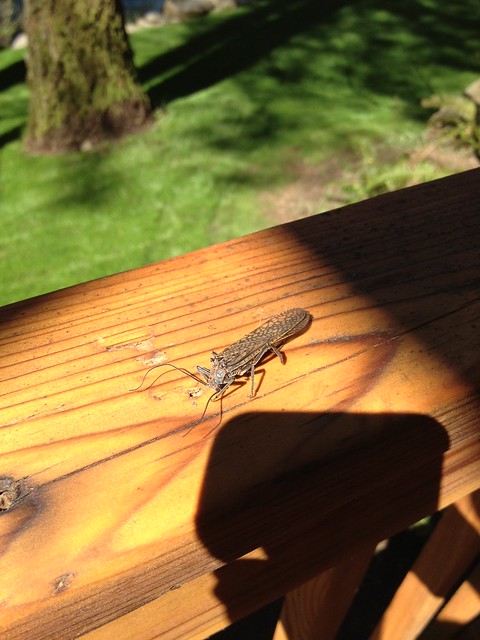
March Brown Adult

Previous to the March Brown hatch, local dry fly opportunities, though not entirely absent, are fairly meager. This is the first hatch of the year to bring the really big rainbows to the surface on a consistent basis. On warm, overcast and drizzly afternoons, the March Brown hatch can be a dry fly bonanza that will last for an hour or two, but when the skies are clear and the winds blustery, the hatch is often very sparse.

Yesterday I guided a single angler on the lower river, and though atmospheric conditions didn’t line up for a good mayfly hatch, the trout were still in a cooperative mood. They just wanted something a bit deeper in the water column. Our most productive flies, and I know this will come as a shock to many of you, were the Possie Bugger and Mega Prince. We were using a right-angle nymph rig with the terminal end about 6-7 feet beneath the thingamabobber, and just a single split shot to help the flies get down.

McKenzie River Wild Rainbow

It looks like this coming week will be a good one for dry fly fishing opportunities; there are a lot of clouds and showers in the forecast, yet the Advanced Hydrologic Prediction Service doesn’t foretell a big spike in flows, so hopefully the river will stay clear and fishable.

March Browns

March Browns

The nymphing before the hatch can be very good this time of year. Just before and during the beginning of the hatch swung wet flies are often the most productive way to go, doing a great job of imitating the March Brown emergers as they swim toward the surface. As the fish start to rise, it is time to move to various floating imitations.

March Browns

It is time to get out and enjoy the some of the best fishing for wild trout of the year on the lower McKenzie, and for those of you interested in a guided trip, don’t forget about our Spring special on half day trips.
-EN

Posted in Fishing Reports, Lower Willamette, McKenzie River, Middle Fork Willamette River fishing | 3 Comments

Water Master Rafts on the South Island

water master new zealand fly fishing

You can fly, walk, and drive to so many of New Zealand’s great trout rivers. Public access is excellent, and the typical day is spent walking upstream on rivers that can be crossed back and forth easily, as to approach each run, riffle or pool from the best position. Continue reading

Posted in Fishing Reports, Fly Fishing Gear Review | 4 Comments

Perfect Steelhead Stonefly Nymph – Great Lakes Pink

Steelhead eat nymphs. They just do. Whether by instinct or hunger or aggression or curiosity, they eat nymphs along with rocks sticks, leaves, feathers, Styrofoam, and eggs. Scrambled mostly, if I recall the research.

Great lakes fly fishers are deep into nymphing for steelhead, and they fish nymphs that are big and tiny, dark, subtle, and bright. Deschutes, Klamath, and Rogue River steelhead anglers here in Oregon fish nymphs when they aren’t soaking night crawlers, maggots, cured eggs, shrimp, rubber worms, jigs, or plastic beads. Yes, you heard it here.

This is a simple stonefly nymph with pink hues and fine rubber for the tails. Steelhead in the Great lakes will eat this fly. Steelhead in the Siletz, Alsea, Siuslaw, and Elk will eat this fly and its cousins too.

The fly is simple to tie and looks good in a box, but looks better in a steelhead’s jaw.

Jay Nicholas
February 2012

Steelhead Stonefly nymph

Perfect Steelhead Stonefly Nymph – Great Lakes Pink

Hook: Daiichi 1730 #6
Thread: Lagartun 95 D Black
Tail: fine grizzly barred rubber legs
Body: Hareline Speckled Crystal Chenille – Midnight Fire
Rib: Copper wire – small or brassie
Bead: Hareline Plummeting Tungsten Bead – 7/32 Fl. Orange
Legs/gills: American Saddle Clump – Pink grizzly

Posted in Fly Tying, Fly Tying Materials and Supplies, Oregon Winter Steelhead Fishing, Summer Steelhead | 6 Comments

Purple Steelhead Matuka Fly Tying Video

The Matuka is a fly style that apparently originated in New Zealand, using a feather wing over the body, to imitate bait-fish. Take that bit of history with a grain of salt, because it is likely that cavemen and cave women were tying their version of the Matuka and fishing it for mondo steelhead and trout at least 14 thousand years ago too. Maybe not with Lagartun thread, but still . . . .

As is usually the case, the Nicholas fly tying style tends to try to simplify and cut straight to the profile and essential form of fly patterns that can seem complex. My version of the Matuka, tied in various colors for steelhead, is a great example.

This Purple Matuka Steelhead fly is simple to tie and every bit as effective as the more complicated versions. Experienced Matuka tyers will decry the absence of a tinsel rib through the Rabbit strip, but I can tell you straight up that this fly will catch the big chrome boys and girls one-on-one with more complicated flies.

For the fly tyer who wants to spend more time on the water than at the bench, here ya go.

This fly has a bold silhouette and is easily seen by steelhead and salmon in dark water and low light. This fly is un-weighted to fish with sink tips; you could add a Tungsten bead in front of the Chenille body material and tie off the Rabbit strip over the bead, or wind on some lead wire under the body if you wish.

Jay Nicholas
February 2012

Purple Steelhead Matuka fly

Purple Steelhead Matuka Fly

Hook: TMC 7999 #3/0 – 4
Thread: Lagartun 150 D Black
Body: Crystal Speckled Chenille – Midnight Fire
Topping/Tail: Black Barred Rabbit Strip – Bright Purple
Hackle: American Saddle Clump – Kingfisher Blue Grizzly

Posted in Fly Tying, Fly Tying Materials and Supplies, Oregon Winter Steelhead Fishing, Summer Steelhead | Leave a comment

March Brown Klinkhammer Fly Tying Video

March Brown Klinkhamer

March Brown Klinkhammer

Hook: Daiichi 1167 Klink Hook #10-14
Thread: UNI 6/0 Black
Tail: Sparkle Emerger Yarn Brown
Body: Stripped Hackle Quill or Quills 2
Post: Brown Caddis Para Post
Thorax: Micro Fine Dub Red Quill
Hackle: Brown/Grizzly or Cree

Posted in Fly Tying, Fly Tying Materials and Supplies, McKenzie River, Proven Spring Fly Patterns | 2 Comments

NW Fly Fishing Expo Coming Soon!

2012 mag banner

A reminder the 2012 NW Fly tying & Fly Fishing Expo (nwexpo.com) is happening this week! This event for a fee of $5 bucks (free for veterans and anyone under 18) is a steal for learning just about anything regarding fly fishing. The event is sponsored by the Oregon Council of the Federation of Fly Fishers and is a venue for fly fishing and tying, casting and a number of seminars and classes. Among dozens of classes in four classrooms, four arenas and an outdoor pond are knot-tying, entomology of both dry and wet fly patterns, distance and precision casting, beginner’s techniques (casting, fishing and fly tying), seasons on each of several rivers (Crooked, Deschutes, etc.), fish-specific fly fishing (trout, smallmouth bass, etc.) and even some how-to for artistic fly displays.

HPIM1884

There is much to do and see at the Expo – You can take classes, talk to vendors, watch casting demonstrations, and a favorite of many is to walk around and view the tyers displaying their tying skills.

See you at the Expo!
LV

Posted in Uncategorized | 1 Comment

Starlight Leech 2012 Winter Steelhead Fly Tying Video

Al Bunell was a friend and fellow fly tier. A man of personal class and exquisite fly tying skill. One of Al’s specialty flies was the Starlight Leech. This is my version of Al’s fly.

Al left us behind during fall chinook season in 2007. Al taught me much about tying flies, and much more, and I miss him. He was always generous with his time and his skill. Thank you, Al.

The Starlight Leech is one of my favorite picks for winter steelhead, summer stelhead, spring steelhead, and fall steelhead. No kidding. In time, I will share this pattern in different colors, but always the same basic components, the stuff that drives steelhead to eat.

Jay Nicholas
January 2012

Starlight Leech Modern Version

Starlight Leech Modern Version

Hook: TMC 700 #2-6
Thread: Lagartun 150 x-strong Black
Tail: Black Arctic Fox and Hot Orange Krystal Flash
Body: Speckled Crystal Chenille Midnight Fire
Hackle: Black Saddle or Schlappen
Eyes: BalzEyes – Red
Head: Fl. Flame Chenille, medium

Posted in Fly Tying, Fly Tying Materials and Supplies, Oregon Winter Steelhead Fishing, Summer Steelhead | 4 Comments