Willamette River Report

Willy 141

The sky outside may not look like the above picture outside right now,…but the sun did come out earlier this week. Jim Y. and I took a quick trip down the Mckenzie and on to the Willy. I wanted to do some “recon” of the winter high water levels had on the river. What we found was not surprising. First, there were no obstructions at 3.9 feet (Harrisburg Gauge). Second, a few new gravel bars have appeared and will possibly improve the fishing in some locations. The cubic feet per second at Harrisburg during the winter flows, was anywhere from 38,000 to 40,000 CPS for days on end. Today, a softer, kinder, flow of 3,800 CPS was much appreciated. However, a storm is brewing and perhaps another week of high flows? Ugh!

I took a quick couple of water temps and the water was 49 degrees. The Middle Fork was pushing in the usual amount of discoloration. Lastly, the fishing! Ok, it wasn’t full flame on, white hot, mad dog crazy, or hatch crazy, but it was fair. The strangest deal was few March Browns and mega hatches of Caddis!

Willy 143

We did manage a couple of nice fish on a CDC Caddis Emerger. With some occasional rises, we tried sub surface and it paid off with a couple of nice fish.

Willy 144

One thing about the Willamette, nothing is for certain and we should always use caution while on the river. Safety is the key to any trip on the water. Let’s stay safe!!

Spring has sprung and its time to get outside and enjoy the great outdoors and maybe, just maybe, a few more fish!

Posted in Fishing Reports, Lower Willamette | 1 Comment

Spring Break Trout Fishing in Coast Lakes


Yep. Mentioned this last week and sure enough, the hatchery rainbow appeared in the Town Lake and Lake Hebo, close to my coastal range haunts last week. My son Jackson and I spent several afternoons in sun sharing water time, healthy snacks (ha ha) and catching some hatchery rainbow trout on nymphs.

Our first challenge was finding the fish, and that took about 45 minutes trying places where I had found them before. Eventually a school of fish showed themselves taking bugs on the surface and we moved to within casting range of the splashing.

Second challenge was finding a good technique. Size 12 & 14 Gold Ribbed Hare’s Ears in natural and black seemed good, and a new Chironomid tied at the Shop a month ago was a close second. We fished about 6 ft under the smallest Thingmabobber on day one, but the second day took a good nine feet of depth to get to the fish.

Trout definitely preferred to take a fly that we moved just an inch or so after sitting still for a few seconds, and we missed three or four fish for every trout we hooked.

Jackson and I fished two Echo rods. One was the E3 9 ft 4 wt and the other Echo’s new 5 wt Glass. The latter rod at 7 ft 10 inches was worlds different from the E3. Rod designers and world class casters like Tim Rajeff can talk and design all they want and I still don’t understand as much as I would like to. I rigged both rods with a 4 wt WF Airflo Elite fly line. Both rods cast the line well and the 4 wt Elite felt very comfortable on the 5 wt Glass rod. I have a hunch that the GLASS series may be just right for under-lining when we fish modern lines designed to load fast action graphite but want to test this further. Anyway, the WF4 Elite cast like a dream on the 5 wt GLASS.

No doubt, the Glass rod is a completely different animal than the E3. The Fast-action E3 has more power and is a superior rod for achieving a long reach. But gosh when a 9 or 10 inch trout was pulling on the end of the leader, the Glass 5 wt made it feel much larger than the E3 4 wt. The Glass allowed Jackson to cast a good 40 ft and I was throwing my clumsy bobber-clad leader a good 60 ft, plenty to cover the trout. Got to say, the softness of the Glass made me slow down on my cast, was easier for Jackson to feel in his learning mode, and made the trout seem a lot bigger than they were.

There were times when we got no tugs, times when we got two on at once, and plenty of interest casting to showing fish.

If you live anywhere in the McMinnville, Salem, Corvallis, Albany, or Lebanon area, these two lakes are pretty close, offer nice scenery, and have a lot of trout in them right now. Small boats and rafts or belly boats are handy, although both the Town Lake and Lake Hebo have bank and dock access for shore angling. Hebo has the best picnic facilities and nice benches too. Nothing but dock at the Town Lake.

Funny thing, I remember my friend Wayne Doughton steering his fly fishing customers to Lake Hebo back in the 1970s. I’m pretty sure they were planting hatchery cutthroat instead of rainbows back then. As the weeks go by, these fish will get larger, some are already in the 12 inch class now, and we saw families with 3 generations of folks stuffed into small boats catching fish on single eggs while we fished our flies.

Just saying the opportunities are there for people to catch a trout or several in the coming months, for those who are not wading or drifting places like the Mckenzie or Deschutes.

And for folks in the Eugene and Southward areas, there are plenty of just as nice trout fishing opportunities around for the next several months. Many lakes have native cutthroat plus the hatchery trout, and some have only natives. This is not a fishery about which I know a heck of a lot, but I believe that many of these lakes offer spectacular fly fishing and some big wild trout for tight-lipped anglers who take the time to delve below the surface.

Best of luck and good weather to you all.

JN
March 24, 2014

Posted in Fishing Reports | 1 Comment

WaterWatch: Oppose S. 1630, the “Water Rights Protection Act”

Via our buddies at WaterWatch of Oregon:

Please contact Oregon’s U.S. Senators Ron Wyden and Jeff Merkley today and ask them to oppose S. 1630, the “Water Rights Protection Act.”

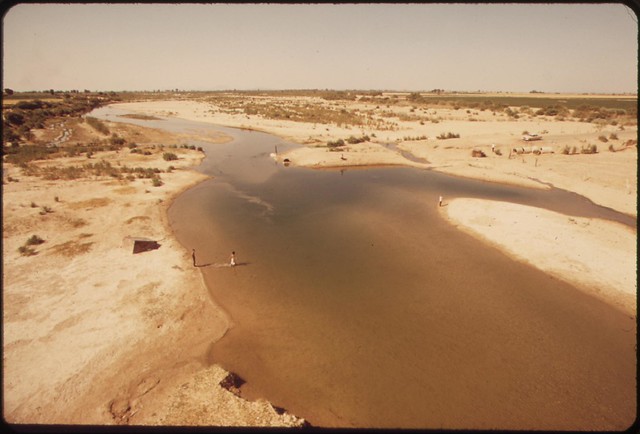
Colorado River at Mexican border, May 1972

A companion bill, H.R. 3189, has already passed the House of Representatives, so we need your help now!

S. 1630’s stated intent is to help resolve a narrow conflict over water rights between the U.S. Forest Service and Colorado’s ski industry. However, as currently drafted, the bill would have serious implications for water management across the country and undermine efforts to improve the health of the nation’s rivers and public lands, including National Parks, National Forests, and National Wildlife Refuges.

S. 1630 would prohibit agencies from requiring conditions that “impair” any water rights. This would greatly inhibit the ability of Department of Interior and Department of Agriculture to protect rivers, wildlife, and public lands.

The bill would also weaken federal laws that allow agencies to place conditions on permits or licenses that would keep water in rivers to support struggling fish and wildlife, or protect instream recreation. It could also preempt state laws that allow the Forest Service to require water diverters to leave some water in a stream on Forest Service land, or stop the U.S. Fish and Wildlife Service from requiring flows that attract fish to fish ladders so that they can safely pass over dams.

WaterWatch and our conservation allies around the country have already come out strongly in opposition to this bill. Please help us get the message across, and take a moment to contact Senators Wyden and Merkley to urge them to oppose S. 1630!

Contact Information:

Senator Jeff Merkley
Web Contact Form
(202) 224-3753
313 Hart Senate Office Bldg.
Washington, D.C. 20510

Senator Ron Wyden
Web Contact Form
(202) 224-5244
221 Dirksen Senate Office Bldg.
Washington, D.C. 20510

Background

According to the Congressional Research Service, the Water Rights Protection Act “Prohibits the Secretary of the Interior and the Secretary of Agriculture (USDA) from:

(1) conditioning the issuance, renewal, amendment, or extension of any permit, approval, license, lease, allotment, easement, right-of-way, or other land use or occupancy agreement on the transfer or relinquishment of any water right directly to the United States, in whole or in part, granted under state law, by federal or state adjudication, decree, or other judgment, or pursuant to any interstate water compact and such Secretaries; and

(2) requiring any water user to apply for a water right in the name of the United States under state law as a condition of such a land use or occupancy agreement.”

Sample Letter

Dear Senator,

As an Oregonian who loves our state’s rivers and public lands, I am writing to ask you to oppose S. 1630, the “Water Rights Protection Act.” Conservation groups around the country have already come out strongly against this bill.

S. 1630’s stated intent is to help resolve a conflict over water rights between the U.S. Forest Service and Colorado’s ski industry. However, as currently drafted, the bill would have serious implications for water management across the country and undermine efforts to improve the health of the nation’s rivers and public lands, including National Parks, National Forests, and National Wildlife Refuges.

S. 1630 would prohibit agencies from requiring conditions that “impair” any water rights. This would greatly inhibit the ability of Department of Interior and Department of Agriculture to protect rivers, wildlife, and public lands.

The bill would also weaken federal laws that allow agencies to place conditions on permits or licenses that would keep water in rivers to support struggling fish and wildlife, or protect instream recreation. It could also preempt state laws that allow the Forest Service to require water diverters to leave some water in a stream on Forest Service land, or stop the U.S. Fish and Wildlife Service from requiring flows that attract fish to fish ladders so that they can safely pass over dams.

For all these reasons, I ask you to please oppose S. 1630.

Posted in Oregon Conservation News | 1 Comment

Fly fishing for sea-run cutthroat in Puget Sound

After reading Chester Allen’s book “Fly Fishing for Sea-Run Cutthroat“, my fishing buddy Doc Reedy bought me a copy, and we took his class on the subject at the Albany Expo. When Chester invited us up for a day of fishing, we jumped at the chance.

In retrospect, I think we were a bit eager, we didn’t see many Chum Salmon fry, and they were quite small – I think our cold weather this winter slowed them down, but the cutthroat we did find were looking for them, and went for the fly aggressively. In another couple weeks it should be in full swing, through May.

It was a rich, different environment to fish, with the salt air, clam beds, birds, etc, and no one other than the occasional group of shellfish workers – all 20 minutes from bustling Olympia. The spring out-migration of chum fry into the salt, by the millions, brings the fry to the shallows, seeking safety, and the opportunistic cutthroat, to line up on seams and rips and wait for dinner. The fish we caught were 10-15 inches, fat and strong, fish to 20″+ are out there.

Stealth is in order when approaching a rocky beach, most littered which clam shells, as while they are aggressive, they are also alert. To avoid injury to the fish, hooks should be barbless, and not too large – size 8-12, and saltwater safe (tinned or stainless).

Finding public access on Puget Sound is initially daunting, most of the 2500 mile coastline is privately owned, and much of the south sound also home to a large shellfish industry, one beachfront property at a time. But by looking for light green patches on the map, and boat landings, roads on the map that end at the water, etc, one can find fish-able water.

You want a beach with rocks on it, the mud flats can be treacherous. The fact that the entire sound is catch and release for cutthroats means there is little fishing pressure, and the shellfish interests support water quality efforts, to the benefit of salmon and cutthroat trout.

The weather was perfect – overcast but not raining (not that the fish mind the rain), and the fishing good. Chester’s book is both an enjoyable read and full of detailed information about a unique fishery.

ML WEBB

Posted in Fishing Reports, Fly Fishing Books | Leave a comment

Lower McKenzie River Trout Fishing Report

LowerMck2

To the sound of the background music of “At Last”, the river is beginning to drop and allowed us a quick drift on the lower McKenzie this week. The March Brown hatch has begun. Not strong in numbers as yet, and with little surface activity.

Nymphing was the key to success for Jim and Kirk aboard the Beast. The Mega Prince and Posse Bugger were the most productive. With the water level high and swift, getting nymphs down along the bottom was must. However, swinging a March Brown soft hackle provided one nice Redside.

We have some really nice weather coming in the next few days and the river is continuing to drop. This should increase the hatch activity and increase the water temp a bit more to making fish gain an appetite.

2014-03-19 11.35.58

Lower Mck3

LV

Posted in Fishing Reports, McKenzie River | 4 Comments

Fly Fishing Links: Geirach and Geobass

John Geirach has a new book out, All Fishermen Are Liars. Great quote from the video trailer… “You can’t waste your life making money, and then go back and try to buy your life back.”

He’ll be in town April 21st at Angler’s Book Supply. Stay tuned.

GEOBASS is a new epic adventure series following four expedition anglers on an around the world ultimate bass slam journey. GEOBASS episode 1 takes place on one of the most hostile waterways of Colombia. So no guarantees on an episode 2. See more at #GEOBASS.

In other Oregon-related fishing news, John Montana has lots of great looking carp hats. Check ’em out. Also, our man Pete has a solid ramble on the mindset that led him to cast to ladyfish until his elbow exploded.

Happy Friday people.

Posted in Oregon fly fishing links | Leave a comment

Native Fish Society Banquet April 11th 2014

header2

Friday, April 11 2014, the Native Fish Society, 300 wild fish supporters, and 100 generous donors come together under the big top at Montgomery Park in Portland, OR to create the largest wild fish fundraiser/party in the universe. We hope to see you there!

For registration information click here.

Posted in Oregon Conservation News | Leave a comment

March Madness Sale Item of the Day: Simms Fall Run Jacket

yhst-17105658520519_2272_1569987986

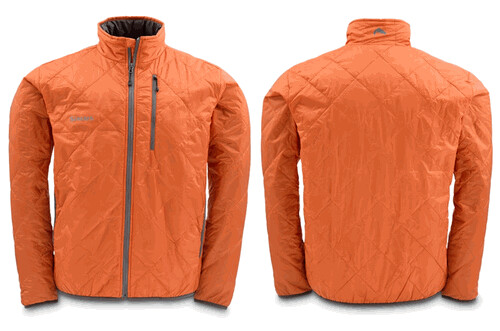
Packable and visible in Fury Orange the Simms Fall Run Jacket is a great insulation piece for those cool and sometimes windy Spring fishing days. Get it now while they last for only $119, regularly $179. Online here, or give us a call at 541 342 7005.

Posted in Shop Sales and Specials | Leave a comment

Late Season Steelhead Show – March 2014

Yes it is mid March, and time when steelhead season often winds down. This year however some rivers are seeing more winter steelhead than they did earlier, so for those folks who still have the energy, there are indeed fish around to show a fly. Or whatever you want to show ’em. Whatever that means.

I had the opportunity to fish a little last few days and found a few fish. Photos attached, and please, no comments from wise persons who notice that this is only one fish photographed from seventeen different angles. It may be the case, but let’s be polite, and pretend that I might have caught more than one even if I didn’t. Thank you so very much.

JN

Posted in Coastal Steelhead Fishing, Fishing Reports | 3 Comments

McKenzie Memories April 4. 2014

Prince and Marjorie Helfrich on the McK Pass 1930
Prince and Marjorie Helfrich on the McKenzie Pass circa 1930

McKenzie Memories
Friday, April 4th, 2014 from 6-8:30 pm
At Cozmic – 199 West 8th Ave in Eugene

Tickets: $10 – a fundraiser for the McKenzie River Trust

Join the McKenzie River Trust for another unforgettable paddle down memory lane with storytelling, music, rare historic films and photographs. The evening will kick off with live acoustic music. Then Dave Helfrich will share early family stories as we celebrate the 100th anniversary of the Helfrich family up the McKenzie. Also, learn about the evolution of the McKenzie Wooden Drift Boat with historian and author Roger Fletcher, and hear River Stories presented by the University of Oregon Environmental Leadership Program. Randy Dersham will be our guide for the evening. This event has sold out two years running, so buy your tickets today!

Live Auction
This year at McKenzie Memories, a very special adventure awaits one lucky person.

We will be offering a brief live auction including a memorable afternoon floating down the great McKenzie River with Dave Helfrich at the oars. Dave will share his personal memories and stories of his family’s 100 year history on the river along the way. Lunch will be provided riverside. Dave Helfrich generously donated his time on the river for this unique experience to help raise money for the McKenzie River Trust’s work to protect the lands and rivers in western Oregon. So come ready to bid for this memorable experience!

Buy Tickets Now
If you share our love of Oregon’s wild McKenzie River and its remarkable history, this evening of storytelling and films is not to be missed. If you wish to buy your ticket, click here!

Driftboat terminology

Kickoff the April Matching Gift Challenge
McKenzie Memories kicks off a month-long Matching Gift Challenge offered by our friends at Mountain Rose Herbs. From April 1st through 30th, every dollar donated to the McKenzie River Trust will be matched dollar for dollar up to $5,000 by Mountain Rose Herbs! Your donation will help protect and care for special lands and the rivers that flow through them in western Oregon.

And if you donate $100 or more from April 1st to 30th, you’ll receive our new ceramic mug.

To donate online, click here.

For more information about McKenzie Memories contact Brandi Ferguson, Development Manager at 541-345-2799 or brandi@mckenzieriver.org
Photo credits to Roger Fletcher & Randy Dersham.

LV

Posted in McKenzie River, Oregon Conservation News | 1 Comment

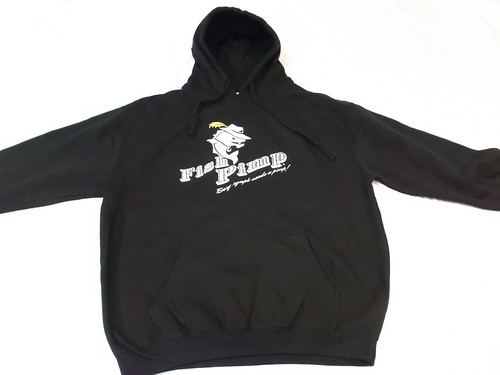
March Madness Sale Item of the Day: Fish Pimp Hoodie

product-hoodie-main

Complete with Fish Pimp slogan “Every Nymph Needs a Pimp” the Fish Pimp Hoodie is on sale now for only $29.95. Check it out online or give us a call at the shop. 541 342 7005

Posted in Shop Sales and Specials | Leave a comment

SIMMS G3 Boot Foot Guide Wader Review: Five Star Performance


Thank you SIMMS, for finally delivering the goods. I’ve been wearing my old set of Simms Bootfoots for the last 4 years, and Eric Nufeld (dear friend and SIMMS rep) was getting a little tired of hearing my annual pestering about bringing back these waders for us mostly boat-oriented anglers.

Be patient Jay, he’d say, you’ll get your new Bootfoots soon enough, but you won’t get ’em until Simms is sure they will knock the ball out of the park in terms of upgrading from their old model.  And how are your old boots doing anyway, he’d ask, smiling, to which I’d reply – still going strong, just a little seepage in the foot, nothing to complain about really, to which he’s smile again, and tell me that was one of the things Simms wanted to address before bringing the latest-greatest Bootfoots to market.

OK, got it Eric, I’d say.

The product development people at SIMMS were being really perfectionist about developing these waders.  Eric explained that the process of building World-Class Boot foot waders wasn’t as simple as I wanted to believe, and that the wait would be worth it.

Well, the wait was indeed worthwhile. Head-and-shoulders better than my last Boot Foot waders, the new SIMMS G3s are by far the best I have ever worn.  Ever.

First, allow me to explain my preference for bootfoot waders versus stockingfoots.  Simple:  a) 99% of my fishing these days is out of a boat, b) entry and exit time wearing bootfoots is super fast and comfortable, and c) bootfoots represent the most simple and comfortable wader option when I fish dawn to dark – day upon day, week upon week, season’s start to season’s end.

I finally got my new G3 bootfoots and I’ll run down some of the key features.  Be advised, I am a loyal SIMMS wearer, based on decades of practical experience; honestly, I expected these waders to be good, and that expectation could have biased my reaction, but when I slipped into these beauties, I found they were better by far than my last set, I took a close look at ’em, and here is why I believe they are a truly superior Bootfoot wader.

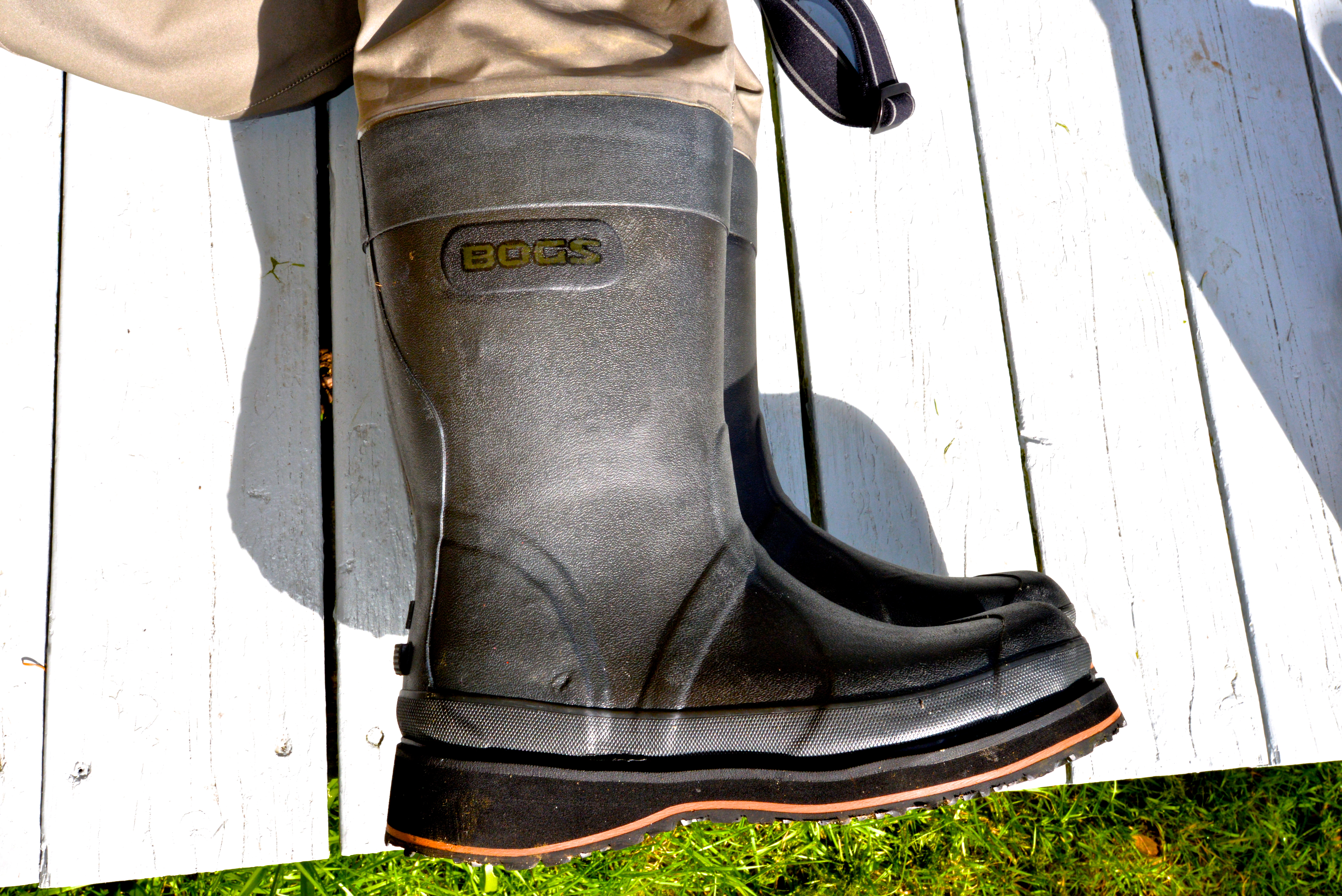
The Boots. These Bogs Boots are far more solid and substantial than any Wader Bootfoot I have ever worn before.  The foot bed is solid and there is serious ankle support, again, far better then any I’ve experienced previously.

The soles. I selected the lug soles, the SIMMS Streamtread, to wear in the boat when I’m fishing the estuary.  No need for felt here where mud or sand is the rule if I get out of the boat.  I also got felt soles for the times I am fishing upriver and want to get out and wade the gravel bars and sandstone in nearby coastal rivers.  Frankly, these two sole options are very nearly as firm and supportive (I think) as on the best wading boots one would wear over stocking foots. True, you don’t have the lace-up stability of the boots, but these Bogs Boots are a different breed of solid than I have ever worn before and I like them.

Note: you can add screw-in cleats to the StreamTread soles if you wish.  I prefer not to have cleats in the boat when I’m fishing the estuary (I always stand on my fly lines), and my Dory friends don’t want my wearing cleats in their glass or wood-decked Dories either.  But for many people, the non-felt, StreamTread sole with screw-in studs might be a great option.

The wader fabric. Oh yes my wait was well rewarded.  These 2014 SIMMS Bootfoot waders have the Gore-Tex Pro Shell material previously reserved for the G4 series; a material 25% more breathable than previous generations of wader material, with 5 layer in the lower leg and 3 layer in the upper wader.

Leg Seams.  SIMMS leg seams are front and rear of the leg, a design selected to prevent seam snagging when legs rub together – this is not an issue for me standing in the boat hour upon hour, but for anglers who are hiking miles each day, the no-inseam seam-design is a major advantage.

Neoprene inside boots. 6mm Neoprene is both comfortable and warm and that can make a huge difference in cold weather wading.

Suspenders.  Substantial, sturdy, easy to adjust 1.5 inch elastic.  The clips allow one to convert the chest wader into a pant, which I find a great option on balmy days out in the bay and in the nearshore Pacific on sunny afternoons.

Other features. Belt loops. 2 inch stretch nylon wader belt. Reach through hand warmer zippered chest pocket.  Inside pocket that is removable, to handle tippets including Maxima sized spools, and other slim items.

If you travel by air: Bootfoots will pack with less mess and moisture, in my opinion, than soggy wading boots that plus Stockingfoot waders.

Entry and exit time. Some people may relish the process of squirming into Stockingfoot waders and lacing up boots. I do not. Yesterday I slipped into my Bootfoots in something like fifteen seconds, including the time to clip on my belt and Stream Works pliers.  No, I did not actually time it.  I’m guessing at how long it took, but honest to goodness it is fast and clean to get in and out of those boots.

Who might consider these Bootfoot Waders? Tons of us PNW salmon and steelhead anglers fish from boats.  These waders make far more sense than Stockingfoot waders.  Lug StreamTread boots, with or without cleats, or felts are absolutely fantastic boat waders and allow us to be ready to exit the boat to land fish, to wade fish, and when launching and loading our boats at ramps.  Duck Hunters ought to love these boots too.  Remember the easy-in and easy-out feature, and the no-soggy dripping boots on the trip home.

Who might NOT want the Bootfoots? Hummmmmm.  Not absolutely sure, but I think that if your style is putting on miles hiking each day, up and down trails and over boulder fields, in that case, the Stockingfoot with separate wading boots might be more comfortable and secure on very uneven terrain.

My daily routine usually involves getting into my Bootfoots in the dark, driving to where I will fish, fishing till dark, and sometimes driving back to the cabin in the dark.  I hang up my waders overnight and then slip back in the next morning.  I only have a month into my new SIMMS Bootfoots this season, but I know how my old waders performed, and I can tell you that these are an absolutely fantastic upgrade over waders that I already loved.

Jay Nicholas, March 2014

Posted in Fly Fishing Gear Review | 1 Comment

Oregon Coastal Lakes Trouting


Time to do some serious thinking about trouting in any of the multitude of Oregon coastal lakes. Sure, steelhead are still nosing into our rivers, but for many people with a love of stillwaters fly fishing, these can be really interesting times. Wild cutthroat are present in many of these lakes, and there is a pretty solid hatchery stocking program ramping up in many of these lakes as well. The stocking schedules are found at the ODFW link shown below.

http://www.dfw.state.or.us/resources/fishing/trout_stocking_schedules/

Trout can range from 8 inches up to several pounds in size. These fish can be easy to catch one day and frustratingly difficult to entice the next day, or even from hour to hour.

Flies to consider (hint: we have a great selection at the shop and a quick call will allow us to develop an effective assortment if this is a new venture for you) include:

1. Bead head Hare’s Ear in natural, black and olive – sizes 12-16.

2. Chironomids, mostly in 12-14 in black, red, brown. Some of these should be very lightly weighted or not weighted at all.

3. The Carey Nymph in size 8 – 10.

4. Any bugger style of fly in olive or black sizes 8 – 14.

5. Damsel nymphs.

6. Pheasant Tail Nymphs, sizes 12-18.

7. Any streamer style fly like the spruce, royal coachman, and the like.

8. Dry flies will come into play on warm still afternoons too, and these can be little or big flies in sizes 8 – 16.

On Technique: streamers should be fished with a little action, either a twitch or a steady slow retrieve.  Nymphs may be trolled behind float tube or boat, cast and stripped back in, or suspended below a very small strike indicator.

I have had some very enjoyable and challenging fishing for trout in coastal lakes from this week through the middle of April, when my attention drifts off to Spring Chinook.

Many of the coastal lakes offer relative solitude and an opportunity to hone casting and fishing skills for beginner and expert alike.  If you go, may you have a blast of a good time.

If you do not have a boat or  belly boat yourself and would like to participate in this entertaining fishery, Jack and John Harrell offer guided trout trips near Pacific City and would be able to provide a very enjoyable family day on one of the nearby lakes for a half day, easy going fly fishing.

Jack can be reached at 541 921 1276, if he isn’t out on the water.

JN March 2014

Posted in Fishing Reports | 1 Comment

Hareline Synthetic Quill Body Wrap

HD pic 3

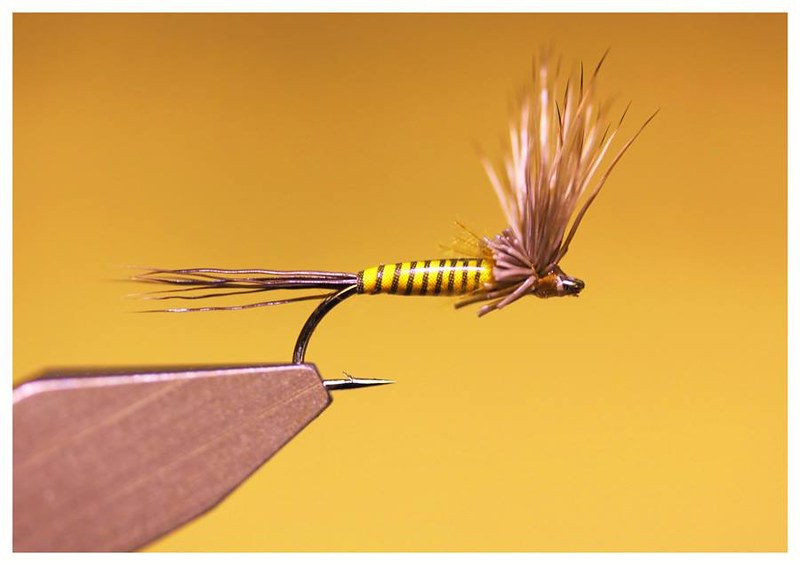
Within a few more days it will be official, spring will arrive! Not that some of us will give up chasing chrome native steelhead, in a few more days, but the official pursuit of those beautiful native Redsides will commence! With the thoughts of dropping river levels during those wet/snowy wonderful (?) winter days, I was busy tying up my favorite pattern, the Comparadun. I use a variety of materials and colors for the body from super fine dubbing to goose or turkey quill bodies. The wing is usually deer hair or bleached elk hair. I use moose hair for the tail to provide extra flotation. I use Alec Jackson’s North-Country Trout Fly Hooks Size 9.

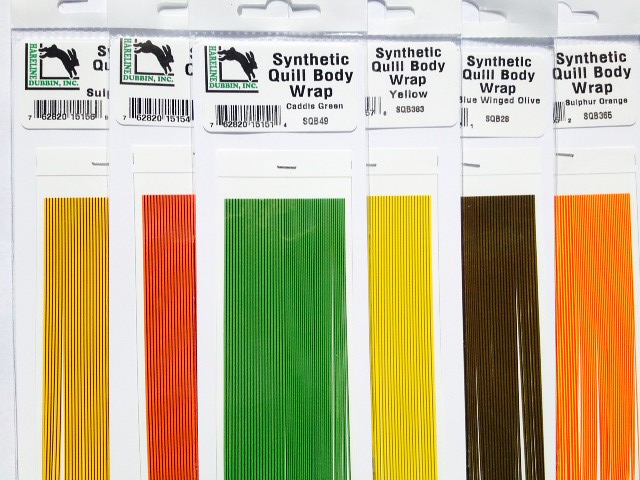
I got the word from the guys at HareLine there might be a something else I should consider; Synthetic Quill Body Wrap. Using natural quills for fly bodies is sometimes not the easiest process. The synthetic body material gives you much more in length to handle and it looks like the real quill body.

As with any quill body you have to coat it with a thin layer to prevent the dentures of those wild Redsides and Cutthroats from tearing it to shreds! I have found a thin layer of Clear Cure Goo Hydro gives you a tough coating for a mighty fine looking fly. I look forward to complaining how my fly gets torn up because too many fish chose to pursue it.

The Quill Body Wrap comes in a good variety of colors and let’s not forget: red Synthetic Quill Body Wrap is a good bet for Choronomids! The ice off is coming…? Ok, maybe in weeks verses days? Get out there and enjoy the coming spring!

LV

HD Pic 1

Posted in Fly Tying, Fly Tying Materials and Supplies, Uncategorized | Leave a comment

March Madness Sale Item of the Day: Umpqua Deadline Duffel

Today’s smoking deal on over-stocked items from The Caddis Fly is the Umpqua Deadline Duffel.

yhst-17105658520519_2272_1579620363

The Deadline Wet Dry Duffel can be worn as a pack or carried as a duffel. It has a completely waterproof compartment to keep wet gear away from dry gear so it’s ideal for wading equipment. It has plenty of room for lunch, extra reels/spools, boots, dry shoes and clothing. You can use the Deadline as luggage on a trip or storage at home or in your vehicle. The Deadline Duffel is extremely versatile. While they last we are offering them at 30% of the normal $159.95, making the sale price a screaming deal at $112.00.

Call the shop now to get one or two. (541) 342-7005

Posted in Shop Sales and Specials | 1 Comment