Reminiscing on summer months I was recounting my annual trip to the Midwest’s Driftless Area spring creeks. This past summer I tried something new: mousing for large brown trout. This is an exhilarating method of fishing that, unfortunately in Oregon, we cannot do. Fishing for salmonids after sunset is strictly prohibited in Oregon. There is nothing stopping you from taking a trip to indulge once things warm up.
Many seasoned anglers are familiar with the term “mousing”. For those that this is a novel term to, mousing refers to targeting fish using a floating mouse fly. It is most commonly associated with large brown trout that feed nocturnally, but mousing can be done for bass, jungle species, other types of trout, etc. It also is not restricted to the night; in Alaska people target large resident rainbow trout using mice. Generally through, when you hear someone across a fly shop talking about mousing, they are talking about chasing aggressive brown trout at night.

The best time to go is when it is dark out, which may come obvious. The level of darkness is generally correlated with better fishing; the more dark the better. This generally means avoiding full moons and timing your mousing trip close to the absent new moon. Most of my mousing on my trip was done over a few nights between the 11pm and 2:30 AM. Minimizing light also means only turning on your headlamp or flashlight when absolutely necessary. This is especially important on the small intimate spring creeks of the Driftless Area that sometimes are a few feet wide.
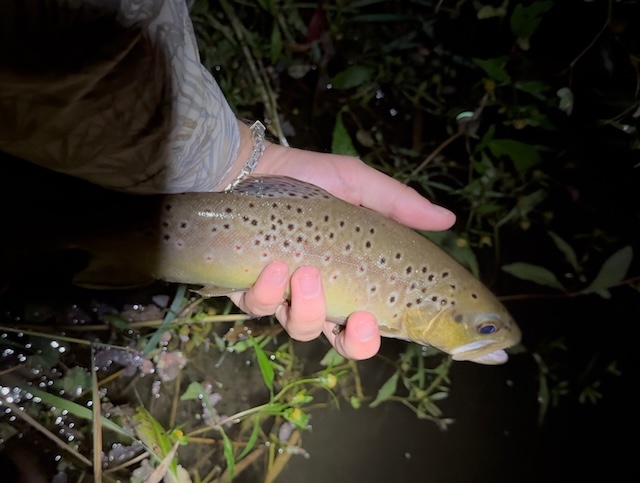
Mousing most importantly requires a mouse. Knowing the size and temperament of the fish you are targeting is helpful when choosing the size of your mouse … or rat. In the jungle of South America Chris has told me stories of throwing rat sized mice for golden dorado. Throwing Squirrel sized rodents for Taimen overseas is not uncommon. Generally I like to start with a medium sized mouse and size up or down based on what I encounter. I feel it is a good way to probe unfamiliar waters.

My top choices for searching mice are: Rio’s Pip Squeek or a Preparation H Mouse. The Pip Squeak has a trailing hook and the Prep H is tied on a classic Salmon/Steelhead hook setting the hook towards the rear. Fish sometimes short strike mice so I always look at the hook placement. If I need a smaller mouse my absolute favorite is the RIO Pip Squeak Baby. For larger mice that blue the lines between mouse and rate try the Satkowski’s Headbanger Mouse . Other options using deer hair are the classic Morrish’s Mouse with or without a trailer or a Mini Mouse. Deer hair mice are great at pushing water, but can bounce off of a trout’s mouth when they try to eat it. I’ve found that I prefer the foam and rabbit strip variations, and get more consistent hookups.

Technique for mousing varies but generally it involves swinging or stripping the mouse across attractive holding water. Generally this is a glossy glide or pool where the wake of the mouse will be more intrusive on the calm surface. This is why mice are designed to push water and drive predatory fish nuts as they pick up vibrations with their lateral line. Mice are surprisingly confident swimmers, so generally swinging is the preferred method. The most difficult part of mousing for browns is not pulling the mouse out of the trout’s mouth. You need to use a significant amount of restraint and not trout set early, yanking the fly out of the trout’s mouth. Instead you need to be patient and feel the take and strip set hard. Another method that helps is tagging a small streamer off of the back of the mouse off of heavier Scientific Anglers Fluorocarbon 3x-0x is the size you’d be looking at depending on the size of the trout. Here are a few good options for your tandem mouse/streamer rig: Rubber Legged Jigged Soccer Mom, Conehead Slump Buster, Conehead Kiwi Muddler, Coffey’s Sparkle Minnow, or the trusty Thin Mint.

There are a variety of items that make mousing much more easy. First a good headlamp or light is necessary even though the goal is to keep it off as much as possible. Using some sort of glowing substance to track your mouse is extremely helpful. Scientific Anglers released their Indicator Markers last year and they have countless uses. I always have one in my pack. The glow color can be charged with a light, but a UV torch is even better. Ive found that the Loon UV Bench Light fits easily in my pack and charges the SA Marker 2-3 times as long as a headlamp. If you tie your own flies, incorporating Atomic Glow Sheets into the fly is fantastic. You can see them incorporated into an articulated mouse that I designed. Having good Fluorocarbon tippet is essential, especially when doing a tandem streamer rig. My favorite is Absolute Trout Fluorocarbon Tippet in 3x-0x depending on your fishery. Lastly having a good line to turn over flies is crucial. A delicate trout taper is what you do not want. You need a line with a powerful taper such as a Scientific Anglers Amplitude Infinity or a Scientific Anglers Amplitude MPX Fly Line. This must be paired with at least a 5 wt, but a 6 is even better. Anything below a 5wt would only work well throwing the RIO Pip Squeak Baby. Some good rod options are: Winston Air 2 , Sage R8 Spey , Scott Centric, Scott Session , or an Echo Trout X. All of these rods are powerful and have ample backbone to turn over a wet mouse. For tighter water I’d choose a rod closer to 8 feet and if you have more space a 9’6 works great. I personally use a 9’6 Sage Sonic with a Scientific Anglers Amplitude Infinity.

Unfortunately to chase large nocturnal browns at night you must leave the state of Oregon. Traveling opens up tons of options and there are rivers in neighboring states that offer shots at massive brown trout. My last trip yielded some decent sized browns, but the massive 24+ inch browns of the Driftless eluded me. What a great reason to make a trip back to one of my favorite small stream destinations. If you want to try your hand at mousing some big browns up, swing by the shop, we are happy to get you geared up.
-Simon