Colombia Peacock Bass Trip Report – March 2021

IMG_3392

Cash and I joined Jon Covich of Flywater Travel and three other anglers for a Peacock Bass adventure in remote eastern Colombia. Flywater Travel handled our booking with Afloat Tours. Our trip was fantastic. Filled with new discoveries and exciting fishing I highly recommend this trip.

We flew through Miami to Medellin where we stayed in a nice hotel ( Hotel Diez ) in the EL Poblado neighborhood of the very large ( Pop. 6.5 million ) city of Medellin. The hotel is located in a great neighborhood with numerous restaurants, coffee shops, and retail shops. It was easy to walk to dinner our first night and last night.

IMG_3097

jon-covich-photos31

The next morning our group was transported by an Afloat representative to the regional airport where a charter plane flew us approximately 1.5 hours east to the agricultural hub of La Primavera. After a quick lunch we drove approximately 3.5 hours to the “Gavilon” River (meaning Osprey in the local Spanish Translation). The long drive over rough road took us through rough farmland and scattered jungle along waterways. The Afloat Camp staff greeted us and after quickly loading supplies and our gear motored us up river about an hour to camp.

IMG_3134

IMG_3126

IMG_3149

IMG_3162

The Afloat Camp is highly organized and powered 24 hours a day by generators. The three owners of Afloat Adventures are young enthusiastic service-oriented guys looking to expand their tourism operations throughout Colombia. We found Simone and his crew to be thoughtful and willing to jump at any request. Two anglers shared a floating cabin complete with shower, toilet, lighting, two power outlets, fans, basic beds, mosquito netting (we never used) and a small storage unit. Each morning you were picked up and dropped off from your floating cabin deck.

jon-covich-photos-6

IMG_3225

Breakfast was served each morning between 6am and 6:30am. Coffee was available earlier if needed. The camp is well located on a massive beach, perfect for enjoying sunset and sunrise from your cabin or while sitting around the fire. Traditional Colombian food, pork, arepas, eggs, potatoes, fruit and much more were served for breakfast throughout the week. The food was really good, not fancy but really good. Often for lunch one of the camp boats would come up river to meet our group of anglers and prepare a wonderful shoreside lunch of chicken, pork, rice, salad and other tasty dishes. It was a nice touch that saved fishing time. Dinner was served around 7pm and again was largely Colombian fair. Wine, beer, water and soft drinks were always available in camp and on your boat. Temperatures often exceeded 90 degrees Fahrenheit during the day and never really got cooler than the high 60s at night. It was hot!

IMG_3353

IMG_3268

jon-covich-photos24

The fishing program we booked included 6 full days and 7 nights in camp along with two nights in Medellin one on each side of our stay. Fishing days began around 7am where our guide Jorge would pick us up. Rods loaded we would head up or down river depending on the beat assigned. Peacock Bass fishing is a blast! I have no idea how many thousands of casts we made but the tactic employed largely consists of casting an 8 or 9wt rod with a floating, intermediate tip, or fast sinking tip line towards structure, cover or defined depth, and retrieving your large baitfish pattern. Each cast brings hope that a lively and color Peacock Bass will abruptly interrupt your retrieve. Leaders consist of a single piece of 60lbs mono or fluro tippet 3-5ft in length, super technical I know… Our fishing was very good. Overall the guides, owners and Jon, who had done the trip the same week last year, felt that the fishing was much tougher this year. Nonetheless we had a great time catching plenty of fish every day. Fish ranged in size from 1-20lbs. The river color varied from clear to brown depending upon depth and location. Most of the time your fly was visible early in the retrieve and then would disappear in depth but vicious strikes were visible despite the water not being clear. We did have some really cool sight fishing on shallow clear water beaches where we cast to sighted Peacocks. Each fishing day included a stop for lunch and ended around 6pm, sunset in this part of the world. Days are long and enjoyable. You are in the heat all day with very little shade, hydrating is critical. Coolers were loaded and then loaded again at lunch with water, Gatorade, and beers.

IMG_3455

IMG_3257

jon-covich-photos-9

jon-covich-photos28

jon-covich-photos27

jon-covich-photos18

jon-covich-photos-15

jon-covich-photos11

jon-covich-photos-5

jon-covich-photos-4

jon-covich-photos-3

The bird life in this area of Colombia is mind boggling. Each day we observed new species and when I return it will be with a bird I.D book in hand.

IMG_3273

IMG_3299

jon-covich-photos20

Caymans, iguanas, snakes, Tapir, Capybara, Jaguar, and monkeys inhabit the jungle edge of the river. We saw all but snakes and Jaguars during our stay. Most mornings the guttural calls of the Howler Monkeys were in full effect, it was awesome. There are undoubtedly more species here than I am mentioning. As with the inhabitants of the water I was amazed at how many species resided in the area. Other than Peacock Bass we caught Bicuda, Arawana, Pirana, Catfish and Plako ( last two by collecting sunken logs ).

IMG_3965

IMG_3437

jon-covich-photos17

IMG_3557

jon-covich-photos26

jon-covich-photos23

IMG_3337

jon-covich-photos-1

There are innumerable insects and some do bite, so covering yourself both from the sun and the bugs is vital. After the sun went down the bugs subsided but during the day we were covered from head to toe in lightweight angling apparel. We even wore socks while in the boat as to protect feet from bites and burns but still be able to tell whether you were stepping on the line or not.

IMG_3541

Gear:

Fast action 8 and 9wts

RIO or SA Jungle Lines, must have floating, intermediate and fast sinking versions with you.

60lbs Mono or Fluoro

Flies should be 1/0-4/0 – our best flies were Rainy’s CF Baitfish, CF Whistler and variations of “Bulkhead” ties on the new Ahrex PR378 hook. EP Jungle streamer and baitfish in 2/0 to 4/0 are also great. Key colors seemed to be white and chartreuse, white and olive, white and sand, white and chartreuse, orange and chartreuse, black was not liked by the guides at all.

Sun gloves and stripping finger protection critical.

jon-covich-photos19

Notes:

The Afloat season is short, only 12 weeks Jan-March. It’s the dry season in this region so the later in the season the lower the water. How this translated to fishing I really can’t say.

Having a couple of extra days in Medellin would be a good idea and Jon Covich can help with organized tours.

Guides spoke almost no English so having Spanish language or an app on your phone would be really helpful. Even just brushing up on “fishing Spanish” would be a good call.

Embracing the camping feel was really fun, showers were river water piped into your room, water temps are between 80-90 degrees. Evening campfires before and after dinner were great. Local musicians came and played traditional music one night.

IMG_3274

IMG_3637

Despite the heat we did have two epic night time storms and the floating cabins handed the rain and wind with ease.

We loved this trip and are planning on doing it again in 2022. If you have interest in joining us in early March of 2022 please don’t hesitate to reach out to me. caddisflyshop@gmail.com

Chris

Posted in Fishing Porn, Fishing Reports, Fly Fishing Travel | 2 Comments

NFS Pacific Northwest Hatchery Release Dashboard Tool

From Native Fish Society

Screen Shot 2021-01-30 at 7.12.12 AMLINK TO LIVE TOOL

The science is clear: the widespread use of hatcheries to replace wild fish contributes to their decline. But wrapping your head around the individual and cumulative impacts of dozens of hatchery programs across the Pacific Northwest is a daunting task. To better quantify the impacts, both ecological and fiscal, of hatchery programs, we turned to John Zemrose—a Native Fish Fellow specializing in data analysis—who created the NFS Pacific Northwest Hatchery Release Dashboard. The Dashboard is a public tool—free to use and available to anyone who would like to see the numbers on Pacific Northwest hatchery programs in their homewaters and across the region.

Posted in Oregon Conservation News | Leave a comment

The Euro Nymph, Step-by-Step Tying Instructions

Everyone knows how to tie Euro Nymphs, right?

Maybe not.

Well everyone watches YouTube when they want to learn how to tie flies, right?

Maybe not.

Each of us has our own way of learning, and our own experience level, and our own reasons for learning to tie new flies.

Some readers might like to see the step-by-step photos that depict the tying of Euro Nymphs. So I decided to take a break from a MONSTER BLOG POST I am currently working on. The big feature will be a head-to-toe, toe-to-head discussion of synthetic winging materials. From EP, Craft Fur, Ice Fur, Strung Fuzzy Fiber, and on down the list to Steve Farrar’s Flash Blend and beyond.

So I headed out to the garage, tied up a Euro Nymph with accompanying photos, came back inside, downloaded the images, cropped the images, began to write, and realized that my Euro Nymph did not look the way I wanted it to, especially not under the harsh revealing perspective of the Macro Lens.

Back at it again this week, and I’m happy with the results.

So here goes.

Here is my Gammie Jig Hook,  a size 14. This is a good size to start with, but you will be tying size 16s and 18s eventually.

Here is my Gammie Jig Hook, a size 14. This is a good size to start with, but you will be tying size 16s and 18s eventually.

Here is my Gammie Jig Hook, a size 14. This is a good size to start with, but you will be tying size 16s and 18s eventually. There is a bead on the hook too.

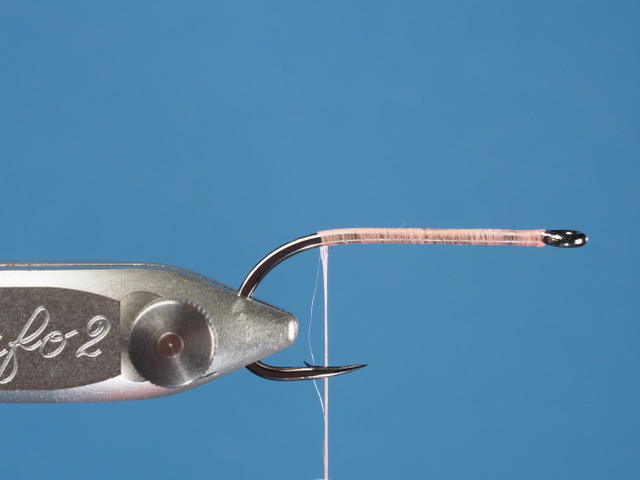
I have added my thread to the hook, using neat, touching wraps. The touchinbg wraps are not 100% essential, but these are a mark of crafts-personship, and I like the touch.

I have added my thread to the hook, using neat, touching wraps. The touchinbg wraps are not 100% essential, but these are a mark of crafts-personship, and I like the touch.

I have added my thread to the hook, using neat, touching wraps. The touching wraps are not 100% essential, but these are a mark of crafts-personship, and I like the touch.

This is my tail materialCoq de Leon Feathers. These are beautifully marked. I only need three fibers for the tail. This doesn't sound like much, but it is plenty.

This is my tail materialCoq de Leon Feathers. These are beautifully marked. I only need three fibers for the tail. This doesn’t sound like much, but it is plenty.

This is my tail material Coq de Leon Feathers. These are beautifully marked. I only need three fibers for the tail. This doesn’t sound like much, but it is plenty.

You see?  Not much material here, but it is plenty, trust me please.

You see? Not much material here, but it is plenty, trust me please.

I have attachted the tail fivers to the hook in this photo. I am using Damville FlyMaster 70D thread. I could be tying this fly with a Veevus  8/0 or 10/0 thread just as well.

I have attachted the tail fivers to the hook in this photo. I am using Damville FlyMaster 70D thread. I could be tying this fly with a Veevus 8/0 or 10/0 thread just as well.

I have attached the tail fivers to the hook in this photo. I am using Damville FlyMaster 70D thread. I could be tying this fly with a Veevus 8/0 or 10/0 thread just as well.

Nothing fancy here, I only continued wrapoing my thread forward on the hook, I will want to build-up the thread base to provide a taper to the body and this is a good time to start.

Nothing fancy here, I only continued wrapoing my thread forward on the hook, I will want to build-up the thread base to provide a taper to the body and this is a good time to start.

Nothing fancy here, I only continued wrapping my thread forward on the hook, I will want to build-up the thread base to provide a taper to the body and this is a good time to start.

I have added a piece of Brassie size copper wire, but this is a nice chartreuse green color wire to contrast on the body. I am showing this here because the wire is wrapped neatly on the top of the shank from just at the bead clear to the back of the body, and the wire is on top of the hook.

I have added a piece of Brassie size copper wire, but this is a nice chartreuse green color wire to contrast on the body. I am showing this here because the wire is wrapped neatly on the top of the shank from just at the bead clear to the back of the body, and the wire is on top of the hook.

I have added a piece of Brassie size copper wire, but this is a nice chartreuse green color wire to contrast on the body. I am showing this here because the wire is wrapped neatly on the top of the shank from just at the bead clear to the back of the body, and the wire is on top of the hook.

Now the story gets interesting. In this photo, I have added a piece (make it 6-inches long so you can hang on to it) of Veevus clear Pearl Tinsel. Make sure you wrap this down securely because you will put some tension on this when you begin winding it on the hook shaft.

Now the story gets interesting. In this photo, I have added a piece (make it 6-inches long so you can hang on to it) of Veevus clear Pearl Tinsel. Make sure you wrap this down securely because you will put some tension on this when you begin winding it on the hook shaft.

Now the story gets interesting. In this photo, I have added a piece (make it 6-inches long so you can hang on to it) of Veevus clear Pearl Tinsel. Make sure you wrap this down securely because you will put some tension on this when you begin winding it on the hook shaft.

Alright. I took hold of the pearl tinsel, which is really a plastic-like material, and wound it around the hook nearly to the bead. You do not need to go all the way to the bead because you will next put on a thorax and cover the area next to the bead, but get at least close, OK?

Alright. I took hold of the pearl tinsel, which is really a plastic-like material, and wound it around the hook nearly to the bead. You do not need to go all the way to the bead because you will next put on a thorax and cover the area next to the bead, but get at least close, OK?

Alright. I took hold of the pearl tinsel, which is really a plastic-like material, and wound it around the hook nearly to the bead. You do not need to go all the way to the bead because you will next put on a thorax and cover the area next to the bead, but get at least close, OK?

This photo shows that i have added the green wire rib on top of the pearl tinsel. What you can not see is the fact that I applied considerable pressure to the pearl tinsel and made it deform or should I say conform to the hook and not be loose and saggy. The wire rib is the same process, and I put as much pressure as reasonable to seat the rib into the body. You will need to develop a feel for the proper amount of pressure. Too much and the material will break. Too little and the material will be loose and slip on the hook.

This photo shows that i have added the green wire rib on top of the pearl tinsel. What you can not see is the fact that I applied considerable pressure to the pearl tinsel and made it deform or should I say conform to the hook and not be loose and saggy. The wire rib is the same process, and I put as much pressure as reasonable to seat the rib into the body. You will need to develop a feel for the proper amount of pressure. Too much and the material will break. Too little and the material will be loose and slip on the hook.

This photo shows that I have added the green wire rib on top of the pearl tinsel. What you can not see is the fact that I applied considerable pressure to the pearl tinsel and made it deform or should I say conform to the hook and not be loose and saggy. The wire rib is the same process, and I put as much pressure as reasonable to seat the rib into the body. You will need to develop a feel for the proper amount of pressure. Too much and the material will break. Too little and the material will be loose and slip on the hook.

This photo shows how little dubbing i will use for the thorax on this nymph. This is peacock ice dub. Ok, it isn't really, but I forgot what it is and  I know that you can use almost any dubbing and the fly will fish so there is no real harm done by saying it is peacock ice dub. the most important matter is that it only takes a very small amount of material to tie the thorax, and I will rub it between my wax-moistened fingers to get it on my thread.

This photo shows how little dubbing I will use for the thorax on this nymph. This is peacock ice dub. Ok, it isn’t really, but I forgot what it is and I know that you can use almost any dubbing and the fly will fish so there is no real harm done by saying it is peacock ice dub. the most important matter is that it only takes a very small amount of material to tie the thorax, and I will rub it between my wax-moistened fingers to get it on my thread.

This photo shows how little dubbing I will use for the thorax on this nymph. This is peacock ice dub. Ok, it isn’t really, but I forgot what it is and I know that you can use almost any dubbing and the fly will fish so there is no real harm done by saying it is peacock ice dub. The most important matter is that it only takes a very small amount of material to tie the thorax, and I will rub it between my wax-moistened fingers to get it on my thread.

Here it is. That miniscule pinch of dubbing is on my thread and ready to wind around my hook.

Here it is. That miniscule pinch of dubbing is on my thread and ready to wind around my hook.

Here it is. That minuscule pinch of dubbing is on my thread and ready to wind around my hook.

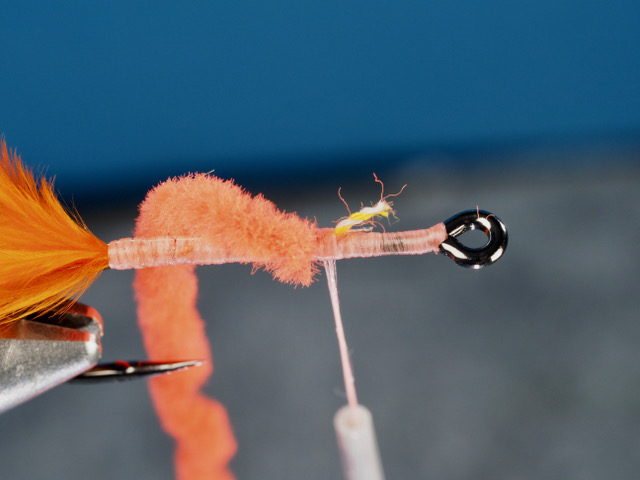
Here is my first thorax. This is not as full as I want it, so I will add a little.

Here is my first thorax. This is not as full as I want it, so I will add a little.

Here is my first thorax. This is not as full as I want it, so I will add a little.

Here is my thorax with the PERFECT bulk. Next, I want to add a color-spot made of my tying thread.

Here is my thorax with the PERFECT bulk. Next, I want to add a color-spot made of my tying thread.

Here is my thorax with the PERFECT bulk. Next, I want to add a color-spot made of my tying thread.

I counted - it took me 30 turnjs of thread around the hook and behind the bead to build my color spot. I will now add a dot of cement, SG, or depleted uranium to secure the thread at this point.

I counted – it took me 30 turnjs of thread around the hook and behind the bead to build my color spot. I will now add a dot of cement, SG, or depleted uranium to secure the thread at this point.

I counted – it took me 30 turns of thread around the hook and behind the bead to build my color spot. I will now add a dot of cement, SG, or depleted uranium to secure the thread at this point.

Done. Ready to catch big trout> PINCH THE BARB PLEASE. IT IS EASY WITH THESE GAMMIE MICRO BARBS. THANK YOU. GAMMIE MAKES A BARBLESS HOOK EXACTLY LIKE THIS TOO.

Done. Ready to catch big trout> PINCH THE BARB PLEASE. IT IS EASY WITH THESE GAMMIE MICRO BARBS. THANK YOU. GAMMIE MAKES A BARBLESS HOOK EXACTLY LIKE THIS TOO.

Done. Ready to catch big trout> PINCH THE BARB PLEASE. IT IS EASY WITH THESE GAMMIE MICRO BARBS. THANK YOU. GAMMIE MAKES A BARBLESS HOOK EXACTLY LIKE THIS TOO.

Perfection held in the palm of my hand.

Perfection held in the palm of my hand.

Perfection held in the palm of my hand.

I hope this helps ….

May each of you find and share some measure of kindness this day.

Jay Nicholas, February 2021


Posted in Fly Tying, Fly Tying Materials and Supplies | Leave a comment

Late Winter Largemouth

Nighttime temperatures here in the south are still damn cold but the days are getting warmer and the bass are moving a little bit.

I went to the Eno River. It’s clear and full of warmwater fish. The locals do a great job protecting the riparian area, making sure the watershed stays healthy.

IMG-6683

The air temp was 60 degrees, and it was sunny. I held a fly rod in one hand and had my therapist on the phone in the other, like some asshole out of a New Yorker cartoon.

I find myself standing at this intersection a lot, where desires collide and create problems.

I’ve started using tarot cards to get a sense of where my blind spots are. I asked the day before, “What happens if I go fishing tomorrow?”

I saw cold, high water. I saw my choices would mess me up a bit, but not disastrously. I saw the fish I would catch might be big. No divorce, or car wrecks, or financial ruin, at least immediately foreseeable.

Every angler I know is a magician trying to read the future, to communicate with the unseen. We try to see how reality works, and then make it work for us. We create a moment when predator and prey collide, and then reverse that moment. We tread the boundary of what is acceptable and unacceptable.

IMG-6233

The river is crawling with snakes. Seems like it’s always doing that. Queensnakes drape their coils over dried stems, warming in the sun.

It feels like there are snakes in my mind. One wants something, another something else. They’re tied together, knotted somewhere in the middle.

I think about why I’m here on the water.

I keep going over it, and the answers I give don’t feel quite right. But I’m trying to explain it to myself.

I’m drawn to the idea of wildness. What is wild and what is not, and what’s the difference? I think it has to do with relationship to your surroundings.

Beings in the wild are built for the world they live in.

For us domesticated creatures, our world is built for us. Like a pen.

And in the presence of wildness, you can feel like you could walk away from all of it.

This society we’re all white-knuckling to hold together for another generation… Who needs it?

I swallow my rage. I wouldn’t survive long without a CPAP or an air fryer. I bring my digital friends with me to poop because I’m scared to be alone with my thoughts.

But being close to something wild lets the blood sing in my own veins.

It’s like if I could connect with one of the really wild largemouth bass in this river, I could look this creature from the other side of the mirror in the eye and be seen as an equal as an adversary.

We have this desire for meaning. The easiest way to find meaning (at least how my brain works), is through story.

You can get lost in a story. You can sacrifice a lot of things to get that story you tell yourself right. A lot of these stories are told with good intentions.

Every time I reach a good-looking piece of water, a pile of river cooters jump off their logs, creating a huge commotion. The trees along the river are tight to the bank. It’s like casting in a jungle. I have a short (7’10”) Redington Predator rod that I’ve been able to cast below the grabbing limbs. I still lose flies all day. But I’ve come to terms with it.

The gamechanger streamers are so effective. I’ve never fished anything I feel this confident in. That in itself makes a huge difference in how I feel on the water. I pulled an olive feather-changer along the seam of a deep pool and the main current and a big wild bass jumped on the line after a few hours of trying to find one.

IMG-5998

The fish had a huge dorsal spines, felt longer than a normal bass, almost looked like a dragon. It ruled this river I find so enchanting.

I held it in my hands, like a relic. The way you might have held the fingerbone of a saint, to heal you of something, as if some quality of that individual might be transferable.

-MS

Posted in Fishing Reports | 1 Comment

Spring 2021 Guide Special on Now through April 15th

Resized_20210228_140059(2)

Each Spring we are reminded of how fortunate we are to have the Lower McKenzie and Willamette rivers within such close proximity to the Eugene area. When conditions align, there is potential for exceptional trout fishing.

Current water conditions and weather are ideal to get out for an early look at the lower McKenzie and Willamette rivers. Let’s hope this continues through the spring. Our spring guide special will continue through April 15th, 2021.

If you would like to experience what the Lower River has to offer in Spring, take advantage of our half day special. The special includes 5-6 hours of fishing, and all tackle is provided. Anglers need only to bring lunch and beverages. The price for this “best part of the day half day” is $375 for one or two anglers.

One of the great things about this early season excursion is the varied tactics you will experience with one of our guides. Indicator nymphing, euro nymphing, swinging and dry fly fishing can all be done in the span of a few hours. It’s a really cool time of year.

Call the shop for a reservation. 541 342 7005

Posted in Classes and Instruction, Fly Fishing Travel, Lower Willamette, McKenzie River, Middle Fork Willamette River fishing | 1 Comment

March Browns – March 1st on the McKenzie – Fishing Report

IMG_9739

Early signs of spring showed up this weekend. Typical winter hatches of blue wing olives and stones were joined by sparse but consistent March brown hatches during the warmest and sunniest parts of the day.

With enough sunshine and warmth, some fish have started looking up. Dry fly fishing has some potential for success this week with the weather forecast looking balmy until next weekend. This weekend’s fishing saw multiple fish came up for small March brown dries in slow, deep, pools and typical cold season holding water. One eager fish took both dry flies in one aggressive sweeping eat. They might be as excited as us anglers are at the prospect of larger insect life showing up on the surface again.

IMG_9748 2

Swinging soft hackles or dropping a lightly weighted softie under a bouyant march brown dry can be a really fun way to fish this time of year as well, and can be a good method to prospect with or use when fish don’t seem to want the dry. Most fish were still taken this past week on standard winter nymphing fare — a mega prince or a large stonefly and a gaudy jig under a bobber— but coming weeks should open up different exciting avenues for angling.

Resized_20210228_140059(2)

Water levels are looking great. The river is dropping and in perfect shape.

hydroPlot-1.php

Water temperatures remain cool. When you see the water temps tick up just a bit you will see more adult insects including more caddis and March Browns.

hydroPlot.php

Posted in Lower Willamette, McKenzie River, Middle Fork Willamette River fishing | Leave a comment

Southwestern Oregon Watershed and Salmon Protection Act

bWFpbi9pbWcvcGFnZXMva2VubW9ycmlzaC00Ni1zbS5qcGc=

From Native Fish Society

Earlier this month, U.S. Representatives Peter DeFazio, of Oregon, and Jared Huffman, of California, reintroduced the Southwestern Oregon Watershed and Salmon Protection Act. The act would make permanent the protections provided by the twenty-year Southwestern Oregon Mineral Withdrawal. If passed, the act would safeguard the headwaters of several South Coast streams from nickel strip mining and, in doing so, it would protect clean drinking water for communities, important fish habitat, and superb recreation opportunities. These cherished rivers deserve permanent protection from destructive mining practices.

+ Please take a minute to thank Representatives DeFazio and Huffman for proposing this important legislation!

+ The Southwestern Oregon Watershed and Salmon Protection Act builds on legislation passed in 2017, after NFS River Stewards rallied their communities and called on the federal government to issue a twenty-year moratorium on strip mining.

Posted in Oregon Conservation News | Leave a comment

“LIFE” ON A TIN CAN – Fishing on the USS KIDD

USS_Kidd_(DDG-993)

The fishing, the camaraderie, the adventurous voyages . . . ! We often kid ourselves – sailors – that our ships are “Tin Cans,” floating about on King Neptune’s Domain, at His Whim.

Long time customer Lou Olton share this grand tale of catching fish off his navy ship. Thanks for your service Lou and thanks very much for sharing.

. . . Twas the night before Christmas and all through the house, not a creature . . . . . WAIT, wrong Intro ! Now let’s get “reel”! Actually, best I can recall, it nearly was close to the Holidays, circa 1997. We, that is the USS KIDD, DDG-993 was scheduled for dry dock in Norfolk Naval Yard, where “she” was stationed, but the reasoning behind it unclear to the crew, which I was a “Plank Owner” of, and Sonar tech./operator 2nd-class (STG2 extraordinaire!).

Long story short, Captain Kearley informed us via internal comms that we were going to be doing a Drug Op on the West Coast. Great yet another Holiday Period away. This would be my 4th trip through the Panama Canal. Best I recall, as I previously said, Thanksgiving was approaching so we knew it would be warm at our destination – a Large rectangle running North-South from off the NW corner of Columbia to Panama’s Northern border.

My Navy career started in San Diego but quickly became an East Coast thing – 1985 through 1998, when USS KIDD finally did get the Dry Dock appointment; this time it was to Decommission “her”! That is a tale left for another time.

Being an Easterner, I was all too familiar with the Beach Fishing scene, but not with a Fly Rod . . . yet! That all started once I got to my 1st ship after boot camp my 1st Sonar C-school in San Diego. That got me to Jax. Florida and Mayport Naval Station and my 1st Fly Fishing Beach Style along all that golden sand. The Saint Johns River wasn’t far away. Pretty much self taught with my experiences as a freshwater trout guy growing up on Long Island (NY).

Now that you have some back-story, on with the Joys of Fly Fishing From a “BIG Yacht”! Turns out that our Captain was also a Fly Fisher and what we like to call – “a crew-members Captain”. Traditional Sundays-at-Sea would be an all day BBQ on the Flight Deck affair with civilian clothes optional if you were not On-Duty.

thumbnail-1

As you see from the 2 photos, one day I was soon to be On Duty and the other I was not. As we patrolled our “box” doing phenomenal trolling speeds I quickly got into the Fantail Fishing Mindset more often than not, but never diminishing my responsibilities as Sonar Watch Supervisor, Division Damage Control Petty Officer or Division Safety Petty Officer. Needless to say, when not Fly Fishing off the Fantail, I was a Very-Busy-Camper.

Floating Flotsam or “peoples floating junk” as it was, was all too prevalent, and in my eyes welcome, as it was (and will always be) a “Fish Magnet”. Fact is, the 2 Mahi Mahi were as a result of quick-casting to trash piles or pallets floating alongside the ship.

thumbnail-2

Catching Mahi Mahi became 2nd-nature, sort of, once the Boatswain-mates got the “Grease Monkeys” to make a long gaff to be able to snag the catch and hoist on deck. Then one beautiful Sunday-at-Sea I was at my usual starboard-fantail railing corner with my homemade sinking fly line set out to about 75 yards. Then I got stupid, remembering like it were yesterday, I feel embarrassed all over again telling this. It was “Hungry Time” and I needed a burger and coke. Here is the stupid me; setting the Sage RPLXI 10wt propped on the steel rail I made for a “mad-dash” toward the Flight Deck Ladder to fetch that “pale of water” (coke and burger). No sooner than halfway across the Main Deck (about 20 feet from the rail, and the rod), I hear a crew member fishing buddy YELL; “Petty Officer Olton!” – a simple Lou would have done. I turn and see My Fly Rod Quiver and Jump, seemingly as though it were Going Overboard . . . but it didn’t. Then I looked up and out to sea to see what I could see; following my Fly Line Backing, and there it was. Never in my wildest dreams did I ever think “OF THAT”! Turns out I hooked a Sailfish. Average sized I supposed. After all it was Sooo-far away in that instant it all took place. It was like that scene in Hemingway’s Novel when the Black Marlin made its first appearance with that leap out of the sea! Well, that image came later, but, you get what I mean, right?
With the rod and reel intact, I would live to fight another day . . . thankfully. That day would come, not surprisingly on another Sunday-at-Sea (when most of the fishing was done). SO, probably the next week? Kind of a dreary day, rain off and on and now nearing dust – about an hour away. The BBQ Crowd had thinned and mostly diehard fishermen remained, with a few interested bystanders watching the sun slowly sinking. Some Dark Low-Hanging Clouds off in the distance had me startled . . . then I saw IT!

I wasn’t sure at first what the disturbance was on the surface as it seemed so far off – guessing 2 or 300 yards. But this Disturbance was Moving from Right to Left – looking aft out over the railing. I, again in my favorite Left-hand corner, said to the other 6 or so fishermen, “Get ready guys, that is a sea of tuna and they’re heading our way!” Yup, pretty much just what I remember saying!

Sure enough, that “Wall of Wondrous” Fish turned a bit toward KIDD. I quickly let out more line and lowered my rod tip as close to the water as I could – still about 3 feet away. My Fly Line Rig consisted of a Very Heavy Sinking Head – I’m thinking it was 30 to 40 feet long; from a Saltwater Cortland Fly Line that I cut the HEAD from and attached to as much 30lb. Backing as I could fit on my Reel.

That was about 300+ yards. Point being; it worked, by golly it worked just as intended. Sadly though . . . I was the only one to get a Hook-Up. Now, I was in the Fight of My Life . . . Literally it seemed as though at the time! IF you’re familiar with those knobby cloth painters gloves (?). I had make-shifted a pair of Fingerless style (cutting the tips off, plus sewing a Leather Pad on my Reel Hand (Left hand Retriever) as a Drag Aid. Half Hour into the fight, those gloves were a “Godsend”. Whatever this fish was – thought I had a good idea it was a Yellowfin – you can’t be certain. It Dogged me bad, and the Drag was set all the way, and yet the line kept going and going and going, like the Eveready-Wabbit.

Seriously I was at wits-end and I asked a young Lieutenant JG, standing watch at the time / radio comms in-hand, if there was any way he could get the KIDD slowed or stopped so I could land the fish. No Joke, that is how it went down, . . . and with a grin on his face (me too), he called to the Bridge and asked JUST THAT ! Surprise, Surprise, surprise . . . Captain Kearley Came Through. Then HE showed up on the Fantail . . . “Oh Boy,” I thought; shits gonna hit the fan now. This is when I 1st learned that OUR Captain was indeed a Fisherman’s Fisherman and fly fisher too-boot. It took, all told, about 45 minutes (guessing) to get that Yellowfin alongside and gaffed. I had to bang the head into the deck a few times to stop the insane thrashing about, but once I was able to lift it up, I could tell it was gonna be a Big Feast come Next Sundays at sea BBQ.

The “Boardroom” officers-mess got their sushi fix and some steaks and the crew did just as well that next Sunday at the Tuna-BBQ Feast . . . yea there were still hot dogs and burgers. Gotta say, of ALL the Navy Cruises I’ve been involved with – 3 ships, trips to the Mediterranean, off West Africa, Bermuda (triangle), Cuba, Caribbean, All of South America (around the Horn / UNITAS), Louisiana (Mardi Gras), Panama, NYC (Fleet Week) . . . hmmm, what am I forgetting? Needless to say MY time in the Navy was a “Circumstantial” Dream Come True . . . and by that, I’ll have to end it — for another “story” could be brewing . . . . . . !?.

FlyFInaticLou.

Posted in Fly Fishing Travel | 4 Comments

Steelhead Shrimp Spey Fly Tying Video – Alex Worth 2021

In this video, Alex ties a steelhead shrimp fly that could be used both for winter and summer steelhead.

Tie them in different sizes appropriate for the river or stream you’ll be fishing. With different colored patterns this fly could be deadly in estuaries, coastal streams, and PNW rivers.

Alex uses Alec Jackson hooks that are sharp, set deep, and are strong. Proven again and again.

Screen Shot 2021-01-15 at 9.15.21 AM

Steelhead Shrimp Spey

Hook: Daiichi 2050 Alec Jackson Bronze Size 1.5
Thread: Uni Thread 6/0 Wine
Tag: Danville Silver Tinsel Size 14
Tail: Golden Pheasant Crest Hot Orange
Golden Pheasant Tip Hot Orange
Body: Lagartun Oval Tinsel Silver Small
Chinese Saddle Hackle Red
Uni Floss Orange
Angora Goat Dubbing Burnt Orange
Wing: Golden Pheasant Hot Orange
Mallard Flank Natural
Chinese Saddle Hackle White
Super Glue

Posted in Fly Tying, Fly Tying Materials and Supplies | Leave a comment

Because Our Words Matter – Sexual Violence and the Fly Fishing Industry

This is a saltwater fly. It has nothing whatsoever to do with this blog post.

This is a saltwater fly. It has nothing whatsoever to do with this blog post.

I’m sitting here at my keyboard, paralyzed. My hands trembling. Heart pounding. Squinting at the monitor through tears. I’ve written hundreds of posts for the Oregon Fly Fishing Blog, but this is the highest stakes article I’ve ever had the courage to write. And that’s odd, because it shouldn’t require courage to write this, but somehow I know that writing about this topic involves breaking a taboo. The taboo of calling out my fellow anglers and our industry for inexcusable behavior.

Here goes.

Sex Dungeon.

Read the words aloud, please. Now tell me what the words mean.

I know it is a fly name. Anyone who fishes for trout with streamers knows what it is, but I want you to stop for a minute, think, and tell me what the words mean. Do you think the words are funny?

What do you think goes on in dungeons?

I’d be willing to bet that most people know that bad things happen in dungeons, and …. sex dungeons?

Let’s step back for a minute and try a game of imagine if

Imagine you are a grandpa, sitting at your fly bench, with your seven-year-old granddaughter standing beside you, watching how you blend materials and craft your masterpiece streamer fly.

“What’s that fly called, Grandpa?” She asks.

“This is a Sex Dungeon,” you answer.

“What’s a Sex Dungeon?” She asks.

How will you answer her? Will you lie? Will you change the subject. Will you laugh it off?

Are you still with me here? Are you still reading? Have you dismissed me and this blog post as over-reaction to harmless locker-room banter?

If so, you are part of the problem, and you need to change your behavior because the words aren’t harmless. This kind of talk normalizes sexual violence. Harsh words? Yes. True? Yes.

The demographic realities of fly fishing say that if you are reading this blog, you probably identify as male. Could gender influence a person’s perceptions?  What if you were a grandma instead of a grandpa?

“Grandma, look at this pretty fly that Grandpa tied for me!”

“Why, that is a beautiful fly,” you answer. “What is it called?”

“It’s a Pole Dancer, Grandma. What’s a Pole Dancer?” Your granddaughter asks. “Grandpa just laughed and said I should go ask you.”

How do you feel, Grandma? Is this harmless?

Let’s play Imagine if again.

Imagine that you are a mid-twenties male, out in the drift boat with two male friends, floating down the river one fine autumn afternoon. The trout are biting and you’re having a great time with your buddies, when someone says, “I think I’ll try a Pearl Necklace.”

Do you think anyone will laugh? Do you imagine any one of you will say anything about the meaning of the phrase? Perhaps you think it is OK to use some of these names because they are double entendres and the real meanings can be debated?

dou·ble en·ten·dre
noun
A word or phrase open to two interpretations, one of which is usually risqué or indecent.

Just because it is a double entendre doesn’t make it OK. The language serves to endorse and coddle and perpetuate a culture of male sexual dominance.

Excuse me. I’m under the impression that the fly fishing industry is making a determined effort to recruit women and children as fly fishers. Is this how we plan on making them feel welcome?

I’m not an expert. I’m not even a great writer, and I have no credentials to have researched these issues. But I know how I feel when I see these fly names. I know the meaning behind the names. They are intended to catch the consumer’s attention. They are meant to sell a product to a consumer that is usually a white male.

But the words hurt everyone, regardless of gender. The words convey the approval of sexual dominance and violence in our society.

Let’s play Imagine if again. Pretend for a moment that you’re a female who is a professional fishing guide with two male clients. You are packing up after a riverside lunch, getting ready to resume the afternoon’s fishing. One of your clients passes you their fly box and begins telling you about the contents. “That top row is filled with Stacked Blondes. Next row down is loaded with my Barely Legals.
And the last three rows hold my Lap DancersT & A Bunkers, and Bottoms Up.”

In case you didn’t know, the English language dictionary says this.

T&A
in American English
noun
Informal
Entertainment, as TV programs or movies, characterized by the deliberately titillating display of the female form.

Remember, you are the female guide, hired by two male clients. How do you feel about these fly names? How do you feel about your clients?

Or more to the point, how do you feel about your fly fishing industry that allows this to go on? These fly names are not new. The fact that the industry hasn’t had the guts or the courage or the smarts to put a stop to this bullshit says something.

Some people will claim it says that the industry is OK with this. Others will claim that this is only a tiny little naughtiness. And certainly some people will say that I’m making a fuss where none is warranted.

Well, it isn’t a little transgression, and it isn’t just naughty. These names and associated visual images don’t belong in a box of fishing flies. These fly names reflect a culture of male dominance that expects superiority in all things, sex included.

And if this is a problem, then who is to blame?

Here’s the thing about these little flies, all of them sitting so innocently in their fly bins in shops and in people’s fly boxes and fly fishing vests and boat bags and strung on their fly rods: No one and everyone is responsible. It is you and it is me and it is every one of our fly fishing buddies; it is all anglers of all genders. Every one of us who has heard or seen these fly names and not spoken up is to blame.

I’m pissed at every one of my friends who has never stood up to this issue.

I’m pissed at myself, and I’m embarrassed that I’ve been too cautious to take a stand on this issue before now.

I’m pissed at every professional fly fishing guide, regardless of gender, for not taking a stand on this.

I find it difficult to understand the silence in the fly fishing industry on matters like this. I’ve been searching the Internet for a week, trying to find anyone who has called attention to the connection between the language we use and tacit approval of sexual violence.

Instead, I found articulate revelations by female fishing guides who are constantly on their guard to avoid situations where they might be vulnerable to male dominance (verbal and physical).

It makes sense. It makes perfect sense.

When female fly fishing guides work for male clients who live in a world populated by Stacked Blonde Pole Dancers who would love to get a Pearl Necklace in their Sex Dungeon, well, what else would you expect?

I’m done. No apologies.

Jay Nicholas, February 22, 2021.

P. S. When I finished writing this blog, I could not find a category that seemed to fit the content. So I listed it under Fly Fishing Books, Fly Fishing Glossary, Fly Fishing Travel, and Fly Tying.  I decided not to use the category Fly Fishing Porn; that category has always bothered me.

P. P. S. Oh heck, maybe we men should all go out and grab ’em by the pussy. A pussy is just a little cat, you know.

Posted in Fly Fishing Books, Fly Fishing Glossary, Fly Fishing Travel, Fly Tying | 84 Comments

NEW RIO’s Skagit Max Launch & Skagit Max Power Spey Head Review

In this video, Greg discusses RIO’s new Skagit Max Launch and Max Power series.

rio-elite-skagit-max-launch-spey-head-25

Skagit Max Launch:
23′ Long
Amazing front taper design to easily cast large flies and tips and load the rod with ease and sensitivity.
Grains 400-750 in increments of 25gr.
Slick Cast Coating
Light blue color w/indicator backend dark blue
Welded Loops
Low Core Stretch
Easy ID printed line weights

rio-elite-skagit-max-power-spey-head-23

Skagit Max Power:
Ideal for switch-rods/short spey/tight quarters
20′ Long
Amazing front taper design to easily cast large flies and tips and load the rod with ease and sensitivity.
Grains 325-650 in increments of 25gr.
Slick Cast Coating
Salmon pink color w/indicator backend dark blue
Welded Loops
Low Core Stretch
Easy ID printed line weights

#flyshopstrong

Posted in Fly Fishing Gear Review | Leave a comment

Hrabik’s Balanced Leech Patterns

DSC00033

Fly fisher Rob Hrabik stopped by the shop to drop off a few of his balanced leeches he fishes on Pyramid Lake, but these flies work great for Cascade and Klamath Lake trout, Umpqua & John Day bass, and many other species.

Screen Shot 2021-02-14 at 4.54.30 PM

IMG_2043

IMG_2046

Hrabik’s Balanced Leeches

Posted in Fishing Porn | Leave a comment

Spend a week on the Babine for just $100! – Benefit Native Fish Society

mail-1

mail

British Columbia’s Babine River is the hallowed homewaters of some of the largest wild steelhead swimming on the planet. Don’t miss this week-long dream trip, including guided fishing with some of the best guides around, delicious home-cooked meals, and tranquil river-side lodging, which could be yours for just $100! We’re talking about your best (and most economical shot) at some of the best dry line (even dry fly) wild steelhead fishing anywhere.

That’s right, the one and only Babine Steelhead Lodge has generously donated a week of steelhead fishing on the Babine River for 1 angler to support the Native Fish Society’s work reviving abundant wild, native fish across the Pacific Northwest.

How does it work? Native Fish Society is selling 250 tickets for $100 each. We’ll draw the lucky winner on March 16th and then they’ll get ready for the time of their life!

Details:
1 angler / August 27 – September 3, 2021 / Guided steelhead fishing on the Babine River.
*Does not include travel to Smithers, B.C., taxes, tip, or licenses.

Raffle tickets on sale: February 15 – March 15, 2021
Drawing: March 16, 2021 @ 3pm

BUY YOUR TICKETS HERE

Posted in Coastal Steelhead Fishing, Fly Fishing Contests, Fly Fishing Travel | Leave a comment

A History of Violence: Brown Trout and the Broken Promise of Conservation Angling

A thing is right when it tends to preserve the integrity, stability and beauty of the biotic community. It is wrong when it tends otherwise.
-Aldo Leopold

European Brown Trout and fly fishing are inextricably entangled. They’re the basis of the sport, the techniques developed for these fish. They thrive in our man-made waterways like tailwaters of dammed rivers, and they are less vulnerable to the warming trends we’re imposing on the planet. They’ve been stocked in every water that would support them, in every beautiful place, for us rich white dudes to play out our fantasies.

Et-qedSXUAAcwpt

Aquatic biologists are starting to look at this species through this lens. Brown Trout have been included in the top 30 worst invasive species on the globe (International Union for the Conservation of Nature). The data shows Brown Trout outcompete native trout (and a host of other unintended species), often displacing them. Then they get bigger and turn piscivorous, feeding on large fish including smaller versions of themselves.

And to that end, I find myself carrying a fly box of 7-inch Game Changer fly patterns, chasing cannibalistic monsters. Streamer fishing strips away the façade we carefully apply, the story we tell ourselves about what it is we are doing out here in the river.

Etq3R2gWYAMNr4T

We all make these choices regarding what lives are important in every moment. But streamer fishing throws it into full contrast. I’ve got half a gray squirrel tail wrapped up in one of these fucking things that invariably is going to wind up in a tree or pinned in some fish’s face. Another fly has a bunch of pheasant rump feathers, stained olive with a dye that surely must have been rinsed back into somebody’s river.

The synthetics aren’t much better. Every time I walk away from the vise after trimming the plastic bullshit into a fish shape, I’m covered in goddam mylar dust. I think about the microplastics floating instead of plankton in oceans.

But I convince myself not to worry about it. I drive to the river.

There is something illicit in this act. I am going to the river to snatch life out of it.

I’m not putting anything back but tobacco ash, maybe a few beads of lead shot, coffee pissed out on the side of the creek.

At best, my license dollars go towards paying small salaries for biologists who look a lot like me to figure out how to keep as many brown trout in the damn river as possible, with no funding to look at what impact that has on anything else.

The dams on the river I fish were put there by dudes who look a lot like me. They got to decide what was important and we’re all living with those decisions. The dams are why there are brown trout in the southeast. The dams are why I am standing here on this water.

I’m starting to learn a section of this river. It’s braided with boulders and islands covered in horsetail. There are some big fish on it, definitely over twenty inches. There are smallmouth bass and kingfishers, beavers and herons – all of them doing what it is they were born to do.

And then there’s me, conflicted.

In my late twenties I thought things were pretty simple. Stop putting hatchery fish on top of wild populations. Stop damming rivers. Put conservation dollars towards habitat restoration. Get the bank-anglers to stop gut-hooking wild trout with bait.

I fought hard for those values. It’s pretty much all that I fought for then. And the fishing was so good in Oregon, I might have never grown out of it.

I never really thought about how much of the “good” I was seeking to impose on the world was really just making things better for myself, for the lives I chose were deserving of reverence. I never really looked at the harm I was doing, that we all do, each of us every day consuming life so we can live. And so I turn to the trout again in my river here, consuming life so that they can live.

A big hen brown takes the game changer. It’s not a fancy one. All of the fancy ones I tied broke because I used the wrong damn wire for attaching the articulated segments. It was the last one in the box, a white chenille body, no trailing hook. It smacked the bait in the head as I it twitched over a pool full of submerged boulders.

Immediately, the fish somehow swung itself around a root-wad at the bottom of the pool. It was really big. I could see it flailing in the current. I called my buddy over, took his net, handed him my tangled rod.

There was snow on the ground, damn cold. But I went in over my waders. I got my hands around the fish but couldn’t get it off the wood. Somehow, it was still hooked, but in the fast current and cold water, I couldn’t get my fingers to work, I couldn’t unwrap the line. I couldn’t pull the hook out of its mouth. There was so much water in my waders, I could barely move.

I’m risking my life to hold this fish. To show you this fish. As if catching this thing changes the story I get to tell about myself, as if my life depends on it. I’m a father of three drowning in February for a stocked fucking trout on a tailwater.

I broke the fish off and it drifted downstream. I hope it was OK.

I was rattled by that experience. Losing a big fish is always hard. But I was struck by how important I thought it was to catch it. How I’ve shaped nearly my whole life, to do this thing, which arguably isn’t very good for the world.

The old saws don’t work anymore. Not for me at least. The idea that rivers need to be saved by rich dudes like me, putting pennies into programs that really only make things better for other rich dudes like me isn’t working.

Conservation angling is broken. It’s not enough to conserve things, to try to keep things the way they are, the way they were. Angling needs to be regenerative, to make things better. I’m not sure what that means yet.

But I can tell you, if fishing is something I’m willing to risk my life for, it needs to be better. It’s not enough to recycle waders into more waders. It’s not enough to teach inner city kids to tie wooly buggers. We need to de-center ourselves, to offer something of value, not to us, but to the multi-species communities we are embedded in.

If I keep fishing (which seemingly I am), I am going to have to find what “regenerative angling” vs “conservation angling” actually means.
-MS

Posted in Fly Tying | 8 Comments

2021 Introduction to Fly Fishing Class Schedule

39621040112_10c16f66e1_z

Classes will be held per latest COVID guidelines set by Caddis Fly Shop owners and the CDC.

The Caddis Fly shop enters 2021 with a strong focus on COVID protocols. The dates set for the 2021 Introduction to Fly Fishing Class are listed below. We have been introducing anglers to basic casting skills for almost 30 years. Inspired by the original casting classes held by Les Eichorn, Bob Guard, Lefty Krieg, Jeff Carr, and Mel Krieger this 6 hour class will have interested anglers on their way to fly casting mastery. Basic tackle discussions, casting, knots, entomology, locations to fish, and fly selection will be covered. All tackle, textbook is included and we maintain a one instructor to 5 student ratio. Four hours of the course will be on water casting. Cost is $65, all equipment is provided, please pay at sign up at the shop or call 541-342-7005 to sign up.

Class Schedule for 2021 : Classes on two dates are Friday evening (6-8PM) at the shop and Saturday at Alton Baker Park (9am-12:30pm).

2021 Schedule

March 19,20
April 23,24
May 7,8
June 4,5
July 9,10
August 6,7
September 24,25
October 15,16

Please call the shop at 541 342 7005 to reserve your spot.

Posted in Classes and Instruction | Leave a comment