In this video, Simon ties a quick and easy terrestrial pattern which is deadly during mid to late summer into early to mid fall. When fish are keyed in on terrestrials, sometimes they will prefer them even over aquatic insects which make up the majority of their diet. The fly features Rainy’s new pre-cut 3 segment foam Gorilla Bodies which are perfect for tying beetle or cricket sized terrestrials. They also come in 4 and 5 segment sizes. The 4 segment would be great for hoppers which have slightly longer bodies, and the 5 segment would make a great stonefly or salmonfly imitation. Fish this fly solo, or tag a small dropper below. The foam provides a significant amount of buoyancy, so tagging on a nymph below works great. When fish are keyed in on the smaller terrestrials, you definitely will want some of these in your box. This fly will fish great locally late in the summer. Late summer it will crush on spring creeks with grassy banks in areas like the Driftless. Fish it and let us know what you think!
Our local water is especially picturesque this time of year with the changing leaves.
Rain and cooler weather have brought lots of Baetis (Blue Winged Olives/BWOs) and our first small winter stoneflies. There are still some lingering Mahogany Duns and October Caddis around, as well as a few leftover small caddis around. Much of the McKenzie has dropped and is in good shape to wade and float, the clarity is good. Most of the Middle Fork is off color and high making it less productive. Fish have largely been feeding subsurface and nymphing has been most productive as of late especially. If the water is high, fish will be found pushed towards the bank in search of more calm water. Dries, wets, and streamers can all be productive as well given the right conditions.
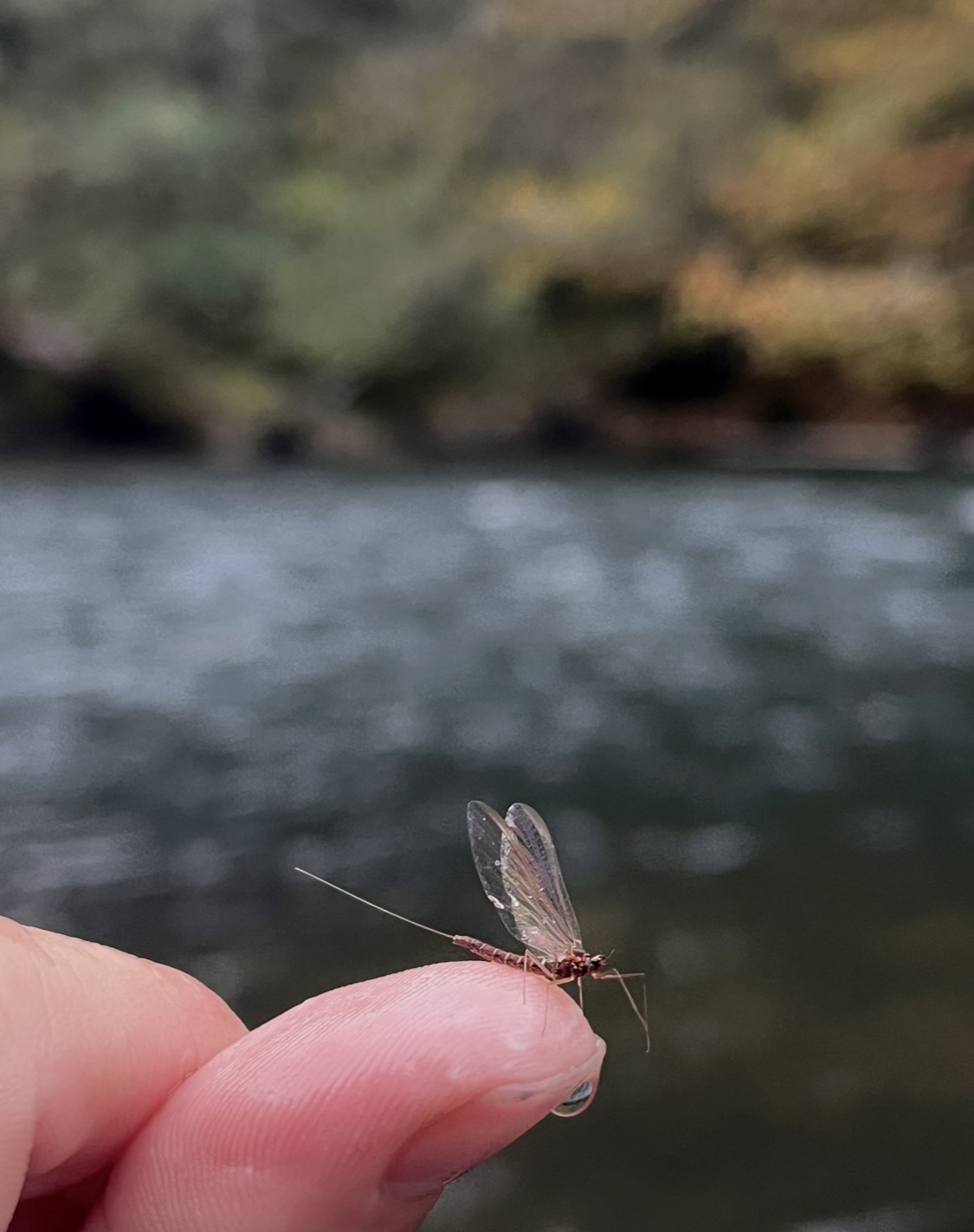
Freshly Emerged Female Mahogany Dun.
The big player in terms of aquatic insect hatches is the Baetis family of mayflies also known as Blue Winged Olives or BWOs. With our cooler weather, these mayflies will hatch on overcast days during the middle of the day. They are often found hatching in more calm water, and most of the time trout will be seen rising to emerging duns. We are beginning to see our first hatch of small winter stoneflies. Female October caddis are still lingering around and will been ovipositing, or laying eggs, in the river on cloudy days during the day or in the evenings. Mahogany Dun Spinners can be found congregating in the evening and the fish will key into a spinner fall of them. There are a few leftover small caddis that are on their last leg.
Small nymphs have been especially effective with current conditions.
The first of the Winter Stones are starting to come out.
Swinging flies is another way to search this time of year. Swinging small soft hackles can be deadly when bugs are coming off, the small flies mimic emerging insects. Swinging small streamers when the water is high imitates disoriented sculpins and baitfish that are fleeing downstream. Add small erratic strips to really drive the point home that your small streamer is a distressed fish. Here are some good choices for smaller soft hackles that are fishing well: Baetis Drymerger #18, Soft Emerger BWO #18, or a Soft Hackle Bead Thorax Mahogany #14. For small streamers try: Jr Sculpzilla, Tactical Jig Zonker #12, or a Thin Mint #8-12.
Swinging soft hackles can be extremely effective this time of year, and give you a break from staring at an indicator all day.
Feel free to stop by the shop or give us a call if you need anything. Have fun out there and don’t forget your rain shell!
-Simon
Get out there and enjoy the last of the fall colors before they’re gone!
The Senior Gotcha is a grey-haired take on the classic gotcha pattern using Rainy’s new silver fox craft fur. This classic flats pattern works great for bonefish and permit if presented correctly. The pattern’s eyes can be substituted to heavier lead or tungsten eyes depending on the tide or water you are fishing. Colors can be substituted depending on your fishery. If you fish it let us know how it works!
Check out this informative article from Propublica.org about dam drawdowns in the Willamette Basin. If you have been wondering why Fall Creek, Cougar, and Lookout Reservoirs are like rivers right now this article will explain. Click HERE to read.
Enjoy a lovely evening of fellowship, festivities, and even a few exciting raffle prizes benefitting Oregon’s native fish and wild rivers.
$100 admission includes a delicious buffet-style BBQ dinner from Cody’s Country Catering, craft brews from our friends at Deschutes Brewing, and a specialty cocktail from the good folks at Crater Lake Spirits and Crafted Life.
Whether you join us live and in person or from the comfort of your favorite easy chair, our Virtual Silent Auction has a little bit of everything for your bidding pleasure. From hosted fishing days with NFS staff to quality Yakima Racks, Patagonia gear to hot air balloon rides, we’ve got it, thanks to our generous friends and sponsors.
Take a sneak peek at the auction catalog, updated regularly, and be sure to register! You don’t want to miss any of the fun!
When: In-person event: Saturday, November 11th, 2022; 6pm – 9pmOnline Auction: Bidding begins Sunday, November 5th, and closes at 5:00pm PST on Saturday, November 11th
Where: In-person event: Tumalo, OR Online Auction: Wherever you have wifi!
What:A Central Oregon celebration and virtual auction benefiting our wild, native fish, free-flowing rivers, and thriving local communities.
Take a sneak peek at the online auction catalog here – open to all for bidding this Sunday, November 5th. And if you’re in the Central Oregon area – or are looking for an excuse to travel to Bend! – you’re invited to join us for our in person event on Saturday evening, November 11th!
Whether you join us live and in person or from the comfort of your favorite easy chair, our Virtual Silent Auction has a little bit of everything for your bidding pleasure. From hosted fishing days with NFS staff to quality Yakima Racks, Patagonia gear to hot air balloon rides, we’ve got it, thanks to our generous friends and sponsors.
Take a sneak peek at the auction catalog, updated regularly, and be sure to register(for free!) and get ready to place your bids soon! You don’t want to miss any of the fun!
For those in the Central Oregon area wishing to attend on November 11th, Homewaters Roundup in-person tickets are limited, so get yours today! We hope you’ll join us in celebrating Oregon’s native fish and wild rivers!
In this instructional video, Simon demonstrates how to tie an effective shrimp fly he uses in the surf off of the Oregon Coast. The fly was originally designed for use targeting surf perch, but could also work for rockfish off of the jetties or other marine species that eat shrimp. Fish on our coast whose diet is largely made up of crustaceans, key in on orange colors or other colors indicating a gravid female shrimp or mole crab full of eggs. Specifically, here on the Oregon coast, Orange is a very productive color for targeting surf perch. Colors and materials can be substituted depending on the fishery. This fly would also work great for trigger fish if a larger hook is substituted.
In this podcast, former shop employee Gregory Nespor along with his friend and guide David Gregory discuss the variety of fly fishing within Yosemite National Park, techniques, fly patterns, how to escape the crowds to find solitude, bear management issues, and the future of conservation and stewardship within this American treasure.
What to Expect at R.U.N. In Unity Convening:The convening will center on three critical pillars:
Education: Raising awareness through informative sessions and expert discussions. Expect to leave with a deeper understanding of the challenges facing our precious water, orca, and salmon.
Cultural Awareness: Exploring the rich cultural heritage intertwined with these natural resources. Learn how Indigenous communities have been stewards of the land and its inhabitants for generations.
Solution Formulation: Developing concrete solutions and strategies to bolster the Northwest’s resilience. This isn’t just an event; it’s a chance to be part of something bigger, to safeguard the future of our Northwest home. Register today!
This event is not exclusive; it’s open to all, including Tribal and Non-Tribal people and voices. Diverse perspectives are vital in our collective efforts to protect these invaluable resources.
The R.U.N. in Unity Convening will also provide clear, precise, and factual information. We believe in empowering informed decision-making.
A block of hotel rooms will be available at the Tulalip Resort. These rooms will be available at a discounted rate for event attendees. Keep an eye out for more information, which will include details on booking your accommodations. Find directions to the Tulalip Resort here. Thank you for your commitment to preserving our natural treasures. Together, we can make a difference.
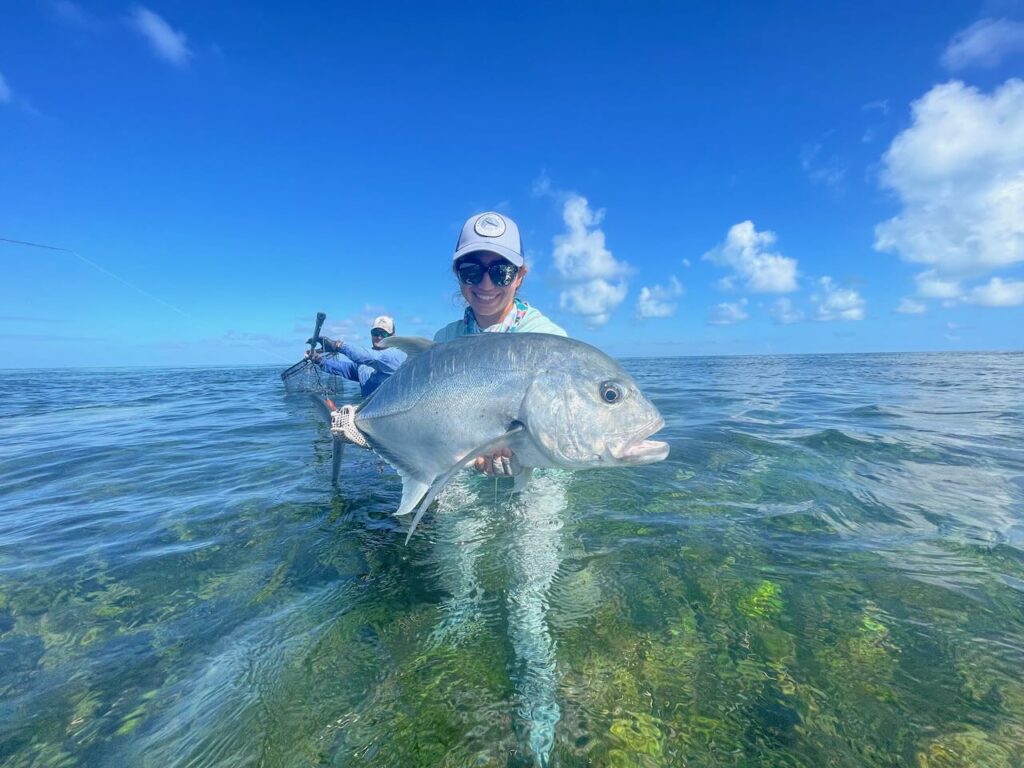
The Seychelles will test the limits of your gear. Every aspect of your tackle, from the type of backing you use, the knots you tie and even the gloves you wear, chasing big fish in the far reaches of the Indian Ocean is hard core.
On a recent trip to the coral head laden waters of Farquhar Atoll our group had a chance to learn about what gear really stood the serious test.
Factory Line Loops
Factory GT lines and other saltwater lines have strong cores that max out at around 60lbs. For most fisheries this core strength is fine. When anglers employ leaders formulated for IGFA standards factory loops hold up almost every time. In the Seychelles the guides don’t care about IGFA leaders, they want you fishing 80-130lbs, about 8ft long. They want to land that trophy GT and when he runs for the outer edge of the atoll or the closest coral head. They want you to turn your drag to max pressure and hold the fish. When you impose this kind of pressure on a fish with 100lbs test, factory fly line loops often fail. Add a bit of razor sharp coral and they almost always fail. Through trial and error Seychelles guides who deal with some of the toughest fish that swim have developed a DIY remedy that will give your fly line the strength it needs to hold giant grouper, wrasse and GT’s.
Step 1: as much as it pains you to cut the loops off of your $130 fly line do it.
Cut off Floating and Sinking Factory Loops
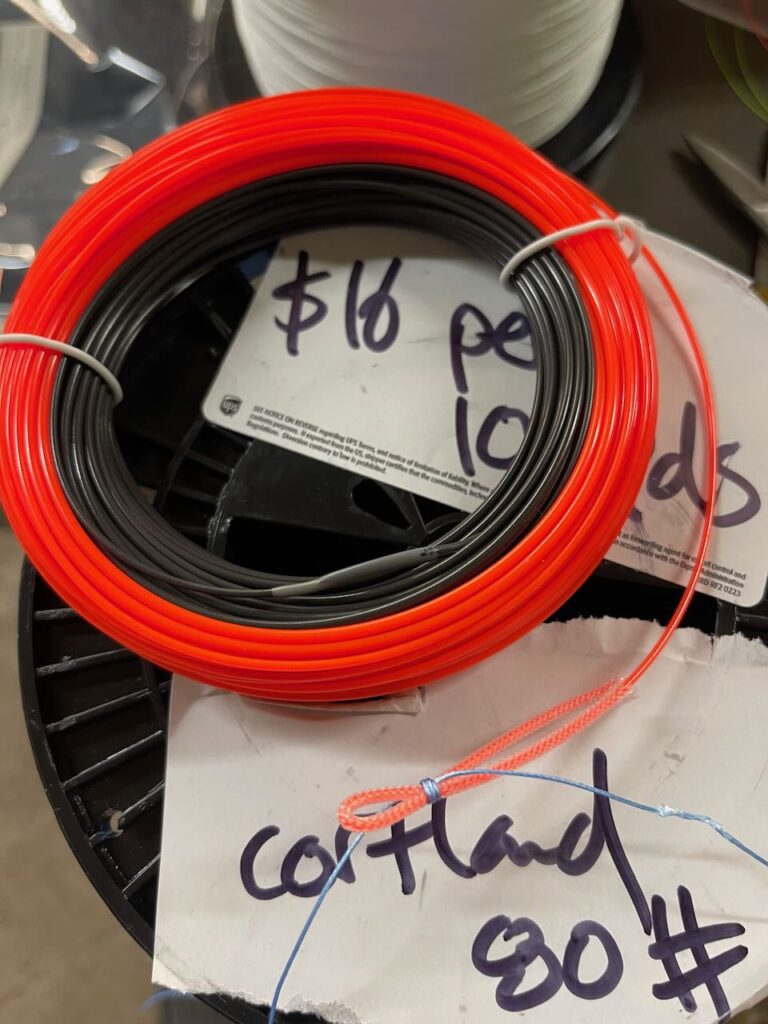
Step 2: Using Cortland 50lbs Braided Mono insert the fly line 3-4inches. The more DIY loops you do the more you can dial in a shorter amount of line but giving yourself some space to start will make things easier. Additionally you can leave extra “braid only” and use this as a transition if you want to make a smoother transition. That said, this new DIY loop is not designed to be in and out of the guides and when landing a big strong fish I don’t suggest brining this loop into the guides ever.
Step 3: Roll the line covered in braid over and tie your first of three nail knots to secure the loop, and create the loop size. Use 65-80lbs braided backing for all your nail knots. I use Cortland 80lbs Master Braid for this step and for all the backing on reels I take to the Seychelles.
Step 4: Tie 2 more nail knots for a total of 3, you can do 4 on the rear fly line loop and leave some braid so that the last nail knot covers one side with fly line and one side with just braid so you have taper. To cinch each nail knot down I use a pair of pliers ( or two ) and really crank on the knots to seat them. When cutting the braided mono, fly line, and master braid don’t use your prized fly tying scissors or even nipper. Use a tool designed to cut braid like the Loon Boat Scissors or the Hareline Cautery Tool.
Step 5: Tidy up the excess braid, mono and fly line. Cover this with a couple of layers of UV Knot Sense, cure and you have an indistructable fly line loop ready for the toughest fish that swim.
Saltwater Fly Reels
When you get a group of 10 together, all packing three 9-12wt outfits you’re bound to have some variety when it comes to reels. We had Nautilus, Sage, Galvan, Abel, and Shilton Reels in the mix of our group. While all of these reels worked on the whole, one reel shone bright in terms of performance/value. The new Sage Enforcer Reel blew me away with its drag, solid build and smooth retrieve. I used the 11/12 Enforcer on an 11wt IMX Pro V2 Saltwater 11wt ( more on that rod later). I had 250 yards of Cortland Master Braid 80lbs (more on that later as well) and a RIO GT line. There is a lot to like about the Sage Enforcer fly reel. First off, its only $575 well under all of the aforementioned reels. Additionally the Enforcer has a numbered, 20 detent drag knob that you can dial in with one full turn. This feature is critical when traveling from flat to flat in search of GT’s and other species. You want your drag locked down when you are fishing but you don’t want to have to pull the line out with the drag maxed each time you come to a new spot. The ability to turn the drag off and on so easily was really useful. When I first looked at the Enforcer Reel our Sage sales rep and legendary angler/hunter George Cook brought the reel to the shop and had us fondle it in store. Then we took the reel outside to cast some rods and test the strength of the drag. I immediately felt the smooth and consistent outgoing drag and the smooth and balance retrieve that the reel had. Then we tested the drag, dialing it up 4 or five detents until we got to max of #20. At the 20 setting I couldn’t not pull the line off the reel, yet with line through he guides and George 30 feet from me pulling hard, the line left the large arbor super smoothly with stopping power. Transfer to the flats of Farquhar, GT is hooked on 100lbs tippet and guide is yelling lock the drag! Lock the drag. He doesn’t want the fish to go off the coral edge or into a coral head. So I lock the drag to the #20 setting and the GT runs a bit more but no question this setting takes its toll and the fish is subdued. The Enforcer Reel just felt solid start to finish and performed perfectly the entire week.
Rods for the Seychelles
I had a chance to fish two new rod models on this trip. The Sage R8 Salt in a 9ft 11wt was a fantastic all around stick in the Seychelles. I had a RIO GT line on it for the entire trip and it cast everything from 2/0 baitfish to 8/0 Beast Flies with ease. The R8 has an unending amount of power. Power that is utilized when making a long cast with a large fly as well as fighting a fish in close quarters. As I mentioned before anglers are using 80-130lbs tippet and when you pull on big fish headed to the coral the tippet simply isn’t going to break. You need to give in by letting the line go with resistance through your hands, or off the reel with the drag maxed. You can’t use to much rod or it’s going to break before the 100lbs does. If the fish makes it to the coral, it’s likely game over. A combination of pressure tactics must come together in order to get a clean tight line on the reel and bent rod for battle ahead. Once the line is on the reel with maxed drag you really get to see what rod is capable of managing a big fish. The R8 Salt did the job numerous times with GT’s, Groupers and Wrasse. I felt I had plenty of “fish fighting” power at distance and close to the boat. You are pulling harder than you ever thought you could in the Seychelles and the R8 Salt stands the test.
The IMX PRO V2 (version 2) Saltwater rod is way too good for the $645 sticker price. I used a 9ft 12wt on our trip and it was shockingly good. Casting big poppers, 8/0 GT flies and big game sinking lines put this rod to the test during my week at Farquhar. The IMX Pro V2 Saltwater passed the test with flying colors. It has the power to make super long casts without the rod “folding” up at any stage in the cast. You felt in contact with line and rod throughout casts of any distance. In terms of fighting fish the rod stood the tough test of keeping fish out of the coral and even fishing in deepwater with sinking lines where lifting fish up off the bottom was required. Bottom line is this rod is a phenomenal value in a saltwater rod.
My 16 and 18 year old children fished together most of the week at Farquhar. Let’s call them the Scott Rod/Nautilus Reel team. They had Scott Sector 9wt and 12wts with Nautilus reels. Patsy caught the biggest GT of the trip with the Scott Sector 12wt. The Sector has been on several trips with us and we continue to love it. The 9ft 12wt is an easy loading, long casting rod that has tons of game for a super light feeling rod. The “Ceracoil” guides are super light and keep the line flying through the guides. The rod is gutsy in terms of battling fish. It’s not so stiff that you lose feel yet it has the strength to wear a big fish down. The Scott Sector is the easiest casting saltwater rod on the market.
Saltwater Backing
On a previous trip I made the mistake of using my old standard 30lbs braided backing. While it’s plenty strong for most applications you just don’t chance anything in the Seychelles. When I was trying to lift a fish off the bottom and out of the rocks…, fly line straight down in the blue water and pop! Line GONE! The Fix? Use Cortland Master Braid 80lbs braided backing and don’t ever worry about failure. You are into the backing on most of the fish you catch in the Seychelles so why chance failure. Cortland Master Braid is not the smallest in terms of diameter but it is the very strongest I have used.
FOR IMMEDIATE RELEASE: Finn Rock Boat Landing Temporary Closure until Spring 2024 FINN ROCK- Ore. – October 11, 2023
Finn Rock Landing is a popular recreation site on the McKenzie River near Blue River, Oregon, attracting as many as 400 people a day in the summer. Owned and managed by McKenzie River Trust (MRT), the boat launch, parking lot, and restrooms will be closed from October 23, 2023 until Spring 2024 for renovations. Improvements to the site will include a better road base, safer traffic flow, and the installation of new parking stalls, ADA- accessible walkways, fencing, bird-friendly lighting, picnic tables, and garbage receptacles.
MRT’s Executive Director, Joe Moll, acknowledges the disappointment of the temporary closure. “We understand that this construction closure will be a significant inconvenience for the many river users who launch or take out at Finn Rock throughout the year. But we expect the site improvements to make the landing more accessible, safe, and enjoyable for all community members and visitors.”
Long provided by the Rosboro Company as a publicly accessible recreation site managed by the McKenzie River Guides Association, Finn Rock Landing was purchased by McKenzie River Trust in 2016 to ensure that future. In the same transaction, MRT acquired the larger Finn Rock Reach habitat conservation area, which has undergone major restoration efforts over the last three years. With ongoing support from community partners and volunteers, the landing has continued to offer an important space for recreation and connection to the river. Support for these upgrades includes grants from Oregon Parks and Recreation Department, EWEB, Lane County, Ford Family Foundation, and the McKenzie Masters, as well as gifts from private individuals.
About the McKenzie River Trust:
The McKenzie River Trust is a regional nonprofit land trust with offices in Eugene and Newport OR. Our mission is to help people protect and care for the lands and rivers they cherish in western Oregon. Since 1989, we’ve acquired property and voluntary conservation easements to protect more than 8,000 acres of clean, free-flowing rivers, plentiful salmon runs, and vibrant farms and forests that provide livelihoods and habitat. We envision a future in which conservation lands are at the core of community efforts to sustain clean water, abundant fish and wildlife, and diverse natural resource economies in western Oregon. Working with private willing landowners from the Cascade Mountains to the Pacific Ocean, we take on the responsibility of caring for land, water, and people, and ensuring that these resources are available for generations to come. For more information,
“Fly Fishing in Argentina: Exploring the Waters of Northern Patagonia and The Fascinating World of Golden Dorado” by SET Fly Fishing
Where: The Caddis Fly Angling Shop 168 West 6th ave, Eugene Oregon 97401
When: October 17th 6pm
Matias Claret of SET Fly Fishing will discuss the Golden Dorado as a species and why they are a great fish to fly fish for. In addition he will discuss SET Fly Fishing’s 3 Golden Dorado programs. For the final part of the program he will talk a bit about Northern Argentina a a trout destination.
Local wines will be served during the free presentation.
Please call the shop to confirm your seat. 541 342 7005.
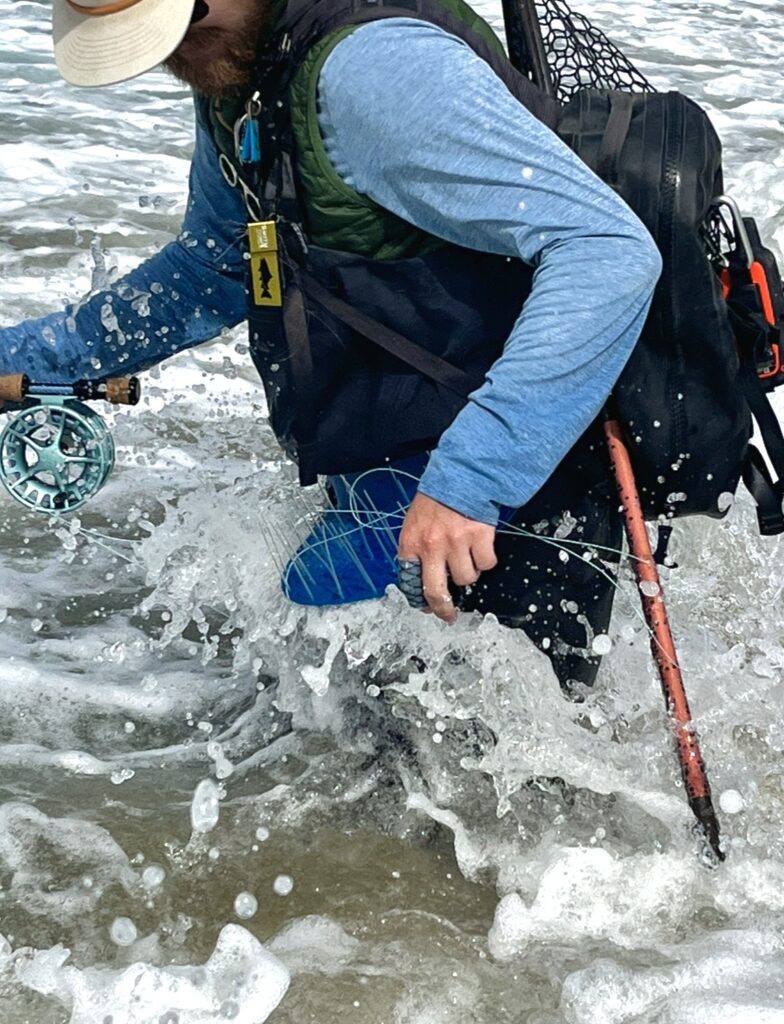
The more time I spent fishing the surf, the more I came to realize that purchasing a stripping basket would make line management much easier. The Ahrex Flexistripper is a lightweight, compact take on the classic, more robust stripping basket. Its design resembles more of a tray with pegs, free of sidewalls. They come in several colors and feature 28 pegs to keep your fly line close. A neoprene belt is included and assembly is quick and easy. Whether you are in the Pacific surf chasing Surfperch and Corbina, the Atlantic surf chasing Stripers, or down South in the surf chasing Pompano or Snook, the Flexistripper will make a big difference in helping you manage your loose line. The Flexistripper also has potential to be used for streamer fishing or in a float tube if you do not have a stripping tray. It keeps your sinking lines close and out of the water, ready for your next cast.
The Flexistripper’s tray design allows for water to rush over the tray while still holding your line.
Surf fishing at times can be a high intensity endeavor with lots going on all at once. Whether its crashing waves, conflicting currents, debris, rips, or getting hung up on your feet or gear, line management is paramount. Pair that with timing your cast, stripping, and still keeping your head on a swivel for waves, you need just about any help you can get managing your line. Stripping baskets are extremely helpful in situations like this where managing your loose line can be difficult, and distract you from actually fishing.
The pegs firmly hold your loose line close when waves and current want to do the opposite.
Jetty fishing for Rockfish, Lingcod, Greenling, Perch, and the many other species can be fun, but the sharp rocks and barnacles don’t get along with your fly line. Cutting your tippet and losing your fly is frustrating, but cutting clean though a fly line is something you really want to avoid. Using a stripping basket to manage your line and keep it off of the rocks and barnacles keeps your line in one piece for longer.
A stripping basket can really save your line from rocks and barnacles when fishing on the jetty.
The low profile design of the Flexistripper makes it great for traveling. If the pegs and belt are removed it can easily be stored in a carry on sized piece of luggage. Because the tray is so flat, it does not take up any more room than a folded shirt. This is perfect for anglers traveling who have a surf trip in mind and want a stripping basket that they can pack with ease.
The peg on the right will fit flush in your tray, the one on the right wont, and your line may get hung up.
My one critique of it lies in its assembly. The pegs come on plastic trees which are remnants of the production process using a mold. To assemble, you pull the pegs off and then put them into the tray. On some of the pegs, there will be a tag end which sticks out. This causes the fitment to not be flush and your line can get hung up on the bottom of the tray. Trimming the excess off makes for a perfect fit and your line will not have anything to get hung up on.
A side profile view of a peg with excess plastic which will catch on your fly line.
One important note directly from Ahrex explains that the pegs can get bent and using an oven can straighten them out. They say: “If the Flexistripper spikes for some reason have bent, you can put the whole Flexistripper (without the belt) into a warm oven (90-100 degrees Celsius) for 5-10 minutes. Remove from the oven and let it cool down. This will straighten the pegs.”
Blue is one of the five colors the Flexistripper comes in.
I think the Flexistripper’s new take on an old design has the potential to change how we think of stripping baskets for the foreseeable future. I have fished with it a lot and am happy with it; it is my first recommendation when someone comes asking for a stripping basket. It’s compact design and lightweight construction seriously rivals the old bulky stripping baskets. If you have any questions about it give us a call or stop by the shop, we are happy to help.
US Fly Fishing Team mini-comp at Diamond Lake Oregon
Saturday, October 21st mini comp and a Sunday October 22nd mini comp. Information posted on www.flycomps.com web page under the “Events” tab.
Although anglers earn points for this competition toward their ranking, we are focused on learning to lake fish using the loch style technique developed in the United Kingdom. This will be a fun weekend where we will help our anglers be more successful.
Organizers of these comps, have been prefishing Diamond Lake and can help anglers with lines, patterns, retrieves, and areas to fish.
This event will follow the new Fly Fishing Team USA cycle format starting this year. For anglers to be eligible to garner points, they need to be from the states of Utah, Idaho, Montana, Arizona, Oregon, Washington, or California.
Angler Limit: This event will be limited to the first 12 anglers.
Transportation will need to be provided by the anglers on their own.
Questions: Please reach out by email to Hann at hlee@hleeassociates.com with any questions.
For insurance purposes, we would need new anglers to sign up for a US Fly Fishing Team membership which covers everyone with their insurance for a year from signing up. Boat rental fees will be $45 to $55 per day.
With colder temperatures at night come our favorite fall hatches: October Caddis, Blue Winged Olives/Baetis, Shortwing/Nocturnal Stone, Assorted Caddis, Grey Drakes and Mahogany Duns. The cooler weather has fish waking up from their heat induced summer sluggishness. Fish are looking up keying in on hatches as well as eating voraciously subsurface. Dry fly fishing locally has been fantastic. We have brought in an extensive selection of brand new fly patterns for this fall that we are excited about. This is one of our favorite times of year, and a great time to get out on the water.
Mahogany Duns are hatching and the fish know it. A Hatchback Mahogany Dun fooled this one
Fall hatches are triggered by cool nights and colder water temperatures; these hatches start high in the system and work their way down as the cooler weather makes its way down into the valley. October caddis pupa emerge at night or on cooler, cloudier days. Their activity is largely concentrated to the afternoon into the evening. Mahogany Duns, Gray Drakes, Short-Winged Stones, and assorted small caddis will be active in the afternoon. Blue Winged Olives will hatch in greater numbers on cooler, more overcast days. You may see some lingering terrestrials like hoppers, crickets, ants and beetles, but with these cold nights they wont last long.
October Caddis, the big fall bug that many of us have been waiting for
Several shucks from an October Caddis emergence the night prior
As more mayflies hatch this time of year, swinging soft hackles that imitate emerging nymphs can be a great way to fish, and produce explosive grabs. For Blue Winged Olives or Mahogany Dun soft hackles try: Soft BWO Emerger #16/18 , Tungsten Soft Hackle Pheasant #14-16, Harrop’s Mahogany Soft Hackle Beaded Thorax #14, or a a Drymerger Baetis #18. The October Caddis Pupa listed above are great on the swing. Most of these pupa emerge overnight, or on especially cloudy days. Try swinging them in various lower light situations.
Now is a great time to get out there, most of our rivers are in great shape to wade
For many of us here in the valley, this is our favorite time of year to get out. The river is conducive for a float, for wading, there are loads of insects hatching, what more could you want? Swing by the shop and check out the back table for a handpicked selection of our best seasonal flies, or to see some of the new patterns. Feel free to give us a call or stop by the shop if you need anything. Have fun out there!