McKenzie River Paddle & Pull

Join McKenzie River Trust in caring for a special property between Hendricks Bridge and Hayden Bridge on the McKenzie River!

Saturday, June 23rd, volunteer to help care for McKenzie Oxbow, a 20-acre conservation area just downstream of Hendrick’s Bridge Boat Landing.

Setting off from Hendricks Bridge at 9am, volunteers and staff will paddle to the conserved property to remove invasive species and trash. Taking a lunch break together on the gravel bar, we’ll have time to learn more about this special area and the fish and wildlife the oxbow supports. The afternoon will be spent paddling downstream, passing nearly 200-acres of protected lands before taking out at Hayden Bridge. McKenzie River Trust will provide a shuttle for drivers from the take out back to Hendricks Bridge.

IMG_3038

Volunteers must be over the age of 18, provide their own river appropriate watercraft, life-jacket/PFD, and be confident paddling in Class II rapids.

McKenzie Oxbow is a Trust-owned floodplain property, located on river mile 19 of the McKenzie River. Composed of 20 acres of oxbow slough, gravel bar, and riparian habitat, it is a typical river floodplain feature that is rapidly disappearing in the lower McKenzie watershed. The conservation of McKenzie Oxbow allows for unfettered river movement and natural hydrological processes across the island, and permanently protects the current riparian and wetland conservation values of the property.

Posted in Oregon Conservation News | Leave a comment

Lower South Fork McKenzie River Floodplain Enhancement Project Phase I

Screen Shot 2018-06-14 at 5.56.39 AM

Phase I of the Lower South Fork McKenzie River Floodplain Enhancement Project is underway. The Project will enhance habitat conditions within the lower mile of the river and restore connections to over 200 acres of floodplain. Contractors are currently collecting large wood for placement later this summer and preparing for floodplain reconnection.

Prior to the start of in-stream activities, the Project will temporarily reroute the lower mile of the South Fork McKenzie River into a floodplain side channel. Project managers plan to begin the diversion in the late afternoon or early evening of June 26, 2018. Project activities, including the diversion, will continue until August 15, 2018.

Project managers expect that the diversion may cause short-term turbidity impacts to the McKenzie River immediately downstream of the South Fork McKenzie River confluence. The Project will take several steps to minimize downstream turbidity impacts prior to the diversion. The U.S. Army Corps of Engineers will reduce flows in the South Fork McKenzie River to at least 275 cfs. Contractors will place large wood throughout the diversion side channel with helicopter in order to minimize disturbance to existing natural conditions. Large wood will slow flows and help reduce erosion. The diversion will take place over a period of several days in order to avoid scouring the floodplain side channel. The slow draw down will also allow for fish escapement prior to fish salvage operations within the current mainstem South Fork McKenzie River channel. Fish salvage operations will occur over a 3-4 day period and done in coordination with ODFW. Fish and other aquatic organisms will be re-located to locations outside of the project area. If you are interested in assisting with fish salvage operations please contact the McKenzie Watershed Council, (see contact info below).

For more information, please contact project managers, Jared Weybright, McKenzie Watershed Council Executive Director, atjared@mckenziewc.org, 458-201-8150 (office), 541-505-0501(cell); or Kate Meyer, USFS McKenzie River Ranger District Fisheries Biologist,kmmeyer@fs.fed.gov, 541-822-7230 (office).

Posted in McKenzie River, Oregon Conservation News | Leave a comment

Old dogs, new tricks: Northern Pike 2018

Hey folks, Matt Stansberry here with an update from our annual fishing trip to Mar Mac Lodge on Lake Esnagi in Ontario. My dad and his buddy have been coming up to this lake for fifty years and I’ve been going since I was just a kid. You can read some highlights from the wilder, younger (drunker?) years here.

It has been great to bring my nine-year old into the tradition, but also fun to watch my dad and his friend John learn to fly fish for Pike. Nate and I had been doing this since we were kids — we had picked up some Larry Dahlberg VHS taps at a very young age. In fact, our very first fly rods were super-cheap 8-wts specifically for our first time on this trip.

It’s an incredibly effective way to catch really big pike in clear, shallow water. And it’s fun to see these guys who’ve been trolling for walleye their whole lives take up the fly rods and bee successful. John is flinging his 9-wt Redington here in the photos below. I hope you enjoy! -MS

Untitled

Untitled

Untitled

Untitled

Untitled

Untitled

Untitled

Untitled

Posted in Fishing Porn, Fly Fishing Travel | Leave a comment

Willamette Falls Fish Counts Up – Water Levels Down

niddle-fork-dexter

Last year was an absolutely miserable local steelhead year. This time last year their were approximately 1000 summer steelhead over Willamette Falls. Those 1000 spread in the Willamette, McKenzie and Santiam River systems, so catching them last year was rare at best. This year has been tough with higher flows and less than impressive numbers when you look at the last 10 years but…..We are now looking at 4000 summer steelhead over the falls and water levels have just plummeted, things are looking up. The water from Dexter dam all the way to the confluence of the McKenzie will be worth a look for summer steelhead now. Daily counts over the past two weeks have been really solid and we have been hearing reports of anglers catching fish.

may fish counts

june fish counts

Best flies for summer steelhead locally have been:

Moal Leech
Green Butt Silver Hilton
Silveynator
Reverse Marabou
Locally inspired Jen Sens Steelhead Patterns

Posted in Lower Willamette, Middle Fork Willamette River fishing | Leave a comment

Rainy Weekend – Hatches on the McKenzie and Willamette

Upper McKenzie

High pressure gives way to an overcast, showery “mayfly friendly” weekend. Fishing has been excellent on the McKenzie and Middle Fork of the Willamette Rivers of late. Look for that fishing to be more surface focussed and even better this weekend. Green Drakes, Pale Morning Duns, and Green McKenzie Caddis will be the highlights. Wet and colder conditions will keep mayfly wings damp and they will struggle to get off the surface giving trout a much longer opportunity to pounce.

The Mckenzie River above the South Fork of the McKenzie is at historically normal levels. The river below the South Fork is much higher than we normally see at this time of year due to increased released from Cougar Reservoir. Add in the fact that Leaburg canal is virtually empty and you have plenty of water in the McKenzie from Blue River to the confluence of the main-stem of the Willamette. While this may be a more water than you are used to this time of year it’s fantastic for fish and bugs.

Best flies for the weekend include the following:

Mercer’s Missing Link

Flies for the McKenzie

Parachute Adams

Flies for the McKenzie

Green McKenzie Caddis

Flies for the McKenzie

Parachute Caddis Tan

Flies for the McKenzie

Stalcup’s Green Drake

Flies for the McKenzie

Parachute Hare’s Ear Green Drake

Flies for the McKenzie

Little Yellow Sally

Flies for the McKenzie

Laser Pointer Green Drake

Flies for the McKenzie

Film Critic Green Drake

Flies for the McKenzie

Tilt Wing Pale Morning Dun

Mayfly McKenzie

Melon Quill

Mayfly McKenzie

Posted in Fishing Reports, Lower Willamette, McKenzie River, Middle Fork Willamette River fishing | Leave a comment

Jay’s White Ghost Tube Trout Streamer Fly Tying Video

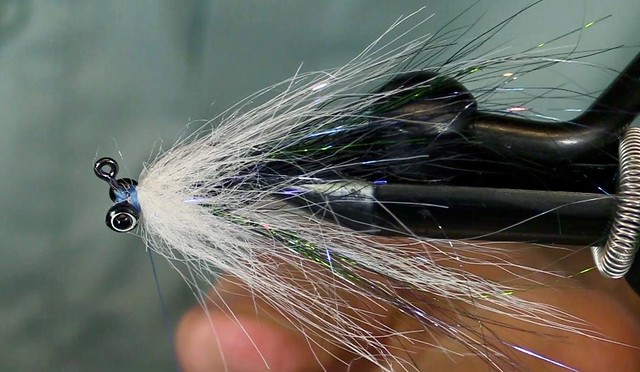
In this video Jay ties up another delicious trout streamer. This fly really illustrates how using a variety of similar colored materials can add subtle accents and several layers of texture. This fly can be cast, stripped, and swung for a variety of critters including Trout, Bull trout, and Bass!

thumbnail

Jay’s White Ghost Tube Trout Streamer

Pro Nanotube Clear
Pro Drop-weight Silver Small
Thread: White Veevus 8/0
Cement: Loc-Tite Brush on
Butt: Seal-X-Ice Dubbing Rogue Red
Body Cactus Chenille Large Pearl
or Speckled Chenille Pearl/White
Brown Barred White Rabbit Strip
Krystal Flash or Angel Hair
EP Sparkle Brush
Craft Fur Brush White
Pro Cone x-small Red

Posted in Fly Tying, Fly Tying Materials and Supplies | Leave a comment

Hook Up or Hook Down – Questions from NZ

OLYMPUS DIGITAL CAMERA

Hey Jay, hope all is well. I was wondering about your thoughts on hook positioning in flies. In particular tube style flies. Have you experimented with hooks in the down position and further up towards the head of the fly?

I have suspicions about fish eating the head of the fly.

The trend towards trailing hooks seems to work ok in the sweet part of the swing where line belly helps to pull the hook into the fish but suffers on the hang down and in slacker water.

Interested in your thoughts on this—and hope you find these photos of NZ Chinook interesting. Thanks in advance.
____________________________________

My answer.

Tubes with hook near the head.
Where Tube flies are concerned, I have to date learned only one way to place the hook near the head of the hook is to tie the fly with a philosophy I believe we see in Atlantic Salmon flies tied for use in Northern Europe. The flies I’m thinking of here are often tied on very short metal tubes with a hook seated at the rear of the tube—these flies are then finished with very long sometimes multi-layered hair wings that ride high over the body and flow well past the bend of the hook

I find the overall appearance of the style is attractive and no doubt effective since it has passed the test of time and has been well established and fished over a large geographic region for decades.

Tubes with hook trailing the rear of the fly.
My preference for hook placement in Tube flies is to rig an up-eye short shank octopus style hook on a loop; then I pull the lop knot into the tube just far enough to allow the hook to ride at the very rear end of the materials. If given the opportunity, I will always choose to let the hook point ride up.

OLYMPUS DIGITAL CAMERA

Why rig hooks with point upward?
I have fished flies like comets, bosses, shrimps, and various deceiver style streamers—all with the hook point down. Contrary to what one might think, I have found the majority (Instinct says 60%) of the kings I bring to hand were hooked in the upper jaw, specifically about a quarter to a third of the distance from the snout to the corner of the jaw. This proves that the hook—in spite of swimming in the down position—somehow rotated before lodging in the upper jay.

Fishing the swing.
Hook inclination (up or down) may not make as much difference when fishing flies on the classic swing. Here’s my thoughts on this subject. A traditional presentation where a fly swings steadily across a current may be more likely to result in a steelhead intercepting the fly and holding it, thereby allowing the line’s tension to pull the hook into the corner of the jaw regardless of whether the fish holds steady in the current with fly in mouth or turns away from the angler with fly held in mouth. Either take form seems likely to result in a hook seated in the corner of the jaw.

Hookups with Clousers.
A decade ago I was fishing Comets and Boss flies far more often than Clousers. Not these days. There is something about the Clouser’s hook-up style that I believe yields a higher percentage of hookups than the hook-down perspective of traditional flies.

Fishing the hang/strip in slack water.
This scenario is common while fishing tidal flows in the estuary. With high confidence, I’ll state that this is the most difficult position from which to hook Chinook, and results in the highest percentage of salmon either not hooked at all or lost after being hooked for some period of time.

I will say again that the fish I hook and bring to hand on the hang down, even with Comets and Boss flies, are hooked in the roof of the mouth or upper jaw more often than otherwise.

Do salmon and steelhead eat the head end of the fly?
Probably they do, yes, unless they inhale the whole thing or unless they take a tentative nip at the rear of the fly. Bottom line is that they will do all of these things depending on their mood from moment to moment.

The Clousers I troll for Albacore with Clousers are in the six to eight-inch size class. I will usually rig a trailer hook on wire with these flies. More than half the time the head or the entire fly will be inside the Albacore’s mouth. At least a third of the time I will only hook tuna of the trailer hook, suggesting that on these days the fish are nipping the rear instead of engulfing the head of the fly.

Best wishes

Jay Nicholas Spring/Summer 2018

Posted in Fly Tying | Leave a comment

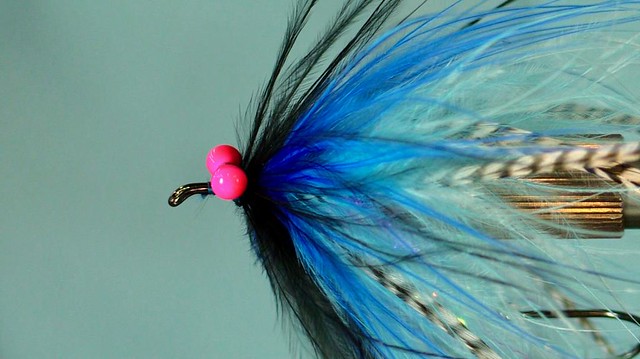
Jay’s Steelhead Tube Fly w/Grizzle Saddle and Pro Sport Flexi bead Fly Tying Video

In this video, Jay demonstrates how to tie a tube fly using Pro Sport’s Classic Tube and Flexineedle. Jay is also tying this fly with Skinny Grizzle Saddle instead of Ostrich. Using Saddle provides a little more durability than Ostrich and will hold up better over time. Jay finishes the fly off with a Gunsmoke Pro Sport Flexibead which fits on a variety of tubes and helps the fly get down to the right depth.

thumbnail

Jay’s Steelhead Tube Fly w/Grizzle Saddle and Pro Sport Flexibead

Tube: Pro Sport Classic Tube
Tube Needle: Pro Sport Flexineedle
Thread: Danville’s 210D blue
Dub: Purple UV Ice Dub
Tentacle: Skinny Grizzly Saddle
Cement: Loc-Tite Brush on
Hackle: Marabou Orange
Flash: Orange Krystal Flash
Hackle #2: Marabou Black
Bead: Pro Flexibeads Gunsmoke
Trailing Hook: Aqua Flies Swing Hooks (Size 2)

Posted in Fly Tying, Fly Tying Materials and Supplies | Leave a comment

Carey Special Fly Tying Video

In this video, Tony ties up a Carey Special. An old but very effective pattern for fishing lakes. The Carey Special is one of those “must have in your box” fly patterns when you visit a lake. It’s the Parachute Adams for stillwater angling. Enjoy!

thumbnail

CAREY SPECIAL

Thread: Veevus 10/0, Black
Hook: TMC 5262, Sizes 4-10
Tail: Natural Brown Pheasant Rump
Body: Olive or Brown Chenille or Peacock Wrapped
Collar: Natural Brown Pheasant Rump
Note: Consider tying with Variegated Chenille

Posted in Fly Tying, Fly Tying Materials and Supplies | Leave a comment

Baja Flies by Gui Allen


Yes, my friends Gui and Jim are (or have very recently been) fly fishing at Gary Bulla’s in Baja. I asked Gui to share several of the flies he has been tying for this trip. Without further comment, I’ll share photos of his favorite flies here, as inspiration to us all. I still hope to make the trip in 2018 but who knows?

Three Sardinas.

Three Sardinas.

Two Yak Hair Sardinas.

Two Yak Hair Sardinas.

Gui's Kinky Muddlers.

Gui’s Kinky Muddlers.

Baja Attractor Flies.

Baja Attractor Flies.

Never forget the crease flies.

Never forget the crease flies.

Two favorite Crease flies.

Two favorite Crease flies.

All of these flies range between roughly 3″ and 6″ long. Key materials used in these flies emphasize

Steve Farrar’s blend

Sculpting Flash Fiber

EP 3D fiber

UV2 Yak hair

I hope you find inspiration here, and wish you many hours of enjoyment at your fly bench and on the water.

Jay Nicholas, summer 2018


Posted in Fly Fishing Travel, Fly Tying | Leave a comment

Big Dry Fly Time in Oregon – Trout Fishing in May and June 2018

You have to love fly fishing in May and June in Oregon. Some of our very best opportunities exist and we are able to fish some of the biggest dry flies of the season. You have hungry trout tying willing to attack active insects like Green McKenzie Caddis, Golden Stoneflies and Salmon Flies. The flies below are proven winners from the Middle Fork of the Willamette to the John Day.

We have photographed and named some of our favorite patterns for this “big fly time” below. Get out and enjoy!

Big flies for Oregon

Top to bottom right to left the patterns above are:

Clarks Stone
Rogue Foam Stone Giant Salmon Fly
Norm Woods
Norm Woods Rubber Legs
Larimer’s Golden Stone
Goodman’s Crowd Surfer Stone
True Salmon Fly
True Golden Stone
CDC Salmon Fly
Chubby Norman

Big flies for Oregon

Green McKenzie Caddis
CDC Green McKenzie Caddis
Green Drake Cripple
McKenzie Green Parachute
Black Winged Stimulator
Parachute Madam X Royal
McKenzie Parachute Sulphur
Parachute Adams

Big flies for Oregon

Green Drake Cripple
Poxy Back Cripple Green Drake
Hair Winged Dun Green Drake
Heavy Hackle Parachute Green Drake
Perin’s Hi Vis Green Drake Parachute
Better Than Sex Green Drake Nymph(I know a nymph but it’s really cool)
Mercer’s Missing Link Green Drake
Laser Pointer Green Drake
Extended Body Green Drake
Film Critic Green Drake

If you are headed to the John Day, Umpqua or other smallmouth destination check out our latest additon of poppers below. The Surface Seducer series of poppers are the best we have seen.

Big flies for Oregon

Big flies for Oregon

Surface Seducer Poppers

Posted in Fishing Reports, Fly Fishing Gear Review | Leave a comment

Tuna Tuxedo (Steve Farrar’s Blend) Fly Tying Video

In this video Jay ties another Tuna Tuxedo using Steve Farrar’s Blend. There isn’t really an advantage using SF Blend over UV yak hair – it’s only preference in materials! Both will fish great. This fly will work for a variety of salt game including Skip Jacks, Dorado, and Rooster fish. Happy tying!

thumbnail-1

Tuna Tuxedo (Steve Farrar’s Blend)

Thread: Clear Danville’s Mono
Cement: Loc-Tite Brush on
Hook: Gammie SC-17
Belly: Senyo’s Chromatic Brush Live Bait
Belly: SF Buck-tail White
Back: SF Bleeding Black
Eyes: 3D Super Pearl 3/8”
Finish Loon Thin

Posted in Fly Tying, Fly Tying Materials and Supplies | Leave a comment

Forgotten Summer Steelhead Flies

An assortment of favorite summer steelhead flies you will find in my shirt pocket.

An assortment of favorite summer steelhead flies you will find in my shirt pocket. All are equivalent of size 6 TMC 7999.

Just a quick note to remind summer steelhead anglers that traditional wet flies or simplifications of these flies are to this day very effective when fishing for summer steelhead.

While we have embraced the art and functionality of the Intruder and various modern fly styles, I’m reminded by my own experience and comments from friends and Shop Clients of the fact that subtle modifications of the flies we fished two to four decades ago are also effective. In fact these modern versions of small traditional or semi traditional wet flies will sometimes and in some places be more effective than much larger flies.

Why should this be so? Plenty of possible reasons – including the occasions when a feeding instinct dominates a territorial or curiosity instinct. That is the shortest explanation I can offer.

I always carry an assortment of these flies. You should consider doing the same.

Here are some of the standards that are always effective – there are others too.

Copper Top

Bennet’s Last Light

Green Butt Silver Hilton

Lady Caroline

Silver Hilton

Purple Peril

Steelhead Coachman

Silvey’s Pool Cleaner

Hartwick’s Silent Assassin

Muddler

Undertaker

Mack’s Canyon

Blue Charm


JN May 2018


A quick note to add to Jay’s post. Willamette Falls fish counts are looking better for summer steelhead this year compared to last. We are nearly at 2000 fish over the falls this year while at the same time last year we had about 500.


Posted in Fly Tying | Leave a comment

Postcards from Pacific City – May 2018

Dear Friends: Here is what I’ve been up to recently in Pacific City.

Mikhail Skopets and Jay at the beach - Pacific City.

Mikhail Skopets and Jay at the beach – Pacific City.

1. My friend Mikhail Skopets visited from Russia for 4 days. He is NOT an oligarch and the only laundry we did was sheets, jeans, and socks. When we met four years ago, he had caught over a hundred fish species on flies. Now the number is pushing up against 150 species. His latest rip to PC added coastal cutthroat but failed again to add spring chinook. Maybe next time.


Mikhail Skopets in 2018 withPacific black rockfish on  a surface popper.

Mikhail Skopets in 2018 withPacific black rockfish on a surface popper.

2. Ocean fishing was decent and Mikhail caught many black rockfish. The bass were feeding heavily on crab spawn but they took our clousers and surface poppers well.

Part of the bounty from the sea at Pacific City.

Part of the bounty from the sea at Pacific City.

3. Thanks to John Harrell and Pacific City Fly Fishing, we not only caught many bass but also took home many Dungeness crab,

Jay and Jack relax while John fillets the rockfish and cook the crab.

4. My friends Ed and Guido visited one evening. The following morning dawned to bowls of empty crab shells, bits of rockfish, chips, salsa, bowls of solidified garlic butter, and a few designer beer bottles. Three hours devoted to cleaning the cabin while my friends were fishing. Ha ha.

Late seafood appetizers at the cabin.

Late seafood appetizers at the cabin.

Springer fishing is so slow that the Point is deserted – Joe and Mikhail are flyfishing in a place normally occupied by 20-40 gear anglers.

5. Springer fishing has been extremely slow. Evidence my friend Joe fly fishing alone from the Point at the Boat Hole.

6.  We fished Echo BAG Bad ASS Glass rods, Nautilus and Hatch reels, and Airflo Sniper Custom Cut Tip fast sinking fly lines. Great gear.

ECHO Bad Ass Glass fly rods on left, loaded and ready to fish.

ECHO Bad Ass Glass fly rods on left, loaded and ready to fish.

Sorry we’re short on fish photos, but sometimes the camera person chokes.

The ocean should calm down very shortly and we expect very good fly fishing for bottom fish and crab. Springers? Yes, there should be a few also.

Best Wishes to you all

Jay Nicholas – late May 2018

Posted in Fishing Reports, Oregon Saltwater Fishing | Leave a comment

Jay’s Slender Trout Streamer (Blue Smolt) Fly Tying Video

This fly is inspired by flies that folks over in Europe fish for Sea Trout. These flies are characteristically long and slender and they tie these flies on really tiny tubes and use less material which gives it a nice slim and translucent appearance when you put it in the water. You could even use a micro tube for this. If you want to use this fly to fish for Steelhead and Coho Jay recommends using a size 4 or 6 hook.

thumbnail

Jay’s Slender Trout Streamer (Blue Smolt)

Pro Sport Flexineedle
Pro Classic Tube Medium Blue
Lagartun Carded Flatbraid Holo Blue
Gamakatsu Glo Bug #6
Pro Ultra Sonic Disk Metallic Blue Small
Loc-Tite Brushable
Spirit River UV Blue Buck-tail Fl. Blue
Krystal Flash Smolt Blue
EP Senyo’s Chromatic Brush Live Bait
Thread 8/0 Veevus White

Posted in Fly Tying, Fly Tying Materials and Supplies | Leave a comment