Skwala Stonefly patterns, softhackle tips: Day 2 at NW Fly Tying expo

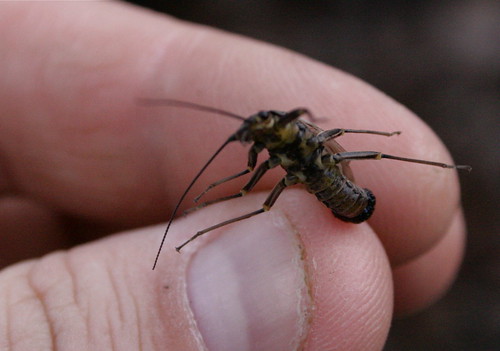
The NW Fly Tyer and Fly Fishing Expo wrapped up yesterday and I picked up a few new fly patterns and tying tips. I was looking for a good Skwala Stonefly pattern, since I’d been seeing a few on the Upper Willamette lately.

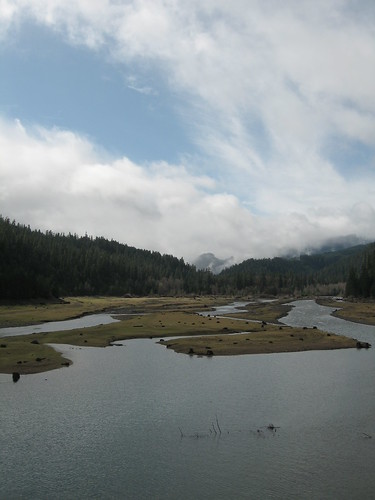
Willamette River March 1st

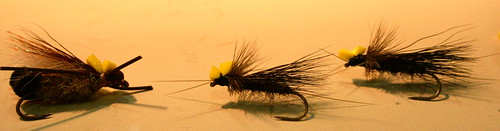
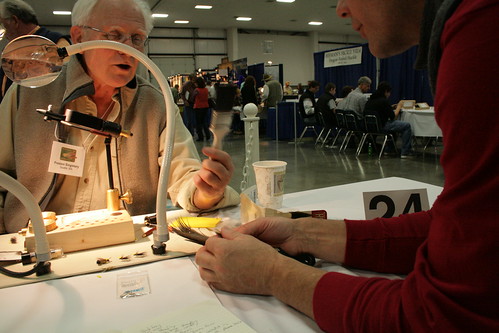
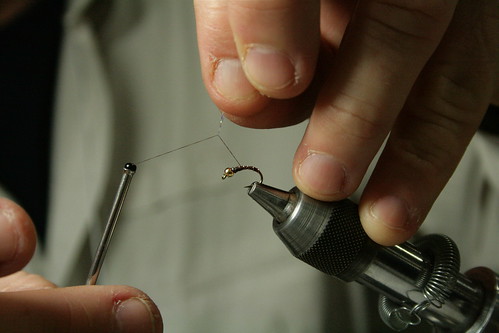
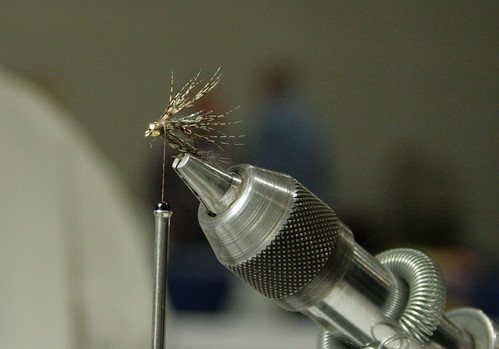
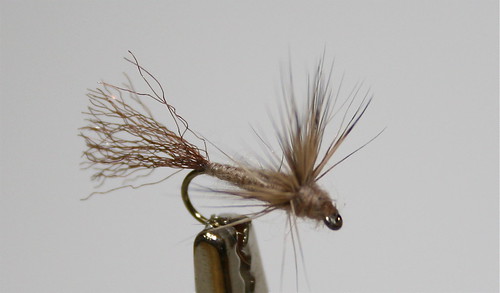
Preston Singletary, a Federation of Fly Fishers member from Seattle was tying Skwalas — a black, pre-runoff emerging stonefly that’s around from February to April. Singletary’s pattern, pictured below at right, is dressed sparser than the typical pattern, pictured at left. He says the typical pattern is overdressed in his opinion, largley in order to hold up a heavy nymph suspended beneath it.

Fly tying show

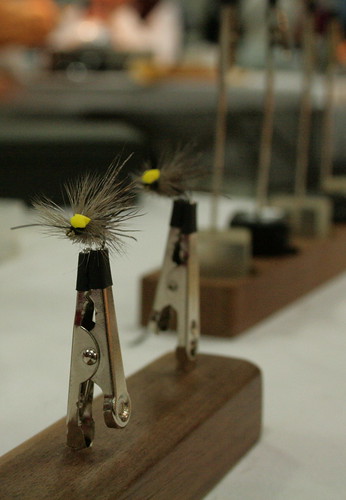
Singletary uses a size 10, 2x long 2512 hook; black dubbing, moose body hair wing and black or dun hackle for the collar. But the icing on the cake is the tapered paint brush fibers that he uses for front and rear antennae. The hotspot is yellow foam.

Fly tying show

Fly tying show

Marlon Rampy of Medford, OR offered up some excellent fly tying tips for softhackle patterns — and adding a little variety for finicky trout. He uses a small piece of crystal flash in some of his soft hackles. He also ties 50% of them with beads, 50% without. His other variation is the thorax: Rampy says peacock makes a great softhackle thorax, but once it’s wet it is basically black. If you’re looking for a little variation, Rampy suggests using a tan/brown dubbing ball for the thorax. He also reccomends using the freshest partridge skins you can find.

Fly tying show

Fly tying show

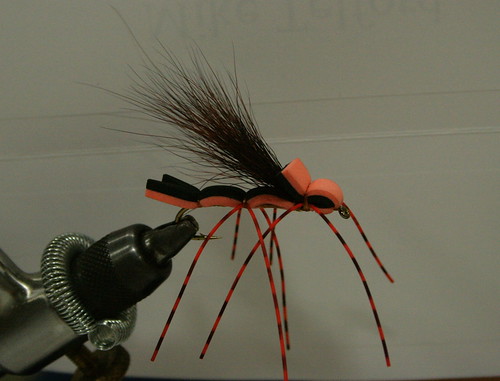
Bend-based tyer, Mike Telford’s foam salmonfly he uses on the Deschutes was a big hit. It’s a four component recipe and super simple. Long two-toned foam body, size 4 hook, bucktail wing and rubber legs. Telford says the pattern is cheap, easy to tie and durable.

Fly tying show

Posted in Fly Tying, Oregon Fly Fishing Clubs and Events | 1 Comment

Skunked.

The same water that has been yielding good catches of native steelhead turned stingy yesterday. After the Oregon Fly Fishing Blog crew landed 11 steelhead last week I was skunked yesterday. I watched one timid steelhead strike short and that was the extent of the action. The coastal rivers are just skin and bones right now; we need a decent freshet to bring a fresh push of natives into the systems and get the fish that are in the rivers already feeling a little more secure. Until then it’s a trout show.

Posted in Coastal Steelhead Fishing | Leave a comment

Oklahoman Senator strangles bipartisan supported Oregon Wilderness

For those of you that fish the Elk and Sixes rivers in Southwest Oregon, I’m sure you’ve been following the Sportsmen for Copper-Salmon Wilderness campaign to protect the Elk River’s headwaters. This wilderness proposal has support from both of Oregon’s senators — Ron Wyden and Gordon Smith.  It also has the support of the local chambers of commerce, Governor Kulongoski, the mayor of Port Orford Oregon and a slew of environmental and sportfishing organizations.

So what’s holding this up? Oddly enough, it’s some jackass senator from Oklahoma that doesn’t have a damn thing to do with Oregon. Tom Coburn (the guy trying to bring guns into the National Parks against the will of park employees) is strangling Copper-Salmon, and a slew of other wilderness bills in Oregon.

The Register-Guard ran an editorial today, blasting Coburn for holding up popular wilderness bills in Oregon. The Mail Tribune in Medford ran an article about Kulongoski’s efforts to push this legislation forward.

Help keep pressure on Coburn by calling his office in DC (202-224-5754) and telling his staff how important the Elk River fishery is to you and other Oregon sportsmen. Or email Coburn and give him a piece of your mind.

Posted in Oregon Conservation News | Leave a comment

From the tying bench: At the Northwest Fly Tying, Fly Fishing Expo

This weekend we’re running a table for Trout Unlimited 678 at the Northwest Fly Tying and Fly Fishing Expo in Albany, Oregon. I spent most of the day at the booth yesterday, but I did manage to sneak away to get some photos of the exceptional tyers and new ideas.

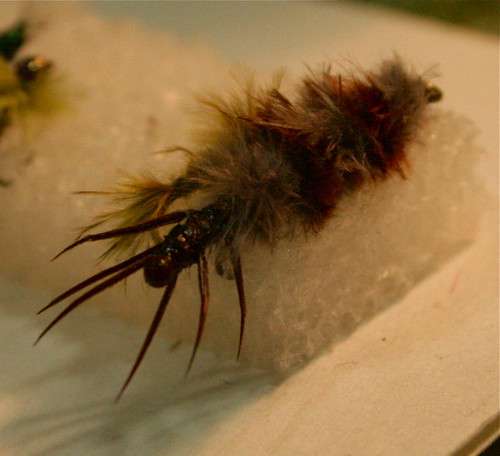
Henry Hoffman, the Oregon-based hackle innovator and fly tying guru, had some impressive flies on display, including a cased caddis pattern that I really liked (pictured below). For more on Hoffman, check out this profile on him in the Astorian.

Oregon Fly Tying expo

Oregon Fly Tying expo

Oregon Fly Tying expo

William Lovelace, a Baker City, Oregon-based tyer, was cranking out some steelhead patterns for the Wallowa and Grande Ronde River. He ties traditional looking steelhead patterns with ice dub and uses Arctic Fox tail for the wing. He also had a cool muddler minnow pattern, a stripped down version with a bright orange clump of shaped deer hair for a hot-spot on the head. He fishes it chuck-and-duck style off a fast sinking line or with split shot.

Oregon Fly Tying expo

On the complete opposite side of the state, Butch Minich is a member of the new Oregon FFF chapter on the Central Coast. He was tying up an east coast streamer pattern called the Sawbelly Special. He says it makes a decent steelhead pattern on the coastal streams. It’s tied on a Tiemco 300, tinsel body, white bucktail and flashabou and peacock herl wing, with mallard flank on either side and small eyes attached to the mallard feathers. The Sawbelly doesn’t look like it would hold up to more than one or two fish, but that may be all you need.

Oregon Fly Tying expo

Posted in Fly Tying, Oregon Fly Fishing Clubs and Events | 3 Comments

The Rogue River’s Gold Ray Dam may be removed

The Medford Mail Tribune reported today that Jackson County received a $100,000 grant to study the composition of sediment behind the century old Gold Ray dam. This is a necessary first step in determining whether to notch, remove or improve passage at the 35 foot tall structure.

Gold Ray dam is a former hydroelectric dam that was decommissioned 35 years ago. With the removal of both Savage Rapids and Gold Hill diversion dam planned and in process, Gold Ray will become the last barrier to a free flowing river for 157 miles from the Pacific to Lost Creek Lake. In fact, improving or removing Gold Ray dam is ODFW’s fifth highest priority for enhancing salmonid passage in the entire state of Oregon. Once Savage Rapids and Gold Hill dams are removed, Gold Ray will remain the single largest artificial barrier in the basin. Upstream of Gold Ray there are 333 miles of spawning and rearing habitat available to sixth different runs of salmonids.

“We’re been wanting to do something for years, but funding hasn’t been there,” said Lin Bernhardt, the county’s natural resources manager. “Now, for fish-passage reasons, the priorities have increased and the attention has increased.

“It’s doing absolutely no good. In fact, it’s doing lots of harm,” Bernhardt said. “We need to figure out how to deal with those issues.”

This should be good news for the Rogue’s salmon and steelhead populations.–Karl

Posted in Oregon Conservation News | Leave a comment

Steelheaders address potential Oregon Wave Energy concerns

An article in the spring 2008 newsletter of the Association of Northwest Steelheaders addresses the potential fisheries concerns regarding Oregon’s plans to locate new wave energy farms two to four miles offshore in the Pacific.

The wave farms would be located in water 150-240 feet deep, in some of the most productive fishing grounds off the Oregon coast. The problem is that these farms would require anglers to steer clear — limiting local fishing grounds for recreational and commercial fishermen.

But since one of these farms could power an area the size of Newport and Toledo, according to the article, this clean power seems to be an inevitable alternative energy source. With dams already decimating our salmon populations, it’s hard to argue against clean alternatives.

That’s why fishermen have organized a group called Fishermen Involved in Natural Energy (FINE). The group consults Lincoln County on site selection for some of the new wave energy farms and will try to mitigate negative impacts of fisheries and fishing.

Posted in Oregon Conservation News, Oregon Fly Fishing Clubs and Events | Leave a comment

McKenzie River still awaiting March Browns

Today was a textbook March Brown overcast warm day. According to Barrett, one of our guides who was out today below Bellinger, the bugs were few and far between.  He said there were a few March Browns coming off mid-day but not enough to get the trout to the surface.  The fish were not even taking swung wet flies but they were taking dead-drifted nymphs and there were some larger fish caught up to 17″.  It’s getting close, but we need the water to warm just a bit to get the hatch in full swing.

Posted in McKenzie River | Leave a comment

Best McKenzie River March Brown pattern — how to tie the sparkle dun

Chris Daughters of The Caddis Fly Shop demonstrates how to tie the Sparkle Dun March Brown, a pattern he says is the hottest McKenzie River fly for this hatch. This fly is pretty easy to tie once you have the fanned comparadun wings posted up.

March Brown Sparkle Dun

March Brown Sparkle Dun
Thread: Uni 6/0 Tan or Brown
Hook: TMC 100 or Gamakatsu F10 12,14
Tail/Trailing shuck: Brown Z-lon or Antron Yarn
Wing: Comparadun Deer Hair
Body: Fine and Dry March Brown Dubbing or similar

Posted in Fly Tying | 4 Comments

North Umpqua Fly Water heating up.

The river has been dropping steadily and good numbers of fish have been showing up in the fly water section of the North Umpqua.   Lead Eyed eggs or Egg-Sucking stones with an egg dropper are catching fish.  Fish slow and on the bottom for best results.

Posted in North Umpqua River Fishing Reports | Leave a comment

McKenzie River: March Brown Hatch in infant stages

Currently the fishing has been decent for nymphing. While the snow melt is not blowing the rivers out it is keeping the water cool enough to keep the March Browns from a heavy emergence.   There has been a few reports of good B.W.O. hatches to provide some dry fly action along with a few March Browns.

Posted in McKenzie River | Leave a comment

Wild Oregon winter steelhead bonanza continues

Oregon’s coastal winter steelhead rivers continue to be in great shape. Last week’s rain pushed more fish into the systems and the quick drop in water levels has them kegged up in the obvious spots. Glo-Bugs fished under a Thingamabobber indicator are catching fish. We’ve been seeing mostly hens. A big run of bucks is probably on its way.

In this video, Wild Bill is battling a nice hen he hooked on his special Kamchatka egg pattern. She’s playing possum here, acting tired. But as soon as you take the pressure off and reach for her, she takes off and you’re scrambling to get line off the reel. Beautiful fish.

Only a couple weeks of winter steelhead season left — and it’s just getting really good. Get out there.

Posted in Coastal Steelhead Fishing | 3 Comments

Eugene area featured prominently in Spring Northwest Fly Fishing magazine

Check out the March/April 2008 issue of Northwest Fly Fishing magazine, on newstands now. Chip O’Brien wrote an article on Willamette Valley coastal cutthroat fishing, much of which deals with fishing the lower McKenzie River.

And the conservation section features the Middle Fork Willamette River, above Hills Creek Reservoir and its major tributary Swift Creek. Trout Unlimited Chapter 678 in Eugene wrote a report on the bull trout restoration projects, spearheaded by the US Forest Service and ODFW.

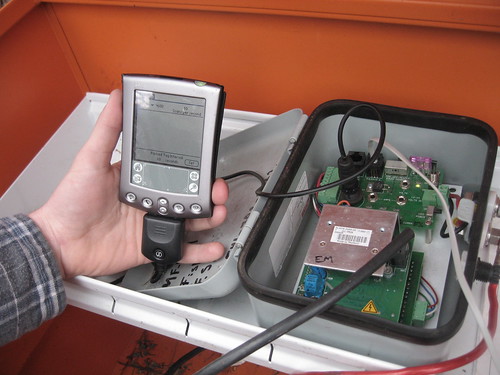
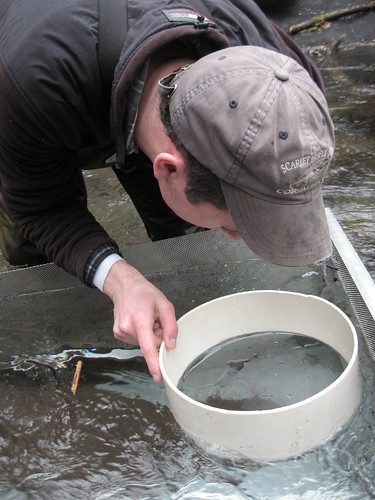
The photos below were taken during the USFS bull trout monitoring project last spring.

Bull Trout monitoring on the Upper Willamette

Bull Trout monitoring on the Upper Willamette

Bull Trout monitoring on the Upper Willamette

Bull Trout monitoring on the Upper Willamette

Bull Trout monitoring

FYI: You can download a PDF of the magazine now. The NW Flyfishing Website is running a promotion. It’s the first time I’ve seen an online version available. Check it out.

Posted in Oregon Conservation News | Leave a comment

“Wild broodstock” steelhead drive angler harvest, spur controversy

Traditionally, coastal rivers in the state of Oregon were stocked with one strain of steelhead, the standard Alsea stock. The Alsea hatchery stock is an early returning fish known affectionately as the “Alsea ugly.” But each strain of steelhead is adapted to the river of its origins and the prevailing conditions in that watershed.  Alsea fish should probably stay in the Alsea.

For the better part of a decade, hatchery managers on the Nestucca as well as other rivers around the state of Oregon have been developing “wild broodstock” hatchery fish. By continually using wild fish to develop the hatchery stock the agencies hope to build a better hatchery fish that impacts wild stocks less.

A recent study on the Nestucca River suggests that the hatchery offspring of “wild Nestucca broodstock” fish are harvested at a rate of two to three times higher than the offspring of the traditional early returning Alsea stock. A higher percentage of smolts seem to survive to return as adults and the run appears to more closely mimic natural run timing, spread out over the course of the season.

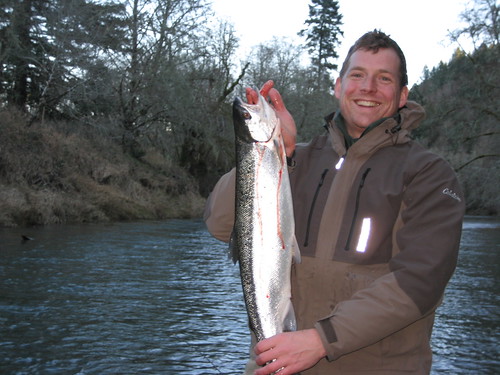
On the Alsea River, the hatchery release is split evenly between the traditional Alsea hatchery stock and the “Alsea Wild” stock. Sixty thousand smolts from each of the two lineages are released in the Alsea River annually. I am not aware of any studies confirming the higher catch rate for the “wild stock” on the Alsea but my limited experience this winter bears this out. I went one for three and the fish I landed was from the “Alsea Wild” stock:
Alsea hatchery steelhead

(Note the adipose finclip and the maxillary clip meaning this fish is descended from the Alsea “wild stock”.)

I have also spoken with a source who fishes the Alsea frequently and he says that almost every fish he has caught this year has been from the “wild stock.”

Using wild broodstock is seen by some as an improvement in hatchery management practices. Where previously out-of-basin fish were stocked in far flung watersheds, hatchery managers have been developing hatchery fish using locally adapted wild fish. The idea is that the in-basin brood is adapted to local watershed conditions and the use of in-basin fish will minimize dilution of the genetic integrity of naturally produced fish in the basin. The practice is not without controversy. Many credible native fish activists have decried the programs pointing to studies that show that “wild broodstock” fish are still hatchery fish and are substantially less fit than their native counterparts.

My position is in the middle. I truly want thriving runs of native fish in our watersheds and there is no question that hatchery fish, no matter their lineage compete with natives for resources. At the same time, I am at peace with the fact that some fish must die otherwise I couldn’t fish, catch and release or otherwise. Whether mortality is caused by my fishing or competition seems almost irrelevant.

I too have seen the studies regarding loss of fitness—but I also wonder how fast the offspring of wild fish and “wild broodstock fish” regain fitness. I’d wager pretty quickly. I’d like to see it studied. Also, wild broodstock fish return and are harvested at a higher rate meaning less fish can be planted resulting in less competition between smolts for the same amount of angler harvest.

The rivers that are not stocked at all are almost devoid of anglers. I like this. I like fishing these streams. Most people don’t and the fact is that most habitat enhancement money comes from license sales. Without at least a limited harvest opportunity, I believe wild fish would suffer in the end.

As usual, there is no easy answer.-Karl

Posted in Oregon Conservation News | 1 Comment

How to tie the Green McKenzie Caddis Fly

Get ready, because it’s been a high-water winter and the McKenzie River Green Caddis hatch should be a major event this spring. In these videos, The Caddis Fly’s Chris Daughters demonstrates how to tie this classic Oregon dry fly pattern. The first version is a simple, stripped down high floating fly. The second video features the same fly with a lime green underwing.

Green McKenzie River Caddis

Green Mckenzie Caddis
Hook: TMC 100 or Gamakatsu F10 size 8-12
Thread: Uni 6/0 olive or green
Rib: Thread or Mono
Body:2mm Thin foam chartruese
Optional Underwing: Green McFly Foam or Z-lon
Wing: Natural Deer or Yearling Elk

Posted in Fly Tying | 1 Comment

Skwala Stoneflies on the lower Deschutes

Fall River, the Crooked River, Metolius and Lower Deschutes are all in good condition for fly fishing. You’ll find blue wing olives on the Metolius from 12-3pm in the afternoon. Now is the time to be there for bull trout with 3 to 4-inch rabbit fur streamers — whitefish patterns.

Anglers on the West side shouldn’t have trouble coming over the pass, but you may see some packed snow near the Metolius. Anglers on the Lower Deschutes are seeing black stones in size 12-14 for surface action. Look for access around Terrebonne and Lower Bridge Rd.

The Crooked River is running clear and it has blue wing olives and lots of fish. Scuds, Prince nymphs and Pheasant tails should produce subsurface action.

Posted in Central Oregon Fishing Report | 3 Comments