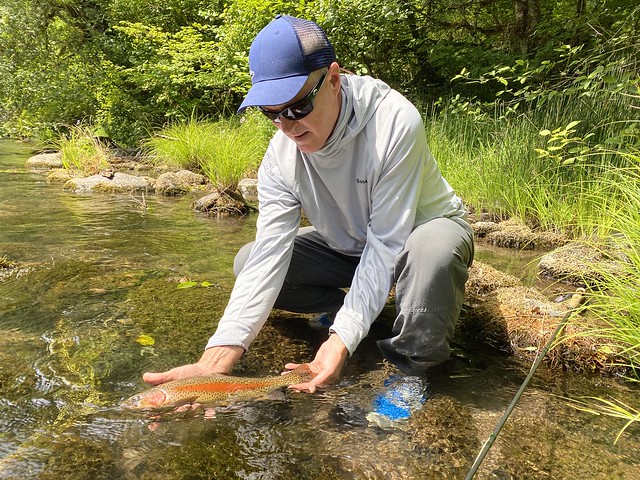
Flathead Valley/Glacier National Park 2020

IMG_1644

IMG_1651

End of Summer road trip with our close friends had us leaving Eugene the first weekend of September to explore the Rockies. None of us had been to Northern Montana so plenty of homework and contacting a local friend led us to the Flathead Valley. After rendezvousing in Bend we spent a couple nights in Sandpoint, ID and then drove North then East into Montana. Our good friend had everything lined up for us and after tenting it for a few nights we were rewarded with a luxury wall tent.

IMG_2845

IMG_2881

IMG_1638

IMG_1640

IMG_2896

IMG_2908

IMG_2923

Next day led to an evening float on the “town run” of the Flathead just outside Columbia Falls, MT. We brought the shop Outcast Ambush and it was the perfect boat for this trip. Fished the normal McKenzie dry dropper and quickly caught 3 whitefish. Somewhat ironic as we were 10 miles from Whitefish, MT. In talking with one of the locals I was apparently fishing “too deep”. Chopped the dropper down and proceeded to get skunked for the remainder, oh well.

IMG_2935

IMG_2950

IMG_2952

IMG_2957

IMG_2958

The following day we drove the Going to the Sun road through Glacier National Park and it lived up to the hype. It is a spectacular 50 mile drive through many different landscapes from Lake McDonald to cedar forests to alpine tundra with stunning mountains views. You cross the continental divide at Logan Pass and due to Covid the East entrance is closed so you are forced to turn around shortly after. At one of the many pullouts and were rewarded with peekaboo views of a Black bear and two cubs from a safe distance.

IMG_2960

IMG_2963

IMG_2969

We then made the short but tedious drive to Polebridge, MT. Polebridge is completely off the grid with all power coming from generators and solar. Next two days we did 2 different floats on the NF Flathead River. First evening we had great fishing for Westslope Cutthroat, with fish hitting both the dry and the dropper. Right before the takeout I had an unusual encounter with fish boiling on a cutbank. I grounded the boat above the rising fish and proceeded to catch whitefish on dry flies on 6 or 8 casts in a row. I have never seen whiteys act that way but apparently it is common out there.

IMG_2987

IMG_2989

IMG_3001

Next day we put in at the previous day’s takeout and did a longer float. Fishing was much slower with shallower runs and less holding lies but we did squeak out a few here and there. Nonetheless the scenery was breathtaking the entire time. The NF is the Western border of the park and around every turn we were reminded why this is truly Big Sky country. River was running about 200 CFS so inflatables were required.

IMG_3003

IMG_1657

IMG_3014

BF

Posted in Fishing Reports, Fly Fishing Travel | Leave a comment

Fly Tying in 1963: The way I remember it ….

nFly Tying in 1963:

I was reading a very good online piece today, pondering the motives of modern fly designers, when I started seeing a movie playing in my head about the days when I was learning to tie flies back in the 1960s. Some of our readers have heard a few of my stories before, but I decided to share a few of my remembrances for the entertainment and perhaps education of our younger reader/tyers.

The number of us old-timers is declining by the week it seems, and people of all ages who are starting the process of learning how to fly fish and tie flies usually have little or no comprehension of the world as we knew it. So here goes. It is the proper time to remember when dinosaurs still roamed free, I was a teenager, my family drove a Rambler American station wagon, and gas was 30 cents a gallon.

Here are a few of the realities in my world of tying flies in the 1960s. If I’m able, I will follow up with more posts in the future describing more about the tackle I/we fished, and what it was like to fish around some of the places we still fish here in Oregon.

Let’s get started.

How did I learn to tie?
No YouTube. No Internet. No fly tying blogs. Very few books of relevance to Oregon fly tyers. At least that is what I thought at the time, right or wrong, I was a kid with no particular mentor or circle of fly tyers to learn from. If there were fly tying clubs I didn’t know anything about them.I read on the internet that the Flyfishers’ Club of Oregon was founded in 1961. I must presume that the club founders had no outreach that could have found an eager teen like myself in the first few years of the club’s existence. I did have a Professional Fly Tying and Tackle Making by George Leonard Herter.

While this grey, black and white soft cover manual described a few fundamentals of tying traditional quil-wing wet and dry flies, it had nothing to say about tying a bucktail caddis, so I was at a disadvantage from the get-go. I eventually found Poly Rosborough’s book and a few others, but I think that was in the 1970s. T

Compared to the resources available to the average 1960s beginning tyer, the 2020 world of learning opportuinities are a marvel. It was common for tyers to learn alone, I felt lucky to find Auety Joy tying flies at the Meir and Freank Department store in downtown portland, and watched her tie whenever my mom took me downtown to shop.

Mustad, my best and most expensive fly hooks.
The best hooks I could afford in the mid-1960s were manufactured by Mustad. These were purchased in boxes of a hundred hooks, each hundred wrapped in wax paper, and placed neatly in a paper box. As a very small commercial tyer, I was able to purchase a lot of ten boxes, a thousand hooks, all the same size, in a long paper box.

Partridge fly hooks.
I heard about partridge hooks but never could afford to tie commercially on these. So, I had no experience with this hook. I think more experienced, more skilled tyers like Dave McNeese might have been tying on Partridge on a regular basis when I struggled to afford the Mustads.

My high-priced steelhead hooks.
The Mustad 36890 was my hook of choice when tying a more expensive grade of steelhead flies, and this hook featured what we called a Japan Black finish. As highly as it was regarded by tyers and anglers, the Mustad 36890 is not nearly the same quality as the TMC 7999 or the Alec Jackson hooks we have available today.

Eagle Claw trout hooks.
I also tied dry flies on Eagle Claw fly hooks, and these were received by anglers nearly as readily as the Mustard hooks, even though the Eagle Claw hooks didn’t have the same quality bronzing finish, and were not quite as sharp as the more expensive Mustad. It is odd, a little spooky even, that I’m writing on an Apple Computer in 2020, and I can still see the Eagle Claw hooks that I tied dry flies on. I can see them as clearly as if they were in the palm of my hand. I can’t quite remember the hook design number though. Was it a No. 50? No. 59? Oh well, I tied a ton of Adams and Mosquito flies on those hooks.

Eagle Claw Steelhead Hooks.
The Eagle Claw 1197-B was actually my favorite hook for steelhead flies. This hook was the bronze version, and the 1197 was also offered in nickel silver (1197-S), and gold finish 1197-G. I tied steelhead, shad, and salmon flies on the 1197 in sizes including 1/0, 2, 4, 6, and 8. My favorite hook sizes were the #4 and #6. Something happened to this hook when the transition occurred from size 6 to size 8. This is a phenomenon that is not unique to Eagle Claw. The best way I can describe it is this: the hook designer changed proportions somehow between size 6 and size 8, such that the size 8 was a little too long and the gape a little too narrow. The end result is that a wet fly tied on the 1197-B #6 was far more appealing, in my opinion than the same fly tied on a size 8.

Favorite Tying Thread.
My favorite fly tying thread in the 1960s was a sewing thread on wooden spools called Nymo. This thread was as close as I could describe as a 3/0 monocord, and was offered in a wide variety of colors that covered all the bases required by a tyer in Oregon, including greys, greens, reds, yellows, oranges, and of course black. Nearly all of my steelhead flies were tied with black Nymo. The exception to this rule was the golden Demon as shown me by Wayne Doughton, of Doughton Hardware in Salem Oregon. Wayne’s Golden Demon pattern called for bright yellow Nymo, red squirrel tail wing, and a hot orange collar or throat hackle. This fly was his favorite Deschutes fall steelhead pattern in a size 4 and 6.

Favorite bobbin in 1963-1971.
The best bobbin I had in the 1960s was a wooden clothespin. I waxed my Nymo by pulling it through a piece of paraffin wax and held tension as I wound the thread around the hook shank by palming the clothespin in my right hand. This a technique I learned from Audrey Joy when I watched her tying in the fishing tackle department of Meier and Frank in downtown Portland Oregon.

Favorite bobbin in 1975-80.
Sometime in the mid-1970s, I graduated to a Matarelli bobbin. The Matarelli was constructed of brass and steel and was, in my estimation, an absolutely reliable fly thing tool. I bet I’ve tied on these bobbins alongside more advanced bobbins for at least 30 years and I might be able to find one or two laying around still today.

Favorite fly tying scissors.
I tied with Thompson scissors, the kind with the red rubber finger holes. The scissor size was perfect and they cut year after year after year.

How often did I replace fly tying scissors and bobbins?
I never ever considered changing bobbins from one season to the next. Never.

What other fly thing tools did I use?
Nearly none. A needle stuck in a wine cork as a bobbin. I tried to use hackle guards but never got the knack, and I managed to hold hackles out of the way with my fingers. Whip finish tool? Never. Audrey taught me how to use my hand to finish my flies. Cement. Yes. Applied with my crude bobbin. Hackle pliers. Yes, I forgot these. Not many of our feathers were long enough to hold by finger pressure alone, so my hackle piers were a necessity. Hair stacker? Forgot these too. Never bought one though. My stacker was an aluminum cigar tube cut open on the side so that the hair could be removed. Parachute gallows? Nope. Profile plate? Nope. Various fancy scissors? Nope. Dubbing twirlers? Never twisted dubbing to make a composite loop so I never missed this tool. Half hitch tool? Nope, though it would have been nice on the very small #22s I tied for special customers. Cauthery tools, razor blade holders, … never thought about them and these were not tools of the trade for the simple trout and steelhead flies I normally tied anyway.

I think I’m memoried-out for the moment. But I promise to return with more stories about tying and fly fishing in Oregon in the days of my fresh, under-educated, unappreciative, and innocent youth.

Jay Nicholas, September 2020.
Where did the last six decades go?

Posted in Fly Tying | 1 Comment

What Happens to Fish After a Wildfire?

HF36W6

From Hakai Magazine
by Starre Vartan

When a wildfire rages, some animals fly, hop, or run to safety. But fish can’t.

During a fire, the temperature of a stream or river will sometimes rise to a lethal degree. If a fish survives without being cooked, short-term changes to its environment might finish it off. Denuded stream banks erode quickly, with topsoil and ash clouding streams and making it difficult for fish to breathe or find food. Even firefighting efforts are a threat: foam fire suppressants can suffocate fish, while fire retardants can be toxic.

Following those immediate threats, wildfires can also change a fish’s habitat for months and even years. If trees that once provided shade burned down, that stream’s water could heat up enough to make it unsuitable for cold-water fish, such as trout. Heat is particularly dire for eggs and fry.

Not surprisingly then, in the weeks and months after a wildfire, “fish populations will decline, sometimes dramatically,” says Rebecca Flitcroft, a fish biologist at the US Forest Service. Flitcroft points out that as populations, many animals, including fish, have evolved to survive severe, shorter events such as fires even if their numbers temporarily decline. continue reading here

Posted in Oregon Conservation News | Leave a comment

Holiday Farm Fire Resources – How Local Businesses and Individuals can Help

Screen Shot 2020-09-15 at 1.41.17 PM

Use the links in the above image to give what you can to our community members in need.

1. Give Time – Volunteer: http://mckenzieriver.org/volunteer

2. Give Money – United Way Wildfire Response Fund: http://unitedwaylane.org/wildfires

3. Give & Get Statewide Resources through Red Cross: https://www.redcross.org/local/oregon.html

4. Offer Local Resources – Fill out our form to share what your business can offer: https://tinyurl.com/lanewildfire


Posted in McKenzie River | Leave a comment

Holiday Farm Fire Sept 13th 2020

IMG_1871Matt Labounty’s drift boat remains were the only thing left on his property.

We continue to feel the pain along with so many others as much of the McKenzie River corridor has been damaged as a result of the Holiday Farm fire. So many homes and businesses have been affected, we share the in the sadness of watching our treasured Mckenzie suffer. Heroic fire crews have worked hard to prevent the further spread of the blaze and we thank them.

Community support in providing supplies for those in need has been incredible and inspiring but the needs will continue for the foreseeable future. We at OregonFlyFishingBlog.com and Caddisflyshop.com are connected with many who are able to help. Please let us know if you know someone who needs help and we will do our best. email us at: caddisflyshop@gmail.com.

There are some great places you can give now to help those in need. Please go to the following link for an update on the the best options: https://mckenzieriver.org/lane-county-wildfire-information-and-relief/

Posted in McKenzie River | Leave a comment

Archie Creek Fire – North Umpqua River

frank and jeanne

From OregonLive.com

WWII vet married 77 years forced to evacuate twice, says beloved wife most important: ‘I have the treasure with me’

The fate of Frank and Jeanne Moore’s home near Idleyld Park remained unknown Wednesday afternoon. Also uncertain were the fate of his World War II medals and decades of memorabilia, and the state of the steelhead sanctuary along the North Umpqua River that bears their name.

As the Archie Creek Fire spread near their home, they evacuated Tuesday morning to their daughter’s house in Glide, and when Glide was evacuated they relocated to their nephew’s house in Roseburg on Tuesday night.

Read the full Article HERE

Posted in North Umpqua River Fishing Reports | Leave a comment

Holiday Farm Fire – McKenzie Bridge, OR

IMG_2026001 copy

We are greatly saddened by all of the wild fires in Oregon. OregonFlyFishingBlog.com wants you to know that our staff wants to help. We have areas for vehicles including RV’s (camping and storage available) and we want to help in anyway we can. Please leave a comment on this post if you have resources for those in need. Please call us at The Caddis Fly Shop if there is something we can help with.

Online Resources (Evacuations, Shelters, Well-Fair Check-ins, Etc.)

Fire Information:
Lane County Fire Information

InciWeb- Incident Information System

Google Map of Fire Area

Donations:

United Way of Lane County

Other Resources:

FEMA- Federal Emergency Management Agency

GRASSROOTS LANDSCAPE HELPING THOSE IMPACTED BY FIRES

Posted in Uncategorized | Leave a comment

Hollow Deceiver Streamer for Chinook and Silver Salmon

In this video, Jay ties a Hollow Deceiver Fly for chinook and silver salmon.

A great fly to use in the Pacific Northwest for Salmon. Don’t be afraid to swing it for steelhead too.

Screen Shot 2019-07-10 at 2.26.46 PM

Hook: Ahrex PR320 Predator Hook 4/0 or size of choice
Thread: Veevus 100D GSP
Cement: Loctite or Hard as Hull
Tail: White Flatwing Saddles (6 long feathers)
Body: White Bucktail
Collar: Bucktail contrasting color
Eyes: Sub Jungle Cock or Pro Tab Eyes

Posted in Fishing Porn, Fly Tying, Fly Tying Materials and Supplies, Uncategorized | Leave a comment

Friday Fish Porn September 2020
My Kiwi mates sent me the following notes and photos. Monster rainbows caught in Central South Island canals. I have been giving them a hard time regarding the ethics of this fishery for some time so facetious language is par for the course with Nicko.

Nick: subject line=”Don’t Judge Me”:Americano!, take a moment from writing placards and general rioting and check out these natural beauties!

thumbnail

thumbnail-1

thumbnail-4

thumbnail-2

thumbnail-3

Me: Those are “bleeping” unreal! You guys are bad asses. Each year your canal skills improve, you will soon need to train prior to going so you can hold the beasts up for photos. I am blown away! And no breakage of gear?

Nicko: Peteski went down hard early and bust his reel! Yeah share away, his two big boys came in at about 28lb and 30lb. Thankyou for the positive feedback, the only real skill displayed was staunching out a couple of numpties that beat us to our hole, but that’s another story…

More midwest predators from our friend Nate Stansberry. Nate has been fishing his brains out lately!

FullSizeRender

Posted in Fishing Porn | Leave a comment

Foul-Proof Clouser Minnow – Jay Nicholas Summer 2020
Listen up all you faithful readers of the Oregon Fly Fishing Blog. I understand that you might be tired of seeing Jay (me) tie yet maybe the one hundredth version of a clouser deep minnow.

Well Let me tell you right here and now that you can NEVER have too many Clousers or enough versions of this fly in sizes from an inch long to twelve inches long. Of course the little shirty will need really small dumbbells properly sized to the hook and same for the big fly but honestly, this fly rocks the world.

This here fly in this video is offered mostly for entertainment while in self isolation – but the idea of wrapping both belly and back hair all the way to the end of the shank is a little on the novel side. I first saw this done in honestly 2003 in a fly shop in Eugene Oregon.

The fly I saw way back then had a black thread wrap but the fly in this video has my favorite Danville’s 210 D white. Remember you can tie this fly with all kinds of hooks and all kinds of materials, but i used bucktail for this beauty.

And you can use different colored threads or you may use a Copic marker in light blue, red, tan, olive or something to blend in with your fly’s subtleties.

I fish Clousers tied like this for black rockfish and you should consider this approach if you want to REALLY toughen up your fly.

I hope you all have fun with this, whether or not you actually tie one — please stay safe and get ready to fish as soon as this awfulness passes.

Jay – Summer 2020
_____________________________

Screen Shot 2020-04-06 at 7.54.13 AM

No-Foul Clouser Minnow:

Hook: Gamakatsu SC15 2/0
Thread: Veevus GSP 150d White
Eyes: Hareline Double Pupil Brass Eyes Lg. Chartreuse
Wing: Bucktail Chartreuse & Blue
Flashabou Red
Marker: Copic Marker
Glue: Zap A Gap

Posted in Fly Tying, Fly Tying Materials and Supplies | Tagged | Leave a comment

“Voices from the Umpqua” Take Action and Help Protect the North Umpqua

Voices from the Umpqua from Cascadia Wildlands on Vimeo.

From Cascadia Wildlands

The Bureau of Land Management in western Oregon is sure feeling emboldened under the Trump administration and its clearcut-focused, new forest plan. This is on full display on the North Umpqua River right now, with the agency’s proposed Umpqua Sweets timber sale.

Absent immediate intervention, 2,000 acres of public forest, some of it located just above the banks of the famed North Umpqua River, will be turned into stumpfields.

Cascadia Wildlands, rural neighbors in the area, and Umpqua River enthusiasts have been working overtime to stop this recklessness in its tracks through field visits, submitting technical comments, activating the public and other grassroots organizing tactics.

Just today, we released a short, compelling video, “Voices from the Umpqua,” showcasing the locals who live around this area and what is at stake with the proposed Umpqua Sweets timber sale.

MAKE A DONATION to the North Umpqua Defense Fund.

TAKE ACTION to help us stop this unpopular clearcut proposal.

This outstanding area is treasured for its stately forests, salmon and steelhead, clean water, carbon storage, and all the recreation values it offers, like fishing, hiking, biking, camping and rafting. The Umpqua Sweets timber sale proposal threatens these closely held values, and must be stopped.

Read more background on the proposed Sweets timber sale at the following links:

Vol 1. Down By the Riverside

Vol 2. Into the Woods

Vol 3. The Eye of God

Vol 4. Community

Thank you for standing with us today to defend the outstanding North Umpqua from irresponsible management.

Posted in North Umpqua River Fishing Reports, Oregon Conservation News | 2 Comments

Oregon Establishes Wild Steelhead Sanctuaries Along the Columbia River

columbia-steelhead

New Oregon Rules Protect Migrating Columbia Wild Steelhead and Salmon Within Cold Water Refugia
Statement of David A. Moskowitz, Executive Director, The Conservation Angler

The OR Fish & Wildlife Commission (OR Commission) adopted permanent angling regulations protecting migrating wild steelhead that rest in three critical cold water refugia CWR) along the Columbia River – action we applaud.

Facing warming water in the Columbia, rising above 68F each year in early July, migrating wild salmon and steelhead move into very specific cold-water areas in order to avoid the physical stresses created by warm water and conserve energy for their migration and spawning once reaching their natal rivers.

    The OR Commission’s action in establishing sanctuary areas where ESA-listed salmonids are protected from angling encounters while they take up residence in cold water refugia, will provide migratory survival benefits for wild steelhead returning to dozens of home water tributaries.

The US Environmental Protection Agency (EPA) was required to review the impact of water temperatures on wild fish migration in the Columbia River as part of a legal settlement in a Clean Water Act lawsuit. The long-delayed EPA Draft CWR Report identified 191 water sources entering the Columbia mainstem between the Columbia River mouth and the Snake River. Thirty-five were warmer than the Columbia in July and August. However, EPA’s research and prioritization found twenty-three (23) significant cold water refugia areas below the Snake River confluence. Based on refined analysis on how wild salmon and steelhead used the CWR, EPA identified twelve (12) of these refugia as critical to wild salmon and steelhead migratory survival.

EPA’s research found that when the Columbia warms to 64F, salmon and steelhead begin to feel the effects of the warm water, and when the Columbia reaches 68F, every source of cooler water, regardless of size or volume, will provide refugia for migrating wild salmon and steelhead.

    Historic water temperature measurement data at Bonneville Dam indicate that the total warming of the river since the late 1930s in August (on average) is approximately 3.6F, rising from below 68F to near 71.6F.

When wild steelhead and salmon encounter water warmer than 68F, migration becomes delayed, there are significant disease risks, increased stress and energy loss, significant sockeye mortality (ala 2015) and high concentrations of wild fish using the cold water refugia which presents a vulnerability to angling encounters.

EPA found that the presence, distribution, and water temperatures in the CWR within the Columbia River provide an advantage to migrating steelhead and salmon in terms of energy savings required to complete their migration, pre- spawn staging and spawning. However, when the migration success of steelhead that used CWR versus those that did not use CWR was evaluated, that study found that migration success to spawning tributaries for those steelhead (wild and hatchery) using CWR was about 8% less than steelhead that did not use CWR. This initially suggests CWR use is not beneficial.

    However, the study also indicated that fishing pressure within CWR explained the decreased survival as wild steelhead using CWR, which must be released when caught, experienced a 4.5% decrease in survival during migration to their spawning tributaries compared to wild steelhead that did not use CWR.
    The increased mortality is likely associated with catch and release mortality as well as incidental catch of wild steelhead in tribal harvest fisheries.

The fishing pressure within CWR makes it difficult to directly measure the benefits of CWR to migrating adult salmon and steelhead.

Exceptionally low wild steelhead returns since 2016 necessitate deep evaluations of angling impacts on migrating wild steelhead using the CWR. The OR Commission action establishing no fishing sanctuaries are aimed to reduce the rate of wild steelhead encounters from fisheries (both indirect and direct) that have impacts on salmonid fitness, survival, and productivity.

    The three Thermal Angling Sanctuaries are at Eagle Creek, Herman Creek and the very lower Deschutes River and a portion of the Columbia River that is cooled by the Deschutes colder waters.

The Conservation Angler has advocated for these conservation measures along the Columbia since 2016 and supports the OR Commission’s adoption of these protective measures. The Washington Commission must take them up as well.

Specific Scientific and Policy Supporting Designation of No Fishing Sanctuaries Within CWR

I. Areas where cold or cooler waters create vitally critical thermal gradients in the concurrently managed Columbia River are well known, identifiable and recognizable to the angling public.

II. Steelhead migration is different and their reliance on thermal gradients is well documented.
a. Scientific References:
Keefer, Matthew L., Christopher A. Peery, William R. Daigle, Michael A. Jepson, Steven R. Lee, Charles T. Boggs, Kenneth R. Tolotti, and Brian J. Burke. 2005. Escapement, harvest, and unknown loss of radio tagged adult salmonids in the Columbia River – Snake River hydrosystem. Can. J. Fish. Aquat. Sci. 62: 930–949. doi: 10.1139/F04-246
KEEFER, MATTHEW L., CHARLES T. BOGGS, CHRISTOPHER A. PEERY, AND CHRISTOPHER C. CAUDILL. 2008. Overwintering Distribution, Behavior, and Survival of Adult Summer Steelhead: Variability among Columbia River Populations. North American Journal of Fisheries Management 28:81–96. DOI: 10.1577/M07-011.1

III. Steelhead using thermal gradients are vulnerable to multiple fishing-related encounters based on extensive and extended residencies within cold water refugia that deplete stored energy reserves and these circumstances begin when the Columbia River reaches 68F which happens, on average, by July 10 and lasts until September 25.

a. Scientific References:
Palmer, John, et al. Environmental Protection Agency, Columbia River Cold Water Refuges Draft Plan October 2019
IV. Existing Oregon Administrative Rules already identify “sanctuaries” where commercial fishing is not permitted, and these areas are well-defined and well understood by the public. (ORS 635-042-0005).
V. Oregon does not have river-specific management regimes to accurately estimate or secure river-specific abundance for wild steelhead. There is no plan to establish goals or monitor attainment so spawning escapement and egg deposition criteria are set and met for every natal wild steelhead stream.
VI. ODFW (as well as other state and Federal agencies) must make it a Departmental Priority to work with all land and resource managers and owners to ensure that the cold water sources are managed, protected and enhanced so that the array of CWR in the Columbia River remains a critical advantage for migratory survival of returning wild salmon and steelhead. Protecting the wild fish using the CWR is only the first step in increasing migration survival in the Columbia River – protecting the sources of this cold water must happen.
VII. The OR Commission, having shown leadership in providing a measure of protection to wild steelhead during their migration to natal rivers by establishing sanctuaries from angling in areas of thermal refugia, in specifically defined areas and under certain environmental conditions in Oregon, must encourage and lead the Washington Commission to undertake the same measures in seven tributaries and in concurrent waters. These include the Kalama, Cowlitz, Lewis, Wind, Little and Big White Salmon and Klickitat Rivers.

Contact: David A. Moskowitz, The Conservation Angler @ 971-235-8953 (direct) or via theconservationangler@gmail.com

Posted in Oregon Conservation News | Leave a comment

ODFW Fishing Regulations and Your Input

20ORFW_cover_small1

Dear Oregon Anglers,

I would like to gather ideas for positive, conservation-oriented regulation changes needed for wild fish and start working them through ODFW’s staff process starting early in 2021.

I would be grateful if anglers would share any rule changes that are needed or new rules that should be implemented on the rivers within your zone (to the coast – out to the cascades, up and down the Willamette, the Umpqua and forks, etc.).

Please leave your ideas in our “Leave a Comment” link.

Thanks very much

Chris Daughters

Posted in Lower Willamette, McKenzie River, Middle Fork Willamette River fishing, North Umpqua River Fishing Reports, Oregon Conservation News | 9 Comments

Proposed Pebble Mine project cannot be permitted in Bristol Bay

DJI_0126

From Trout Unlimited Article by Jenny Weis

Today, the U.S. Army Corps of Engineers announced that it found the proposed Pebble mine would cause significant degradation to the Bristol Bay region and cannot not receive its key federal permit.

“This is a good day for Bristol Bay,” said Nelli Williams, Alaska director of Trout Unlimited. “No corner should be cut when considering a giant mine in the heart of a place this cherished and important. The Pebble Partnership put forward a half-baked plan with a litany of problems. Pebble had its opportunity to go through the process, but the project fails to meet the standards required. Kudos to the Army Corps, the Trump Administration, and other resource agencies who were critical of the mine proposal for calling Pebble out on that.” Read Trout Unlimited’s full press release here.

Over the two-year permit review process, scientists, agencies and countless individuals repeatedly raised concerns related to Pebble’s plans. Moreover, the voices of hunters and anglers across the country prove instrumental in showing the Administration that Americans cherish the Great Outdoors and places like Bristol Bay are worthy of protecting.

Thank you to each and every one of you who signed petitions, wrote letters, made calls and donated to ensure that our voices for Bristol Bay were heard loud and clear.

Posted in Oregon Conservation News | 2 Comments

2020 Fly Fishing Film Tour – Virtual Tour Details

banner1612_2020-EventGroove-Banner

The 2020 Fly Fishing Film Tour has gone digital. Check out all the trailers related to the event below and get your tickets and information at this link: FT3 Virtual Tour

Posted in Fly Fishing Gear Review, Fly Fishing Glossary, Oregon Fly Fishing Clubs and Events, Oregon fly fishing links | Leave a comment