Local Trout Unlimited ” The Redsides” News and Notes

mail

Volunteer Day with McKenzie River Trust

November Volunteer Planting Day at Green Island
Sunday, November 17th, 10:00-2:00

The Redsides, and our new Five Rivers Chapter at U of O are partnering with the McKenzie River Trust to host a planting day at Green Island! We’d love to see you out there! Make sure you register below.

Details and registration are here.

The Redsides Chapter is Looking for New Leaders

The positions of President, Vice President and Conservation Chair are open. Thanks to those members that served in these positions for many years. Paul Wagner, Monica Mullens and Mark Robershaw have made significant contributions to the chapter and I wanted to thank them for their service.

The chapter provides a vital link between the various conservation and angling groups in the McKenzie basin and is positioned to provide members the opportunity to weigh in on the many policy issues that affect fish management. The Oregon Council and TU staff are available for support, training and tools needed to be an effective volunteer leader.

Contact Terry Turner for more information at: terry@clackamasrivertu.org

Posted in Oregon Conservation News | Leave a comment

Call to Action: Nominate your favorite piece of water for Wild and Scenic Designation

IMG_6180

Oregon Senator Ron Wyden is a man on a mission. It’s a mission that should put a smile on the face of many readers of OFFB and all who care about protecting Oregon’s rivers and fisheries. In meetings, townhalls, and private conversations over the past few months, Senator Wyden has consistently voiced his ambition to overtake Alaska as the state with the greatest number of Wild and Scenic river miles in the country.

With 2,173 Wild and Scenic river miles designated across the state, Oregon currently trails Alaska by about 1,000 river miles. In pursuit of the top spot, Senator Wyden recently put out a public call for Wild and Scenic River nominations, giving Oregonians the opportunity to achieve federal protection for their favorite rivers and creeks.

A list of Oregon’s existing Wild and Scenic Rivers can be found here, although that list doesn’t include about 250 river miles that were recently added to the W&S system through passage of the John D. Dingell Conservation, Management, and Recreation Act earlier this year. Many of Oregon’s most well-known rivers are already protected under the Wild and Scenic Rivers Act, so anglers and river enthusiasts with intimate knowledge of smaller rivers and creeks are well-suited to help Senator Wyden get to his 1,000-mile goal. Please take the opportunity to nominate your favorite piece of water, for the benefit of current and future Oregonians and the rivers and fish that we all know and love. Submissions are due by January 20, 2020 and should be sent via email to rivers@wyden.senate.gov.

Posted in Oregon Conservation News | Leave a comment

To the Salmon, with hope …..

Jay Nicholas Chinook buck IMG_2618
We find ourselves living in a time when there are legitimate questions regarding the salmon’s future in a world where climate and oceans seem to be acting in ways unlike they have in at least the last few thousand years. Maybe I have the time scale right and maybe I’m off. Without belaboring who did what and what should be done at this point in the earth’s evolution, I’ll simply say that the next twenty or forty or sixty or maybe even ten years could hold some unpleasant surprises for salmon and for us humans who are affected by weather around the world.

I always always always loved to fish when I was a kid, and I still do to this day. I never doubted that fishing would be part of the future of the citizenry of North America. I never considered the possibility that rivers in Oregon might not always provide a home to salmon in the future – at least I thought the rivers where I’d always found salmon would hold salmon in perpetuity.

Now I’m not so sure.

Please don’t get me wrong. This is not a doom and gloom prediction. But my sense of confidence isn’t what it once was. My role in fisheries management seemed to require that I put on a public face of confidence in the future of salmon and salmon fisheries and wild salmon and hatchery programs and science and managers, and so forth and so on.

For me to have been a half-full thinker was, it seemed, untenable. I had to have genuine hope and optimism and confidence. If I, the salmon guy, wasn’t confident, who else should be, after all.

So I exuded confidence in the ecological system.

Confidence in people and government and anglers and management plans and environmental laws and law enforcement and all that.

And confidence in the salmon too.

I did.

At least I think I did.

Now I’m not so sure.

Jay Nicholas Chinook 2019

The salmon have been a vital part of my life. Of course there is much beauty and meaning in life without salmon. Of course there are more important issues to humans on this planet than the health and the future of salmon. Perhaps salmon are a placeholder of sorts, an iconic representation of uncountable matters, good and ill, that people will encounter in the future.

Still . . . . .  while the 2019 salmon season draws to a close. I’m pausing to reflect on our shared history, rocky as it has been, and express my hope for our shared future, whatever that may be.

Jay Nicholas


Posted in Oregon Conservation News | 2 Comments

Nate’s Great Lakes Update

Many of you will remember Nate Stansberry. Nate worked at the shop and did a ton of fishing around the Pacific Northwest. Nate returned to his Great Lakes roots in 2010 and he has been fishing his brains out since. He also got married, has a couple of girls and works full time in HR for an apparel company.Capt. Nate and I caught up on the phone the other day and here is the latest.

It’s been a record high water year in the great lakes region and in an area with no shortage of water that is saying something! The world’s largest freshwater delta feeds into Lake Saint Clair creating some of the bluest water I’ve ever seen anywhere…

nate-1

Along with it you’ll find some of the most spectacular warm-water fly fishing on the planet… While this is nothing new it is still so vast and teaming with life that continues to astonish me as I’ve grown to learn this strange fishery on the fringes of Detroit. The delta saves itself by being nearly unusable by commercial standards and is in stark contrast to the urban landscape on her southern shores… There are islands in the delta and some have small homes on them. These places are inundated with water and likely will be for the foreseeable future as the delta expands and swells with the record water.

nate-2

nate-3

nate-4

Strange fisheries continue to pop up all over the great lakes… I keep thinking back to the quote in Jurassic Park “nature will find a way” when I think about the fisheries surrounding the rust belt. As I’m writing this I’m nursing bitten fingers from spending the night before fishing the
break-walls of Cleveland for walleye in the middle of the night. While not a new fishery it has gained popularity in recent years with an influx of anglers and fish.

nate-5

Walleye have enjoyed banner years thanks to wetter and colder springs with record spawning numbers. I imagine my daughters talking about how many there were when they were kids. Strange winners and losers are everywhere but, booms and busts are nothing new to fishing and the region. The current thinking has catfish eventually dominating the watershed, but who really knows.

nate-6

Still, tucked away in hidden pockets you’ll find special fisheries… Those that go largely ignored, but are still intact. In those places you are likely to find the ancestors of giants…

nate-7

Posted in Fly Fishing Travel | 1 Comment

Olive Soft Hackle Fly with New Hareline Hen Capes – Jay Nicholas

In this video, fly tier and author Jay Nicholas ties a simple Olive Soft Hackle using new hen capes from Hareline. In a variety of colors, each pack contain serval feathers for soft hackles, wings, nymph backs, etc.

Many new materials including Hareline Hen Capes and more at Caddisflyshop.com Links below.

Screen Shot 2019-10-26 at 11.20.35 AM

Materials:
Hook: TMC 3769 Size 8
Thread: Uni 6/0 Black or similar
Rib: Cooper Wire Small
Body: Whitlock’s SLF Dubbing Olive
Hackle: Hareline Hen Capes
Zap A Gap

Posted in Fly Tying, Fly Tying Materials and Supplies | Leave a comment

Artifishal Digital Release – Save the Date!

mail

From Patagonia

OCT 18, 2019 —

On Wednesday, October 30 we will be releasing our feature film, Artifishal, for free!!
Artifishal is a film about people, rivers, and the fight for the future of wild fish and the environment that supports them. It explores wild salmon’s slide toward extinction, threats posed by fish hatcheries and fish farms, and our continued loss of faith in nature.
Learn more at: patagonia.com/artifishal

Posted in Oregon Conservation News | 1 Comment

Guiding the Sierra – Fall 2019

This summer I returned home for a few weeks of guiding in the Sierra.  Here are some pics to enjoy.

D06B0AA9-358C-49A2-9B4D-FECB67544BEB

Aidar

1BD59D82-365F-4437-9026-8427D2E50429

First Fish on a Fly Rod

C1484B39-A656-4CF8-AFC4-78E23A8A7966

Native Rainbow

IMG_1489

The Chaffins

IMG_1492

Mr. Chaffin

CBC723DC-60FA-40EF-9EBF-B41EF5C33943

Stimulator

F183C1BC-0018-448F-AE31-681189F03AA2

Native Rainbow Trout

IMG_1511

Pat

E509BB63-D636-4082-A150-28E8320055A5

Lower River

B2D994E5-875C-415D-91A1-39E1B3FAB3C4

Don

IMG_1423

Smallmouth Bass

6C4C1B6B-86E0-49AA-BE3E-15E8243F188F

Brent

IMG_1351

High Sierra

IMG_1430

The Preacher and Chad

DF5D205A-E200-4E76-8A74-705EC486130B

Parachute Adams

867C7883-2865-4EA4-AA0F-F894E5993AD5

The Preacher

IMG_1478

Rainbow Trout

IMG_1462

Rob “The Magician”

IMG_1455

Creg

13176F16-7362-40BF-89A1-7BA45E60CB9B

Brown Trout

5F2945F2-B25A-4E11-BEAB-B871AF43DB7D

Brown Trout

IMG_1362

Sequoias

For information contact: Yosemite-outfitters.com

Tight Lines,

Greg Nespor

– Caddis Fly Shop and  (Lead Guide/Yosemite Outfitters)

Posted in Fishing Porn, Fly Fishing Gear Review, Fly Fishing Travel | Leave a comment

LINE MANAGEMENT – Scientific Anglers Line Care Discussion

mail

From Scientific Anglers Blog

Usually when we discuss line management in fly fishing terms, we refer to line control on the water and handling line while wading or in a boat. Today, we are going to look at line management in a different way. In short, what do we have to do to preserve the life of our fly line and achieve optimum performance?

During use, fly lines pick up material that is in the water. This happens anywhere we fly fish- in trout streams, bass ponds, saltwater flats, and more. There is a build-up of residue that adheres to the line, creating friction that slows the line as it passes through the rod guides. This same residue can also increase the density of line, making it float lower in the water and become harder to pick up. Bottom line- the performance of the line is compromised.

The fly line is arguably, the most important part of our entire outfit. The line weight determines the type of fishing we can do and the outfit is assembled around that line weight. You can have the finest fly rod made with a proper weight line, but if the line is dirty or sub-standard in some way, casting becomes difficult at best or possibly even impossible.

A good line will make any rod perform to its maximum potential. Having the line balanced to the rod with a proper taper design are keys to this. A modern, premium fly line is a precision tool and just like most tools and equipment, needs periodic maintenance. We are fortunate that this is a quick and simple process.

Scientific Anglers fly lines are made of a proprietary formulation of PVC coating that is adhered to one of several type cores, depending on what the line’s primary purpose is. We feel that PVC is the best all-around coating for fly lines at present. The addition of microscopic glass bubbles make the line float, while tungsten powder makes it sink.

Various additives help to increase the slickness of the line and increase durability. Scientific Anglers AST and AST Plus are impregnated through the entire line, from the core to the outer surface. They are not just a coating which wears off over time causing the line to “drag” through the rod guides and decrease casting efficiency and distance.

AST and AST Plus last the entire life of the fly line and are designed to move to the surface of the line, passing through microscopic pores, to maintain the slickness and UV protection of the line. Over time and depending the type of water where the line is used, these pores can become clogged and the performance of the line is affected. This is most prevalent in places with a lot of vegetation, algae, or suspended matter in the water.

To clean the line and open these pores, the best item to use is Scientific Anglers Fly Line Cleaning Pads. These have a micro-abrasive side to them, very similar to a polishing pad. They can be used on all fly lines from any manufacturer. Wet the pad, pinch it over the line, and run it up and down the line. Do this until a bit of the line color shows on the pad. At this point the line is clean and ready to fish. This will also restore slickness and floatation to any line containing AST or AST Plus. You can rinse of the pad and store it for future use.

In this short video, Scientific Anglers R&D Manager, Josh Jenkins gives us a look at using the Line Cleaning Pads.

If the line is really dirty, say lots of caked-on scum or after extended saltwater use, an extra pretreatment may be necessary. In this case, Scientific Anglers Fly Line Cleaner is the perfect thing to use. This is a biodegradable soap specially designed for fly line cleaning and will quickly and easily restore line performance.

A few drops of the cleaner are added to a gallon of lukewarm water and mixed. Strip off the amount of line you want to clean and put it into the soap solution. Let it set for several minutes, then take a Line Cleaning Pad and wet it in the solution. Pull the line through the pinched cleaning pad to remove all of the dirt and grim on the line. Rinse the line in clean water and you are good to go with a line that will float and shoot again.

Here, Josh Jenkins of Scientific Anglers shows us the proper procedure for cleaning a dirty fly line.

If you are using a fly line that does not contain the AST or AST Plus additive, you will likely have to apply a coating to the line to enhance both floatation and shootability. Scientific Anglers Fly Line Dressing comes with a cleaning pad as part of the package. This is a hydrophobic (water repelling) solution that will noticeably increase the performance of the fly line.

A bit of the dressing is squeezed on to the foam or sponge side of the cleaning pad. Pinch the pad over and pull the fly line through the dressing. Apply more dressing if you feel the line begin to “drag”, but try not to use too much. The dressing can be used for a number of additional line treatments.

Josh Jenkins shows the correct way to apply line dressing here:

It is important to note that both intermediate and sinking lines also benefit from periodic cleaning. Although we are not concerned with floatation, using Scientific Anglers Line Cleaning Pads and Fly Line Cleaner will help these lines shoot better and increase longevity. Here a build-up of dirt may actually impede the line from sinking properly. Using these products will keep sub-surface lines performing at their best.

Final Thoughts

Scientific Anglers Fly Line treatment products are designed to keep your fly line functioning properly. A clean line will shoot easier and float higher, allowing you to present the fly more effectively. These products are simple to use and can quickly improve the function of ANY fly line. If you have a line with AST or AST Plus, no dressing is necessary. A proper cleaning will restore the line to maximum performance. A clean line matched to rod makes both casting and fishing an enjoyable experience, allowing us to focus on our primary purpose of catching fish.

Posted in Fly Fishing Gear Review, Fly Fishing Glossary, Oregon Fly Fishing Tips | Leave a comment

Lower McKenzie and Willamette Fishing Well Late October 2019

IMG_7142

My final day of guiding locally for 2019 was a memorable one. Good friend Pat Banks and I put my Ambush raft in at Armitage Park around 11am yesterday. Soupy fog enveloped the river and most the the Willamette Valley. Mahogany Duns had already begun hatching and fish were rising in the flat below the I-5 bridge. Pat made a couple of casts and a 17″ white fish took the #14 pheasant tail jig dropped off of a size #10 Parachute Madam X Rusty Orange. That was the last white fish of the day, we stuck cutthroat after cutthroat on the PT after that.

Down the river a bit and Pat hooks into something that stays down. I am thinking big rainbow a short while later Pat lands a small steelhead.


IMG_7145

Banks, shallow riffles and mid-stream gravel bars all held fish. We fished what we thought was ideal trout water all day. Around 12 noon the fish really began to rise and we switch to size #14 Parachute Purple Rooster. The fish loved that until the sun popped out and then we went back to the Madam X with the Pheasant tail jig dropped off of it about 24″.


IMG_7195

IMG_7214


Just below the Wildish gravel conveyer belt now and we are still catching trout in a variety of water types. The sun is out and it’s turned into one of those glorious fall days. Pat makes an upstream cast into a nice run and his rig is immediately ripped upstream and another steelhead is leaping and cartwheeling on the surface. No idea how this fish stays on the 4x dropper tippet but Pat manages to skillfully work the fish into shallow water and I tail our second steelhead of the morning. Wow!


IMG_7170

IMG_7174


IMG_7183

More trout as we quietly run down through the riffles and bars of the water approaching the Willamette confluence. Fish are rising in many of the broken riffles and we switch back and forth between dries and hopper dropper tactics. When we are on the move we generally employ the hopper dropper. With the water low and clear reading the superb looking trout water in the lower stretch is a piece of cake. Not having steelhead fished at all this year my head is definitely in steelhead mode.

I tuck the boat in behind a huge downed cottonwood midstream and Pat runs a drift just in front of the raft (10 feet from the boat) down goes the Parachute Madam X, bottom? Nope. He lifts the moderate action Winston rod and the fish slowly swims out of the perfect trout slot and into the main river. I am in total disbelief, thinking again a nice rainbow or maybe a sucker? Nope, another steelhead! This one is bigger and a buck that stays down during the 15 minute fight with a 5wt. Another steelhead to the bank and we are reveling in the moment and the day.


IMG_7201

IMG_7203

IMG_7210


How nice are Oregon fall days? So much to do all over the state and right in our own back yard.

CD

Posted in Lower Willamette, McKenzie River | 2 Comments

Fly Fishing in Columbia

Our friend Jon Covich is leading a trip to Columbia this coming May. Check out the info below. The trip looks awesome! Reach out to Jon at jcovich@mindspring.com for more info.

From Mangroves and Mojitos – Jon Covich

I know…..I know! This Blog is supposed to be all about Cuba. Well, I am just going to expand the horizons a bit to a country that starts with a “C” and where the people all speak Spanish. So, it is not really that different!

Many of you who have been with me on trips have heard about my interest in Colombia. I am bringing a group in March to the Orinoco basin where we will fish for Peacock Bass. Now, I have been able to add a second destination, which I am really happy about. Our challenge has been to find outfitters who had all of the pieces of the puzzle together, and that has been harder than you might think. We are really comfortable with what we can now offer.

The Pacific Coast of Colombia is quietly talked about by people in the know as an undiscovered mecca for both inshore and offshore species of saltwater fish. With the jungle canopy descending directly to sandy beaches, and rock outcroppings jutting out of the surf, the coast here is wild and teeming with a plethora of species that one might not expect.

Screen+Shot+2019-10-21+at+10.49.03+AM

In the late Spring, the ocean comes alive as masses of Sardines congregate near the sandy shores of Bahia Solano. Although fed upon by all species of predatory fish, schools of Yellowfin descend on these bait balls, making the surface a boiling mass of fish torpedoes. Sailfish and Marlin also will congregate here, pushing through the writhing masses of bait and feeding themselves to the brink. And, much of this is happening with the backdrop of the beach and jungle only a few hundred yards away. Nowhere in the world do these pelagic species come as close to shore to feed, making this a truly unique experience and cutting down on long travel times each day to access them.

BLACK SANDS – PURE FISH PORN from Machado Outdoor Films on Vimeo.

Black Sands Lodge is located on the beach, a fifteen minute boat ride from the small town of Bahia Solano. Our group will arrive there by a short commuter flight after having spent a night in the very interesting city of Medellin. The lodge has beautifully appointed rooms, and all guests will have a room to themselves. Meals are hearty, and often made up from seafood from the nearby ocean.

Screen+Shot+2019-10-21+at+10.52.00+AM

Our small group will fish five full days. The boat used by the lodge is brand new, and beautifully outfitted. Three anglers will fish from this 32’ Contender, taking turns casting to whatever fish are present, and often needing to rest in between battles!! I will host, making this my fourth trip to Colombia. I will also coordinate with guests before the trip, be on hand in Medellin to show people the city, and then advise during the fishing portion of the trip. I will spend part of the time in the boat with guests, taking photos and video. Other times, I may be in a smaller skiff nearby, doing the same thing with a better perspective. In any case, I will be along every moment of the trip to help when needed, and to share my knowledge of fishing in general, and Colombia more specifically.

I have room for 3 (and 1 spot may already be taken.) Fly Water will start advertising the trip this Thursday. Here are dates and prices:

Dates: May 22-30, 2020

Pricing: $5013 per person (includes all transportation once in Colombia, two nights at hotel in Medellin, 5 full days fishing, all food and drink at lodge, single rooms at lodge)

Posted in Fishing Reports, Fly Fishing Travel | Leave a comment

Fall Steelhead Deschutes 2019

I love the fall season for steelhead fishing and for the past three years my good friend and fishing guide Rob Hrabik (@Sierraflyguy) and I have ventured out in October for the “Fish of a Thousand Casts.”

IMG_1543

Rob’s beauty

This year was exceptional fishing for us despite the low fish-counts.  We were up early swinging skaters with a dropper.  We covered lots of water and kept moving.  This is the key to steelhead fishing, covering lots of good water with effective casts and take a few steps.  Move!

IMG_1536

Extra tube? Check Flies? Check Beer? Check

Years ago my girlfriend built homemade panniers for a bike tour across Tasmania.  She had limited supplies, because at the time she was working in Antartica and made due with two buckets she grabbed from the McMurdo Station kitchen.  They work great and three years ago Rob and I decided to leave the raft at home and use bikes instead to camp out.  Why?  You can go back up-river.  But what about a jet boat?   Simple….expensive, don’t’ have one, and I’m a sailor who uses wind not petrol.

IMG_0941

The “Magician” at work.

We primarily covered the surface skating flies or used a “hoover” poly-leader to swing flies just under the surface.  Variations of green-butt skunks and freight-trains in purple seemed to get the fishes’ attention.  We did hook up twice using sink-tips.  I connected to a nice steelhead with a black leech pattern that popped off and Rob hooked up with what we believe was a king salmon who broke off.

IMG_1545

Randall still at it!

After a week camping on the river our good friend and fly fisherman Randall Kaufmann invited us to his home on the D.  We spent a few days with him and I learned more in two nights around the dinner table from Randall than in the past three years since I started my pursuit of steelhead.  He even tied us some flies to use and they were successful.

IMG_1532

Beautiful 8lb. hen that took Randall’s dropper-skater.

Steelhead fishing is awesome.  They say, “the tug is the drug.”  I guess you have to experience it to know the feeling, because it could literally take years to catch one on a swinging fly, yet we go out again and again fishing for them usually skunked at the end of the day, because we want that “tug drug” again.

IMG_1529

I always wonder what these fish have gone through in life?

Steelhead Success:

Get out there and get a fly in the water.  You’re not going to catch one otherwise.  Go out with somebody who could show you the ropes to get started.  Explore, observe, ask questions, read books and listen to those who are successful.  You’ll eventually find one and when you do your life will forever change.

Tight Lines,

Greg


Posted in Fishing Porn, Fishing Reports, Summer Steelhead | Tagged , | Leave a comment

Black & Chartreuse Deceiver Fly for Dorado

In this video, Jay ties another deceiver style fly for dorado.

These flies incorporates lots of hackle, bucktail, and flash for life-like movement if you’re chasing dorado, musky, or peacock bass.

Jay breaks down and simplifies these large flies and discusses techniques fishing these beast.

Screen Shot 2019-08-18 at 8.38.55 AM

Hook: Ahrex PR320 2-6/0
Thread: Veevus GSP 150D White
Cement: Loctite or Hard as Hull
Tail: Strung or Flatwing Saddle (6-8) Chartreuse and Grizzly
Flash: Mixture of Holographic Flashabou & Magnum Flashabou
First three hollow stations: Black Bucktail
Finishing Bucktail: Chartreuse Bucktail
Eyes: Pro Tab or Jungle Cock sub
Head: Copic Marker Chartreuse and Blue

Posted in Fishing Porn, Fly Tying, Fly Tying Materials and Supplies | Leave a comment

Coho or Chinook – it’s in the gum line

The question always, always comes up this time of the year, and is especially common this year because the coho salmon run is more abundant than usual, and people are catching more of these fish than they do in other years when the run to the rivers is smaller.

How can I best distinguish coho (silver) salmon from Chinook (king) salmon?

Size isn’t a good test, and features like spots on the tail and tail-firmness are elusive to many people, especially when large bright coho and small bright chinook are concerned.

Here is the diagnostic feature I suggest to classify a salmon as coho or chinook.

I look closely at the gum line, the channel where the teeth are embedded. The Chinook have a black gum line and the coho have a white gum line – without exception, and this is true whether the salmon are chrome fresh from the sea or in a well advanced state of maturity and full of bright colors.

Here are two images to show the feature I refer to. with coho on top and chinook on the bottom.

FYI both of these salmon are males, bucks, and have the characteristic kype (hooked snout) that develops as the fish mature sexually.


Coho salmon: white gum line.

Coho salmon:  white gum line.


Chinook salmon black gum line.

Chinook salmon:  black gum line.

I hope this helps anyone who has this question, and my best to you all.

Jay Nicholas, October 2019

Posted in Oregon Salmon fly fishing | 5 Comments

Update From the Estuary – October 2019

Great day for a swim in the estuary!

Great day for a swim in the estuary!

Where to start?

The days fly by when you salmon fish the way some people do in the autumn.  The tides flow and ebb, the moon passes overhead and underfoot, water temperatures finally moderate, and we fish. Yes we do.

Some of us fish an incoming, or an outgoing, but some fish dawn to dark regardless of the tide’s temperament.

If we are lucky, we have special days.

Imagine this.

I was poised on the bow deck of my boat last week, with the benign intention of tossing my anchor a mere 4 or 5 feet ashore onto the high ban, so as to allow me to step ashore at high tide. Of course, being a physics-educated and wordy man of 70 years, I knew that every action has an equal and opposite reaction. I reasoned, however, that I could make this little tiny toss with no ill effect, and so I proceeded, One, two, three —  and tossed the anchor.

To no one’s surprise, the anchor flew onto the bank, just where I aimed it, and the boat lurched away in from shore quite rapidly. Of course, standing on the bow as I was, the movement of the boat to the left, took it right out from under my feet, and I dove headfirst over the side into crotch-deep water.

Face planted as I was, off flew my glasses and signature SIMMS ball cap, andout of my short pocket flew my IPhone.

I stood between boat and bank. steadied myself holding the boat with left hand and tuft of grass with my right, and began the search for glasses and phone, now hidden under a cloud of muddy water stirred up by my fall.

Ten minutes elapsed, the water cleared enough to reveal my glasses, but the phome was no where to be seen. Eventually, I dared to move my feet, discovered that I’d been standing on the phone, and retrieved it.

My first action was to take a selfie recording the moment, text Lisa to assure here i was alright but might not be able to text or call with a dying phone.

OK.  Wet shirt off, dry coat on, climb up on the bank, waddle-off upriver, casting where I’d seen salmon rolling. Twenty minutes removed from my unintended estuarine immersion. I’d hooked a fine bronzed chinook buck.

The high bank I fished from made a poor place to release a fish, so I resolved to lead it back to the boat, get into the boat, and release it there.

Here we go again. A grass camouflaged fence post took me down and nearly back into the water. Arriving at the boat, my most careful effort to board resulted in falling nearly flat on my face in the bow, with both knees across Chris’s Winston BiiX. Still holding my bent fishing pole upright, it took me several minutes to regain my composure, sit up, and consider if I could bring the salmon close for release.

Well, I could and I did. A friend nearby motored over and asked if I was OK, did I need anything, and then went on his way after wishing me no more mishaps for the afternoon.

Truly, I am blessed to be able to appreciate such excitement.

So how has the salmon fishing been anyway?

As always, the report goes like this: salmon fishing has been Ok for some folks and slow for most.

I’ll close with some images from my ventures over the last few weeks, and add my wishes that each of you find something heart-warming in each day, whether you’re tying flies, fishing, or going about the day do day conduct of your life.

Cute little birds on the estuary in morning sunlight.

Cute little birds on the estuary in morning sunlight.

Managing the riparian zone on the estuary.

Managing the riparian zone on the estuary.

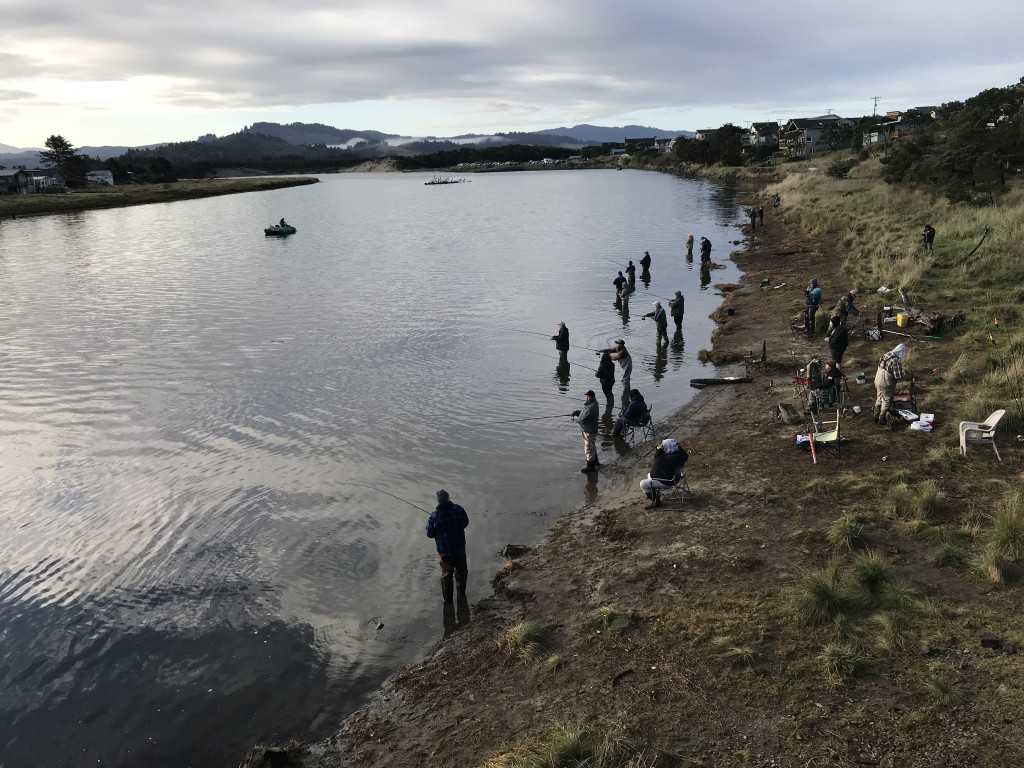
Anonymous angler releasing a kwikfish caught  Chinook.
Anonymous angler releasing a kwikfish caught
Chinook.

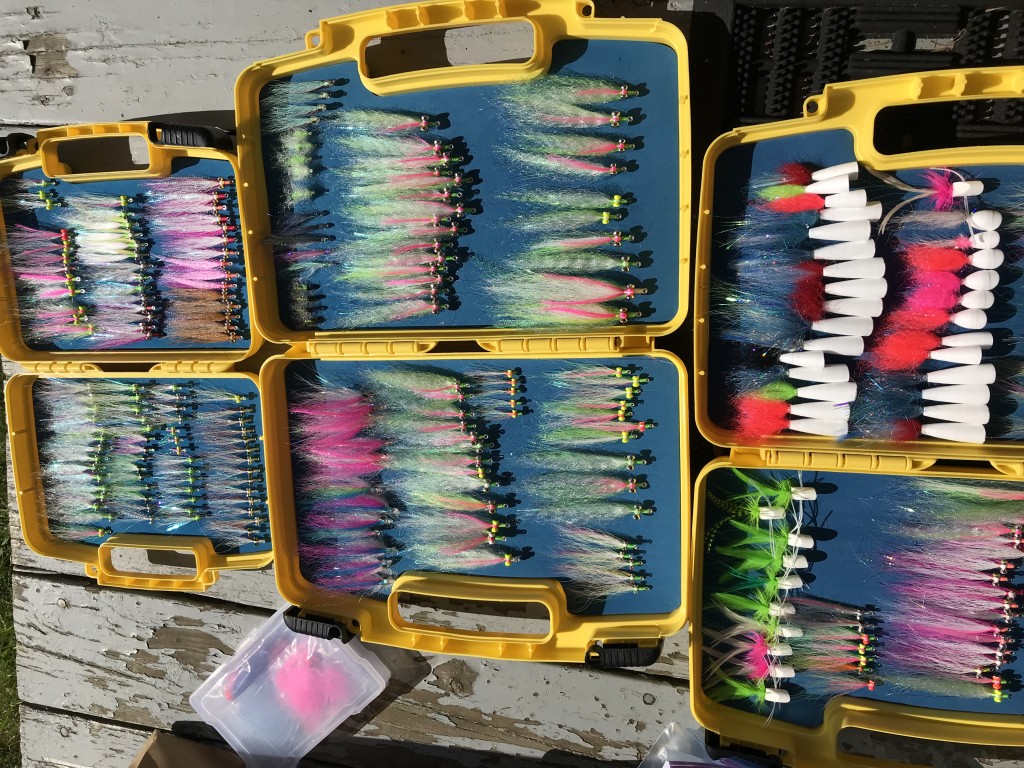
Clousers, poppers, and tube bucktails for my friend Jack.
Clousers, poppers, and tube bucktails for my friend Jack.

But where is the hog line today?

But where is the hog line today?

A grand hen released.
A grand hen released.

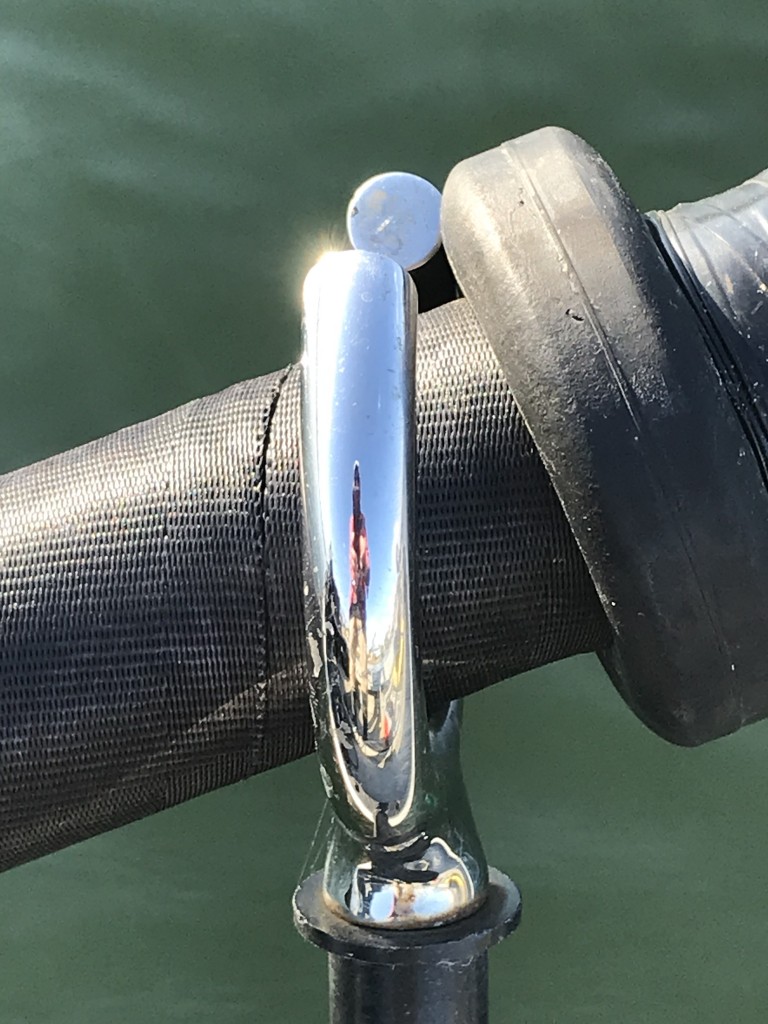
Self portrait in oarlock.

Self portrait in oarlock.


Jay Nicholas, October 17th, 2019


Posted in Fishing Reports, Oregon Salmon fly fishing | 4 Comments

Fall Guide Trip Special on Now Through November 2019

IMG_5592 2We are offering a shortened half day trip on our local waters for trout and steelhead October 15-November 30th. The cost of the trip is $375. The trip includes guided fishing and equipment for two anglers. The trip does not include lunch. The trip is designed to hit the best time of day, we recommend approximately 11:00am-4:30pm. This is a great opportunity to learn some of our close in to the Eugene/Springfield waters. Give us a ring to discuss options, water conditions and booking possibilities. Phone (541) 342 7005 Email: caddiseug@yahoo.com oc caddis dry 007 copy

Posted in Fishing Reports, Oregon Fly Fishing Tips, Shop Sales and Specials | Leave a comment