Fishing, Hunting, and Conservation News, October 1913 – Part II

These notes are from the Oregon Sportsman.

…. on the coast streams, the trout now decline the fly because of the abundant store of salmon eggs, which are spawned by the Chinook and river salmon, now coming in abundantly. Salmon eggs bought in a Portland market and taken down to Seaside rf Tillamook are too stale to tempt the big cut-throats of the Trask or Wilson. One may drop his hook with a bait of these stale eggs among a plainly visible school of big trout and see them sail away in disgust. They are already overfed and over particular. An angle worm is likely to be a more successful bait in such cases, and a little piece of the flesh of the too-abundant sculpin may always be considered a hopeful bait for these sea-run trout. They will take a medium sized spoon or spinner occasionally in the lower waters near the sea, and trolling from a boat these beautiful sunny days of Indian Summer is delightful sport, if less productive in quantity.

The “quinna” or Jack salmon have given but little sport this season, coming in later than usual; and they are now mostly spent, stale, and unfit for food.

The silver salmon are now running abundantly in all the coast rivers and bays, and give fine sport trolling. They are in fine condition too, and at this time, in the beginning of their run, scarcely inferior as table fish, to the best Chinook, and far superior the the Chinooks now to be had in market, which are hardly fit for food.

There have been for three weeks past in our markets unusually fine humpback salmon in large numbers, and as is always the case with these fish in their best condition, entirely innocent of the hump which becomes very pronounced as the fish reaches spawning time, in which condition it is almost worthless for food. Silver, chum (or dog) and humpbacks are better baked than fried in slices. Skillfully cooked thus, the fish being baked whole, there is no reason for contempt of either of these three as a delicious table fish The season for the three varieties named is a very short one, either for the sport of catching them by trolling or for utility as food, and a month in fresh water renders a fish of either of these three families a thing to avoid. Sea trout usually follow up the salmon in large schools and after the next big gain there will be find trout fishing with bait in the lower Columbia and coast streams, put the flies and fly rod may be laid away till next June.

It may be wiser, however, to see that your rod is laid upon some perfectly level shelf, with no weight of any kind piled upon it, and see to it that its joints are not tightly bound by the cords at either end of the case containing it (unless it is in a rigid wooden form in which each part has its own groove) or you will fid it so warped next spring as to be disappointing or useless.

More still to come from this October 1913 edition….

Jay Nicholas

Posted in Fishing Reports, Oregon Conservation News | Leave a comment

Tying the Tube Clouser Minnow Fly …. How and Why?

The Clouser Deep Minnow is a GREAT fishing fly. The darn thing, in many colors and sizes, just looks like food to many fish around the world and is among my very favorite flies for salmon fishing here in Oregon. And yes, I do know that the Clouser deep minnow is a fly that is fished around the planet by anglers seeking to catch anything but a salmon, like smallmouth bass, musky, bonefish, tarpon, shad, snook, redfish, toadfish, giant grouper, blue shark, and guppies.

Lately, I have had the opportunity to explore some new fly fishing territory, shift fishing obsessions to new targets, and dabbled with adapting some of my traditional Clousers to new species and fly styles. This has been tons of fun. Rockfish (including Lingcod) love Clousers. Sea Run Cutthroat love Clousers too. Silvers love Clousers.

So, what the hey, why not tie up some Clousers on tubes? Sure, plenty of fly fishers have probably been doing this for ages, but this was new for me. This started when I ventured offshore for the first time this year with Jack and Jon Harrell, in their Pacific City based Dory, the Gold Comet. A decades old fear of being sea-sick had kept me off the ocean, but I finally decided to give it a go. Wow. This was fun on top of fun. No puking whatsoever, and willing bottom fish to the fly were a new treat for me. My slow sinking salmon lines were quickly replaced with my fastest sinkers, I upped my rod weight a little, and started tossing salmon Clousers to the Black Rocks (the fish, that is). They ate them plenty nice.

I noticed, sadly, that my grabs were plenty and my hookups were on the sparse side. Hummmmmm. Maybe the #2 hook I LOVE for Kings in tidewater was a little small for the big mouths of the briny deep. This got me thinking about tying Clousers on 1/0 and 2/0 hooks, which I did on short order. These flies definitely upped my hooking ratio on the bottomfish. But I was still plagued, if this could be considered a negative, by receiving many many more grabs than solid hookups. Now I wondered if this might be on account of short strikes, a function of the fish nipping at the tail end of the fly and just giving the fly a tug with no contact with the hook.

Then too, I was not entirely pleased with some of the larger hooks or with long shank hooks that I tried in order to overcome the short strike phenom> These hooks are too large for my liking when fishing Chinook and silvers in the estuary. The hooks may not actually be too large, but I thought they were, and once I start down the path of confidence reduction in any particular fly, they are likely to be eliminated from my box.

What to do? Some of the ocean Clousers I was fishing were not much larger than my in-river Clousers. Hummmmmmm. Silly head. Tie on tubes and switch out hook sizes depending on where they will be fished. Simple and effective. So I went to the bench and made it happen. Then in short order I put to sea with my friends and behold, the tube Clousers were an instant hit and my hooking ratio stayed high. The bonus was that my fly endured for many, many hookups. Often, the fly would ride up the leader, just as it is supposed to, and evade at least some of the beating it would normally have experienced if it were lodged in the chompers of a sharp toothed bottom-fish.

By the way, these rockfish ranged from as deep as 40-50′ to a shallow as rolling on the surface. This naturally called for different fly lines and some Clousers with large and small dumbell eyes. This was wonderful because it offered a justification to tie lots of flies and buy lots of materials and boxes to store the flies and hooks in and …………

My Sea Run tube clousers, tied very slender with Fish hair were just what the Blueback wanted to eat during several recent evening forays into the estuary. These were tied in white and pink, and in white/pink/blue, all with a little multi color Krystal flash and #8 TMC 811S hooks.

We will cover the next stage in the evolution of the Tube Clouser when we get to the Tuna Tube Clouser, but that is yet to be fully researched, so wish me luck. The Silver Salmon Bucktail Clouser has indeed been tested with wonderful results, and that too will be covered shortly.

A few recap thoughts: Tube cClousers offer the advantages of 10 protecting the fly from excessive chewage by the multitude of fish you will catch on these flies; 2) allow you to adjust the hook size with the same overall fly size remaining constant; and 3) allow placement of the hook near the very tail end of the Clouser, which can be a huge advantage when receiving short strikes.

tube clouser

Tube Clouser Minnow

Tube: Pro Tube Micro Tube
Eyes: Aluminum Sea Eyes w/3D Pupil
Belly: DNA Holo Fusion
Lateral Line: Red Krystal Flash
Dorsal Surface: Blue and Lime Green Bucktail
Overtopping: Mixed Colors Krystal Flash
Hook Guide: Pro Tube XL Hook Guide
Hook: Gamakatsu S12S # 2

JN

Posted in Fly Tying | 2 Comments

Caddis Fly Hat Makes it over 20,000 Feet at Everest

mike scheer at everest

Mike Scheer at Everest caddis fly hat

Mike Scheer is with his “special forces” group (Army) training
on Mt. Everest.

He was proud to advertise the Caddis Fly Shops highest ever ad at over
20,000′

Mike,

Thanks Very Much for your service and for wearing your best fishing hat.

CD

Posted in Uncategorized | Leave a comment

Fishing, Hunting, and Conservation News, October 1913 – Part I

These notes from the Oregon Sportsman.

The time of the fly fisherman for the present year grows short, and after a few sharp frosts there will be no more of it. Then we must resort tot he winter lures – the spoon, the worm, the flesh of sculpin, squawfish and carp; or the nasty salmon egg. Indeed on the lower waters of streams tributary to the sea, fly-fshing is already practically over.

But there remain, so long as the present delightful weather shall last, magnificent fishing on the Rogue, McKenzie, Santiam, Molalla, and Clackamas. The favorite food of the rainbow trout in these streams is now the stonefly, which hatches in late summer and early fall, coming out from the water in the larval stage and hiding among the rocks of the shore, where he shortly emerges from his shell as the mature insect in the form of a gauze-winged, soft bodied fly, which gather in great numbers on the branches of willows along the steams. Flies that light or fall upon the water are eagerly seized by trout, which frequent the shores at this time for the purpose of feeding on the stoneflies.

A party of sportsmen, just returning from the upper McKenzie, report remarkably fine fishing at McKenzie Bridge and Frizzell’s, where a large number of fishermen have enjoyed great sport. Their catches were made mostly by using the stonefly, carefully hooked, with wings spread, and very lightly cast. Rainbows of two pounds and upwards fell to the lot of several of these gentlemen daily, and many smaller fish, so that a four-automobile party had all the fish they cared to use daily for a week.

The Dolly Varden does not rise readily at this season to the fly in the Cascade streams, but skillful fisherman catch occasional monsters with salmon eggs.

Doubtless fishing on the McKenzie at this season will be found to correspond with that on the waters of other large rivers of the Cascade mentioned above. Fly-fishing proper has been better in the earlier months of summer on the Mckenzie. The fish reject the artificial fly now because of the abundance of natural fly food.

Note: There will be more to follow from the October 1913 edition……..

Jay Nicholas

Posted in Fishing Reports, Oregon Conservation News | 1 Comment

RR brings it home! Wins IFTD Iron Fly Competition 2011

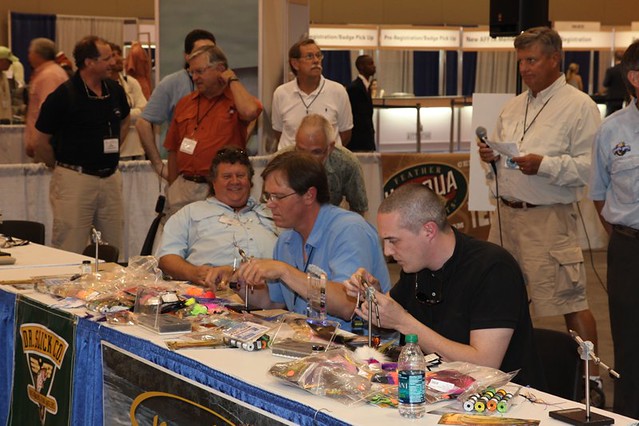
I was minding the booth, walking dealers through the latest and greatest books and DVDs, when I heard someone yelling my name. My giant carrot-topped boss was waving me over, with a devious grin on his face. His wife, Joy, ran up to me, grabbed my arm, and pulled me to the front stage.

“Here’s your guy!” she yelled. Then to me, “Rob, there’s an open seat in the fly tying competition! You have to do it!”

Resistance was futile. None of my weak arguments found purchase. And before I knew it I was pushed into a chair, smack in the middle of an international string of tyers, with fair crowd looking on.

IFTD Iron Fly

Similar to Iron Chef competitions, contestants had a limited time to create a masterpiece, using selected materials and a couple of “secret” ingredients. For the first round, tyers were given 15 minutes to tie a fly.

As the clock started, I found myself shaking nervously. My bobbin was strung way too tight, and my thread broke repeatedly. I looked to my right and to my left, relieved to see that my neighbors’ hands were also shaking wildly. One poor fellow was so nervous, he resorted to a desperate lashing of odd materials to his hook. I took a deep breath and opened the bag containing the secret material: beautifully dyed ostrich herl! I looked backward at Bill Black, whose Spirit River was sponsoring the event. He had supplied the materials.

“Thanks, Bill!” I said with a smile.

“You like that?” he replied, with a knowing smile and a wink.

I tied a funky little shrimp/crawfish fly, which I was sure would be cast off by the judges. But no dice. The final round came down to myself and a young man from London. This time we had 10 minutes to finish our fly, and my rival struggled for several minutes just threading his bobbin. I cranked out a simple summer steelhead fly, stripping and hackling the tip of a blue-dyed ostrich plume to radical effect.

IFTD Iron Fly

When it was all over, Bill presented me with the trophy, and Jon Bauer handed me a brand new Rogue reel.

Let the teasing begin…
-RR

Posted in Fly Tying | 17 Comments

Preparing Aluminum Sea Eyes for Tying Baitfish Patterns

Hareline Aluminum Sea Eyes are huge barbell style eyes that offer profile without weight. We have had excellent success using them on large streamers such as Clousers and Deceiver type flies. Big fish like to eat little fish and often use the large eye on a baitfish for a target. The Aluminum Sea eye allows the tyer/angler to create a great target for attack.

Products Shown

Aluminum Sea Eyes
Big Fish Eyes
Oval Pupil 3D Eyes
Zap Gel

tube clouser

Posted in Fly Fishing Gear Review, Fly Tying | 2 Comments

Get Extra Terrestrial: It’s hopper time

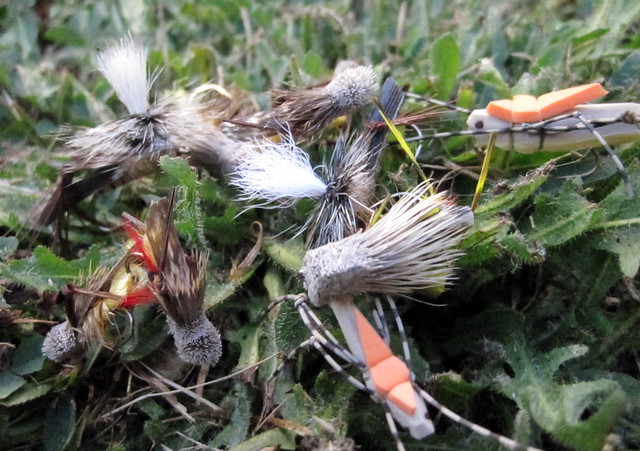
If you head up into the way backwoods of the Cascades and get close to the river and watch and listen to the hoppers springing out of the grass, you’ll hear the big trout smacking their lips. They’re huge, they’re obnoxious, they’re irresistible. And they’re all over our watersheds for the next couple months.

hoppers

Trout Fishing

Trout Fishing

Excellent patterns include: Dave Whitlock Spun Deer Hopper, Morrish’s Golden Hopper, and other leggy abominations in the terrestrial bin.

Posted in Fishing Reports | 6 Comments

Smallmouth Bass Clouser Minnow Fly Tying Instruction Video

Smallmouth Bass Clouser Minnow

Smallies are a non native gamefish brought to Oregon by officials and anglers who longed for the kind of fishing they had experienced East of the Rockies. Today, these fish have established a permanent foothold in places like the John Day, Umpqua, and Willamette, to mention but a few. Smallmouth bass are one of the key species on the radar of many Oregon Anglers, some of who spend ten times on chasing smallies and bucketmouth than I could ever imagine in my most obsessive salmon and steelhead fever. Continue reading

Posted in Fly Tying | 4 Comments

Oregon Cascade Trout Part IV: Fly Fishing Tactics

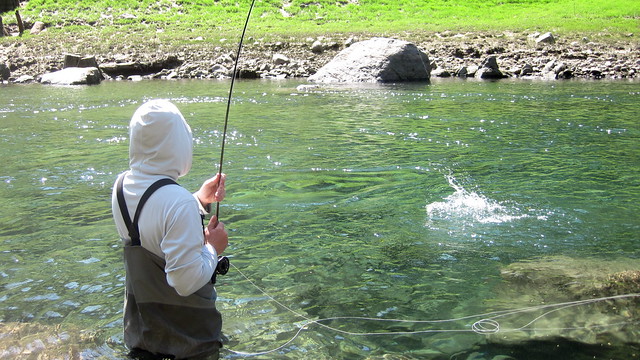
Ok. You’re in the Oregon Cascades. You are near a stream, river, rivulet, creek, or ditch. You need to figure out where to start fishing, right?

Try the first bridge you come to. Trout always live under bridges. Next, look for places where people have parked alongside the river. The wider the turnout, the better the fishing will be. Finally, as shown above, look for evidence that this is a swimming hole, in this case, still-wet socks, or as the evidence depicted below (no explanation needed), will tell you that, yes, this is where trout live. Continue reading

Posted in Oregon Fly Fishing Tips | 4 Comments

The Clouser Deep Water Minnow – Fly Tying Instructions Video

The Clouser Deep Minnow or as some name it, the Clouser Deep Water Minnow is a must have fly that deserves a home on your fly bench and in your fly boxes. This is a fly that I began fishing for King Salmon here in Oregon. A little research on the fly taught me that its use for salmon fishing is but a teeny tiny fraction of the applications where this fly is top cabin, front line, and among the best of the best flies to fish. Continue reading

Posted in Fly Tying, Oregon Saltwater Fishing | 3 Comments

Get thee to the Bow River

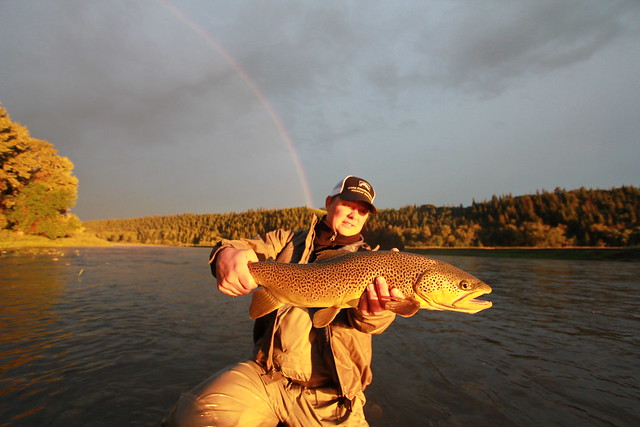
One of my good friends Matt Zlotkowski just sent me this jaw-dropping brown trout photo and the following message for blog readers.

Bow River Brown Trout

Josh Nugent, owner/operator of Out Fly Fishing Outfitters, is one of the hardest working guides that I have had the pleasure to fish with and a great guy to boot. We spent several days in and around Calgary on the Bow River with Josh and experienced first-hand why the Bow is regarded as a tremendous wild trout fishery that is home to both browns and bows in significant numbers. Give Josh a call if you’re planning a trip to Calgary – he’ll make you a believer in the Bow.”

Matt says it’s a big streamer show when he was there. Definitely considering my own trip to Calgary now.
-MS

Posted in Fishing Porn, Fly Fishing Travel | 1 Comment

Book Review: Holding Lies by John Larison

John Larison’s new novel Holding Lies is a grown up version of The River Why. It’s grim. In some ways, it’s the book David James Duncan said he didn’t want to write, couldn’t. Because the situation facing the Northwest’s wild salmonids is too dark.

That said, it’s a gorgeous book and you need to read it.

Published last week by Skyhorse Press, the five word summary would read: Oregon fly fishing murder mystery.

Rob Russell fly fishing for salmon

But it’s really about learning how to fight for a river, and for wild steelhead. Hank Hazelton and his crew of river stewards illustrates a tight knit community’s beautiful and tragic commitment to wild fish. Plus, there is hatchery puke sabotage, some Monkey Wrench Gang antics to keep it entertaining. Continue reading

Posted in Coastal Steelhead Fishing, Fly Fishing Books | 3 Comments

Oregon Cascades Trout Part III: The Flies Trout Love

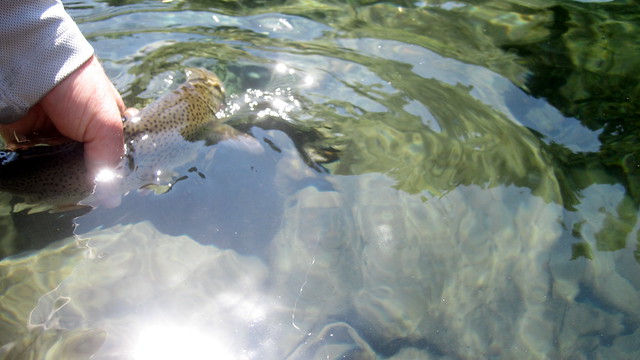
Oregon Cascade trout flies. Simple, really. These trout eat about everything that we throw at trout, generally, and seasonally, in other rivers around the western United States. I just wanted to note some of my favorites with a few notes in case it proves useful. Continue reading

Posted in Oregon Fly Fishing Tips | 2 Comments

Fly Fishing For Bass on the Willamette River

bass fishing in a bass tracker

Bass fishing guide Larry Cross called the other day to invite me to come have a look at the Willamette River Bass fishery. I jumped at the chance exited to learn a new section of the Willamette. Larry suggested we meet at the Peoria County Park and Boat Ramp at 6am. Just 40 minutes from North Eugene. Continue reading

Posted in Fishing Reports, Lower Willamette, Oregon Warmwater Fly Fishing | 1 Comment

Deschutes River Steelhead: Current Report and Looking Ahead

drifing the deschutes

It’s shaping up to be a good steelhead year on the Deschutes. In the past week, 6,000 to 8,000 steelhead a day have been making their way over the Dalles Dam on average, for a total of over 170,000 already this year, and it is still very early in the game. Unlike our steelhead runs here in the Willamette valley, the Deschutes fish don’t start to show up in really good numbers until sometime in July, and continue to enter the river until late in the fall. Continue reading

Posted in Central Oregon Fishing Report, Fishing Reports, Summer Steelhead | 6 Comments